Quick Summary: Buyers should request complete health records, including vaccination, deworming, and vet certificates, before reserving a puppy in Massachusetts. It’s important to verify that these records match the puppy’s details and to ask about breed-specific health tests and how results influence breeding choices. Clear, detailed documentation and transparency from breeders indicate responsible care, while vague or incomplete records are red flags.
A breeder can call a puppy “healthy,” but the proof sits in the file. You want to see the health certificate, Puppy Health Records, Vaccination Records, deworming dates, and any breed-related test results before you reserve a puppy.
That is where many families get stuck. They are told the puppy is checked, up to date, and ready to go, yet they are not sure which Health Records Required papers to request, what each record should say, or what a missing detail might mean.
This guide fixes that. You will learn the Health Records Required for Massachusetts puppies, how to read them, and which questions help you confirm a breeder is open and organized. We also cover the Health Records Required that matter most for small-breed puppies and what to ask before pickup or delivery.
At Sage Puppies, we know careful families want clear records, not vague promises. This article gives you a practical buyer checklist you can use right away.
What Health Records a Massachusetts Puppy Buyer Should Request
Ask for the complete puppy record, not just a vaccine card
A vaccine card alone is not enough. In Massachusetts, records tied to dogs offered for sale must include more than shot dates. State rules say buyers should be able to get the puppy’s complete vaccination, worming, medication, and treatment records, plus key identity details and source information under 330 CMR 12.05 and 12.09.
Ask for a full packet that includes:
- Date of birth
- Breed, sex, color, and markings
- Microchip number, if placed
- Vaccine dates and product names
- Deworming dates, drug names, and doses
- Any treatment for diarrhea, coughing, skin issues, or parasites
If a breeder hesitates, gives partial screenshots, or says “the vet has it,” slow down.
Use this quick check:
| Record to Request | Why It Matters | Red Flag |
|---|---|---|
| Full individual puppy record | Shows the puppy’s real care history | Only a handwritten vaccine note |
| Birth and source details | Confirms where the puppy came from | Vague answers about origin |
| Medication log | Reveals illness or repeat treatment | Missing drug names or dates |

Look for a dated veterinary health certificate
You should also ask for a veterinary health certificate, not just a breeder promise. Massachusetts law says a dog brought or shipped into the state must be accompanied by an official health certificate, and dogs sold by licensed sellers must have a recent health certificate in hand before sale in many settings under Massachusetts General Law Chapter 129, Section 39G.
Check that the certificate shows:
- The puppy’s age, sex, breed, and description
- The exam date
- A statement that the puppy showed no visible contagious disease
- Rabies status, if age applies
- The veterinarian’s name and signature
A health certificate is a snapshot from one exam day. It does not replace the full record.
Confirm vaccination, deworming, and treatment history
Look closely at the care timeline. You want dates, product names, and reasons for treatment. That matters more than a simple “up to date” claim.
Ask these questions:
- Which vaccines were given, and on what dates?
- Was the puppy dewormed on a schedule?
- Were flea, tick, or parasite treatments used?
- Did the puppy ever need antibiotics, probiotics, or other care?
For rabies proof, Massachusetts says only a certificate issued by the veterinarian who gave the vaccine counts as legal proof under 330 CMR 10.03.
If you want a model of transparent paperwork, this is the standard to expect from any careful breeder, including programs like Sage Puppies.
Also Read: 10 Adorable Havapoo Colors You Need to See (2026)
How to Read Vaccination Records the Right Way
Start with the puppy’s date of birth. Then match it to the vaccines already given. According to AAHA canine vaccine guidance, puppies usually get a combo vaccine series between 6 and 16 weeks, spaced 2 to 4 weeks apart. So if a puppy is 10 weeks old, one vaccine entry may be normal. If the puppy is 15 or 16 weeks, you should expect more than one entry unless your veterinarian used a different plan.
Use this quick check:
- 6 to 8 weeks – first combo vaccine may appear
- 9 to 12 weeks – follow-up dose is often due or already given
- 12 weeks and up – leptospirosis may appear if the vet recommends it
- By 6 months in Massachusetts – rabies must be given by a licensed vet
A record is not “better” just because it lists more shots. What matters is whether the timing fits the puppy’s age.
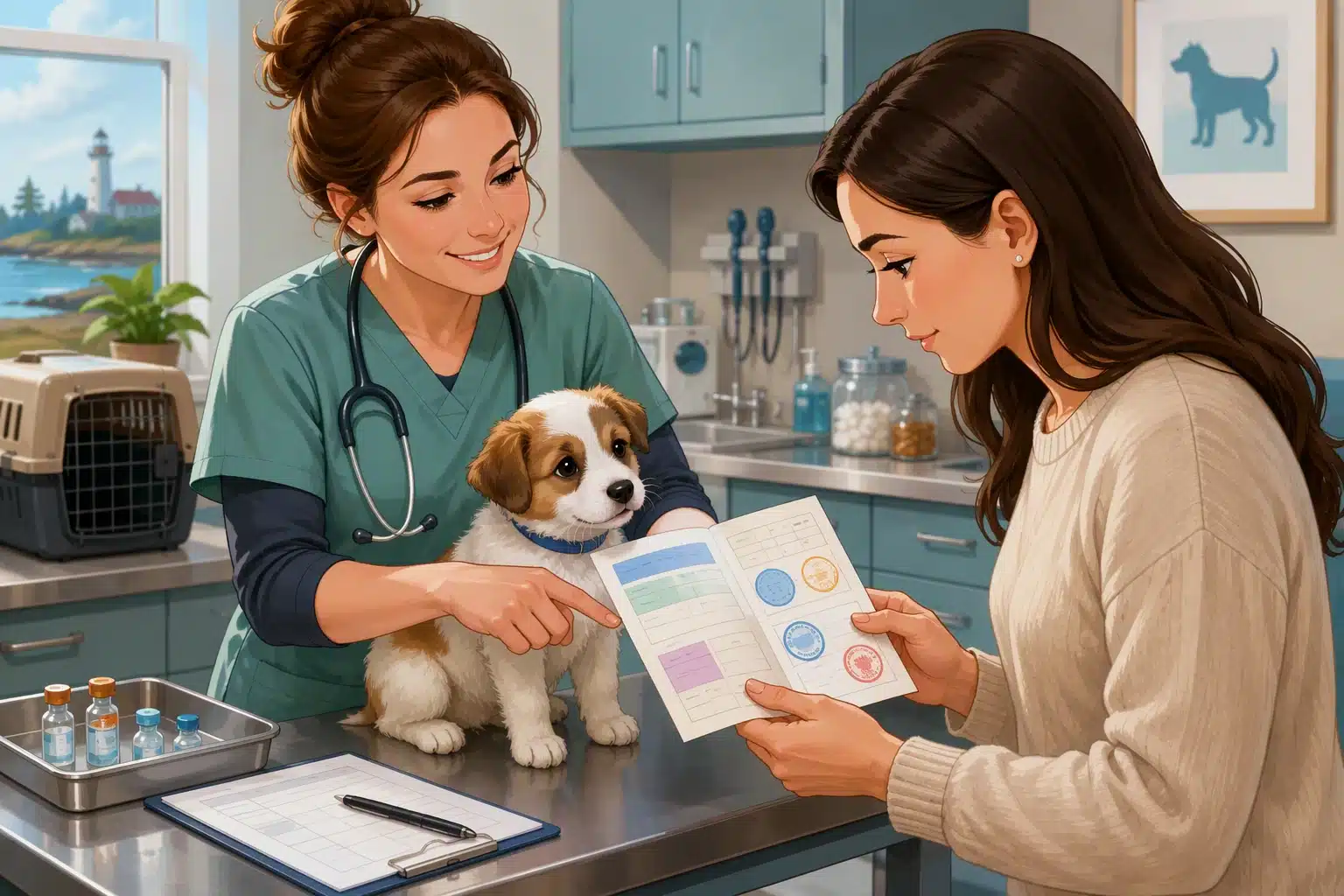
Next, verify the vaccine name, date given, and who gave it. A useful record should not just say “shots done.” It should show clear details.
| Record item | What you want to see | Why it matters |
|---|---|---|
| Vaccine name | DA2PP, rabies, Bordetella, leptospirosis, or similar | Tells you what protection was started |
| Date given | Exact calendar date | Helps your vet time the next booster |
| Administering vet | Clinic name or licensed veterinarian | Confirms the record is traceable |
| Lot or certificate info | Often listed for rabies | Helps prove the vaccine was properly documented |
Massachusetts is especially strict on rabies. State law says rabies vaccination certificates must be completed by the veterinarian who gave the vaccine, and the dog is required to be vaccinated by 6 months of age under Massachusetts rules.
Last, ask what is due next. This is where buyers get tripped up. A puppy can leave with records that are real and still need another booster within days.
Ask these questions:
- Which vaccine is due next?
- What date window should my vet use?
- Is rabies still pending?
- Are any noncore vaccines recommended for my area or travel plans?
Good breeders hand you records. Great breeders also explain the next appointment before you reserve.
Also Read: Health-Tested Puppies for Sale Near Me: Questions to Ask Breeders
What Health Testing Questions to Ask the Breeder
Ask these questions before you reserve a puppy, not after. A good breeder should answer clearly, show records fast, and explain how test results shaped the litter.
Ask which breed-relevant tests the parents have completed
Start with one direct question: “What health tests did the sire and dam complete for this breed or mix?” That matters because testing is not one-size-fits-all. AKC notes that breed parent clubs set the recommended health screens for each breed in its breed health testing requirements.
Ask for specifics, such as:
- Eye exams
- Heart screening
- Patella or hip evaluations
- DNA screening for inherited conditions
- Any breed-club recommended tests for both parents
If you are comparing Havanese, Cavapoo, or Havapoo puppies, ask the breeder how they chose tests based on the parent breeds, not just one side of the pedigree.
A vague answer like “our dogs are healthy” is not health testing.
Request written proof, not just a verbal summary
Next, ask: “Can you send the actual reports or public record links?” OFA tells puppy buyers to ask what screenings were done on the parents, ask to see the results, and be careful with records that cannot be verified through the OFA database or other lab paperwork when interviewing breeders.
You want documents, not promises. Ask for:
- The registered name of each parent
- Dates of each test
- The lab, specialist, or registry used
- Final results, not just “passed”
- Any limits on the result, such as annual eye exams
| What to request | What it tells you | Red flag |
|---|---|---|
| OFA or specialist record | Test type and final result | Breeder will not share names |
| DNA lab report | Carrier, clear, or at-risk result | Screenshot with no dog ID |
| Date of exam | Whether the result is current | Old test used as current proof |
Ask how the breeder uses results to guide breeding decisions
The best question is often this one: “How did these test results affect your choice to breed these two dogs?” This shows whether the breeder uses health data to lower risk, or just collects papers.
Look for answers like:
- They avoid pairing two dogs with the same harmful DNA risk
- They repeat heart or eye exams on schedule
- They skip breeding dogs with poor structural or inherited findings
- They can explain why this pairing made sense
A CHIC number or completed test list does not automatically mean the results were ideal. It means the dog completed the required screening set. You still need the breeder to explain the actual findings and the pairing logic.
Clear, calm answers are a strong sign. At a transparent program like Sage Puppies, that conversation should feel easy, not defensive.
Also Read: Puppy Health Guarantees: What Good Breeders Include
How to Verify a Puppy’s Records Before You Reserve
Ask for the records before you place a deposit, not after. In Massachusetts, sellers must keep an individual animal record with vaccinations, treatments, medications, and source details, and must provide that record at sale under 330 CMR 12.09. That makes your review easier if the breeder is organized and transparent.
Compare the paperwork to the puppy in front of you
Match the record to the actual puppy, line by line. Do not just glance at names.
Use this quick check:
| What to match | What you should see |
|---|---|
| Puppy identity | Breed, sex, age, color, markings, microchip if listed |
| Health entries | Vaccine dates, deworming dates, medication names |
| Source details | Birth location, breeder or seller details |
| Current condition | Bright eyes, clean coat, normal breathing, no active illness signs |
If a puppy was brought into Massachusetts from another state, it should be accompanied by a health certificate, and imports need an OCVI with identifying details like breed, sex, age, markings, and health status under 330 CMR 30.08.
If the puppy’s markings, age, or sex do not match the record, pause the reservation.

Ask for clarity on missing or abbreviated entries
Short notes like “DHPP done” or “dewormed” are not enough by themselves. Ask what product was given, on what date, and by whom.
Use direct questions:
- Which vaccine or medicine was used?
- What date was it given?
- Who gave it – breeder or veterinarian?
- Was anything recommended but not yet completed?
Red flags include:
- Crossed-out dates
- Blank medication lines
- No explanation for missed doses
- “Vet checked” with no dated paperwork
A good breeder will answer calmly and send clearer copies if you ask.
Confirm what will be handed over at pickup or delivery
Before you reserve, ask for a simple list of what you will receive on go-home day.
That list should include:
- Vaccination record
- Deworming or treatment record
- Any recent vet exam paperwork
- Feeding instructions
- Microchip details, if used
In Massachusetts, a rabies certificate only counts as proof if it was issued and signed by the veterinarian who gave the vaccine, according to 330 CMR 10.03. For small puppies, rabies often is not due yet, so ask what is complete now and what your own vet should finish next.
Red Flags in Puppy Health Paperwork
Watch for records that feel incomplete. A real file should match the puppy in front of you. Massachusetts law says a rabies certificate is legal proof only when the vaccinating veterinarian issues and signs it, and it must list details like the date, vaccine lot, and animal description in 330 CMR 10.03. Red flags include:
- missing exam dates
- white-out or edits
- vaccine entries with no clinic name
- markings, sex, or age that do not match the puppy
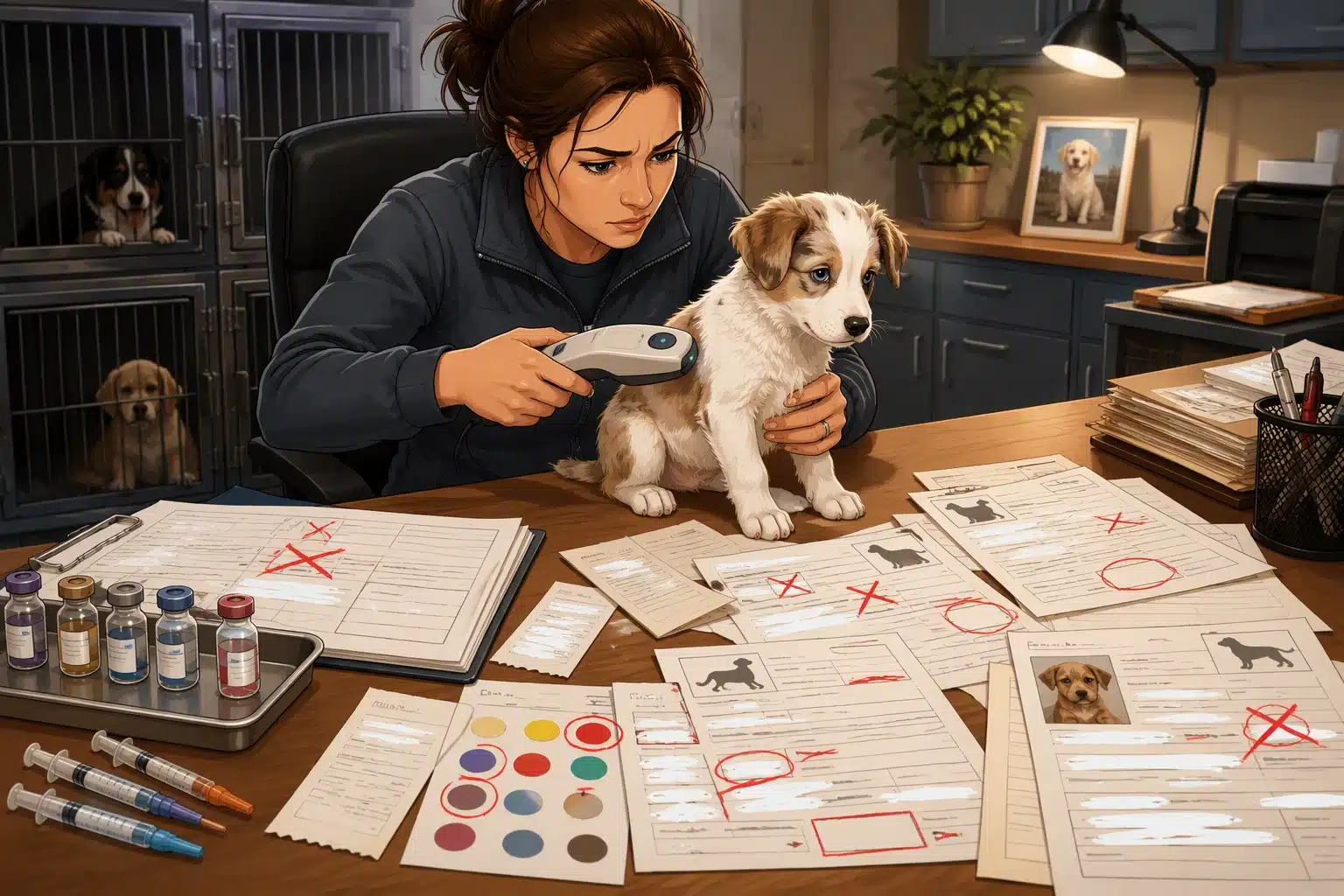
Be careful when a breeder delays, deflects, or says, “I’ll send that after your deposit.” Transparent breeders share records before you commit. In Massachusetts, dogs sold by licensed sellers must come with complete vaccination, worming, medication, and treatment records, and buyers must receive the individual animal record at sale under 330 CMR 12.05. Pause if the breeder:
- sends blurry photos only
- crops out clinic details
- refuses a vet name
- gets irritated by normal questions
Treat missing veterinary paperwork as a pause point, not a small issue. No health certificate, no clear exam record, no reservation yet. If a puppy entered Massachusetts from another state, it must be accompanied by a health certificate. If paperwork is missing, stop and verify before moving forward. Ask for:
- the most recent vet exam date
- vaccine dates and product names
- deworming dates
- microchip number, if placed
Good breeders do not rush you past missing records. They help you confirm them.
Also Read: 10 Questions to Ask Before Buying a Puppy Locally
Common Questions About Massachusetts Puppy Health Records
What records should I receive at the time of sale?
Ask for the full health file, not a short vaccine note. In Massachusetts, pet shops must give buyers a copy of the dog’s complete medical record at sale, and the puppy must have had a vet exam within 7 days before sale, according to Massachusetts buying guidance. You should request:
- Vaccines with dates
- Deworming with dates and products
- Vet exam notes
- Any illness or treatment history
- Microchip details, if used
If a breeder hesitates or says records will come later, slow down.
Do out-of-state puppies need different paperwork?
Yes. A puppy shipped into Massachusetts should come with an official health certificate or OCVI from the state of origin. Massachusetts guidance also says shipped puppies must be at least 8 weeks old and identified to match the paperwork in the state health protocol.
| Paperwork | Why it matters |
|---|---|
| Health record | Shows vaccines and care history |
| OCVI or health certificate | Confirms legal interstate shipment |
| Matching ID | Ties the puppy to the document |
Should I still take my puppy to my own vet?
Yes. Always. Even if the breeder seems careful and the records look complete, book your own exam right away.
- Review the records with your vet
- Confirm vaccine timing
- Check for parasites, infection, or heart issues
- Ask what comes next in your puppy’s care plan
Your vet visit confirms the paperwork matches the puppy in front of you.

If you want a puppy program that welcomes these questions, start with Sage Puppies. You can review available Havanese, Havapoo, and Cavapoo puppies, learn how reservation works, and ask for the health records that matter before you commit. That kind of clarity helps Massachusetts families buy with confidence, whether you plan local pickup or nationwide delivery.
Frequently Asked Questions
Q1: What health records should Massachusetts puppy buyers request from breeders?
Ask for a dated vaccine record, deworming log, exam notes, parent health testing, and any lab results tied to breed risks. You should also request the puppy’s birth date, microchip details if used, and the vet clinic name.
Q2: What questions should I ask about health testing and vaccinations when buying puppies in Massachusetts?
Ask who gave each vaccine, what product was used, and when the next dose is due. Ask which parent tests were done, whether results are available to review, and what issues have appeared in past litters or close relatives.
Q3: How can Massachusetts puppy buyers verify a breeder’s health testing and disease screening practices?
Match records to the puppy’s age and breed. Look for clear dates, parent names, and test types. A transparent breeder should explain the paperwork calmly, share supporting records, and answer follow-up questions without getting vague or defensive.
Q4: Are vet check summaries enough on their own?
No. A short “healthy puppy” note helps, but it does not replace full records. You still need vaccines, deworming dates, parent screening details, and any treatment history so your own vet can continue care without guessing.
Q5: What is a red flag in puppy health paperwork?
Watch for missing dates, handwritten notes with no clinic name, vaccine labels that do not match the puppy’s age, or claims of “fully vaccinated” too early. If records change from one conversation to the next, pause immediately.
Conclusion
The main point is simple: ask for the records before you reserve, not after. A transparent Massachusetts puppy seller should clearly share the health certificate, vaccine dates, deworming and medication history, and basic ID details that match the puppy in front of you. Massachusetts law requires imported dogs and cats to arrive with a health certificate, and dogs sold in the state must come with a health record showing each vaccine given, according to Massachusetts General Law Section 39G. State import rules also say the official certificate must include the puppy’s age, breed, identification, health status, and vaccine information, as shown in 330 CMR 30.08. If answers feel vague, slow down. Clear records usually signal a breeder who has nothing to hide.