
Quick Summary: Prioritize a breeder’s health testing and socialization practices over local proximity when searching for a puppy in Massachusetts. Ethical programs like Sage Puppies provide documented care and transparent records that help families assess a puppy’s start, regardless of distance. Always request proof of parent health screenings and a live video tour to avoid common red flags.
Searching for puppies for sale in Massachusetts is a heart-led journey. You picture the moment your family meets its new member, and every listing looks promising. The trouble is that local classifieds rarely show what matters most: how a puppy was bred, socialized and raised in its first eight weeks.
That gap is the problem this guide solves. Massachusetts families who want a Havanese, Havapoo or Cavapoo often find thin listings, missing health records and breeders who cannot answer simple questions about early development. Proximity tells you how short the drive is, not how sound the puppy is.
The better path is a clear, ethical framework you can apply anywhere. Below you will find how to read a breeder’s practices, which health questions to ask, what red flags to walk away from, and how small companion breeds fit busy family life. We lean on the standards used at Sage Puppies, a boutique program that raises Havanese, Havapoo and Cavapoo puppies with documented care and owner-managed placement, because those standards travel well beyond one state. Use them to evaluate every puppies for sale in Massachusetts listing you see, starting with the available puppies and pricing details that show what transparent breeding looks like.
Prioritizing Health and Temperament Over Proximity
The best puppy is not always the closest one. Plenty of “puppies for sale in Massachusetts” come from kennels that rush litters out the door with no health testing, no record keeping, and no plan for the dogs’ first eight weeks. A four-hour drive to a breeder who does things right beats a twenty-minute trip to one who doesn’t. The two things that matter most are how a puppy was raised and what its parents were screened for.
The Importance of Early Socialization
Temperament is shaped before you ever meet your puppy. From about three weeks to sixteen weeks, a puppy’s brain is wide open to new experiences. Breeders who use that window well raise dogs that handle car rides, grooming, kids, and new sounds without falling apart.
Ask any breeder you visit what they actually do during those weeks. Strong programs expose puppies to different surfaces, household noises, gentle handling, and time apart from littermates. That last one matters more than people expect. A puppy that learns to be briefly alone settles into a new home far faster than one that has never left the litter.
Bad socialization leaves a mark too. Puppies raised in barns, garages, or outdoor runs with little human contact often arrive fearful, and fear in a small companion breed tends to show up as barking, nipping, or house-soiling issues.
At Sage Puppies, every litter is raised in the home with daily handling from day one. That work follows the puppy to Massachusetts, whether it’s picked up or delivered, while continued socialization, individual temperament and your home routine still shape how the puppy develops.
Understanding Breed-Specific Health Screenings
Health testing is where ethical breeders separate themselves from everyone else. Ask to see certificates, not just hear the words “health tested.” Every breed has specific risks that responsible programs screen for before breeding.
| Breed | Common Risks | Recommended Screenings |
|---|---|---|
| Havanese | Luxating patellas, eye disorders | Patella exam, ophthalmologist evaluation, BAER hearing |
| Cavapoo | Mitral valve disease, hip dysplasia | Cardiac exam, hip evaluation in parent dogs |
| Havapoo | Patellas, progressive retinal atrophy | Patella exam, genetic eye testing |
Note that the parent dogs carry the weight here. For the Poodle crosses, a breeder should show you the Cavalier or Havanese parent’s testing as well as the Poodle’s. If you want a fuller walkthrough of what to request, our guide to breeder documents guide covers it step by step.
Any breeder of puppies for sale in Massachusetts who dodges these requests is telling you something. Walk away, whatever the distance saved.
Evaluating Breeder Ethics and Transparency
A good breeder answers hard questions without flinching. Before you fall for a puppy photo, find out how the dogs live, who raises them, and what proof comes with the litter. The two areas below cover most of what you need to ask.
Ask About the Breeding Environment
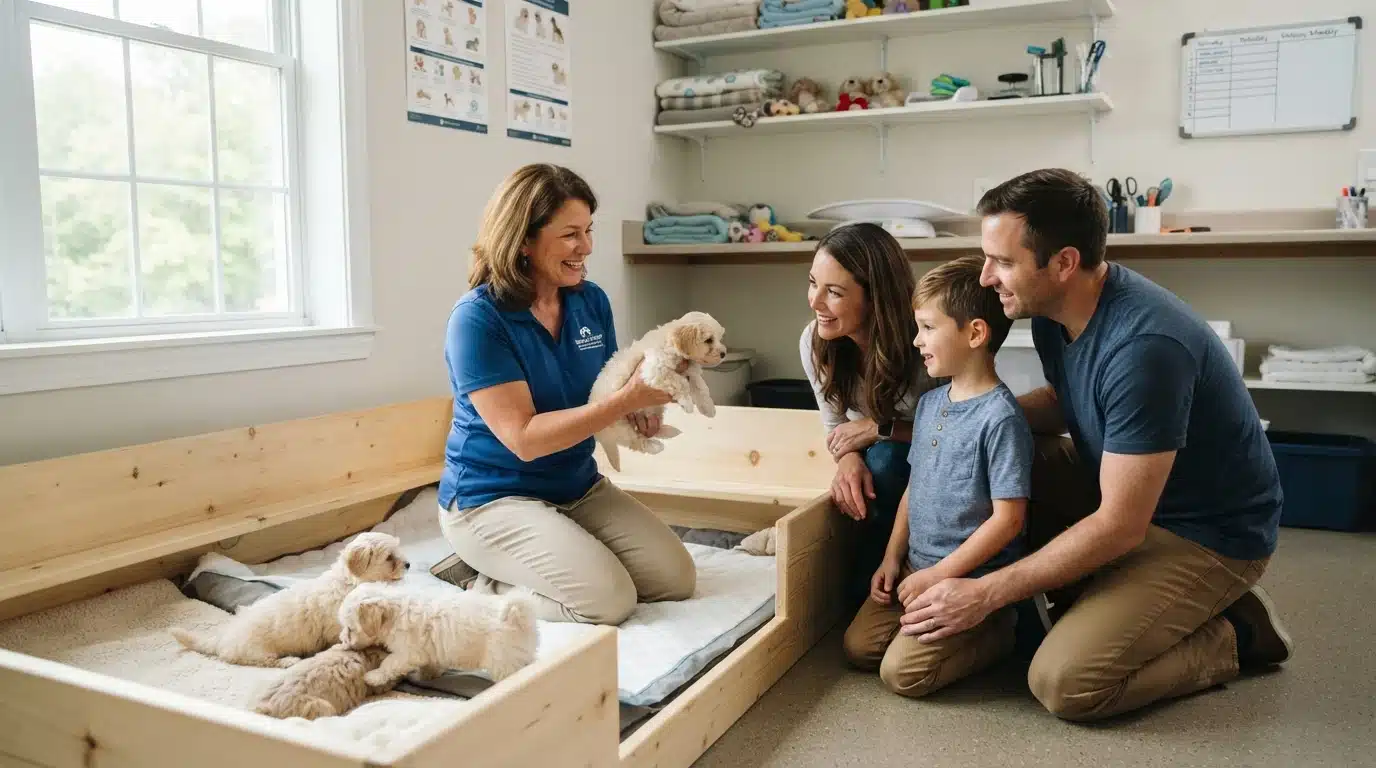
Start with the basics. Where do the puppies spend their first eight weeks? Ethical breeders raise litters in the home, around normal family sounds, handled daily. Puppies from kennels, garages, or barns often miss that social window, and the gap shows up later as fear or reactivity.
Ask about the mother dog’s age, health, litter history and the veterinarian’s guidance for breeding and recovery. Evaluate the actual program and its records rather than assuming a fixed calendar rule proves responsible breeding.
Location matters more than most families expect. Some programs list puppies in many states but ship from distant facilities, so you never see where the dogs live. Others, like Sage Puppies in South Jordan, Utah, keep everything owner-managed and local: one person knows each dog, each litter, and each buyer. That single point of accountability is hard to fake.
Tip: Ask how you can see the puppy’s living environment and discuss its care. A breeder may arrange a scheduled video call for practical or biosecurity reasons. Evaluate clear answers, records and consistent communication rather than demanding an unscheduled tour within a fixed deadline.
Also ask how puppies are matched to families. A thoughtful breeder asks about your home, schedule, and experience before agreeing to sell. Boutique programs use an application for exactly this reason, and you can see how a careful matching process works before you commit. If a seller takes anyone with payment, the puppies’ welfare is not the priority.
Documentation and Records
Proof separates careful breeders from smooth talkers. Ask to see:
- Veterinary exam records for the puppy, dated within days of pickup
- Vaccination and deworming logs, with dates, products, and lot numbers
- Health testing results for the parents, ideally through OFA or CERF
- A written contract covering health terms and return policy
- Registration or pedigree papers, if the breed qualifies
Review the papers before you pay, not after. Any breeder who promises documents “will follow later” is asking you to take a risk with no safety net. Good programs send records in advance and invite your vet to review them.
Keep copies of everything in one folder, digital and printed. Those records protect your puppy’s future care, and they prove exactly who stood behind the sale if questions come up later.
The Practicalities of Finding Your Puppy Beyond Massachusetts
Falling for a puppy two thousand miles away is common now. Most reputable small-breed programs no longer count on you walking past their kennel door. Instead, they rely on video calls, references, and trusted transport to place puppies with the right family, wherever that family lives. The good news for Massachusetts buyers is that travel logistics are well established. The key is knowing which option protects an eight-week-old puppy best.
Safe and Compassionate Travel Options
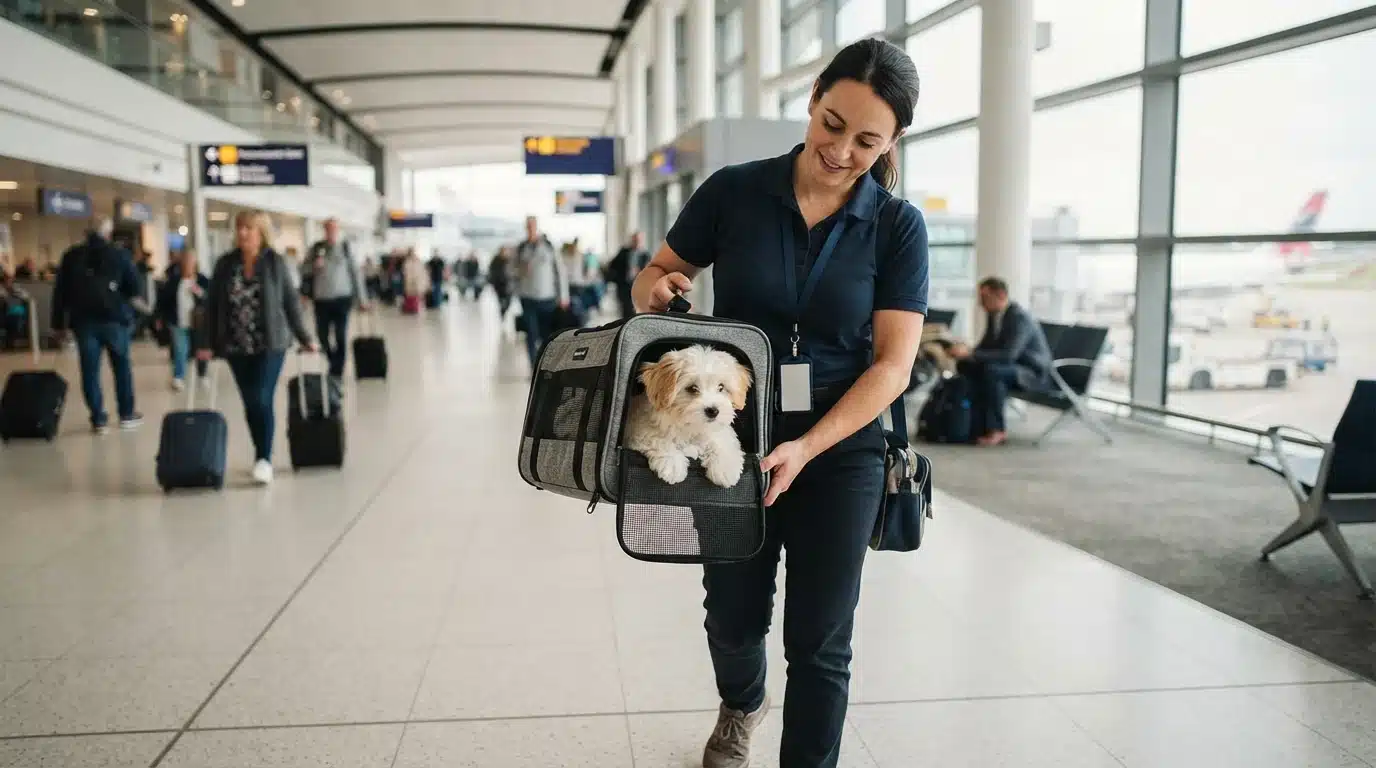
You have three main ways to get a puppy home to Massachusetts. Each differs in cost, stress on the puppy, and how much you control. A closer look at ground transport versus air travel helps you compare them side by side.
1. Traveling to the breeder yourself. Ask about the pickup arrangements before booking. For air travel, confirm the particular airline’s current age, carrier, reservation and in-cabin rules. Ticket and pet fees vary by itinerary; obtain current quotes rather than relying on a fixed range.
2. A flight nanny. Discuss who accompanies the puppy, the actual airline and route, handoff location, updates and current quoted cost. Confirm the planned transport arrangement with Cassie before assuming a particular service or destination is available.
3. Ground transport. Ask about supervision, travel duration, rest arrangements, required credentials and the written quote. Review the actual provider and route instead of assuming every ground service offers the same experience.
Before you commit to any option, ask the breeder two questions: at what age does the puppy travel, and what health checks happen first? A responsible program waits until the puppy is at least eight weeks old, examined by a veterinarian, and cleared for travel.
Tip: Whichever route you choose, prepare a quiet space at home before arrival. The first 48 hours of calm settling matter more than a fast trip.
Before arranging travel, confirm the current Massachusetts entry requirements with the Massachusetts Department of Agricultural Resources and the puppy’s veterinarian. Agree which health certificate and vaccination records must accompany your puppy, and check carrier requirements separately.
One last note on choosing distance over proximity. A slightly longer trip is a fair trade for a breeder who health-tests, socializes, and matches carefully. The drive ends in a day. The dog stays for a decade or more.
Preparing Your Massachusetts Home for a Small Breed
Climate Considerations for Small Dogs
Massachusetts weather tests small dogs in ways southern climates never do. Winters bring nor’easters, icy sidewalks, and road salt. Summers turn humid fast. A 10-pound Havapoo feels every shift more sharply than a larger dog, so your prep work matters before puppy day arrives.
Plan outdoor time around your puppy’s age, coat, health, wetness and the wind, rather than a single temperature cutoff. Keep outings supervised and head indoors when your puppy shivers or seems uncomfortable. The AKC breed standard describes the Havanese as double-coated, but that does not make a young puppy a cold-weather working dog. Tufts veterinary guidance emphasizes individual tolerance and close supervision.
Watch for shivering, reluctance to walk or changes in behavior during cold outings. Bring your puppy into a warm, dry setting promptly. If your puppy seems weak, unusually sleepy or unwell, contact a veterinarian; a blog temperature rule cannot assess your puppy’s condition.

Salt is the hidden hazard. Ice-melt chemicals burn paw pads and upset stomachs when licked. Wipe paws with a damp cloth after every winter walk, or teach your puppy to wait on a mat by the door. Many families set up a shallow indoor potty option on the worst days, which saves everyone misery during a blizzard.
Summer needs its own plan. Pavement on a humid July afternoon can hit temperatures that burn small pads in seconds. Test it with the back of your hand. If you cannot hold it there for seven seconds, walk early or late instead. Keep fresh water in two rooms, because small dogs dehydrate faster than big ones.
Inside your home, think drafts. Old New England houses leak cold air at floor level, exactly where a puppy lives. Block drafty doors, give her a bed away from windows, and place it out of the direct path of winter heating vents.
For a fuller rundown of supplies and setup, see our guide on how to choose a small breed puppy for your home. When your space is ready and you want to meet puppies raised for family life, our application is the next step.

You found the right small breed and know what a healthy puppy should cost in Massachusetts. The next step is a breeder who raises every Havanese, Havapoo and Cavapoo with the same care, wherever you live. See Sage Puppies for current litters, then visit the application page to tell Cassie about your family and start owner-managed matching. Wisely Bred. Beautifully Loved.
Frequently Asked Questions
Q1: What should I know about choosing a puppy in Massachusetts?
Focus on health and breeding quality first, since ethical breeders ship or deliver nationwide safely. Confirm health testing, ask to meet the parents by video, and review the contract. A well-bred Havanese, Havapoo, or Cavapoo from a trusted program beats a convenient local choice.
Q2: How much do Havanese or doodle puppies cost in Massachusetts?
Puppy prices vary by program and the individual puppy. Sage Puppies’ owner-approved general purchase range is $3,500–$4,500; check the current pricing and reservation page and each puppy’s listing. Compare documented care, written terms and suitability rather than treating price alone as proof of health.
Q3: Can I have a puppy delivered to Massachusetts?
Yes, reputable programs use flight nannies or ground transport to place puppies nationwide. Ask how the puppy travels, how long the trip lasts, and who supervises it. Safe, low-stress delivery is standard practice, not an exception.
Q4: What paperwork should a breeder provide?
Expect vaccination and deworming records, a written health guarantee, and parent health testing results. Ask about the return policy too. A breeder who documents everything and offers support after pickup is one you can trust.
Q5: Are Havanese, Havapoo, or Cavapoo breeds good for apartment living?
Yes. All three stay small, adapt well to indoor routines, and need moderate daily exercise. Regular brushing and grooming matter more than yard space, so plan that into your routine.
Start your journey on Sage Puppies’ application page when you’re ready.
Conclusion
Massachusetts has plenty of puppies for sale, but the healthiest ones come from breeders who raise them right. Look past proximity and focus on health testing, early socialization, transparent contracts, and breeders who answer your questions plainly. For families leaning toward small companions, the Havanese, Havapoo, and Cavapoo all bring affectionate, low-shedding temperaments, so the better question is which coat care and energy level fit your home.
The framework matters more than the zip code. A breeder two time zones away who proves her dogs’ health and raises puppies in her home is a safer choice than the nearest listing. That is how we breed at Sage Puppies, and it is a standard you can hold any breeder to, anywhere.





