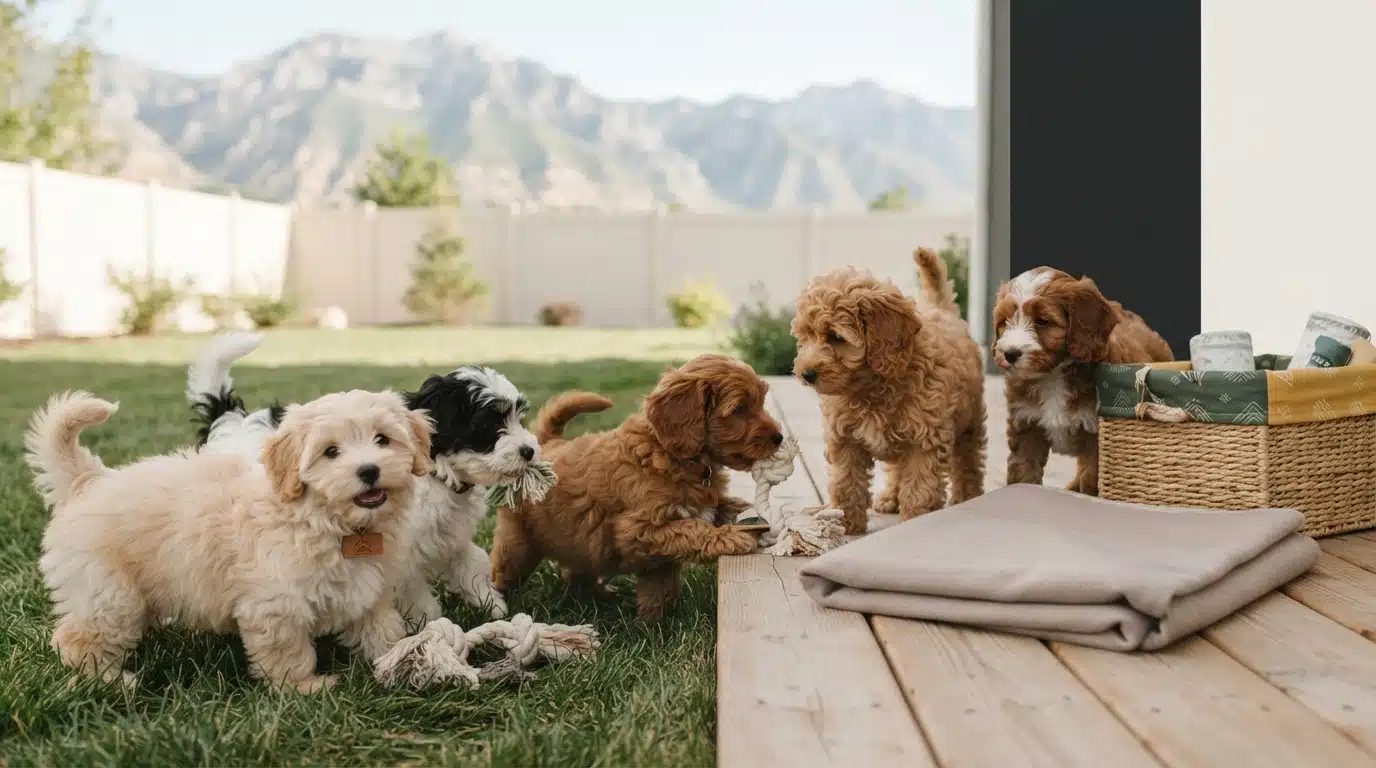
Quick Summary: Before sending a deposit on a Havanese, Havapoo, or Cavapoo, buyers should run through a ten-question breeder checklist covering parent health and genetic testing, live access to the litter, socialization routines, vaccination records, matching process, contract terms, and after-pickup support. The article flags specific warning signs like vague health answers, refused visits, urgency to pay fast, and USDA-only licensing, which often point to scams or mills. Sage Puppies, a small program in South Jordan, Utah, is presented as an example of a breeder that shares verifiable OFA records, lets families meet the mother, and keeps matching owner-managed from start to finish.
You have narrowed your search to a Havapoo, Cavapoo, or Havanese, and the listings all look alike. Same smiling families, same cuddly photos, same “well-loved” language. The difference between a healthy eight-week-old puppy and a year of vet bills often comes down to the breeder questions checklist you work through before you send a deposit. Most first-time buyers skip this step because they don’t know what to ask, or what a good answer should sound like. This must ask breeder guide fixes that. Below you’ll find ten questions for choosing puppy breeders with confidence, plus a cue for what a strong answer sounds like each time. We run a small Sage Puppies program in South Jordan, Utah, so we wrote this from the breeder’s side of the table. Browse our available puppies and pricing to see how our answers hold up.
Step 1: Ask Which Health and Genetic Tests the Parent Dogs Have Completed
Any breeder questions checklist worth using starts here, because health testing separates careful breeders from casual ones. Ask each breeder: “Which tests have both parents completed, and can I see the results?”
What “vet checked” is not the same as genetic screening
A vet check is a one-time exam. A vet listens to the heart, looks at the eyes, and confirms the dog seems healthy that day. It catches nothing hidden in the genes.
Genetic screening is different. It uses DNA panels and breed-specific exams to find conditions a dog can carry without showing signs. For Havanese, that means cardiac, hearing, and eye evaluations plus tests for inherited conditions. Cavapoos and Havapoos inherit risks from both the Cavalier and Poodle sides, so both parents need testing, not just one.
When you’re choosing puppy breeder programs, listen for the difference. A strong answer names specific tests and dates. A weak one leans on “the vet said they’re healthy.”
How to verify the results yourself on OFA and the parent’s registry
Don’t take a paper claim at face value. The Orthopedic Foundation for Animals (OFA) runs a public database called OFA’s Chi-F at website where you can search any dog by registered name or number and see exactly which tests passed and when.
Ask the breeder for each parent’s registered name. Then search it yourself before you pay a deposit. Results should be posted under the parents’ names, not described verbally.
What a good answer sounds like: “Here’s the mom’s OFA number, her cardiac and eye results, and the dad’s DNA panel for the Poodle-side conditions. Look them up.”
If a breeder resists showing verifiable records, treat that as a serious warning sign and read our guide to unethical puppy breeder red flags. At Sage Puppies, health documentation on both parents is part of the application conversation, not an afterthought.
Step 2: Ask to Meet the Parents and the Full Litter on a Live Call or Visit
Photos are easy to stage. A live video call is not. Any breeder you are considering should walk you through where the dogs sleep, eat, and play, then let you see the mother and every puppy in the litter, not just the two that are still available. At a small program like Sage Puppies, Utah families simply visit in person, and out-of-state families get the same walk-through on a call. This is a core line in any breeder questions checklist, and a refusal is covered in more detail on our page about red flags in unethical breeders.

Questions that prove you can see the dogs, not just a photo gallery
Ask these four, and note how easily the answers come:
- “Can we do a live video tour right now, or schedule one today?”
- “Can I see the mother with the whole litter in one shot?”
- “Where do the puppies spend their days and nights?”
- “How often is the dam handled by people, including kids?”
A good breeder answers without hesitation and keeps talking. Deflection, stock footage, or “the dam lives elsewhere and I’ll send photos” are reasons to keep looking.
Temperament cues that predict the puppy you will live with
While you watch, look past cuteness. Calm, confident parents usually produce calm, confident puppies, and socialized puppies recover quickly when startled. Ask which puppy is boldest, which is quietest, and how each reacted to being turned over gently. Then ask the breeder to handle a puppy on camera: a relaxed body and curious sniffing are good signs; frozen stillness or frantic squirming tells you more than any description. Honest breeders will also steer you away from a puppy whose energy does not fit your home. If they push the “last one available” without asking about your family, your schedule, or your yard, treat that as data too.
Step 3: Ask About Early Socialization and the Puppy’s Daily Routine
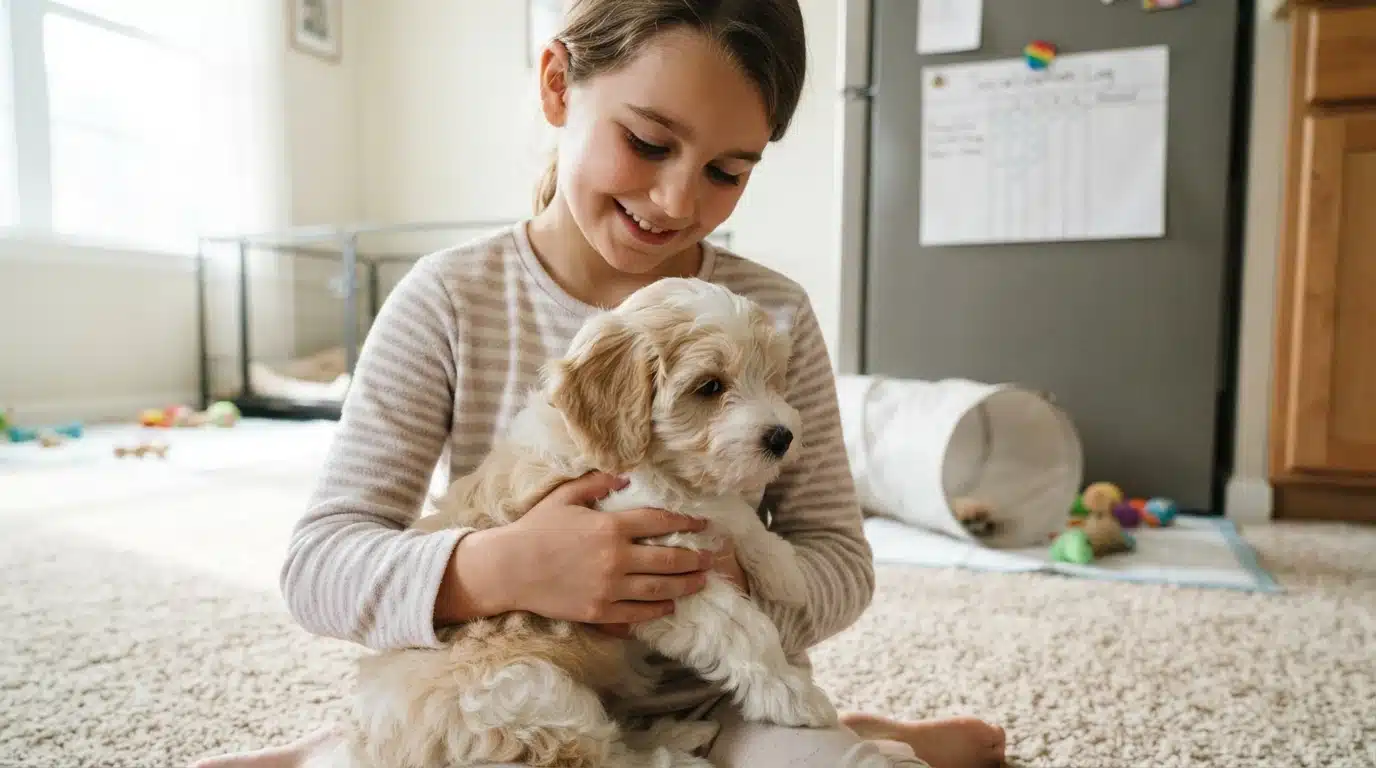
A puppy’s first eight weeks shape how it handles new people, sounds, and handling for life. So ask how the breeder socializes each litter, then ask what a normal day looks like for the puppies. Good breeders answer both without hesitation.
What a real socialization log looks like
Ask to see or hear specifics: which sounds the puppies have heard, how often strangers handle them, and what surfaces they walk on. A strong answer sounds like “they hear the vacuum and doorbell daily, and my kids hold them several times a week.” Vague answers like “they’re raised with our family” are not a plan. The AVSAB position statement on puppy socialization recommends starting this work before puppies leave the litter, not after. A daily log, even a simple note on the fridge, shows the breeder treats socialization as a task, not a slogan. That detail separates a boutique program from a volume operation, and it is a fair question to ask every breeder you interview.
Questions about feeding, sleep, and crate time before pickup
Ask exactly what the puppies eat, how often, and whether the litter has started crate naps or potty routines. A good answer includes the food brand, meal times, and honest limits. Then keep that same food for the first weeks so you avoid stomach upset during transition.
Ask for a written daily routine you can follow at home. Good breeders send one, because a steady first week matters more than any gadget you buy.
Step 4: Ask for the Health Records, Vaccinations, and Deworming Schedule
A reputable breeder hands over health records without being asked twice. Ask for the exact dates of each shot and deworming dose, not just “up to date on everything.” Vague answers here are a red flag.
The minimum vaccination and deworming timeline for an 8 to 12 week puppy
Core shots start between 6 and 8 weeks, then repeat every 2 to 4 weeks until at least 16 weeks, following the AAHA vaccination guidelines. Deworming usually starts earlier, at 2 to 3 weeks, and repeats every 2 to 3 weeks through 12 weeks. Here’s what your puppy’s record should show:
| Age | What the record should show |
|---|---|
| 2 to 3 weeks | First deworming |
| 6 to 8 weeks | First DHPP shot (distemper, hepatitis, parainfluenza, parvovirus), deworming repeated |
| 8 to 12 weeks | Second DHPP dose or next deworming dose due |
If a puppy comes home with zero shots, walk away. An 8-week-old from a careful program has already had its first dose.
Documents you should walk away with at pickup
You should leave with a printed or digital health record listing each vaccine date, dewormer used, and dosage. Ask also for a vet exam record or health certificate, plus any written health guarantee. A breeder who can’t produce these papers isn’t ready to sell you a puppy. 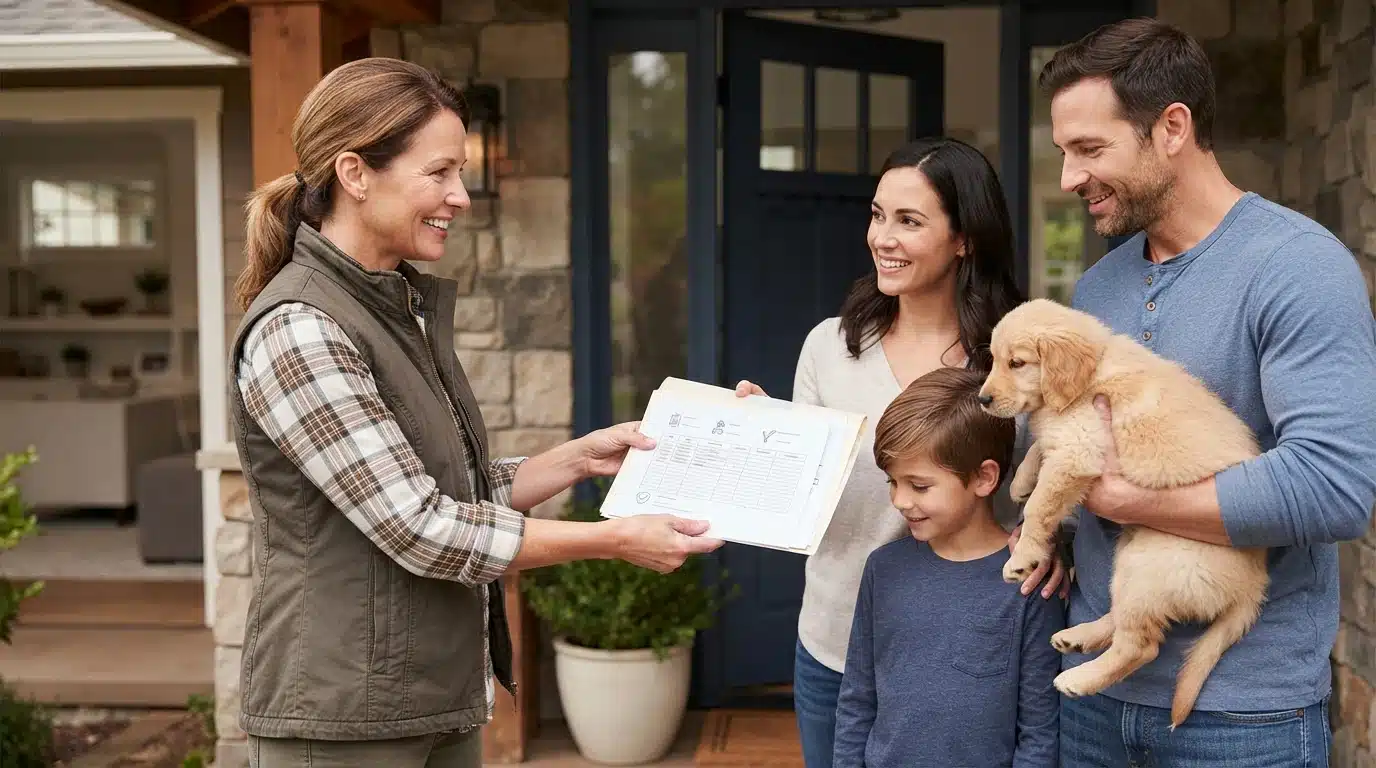
Step 5: Ask How Puppies Are Matched With Families and When You Can Reserve
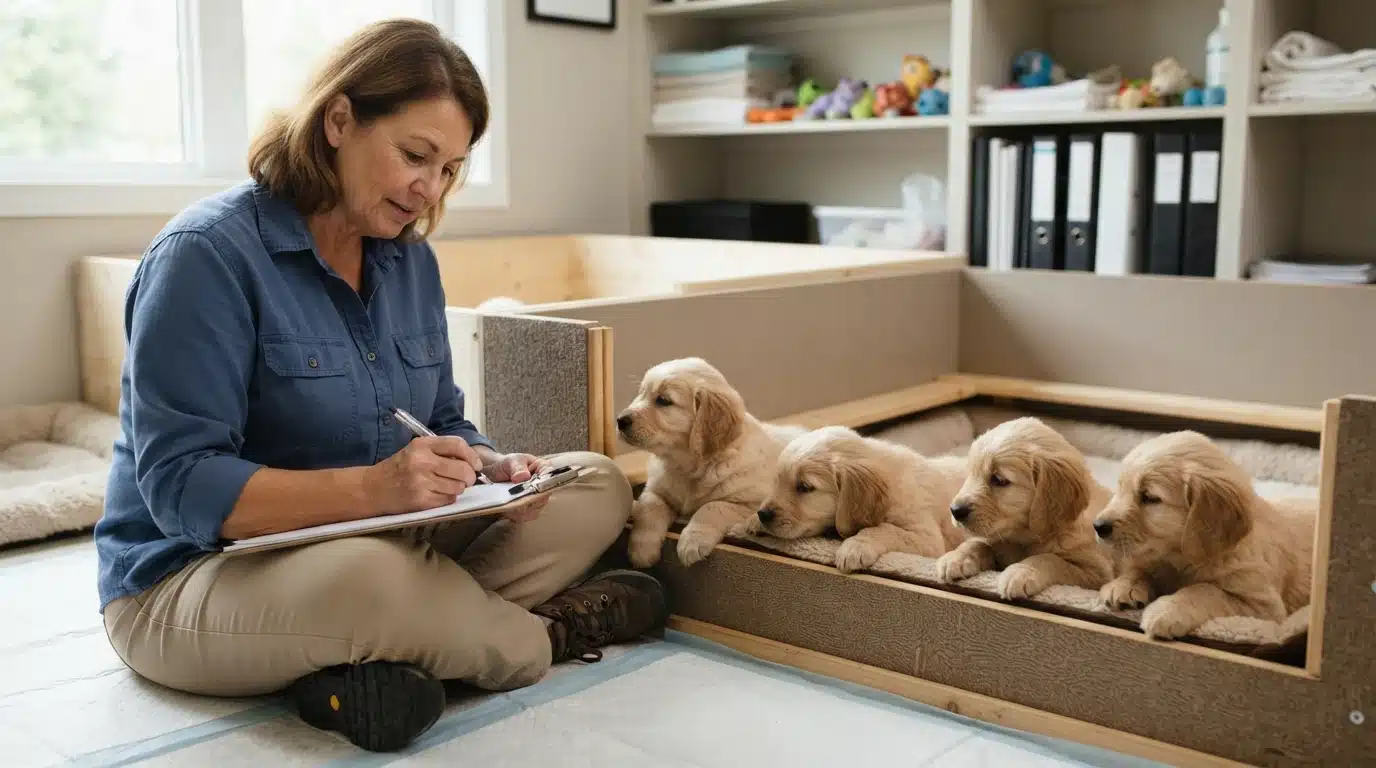
A good breeder will not hand you the first puppy in the litter. Matching should be a conversation, not a lottery. Ask how the program learns about your home, your schedule, and your experience with dogs. A small program should describe this clearly: an application first, then a discussion about temperament, energy, and what you want in a companion.
Listen for specifics. How does the breeder read each puppy’s temperament? Do they place a calmer pup with a family that has young children? At Sage Puppies, matching is handled by the owner, so the person who raised the litter also decides which puppy fits your family. That continuity matters. If a breeder cannot explain how they match, or lets a website pick for you, keep looking.
Questions about deposits, refunds, and puppy selection timing:
- When can I reserve a puppy, and when do I pick one out? Selection order should be explained in writing, often based on deposit date.
- What does the deposit cover, and is it refundable? Get the policy in writing before you send money.
- Can I meet puppies before choosing? For out-of-state buyers, video visits should be offered.
- What happens if no puppy in the litter fits? A good answer: your deposit rolls to a future litter.
Compare terms on the pricing and reservation page before you commit anywhere.
Step 6: Ask About the Breeder’s Contract, Health Guarantee, and Take-Back Policy
A good contract protects both of you. Before you pay anything, ask for a blank copy and read it slowly. Reputable breeders send one without hesitation, and many explain their health guarantee up front because they are proud of it.
The four contract clauses that protect you after pickup
- Health guarantee window. It should cover genetic conditions for at least one year, ideally two. Note the deadline for your own vet exam, often 72 hours.
- Take-back or return clause. A serious breeder takes the dog back at any age, no questions about your reason. This matters most if life changes.
- Vet exam requirements. The contract should spell out what records you must keep to stay covered.
- What the guarantee pays. Some offer a replacement puppy, some a refund, some both. Know which before you sign.
Ask the breeder to walk you through each clause. If they get vague, treat that as information too.
Red flags in spay/neuter, breeding rights, and replacement language
Watch for pressure tactics dressed up as policy. A guarantee that expires in 30 days, a demand that you use only the breeder’s vet for claims, or a “no returns ever” line are all warnings. Replacement-only terms that ignore your vet costs shift the risk onto you. Spay/neuter clauses are normal; breeding rights priced at the last minute are not. For a fuller list, see our guide to unethical breer red flags.
Step 7: Ask How the Breeder Supports You After the Puppy Comes Home
A good breeder’s job does not end at pickup. Ask directly: “What happens if I text you in week two with a question?” The answer tells you whether you are joining a program or finishing a transaction.
What good post-purchase communication looks like for the first 90 days
Strong breeders stay reachable and specific. Look for these signs:
- They answer questions about potty training, crate settling, and first vet visits within a day or two.
- They check in during the first week, not just at handoff.
- They explain what your puppy ate, what schedule it keeps, and which food to keep using.
- They want updates, and they answer honestly even when the answer is “ask your vet.”
What a good answer sounds like: “Text me anytime in the first few weeks. Here is the food transition plan, and here is what a normal first night looks like.”
Resources that signal a breeder is invested beyond the sale
Ask what written guidance you take home. A health record, feeding schedule, and grooming notes for a Havanese coat show real preparation. Some programs, including ours, publish preparation guides and honest product picks so you can shop before pickup day instead of guessing after.
If a breeder’s support ends at the front door, keep looking. When you are ready, start your application.
Step 8: Recognize the Pressure Tactics That Signal a Puppy Mill or Scam
Ethical breeders answer questions patiently. Scammers and mills rush you, because a buyer who slows down starts asking better questions. Watch for these five phrases.
Five pressure phrases and the question that breaks them
| Pressure phrase | What it really means | Ask instead |
|---|---|---|
| “If you don’t pay today, someone else will” | Manufactured urgency | “I’ll wait. Please let me know if the puppy is still available next week.” |
| “Full payment by Zelle or Venmo only” | No paper trail, no refund | “Can we use a method with buyer protection?” |
| “Pickup isn’t possible, we’ll ship the puppy” | Hiding the facility | “Can I visit and meet the mother?” |
| “No papers yet, I’ll send them later” | Often no registration at all | “Can I see the parents’ paperwork now?” |
| “Health is guaranteed, no vet check needed” | Avoiding scrutiny | “Which vet examined the puppy, and when?” |
A legitimate breeder welcomes any of these questions. A seller who dodges, guilt-trips, or repeats the urgency line is telling you everything you need to know.
USDA licensing, state licenses, and what “licensed breeder” really means
“Licensed” sounds reassuring, but it often signals the opposite. A USDA license is a wholesale commercial license, and large-scale mills commonly hold one while selling through pet stores and online shippers, as Stop Online Puppy Mills explains. The ASPCA has documented cruelty at federally licensed facilities that inspection failed to fix. Licensing sets a legal floor, not a quality mark. Ask instead how many litters the program raises each year, where the dogs live, and whether you can meet the mother.

You have the questions now, so put them to work. Start with a breeder who answers them openly. At Sage Puppies, every Havanese, Havapoo and Cavapoo is raised in our Utah home with owner-managed matching from day one. Review our current puppies, then submit your application and let’s find your right fit.
Frequently Asked Questions
Q1: What questions should I ask a reputable puppy breeder?
Ask about parent health testing, how puppies are raised, socialization routines, vaccination records, and the return policy. A good breeder answers openly and asks you questions too, because careful matching matters as much as the sale.
Q2: What health tests should a puppy breeder have done?
Expect OFA or PennHIP evaluations for hips and knees, a veterinary eye exam, and breed-specific DNA panels. For Havanese, Havapoos, and Cavapoos, patella checks and cardiac screenings are especially worth confirming in writing.
Q3: How can I tell if a puppy breeder is a puppy mill?
Watch for multiple litters always available, no visits allowed, no health testing records, and sellers who push you to pay quickly. Mills avoid questions; responsible breeders welcome them.
Q4: Should I visit the breeder before choosing a puppy?
Yes, whenever possible. Seeing where puppies live tells you more than any website. If distance is an issue, request a live video tour and unedited puppy updates.
Q5: How much should a well-bred small-breed puppy cost?
Healthy, thoughtfully bred Havanese and doodle mixes typically range from $3,500 to $4,500. Prices far below that often signal skipped health testing or outsourced litters.
Q6: When should I submit a puppy application?
Apply before litters are announced. Reputable small programs match approved families first, so early applications give you the best pick and preparation time.
Bringing It All Together
Ten questions do the heavy lifting. Ask about health testing, socialization, the puppy’s parents, and how the breeder screens you. A good breeder answers patiently and asks plenty back, because a careful program wants great homes as much as you want a healthy puppy.
Trust your reactions as much as the answers. Vague health talk, pressure to pay fast, or no paperwork are reasons to walk away, however cute the litter.
| Green Flag | Red Flag |
|---|---|
| Shares parent health clearances | Dodges testing questions |
| Asks about your home and plans | Sells to whoever pays first |
Ready to see what careful breeding looks like? Browse the Havanese, Havapoo, and Cavapoo puppies currently available at Sage Puppies.