
Quick Summary: Verify a breeder’s health claims by requesting OFA or CERF test results for both parents and a recent vet exam record for the puppy. Cross-check these documents independently on official databases rather than relying on breeder-provided screenshots. Sage Puppies supports this transparency by sharing health testing results for all parents before families commit to a puppy.
When you welcome a new puppy, those first weeks often revolve around cuddles and training. But true peace of mind starts earlier, long before pickup day. To verify dog health claims, you need to see the paperwork behind them: parent health testing, vet exams, and vaccination records. Many families struggle with breeder record verification because some Illinois breeder standards leave plenty of room for vague answers. This guide walks you through exactly which documents to request, how to read them, and which red flags mean walk away. At Sage Puppies, we raise Havanese, Havapoo, and Cavapoo puppies at home in South Jordan, Utah, and we share health records openly with every family, so we know what trustworthy documentation looks like. Here’s how to spot it.
The Foundation: Why Health Verification Matters
Beyond the Surface
A fluffy puppy can look perfectly healthy on day one and still carry a problem that shows up two years later. That is why learning to verify dog health records matters before you fall in love with a face. Paperwork, not charm, tells you whether a breeder actually screened the parents or just said they did.
For companion breeds like the Havanese, Havapoo, and Cavapoo, a few conditions show up often enough to check for. These include patellar luxation, hip dysplasia, eye disease such as cataracts, and heart issues. Responsible breeders test the parents for these conditions before breeding, because a puppy’s health starts with its family tree, not its first vet visit.
Real verification rests on three documents. The first is proof of OFA or CERF testing on both parents, which you can confirm yourself on the OFA website. The second is a veterinary exam record for the puppy itself, dated within days of pickup or delivery. The third is a written health guarantee that spells out what the breeder covers and for how long.
When a breeder hesitates to share any of these, treat it as useful information. A confident breeder sends records quickly and explains what each test means.
At Sage Puppies, we share health testing results for both parents before you commit, because trust should come standard. If you are still choosing a breeder, our Illinois buyer’s guide walks through what to ask.

Essential Documents Every Buyer Should Request
Words are easy to ask for, but real records are harder to fake. Before you commit to a puppy, request paperwork for the parents and the puppy itself. Any breeder who hesitates here is telling you something.
Parental Genetic Screenings
Responsible breeders test their breeding dogs before ever pairing them, not after a buyer asks. For Havanese, Havapoos, and Cavapoos, ask for results from an OFA or CERF eye exam, a patella evaluation, and cardiac clearance. These conditions run in small companion breeds, so testing matters.
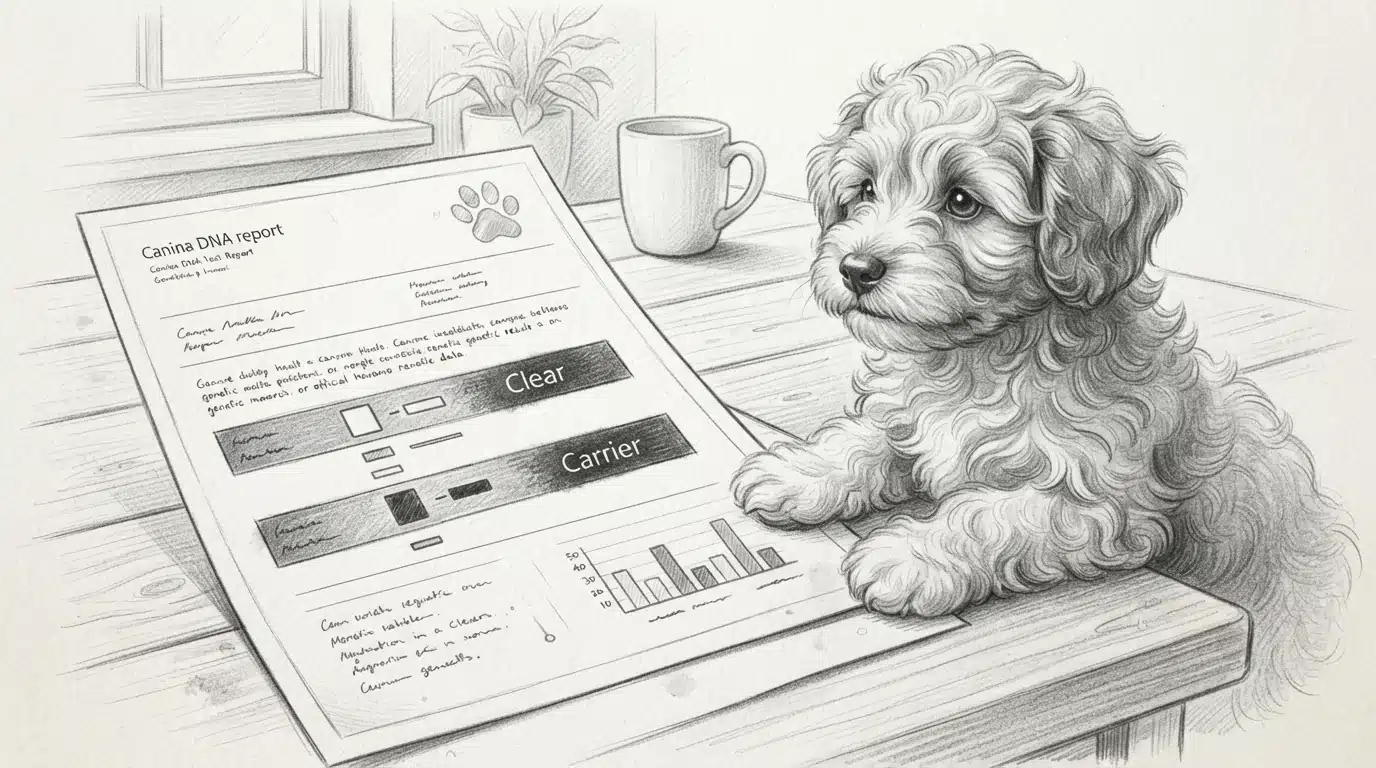
You should also see DNA panel results. Look for screenings for conditions such as progressive retinal atrophy, cataracts, and degenerative myelopathy. A DNA report should show each parent’s registered name, the testing lab, and clear or carrier status for each condition.
One healthy parent is not enough. A puppy can inherit problems when only one dog was tested. Ask to verify dog health on both sides of every pairing, and cross-check results directly on the OFA website using the parents’ names.
At our available puppies page, you can ask about the specific tests completed for each litter’s parents before you apply. A good breeder will share them without being asked twice.
Comprehensive Veterinary Health Certificates
Your puppy should come with a health certificate from a licensed veterinarian, dated within ten days of pickup or delivery. It should confirm a physical exam, current vaccinations, and deworming records.
Read it carefully. The certificate should list the puppy’s date of birth, the exam date, and the vet’s license number, so you can call the clinic to confirm it is genuine.
How to Interpret Genetic Test Reports
A genetic test report looks intimidating, but it usually answers one simple question: which genes did this dog inherit from each parent? Most breeding dogs are screened through panels like Embark or Paw Print Genetics, and results fall into three words you will see again and again: clear, carrier, or affected.
Understanding “Clear” versus “Carrier”
Clear means the dog inherited no copies of the mutation being tested. A clear dog cannot pass that condition to puppies. Carrier means the dog carries one copy but shows no symptoms. That alone is not a problem. It only matters when bred to another carrier of the same mutation, because then each puppy has a 25 percent chance of inheriting two copies and developing the condition.
Affected means the dog has two copies and likely shows symptoms. Ethical breeders do not breed affected dogs for that condition.
So when you review a puppy’s parents’ reports, look for pairs. A clear bred to a carrier produces no affected puppies. Two carriers bred together is a red flag, no matter how healthy the parents look.
| Parent pairing | Affected puppies possible? | What it means |
|---|---|---|
| Clear x Clear | No | Safest pairing |
| Clear x Carrier | No | Puppies may be carriers, but stay healthy |
| Carrier x Carrier | Yes, 25% chance per puppy | Avoid |
| Affected x Any | Yes or carrier | Avoid |
For conditions like the ones relevant to Havanese and Cavapoo lines, ask how the breeder paired around each result. A responsible program, including health-tested parents at Sage Puppies, can explain any carrier status and show why the pairing is safe. If a breeder cannot walk you through the report line by line, that is your answer.
Evaluating the Breeder’s Transparency
The Open-Door Policy
A trustworthy breeder has nothing to hide. Ask to visit in person, or request a live video tour if you live out of state. Someone raising puppies at home should be able to show you the whelping area, the puppy’s living space, and both parents on request. Vague answers or “we only meet in parking lots” are red flags. Puppy mills often sell through intermediaries precisely so buyers never see the conditions.
Watch how the breeder answers harder questions. Ask which health tests each parent has completed, and whether you can see the actual results, not just hear the word “health tested.” An honest breeder shares certificates openly and explains any condition that shows up in the breed’s history.
Other signs of transparency worth checking:
- Parent access. You should be able to meet or view the mother, at minimum.
- Written health records. Vaccinations, deworming dates, and vet exams, documented and dated.
- Real photos and updates. Current pictures and videos of your specific puppy, not recycled stock images.
- Willingness to stay in touch. Good breeders welcome questions after you take your puppy home.

We built Sage Puppies around this kind of openness. Families can see where our Havanese, Havapoo, and Cavapoo puppies are raised, review parent health records, and follow their puppy’s progress until pickup in South Jordan, Utah or delivery. If a breeder resists every step above, keep looking. You can compare what transparent programs offer in our Illinois buyer’s guide.
Navigating State Laws and Breeder Ethics
Regulations versus Reputation
Illinois licensing rules are easy to find. The Illinois Department of Agriculture oversees commercial dog breeders, and anyone selling more than a handful of litters each year needs a permit. But a permit only proves paperwork. It says nothing about how a breeder raises puppies or whether the parents were truly health tested.
That gap is why ethics matter as much as compliance. A breeder can meet every legal minimum and still skip OFA eye exams or heart checks. So your real job is to verify both layers: legal status first, then the habits behind the paperwork. Ask whether their breeding dogs live in the home, how many litters they produce yearly, and which tests apply to the breed. For Havanese, Havapoo, and Cavapoo puppies, that usually means eye, hip, and heart screening on both parents.
Ethical breeders welcome these questions. They explain results in plain language and happily show you where puppies sleep, eat, and play. If a seller dodges, slows down or pushes a same-week decision, treat that as data.
Reputation fills the space regulations leave. Reviews, references from past puppy families, and transparency about a home-raised setup tell you far more than a license number ever will. 
When you compare options, look for a breeder who pairs both qualities, like the home-raised program at Sage Puppies, where health testing and open communication come standard.
Planning for Your Puppy’s Arrival
Finalizing the Health Record Transfer
Once your puppy is matched, the last step before pickup or delivery day is the health record handoff. Ask your breeder for a complete packet: vaccination dates, deworming history, microchip number, and a recent vet exam note. Review it while the puppy is still with the breeder, so any missing detail can be fixed before travel.
Set up a folder, physical or digital, and keep every document together. Your first vet visit will go much faster when everything is in one place. Most Illinois vets want to see a puppy within a few days of arrival, so call ahead and book that appointment as soon as your go-home date is set.
Confirm the details that matter most:
- Vaccine record showing which shots were given and when the next one is due
- Deworming dates and any remaining treatment schedule
- Parent health testing results, especially for breed-specific concerns in Havanese, Havapoo, and Cavapoo lines
- Feeding instructions so you can keep the same food and avoid stomach upset
When you reserve through our Illinois buyer’s guide, you will see exactly what paperwork arrives with your puppy and how pickup in South Jordan or nationwide delivery works. Transparent records are part of the process, not an extra request.
If something in the packet looks unclear, ask questions before the puppy leaves the breeder’s care. A good breeder expects that and answers willingly.
Common Mistakes to Avoid
Even caring families slip up when checking a breeder’s health records. Watch for these traps:
- Trusting paperwork alone. A folder of certificates means little if the names and dates don’t match the puppy’s parents. Cross-check every page.
- Skipping parent verification. Ask to see the mother in person or on a live video call. Photos from last year don’t count.
- Accepting vague claims. “Vet checked” is not a health record. Ask which tests were run and request results in writing.
- Missing dates and ages. Eye and heart exams expire. Confirm each screening happened recently, not years ago.
- Ignoring red flags in behavior. A breeder who rushes you, avoids questions, or pushes a fast deposit is telling you something.
Avoid these mistakes and you’ll quickly separate ethical programs from the rest. A transparent breeder welcomes every question, which is exactly how we approach health records at Sage Puppies. When you’re comparing litters, our buyer’s guide to Illinois puppies walks through each step in more detail.
Your Partnership with Sage Puppies
Verifying health records puts you in the driver’s seat. It turns a hopeful purchase into a confident decision, and the right breeder will welcome your questions rather than deflect them.
That’s the standard we hold at Sage Puppies. Every parent dog is health tested, every puppy is raised in our South Jordan home, and every family receives clear documentation before pickup or delivery. You shouldn’t have to chase paperwork; it should arrive before you ask.
We serve families nationwide, with local pickup in Utah and delivery across the United States, including Illinois. If you’re comparing breeders, use the steps in this guide as your checklist, then browse our current Havanese, Havapoo, and Cavapoo litters to see how transparent breeding works in practice.
Wisely bred. Beautifully loved. That’s the partnership we offer.

Verifying health records takes time you may not have. At Sage Puppies, our Havanese, Havapoo, and Cavapoo parents are health tested, and every puppy is raised in our South Jordan, Utah home with full transparency. See our Available Puppies and start your application today.
Frequently Asked Questions
Q1: How do I verify the health testing claims of Illinois dog breeders?
Ask for the parent dogs’ OFA or PennHIP numbers, then look them up yourself on the OFA website. Cross-check any DNA panel results against the report date and the actual parent names.
Q2: What specific health records should Illinois puppy buyers ask for?
Request the vet exam record, vaccination and deworming dates, parent health test results, and a written health guarantee. Reputable programs share these before you commit.
Q3: Are there Illinois-specific laws requiring breeders to provide health documentation?
Illinois requires a health examination by a licensed veterinarian within a set window before sale, plus disclosure of known conditions. Get that paperwork in writing.
Q4: Should I trust breeder-provided PDFs of test results?
Verify them independently. Match registration numbers on the OFA database rather than relying on screenshots alone.
Q5: What if a breeder refuses to share health records?
Walk away. Transparency is a baseline, not a bonus.
Conclusion
Verifying health records comes down to a few habits. Ask for OFA or CERF results, request the vet exam paperwork, confirm vaccination and deworming dates, and match microchip numbers to the documents. Check that both parents were health tested, not just the puppy. A breeder who answers willingly, shares records without being asked twice, and lets you verify everything independently is showing you how they’ll treat you after pickup day.
Ethical programs like Sage Puppies welcome these questions, because transparency protects families as much as puppies. Take your time, keep copies, and trust the breeder who makes honesty easy.





