
Quick Summary: To find health-tested puppies near you, ask breeders for specific, verifiable health test records for both parents and understand breed-specific risks. Good breeders provide transparent documentation, detailed early socialization routines, and clear support policies. Avoid vague claims like ‘vet checked’ and focus on concrete proof to ensure you’re choosing a responsible breeder who supports lifelong puppy care.
If you are looking for health-tested puppies for sale near me, start with one question: can the breeder prove the parents were screened for the right breed risks? Cute photos do not tell you that. A polished website does not tell you that either. The real difference shows up in test records, breeding choices, and how clearly a breeder answers hard questions.
That is the problem this guide solves. Many people search for health-tested puppies for sale near me and still end up comparing vague claims like “vet checked” or “raised with love.” Those phrases sound good, but they are not the same as breed-relevant health testing. First-time puppy buyers often do not know what to ask, what proof to request, or what warning signs to catch.
This article gives you a simple way to interview breeders with confidence. You will learn which questions matter, how to verify health testing, and how to tell the difference between careful breeding and sales talk. If you are searching for health-tested puppies for sale near me, this framework helps you choose with a calm, clear head. It is built for families who want a well-bred Havanese, Havapoo, or Cavapoo puppy and want facts before they commit.
Question 1: What health tests were done on both parents?
Ask for the exact test names, not a summary
Do not accept, “Our dogs are health tested.” Ask for the exact test names, the date, and the result for both parents. Good breeders should be able to show records, not just say the right words.
The safest way to ask is simple:
- What tests were done on the sire?
- What tests were done on the dam?
- Which lab or registry recorded them?
- Can I see the certificates or public listings?
According to the OFA CHIC program, breed clubs set breed-specific screening protocols, and dogs earn CHIC recognition only when they complete the recommended screenings and the results are public. That matters because small companion breeds may need different checks than larger breeds.
| What to ask for | What a strong answer sounds like | Red flag |
|---|---|---|
| Test names | “Patella, eye exam, cardiac, DNA panel” | “They’re fully tested” |
| Proof | PDF certificates or public OFA record | Screenshots with no details |
| Parent-by-parent results | Separate records for sire and dam | Only one parent shown |
Tip: Ask the breeder to walk you through each result in plain English. A good breeder will not get defensive.
Learn the difference between DNA testing and physical clearances
This part trips up many buyers. DNA testing and physical clearances are not the same thing.
The AKC explains that DNA health tests show genetic risk or carrier status, but they do not prove a dog currently has or does not have a disease. A breeder still may need physical exams, imaging, or specialist checks.
Use this quick filter:
- DNA tests check for known inherited variants
- Physical clearances check the dog’s body right now
- Both matter when choosing breeding parents
| Test type | Examples | Why it matters |
|---|---|---|
| DNA testing | PRA, DM, breed-specific variants | Helps avoid risky pairings |
| Physical clearance | Patella, cardiac, eye exam, hips | Checks actual structure and function |
Warning: A big DNA panel alone is not full health testing.
For Havanese, Havapoo, or Cavapoo parents, ask whether the breeder used both kinds of screening when relevant for that breed or line. At Sage Puppies or any breeder you consider, you want clear records, honest answers, and no vague shortcuts.
Also Read: 10 Signs a California Puppy Listing Is a Scam – Sage Puppies
Question 2: Can I verify the results myself?
Yes. You should be able to verify most breeder health claims on your own. A reputable breeder should give you the registered names or registration numbers for both parents, plus copies of each result. The Orthopedic Foundation for Animals says buyers can use its advanced search database to look up dogs by name, number, breed, or kennel name. OFA also explains that dogs with all breed-required screenings made public can receive a CHIC number, but that number only shows the tests were completed and shared. You still need to read the actual results.
Ask for:
- Parent dog registered names
- OFA or lab certificate copies
- Test dates and the dog’s age at testing
- The microchip or tattoo match, if listed
- The exact lab name for DNA panels
If the breeder says the parents were “cleared,” ask cleared for what, by whom, and where can I confirm it?

A solid breeder makes this easy. Programs like Sage Puppies should be ready to walk you through each parent’s records without getting defensive.
Red flags in the verification conversation
Watch how the breeder responds when you ask for proof. Good breeders answer clearly. Weak breeders shift the topic.
Common red flags:
- They only say “vet checked.”
- They send blurry screenshots with no dog name.
- They refuse registered names “for privacy.”
- They show one parent’s tests, not both.
- They claim results are private, so you cannot see them.
- They use “DNA tested” as a stand-in for all health testing.
A routine vet exam is not the same as breed-specific health testing.
Use this quick check:
| Claim | What you should ask for | Why it matters |
|---|---|---|
| Health tested | Test names and result copies | Vague claims prove nothing |
| CHIC certified | CHIC number plus full records | CHIC is not the whole story |
| DNA clear | Lab report and parent IDs | DNA panels vary by breed |
| Vet checked | What breed-specific screenings were done | Wellness exams miss inherited issues |
Also Read: Puppy Health Guarantees: What Good Breeders Include
Question 3: What breed-specific risks are you screening for?
A breeder can show test results and still miss the bigger point. You need someone who knows the actual risks tied to the breed or mix. For Havanese, the Havanese Club of America points buyers to concerns like patellas, hips, eyes, hearing, heart, liver shunt, seizures, and Legg-Calve-Perthes. It also notes that Havanese CHIC-related screening includes BAER, annual eye exams, patellas, and hips through OFA reporting Havanese health guidance.
For Cavapoos and Havapoos, the breeder should talk through both parent breeds, not just say “hybrid vigor.” A Cavapoo can inherit Cavalier heart and neurologic concerns, plus Poodle and small-dog issues like eye and knee problems Cavapoo breed health guide.

Good breeders do not promise a risk-free puppy. They explain what they screen for, why it matters, and what can still happen anyway.
| Breed or mix | Strong screening talk should include |
|---|---|
| Havanese | Patellas, hips, annual eyes, hearing, heart discussion, line history |
| Havapoo | Havanese-side and Poodle-side eye, knee, hip, heart, dental and line risks |
| Cavapoo | Cavalier heart risks, eye checks, patellas, hips, neurologic history, parent records |
A strong answer sounds calm, specific, and easy to verify. Look for points like these:
- “For this pairing, we screen for the issues most seen in these lines.”
- “Here are the parent test results, not just a summary.”
- “This mix can carry risks from both sides.”
- “We do not breed dogs with weak structure, unstable temperament, or poor family history.”
- “If a line has a pattern, we tell families.”
Weak answers sound like this:
- “Our dogs have never had problems.”
- “The vet checked them.”
- “Mixed breeds are healthier.”
- “You do not need to worry about that.”
If you are comparing programs, this question helps you spot the difference between real breed knowledge and sales talk fast.
Question 4: How are the puppies raised during the first eight weeks?
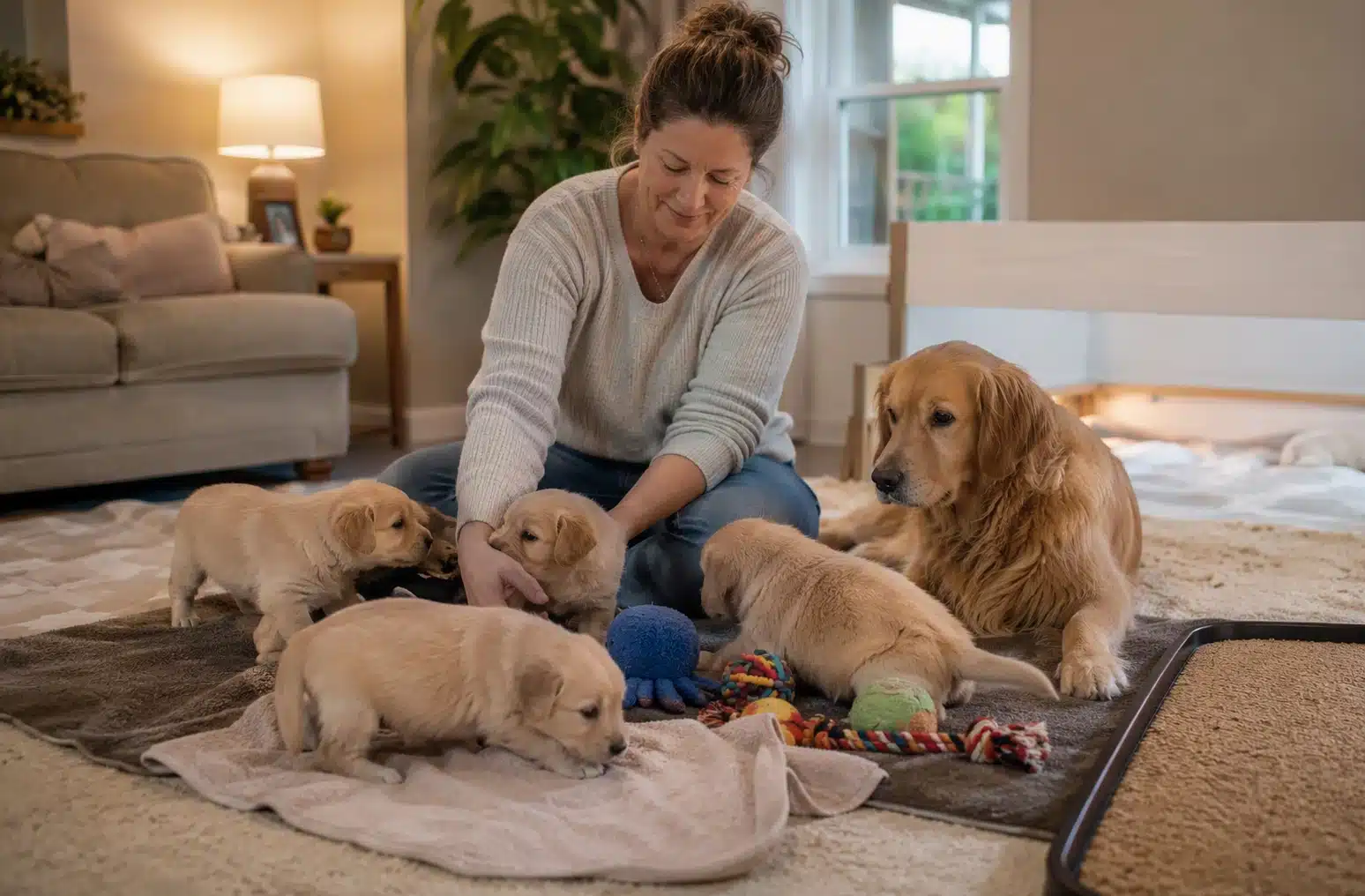
Look for home-based, intentional early care
The best answer is not just “they’re well socialized.” You want details. The first weeks matter because puppies are forming early links with people, sound, touch, and daily life. The AVMA notes that puppies benefit from diverse, positive exposure during this sensitive period, and that this should begin by or before 3 weeks of age with the breeder or raiser during early socialization.
Ask if the puppies are raised inside the home, not apart in a separate kennel area. Then ask what happens each day.
Good signs include:
- Daily gentle handling
- Time with littermates and mom
- Clean sleeping and play areas
- Short, calm exposure to normal household sounds
- Age-appropriate toys, surfaces, and rest time
Weak answers sound vague:
- “They do great with kids”
- “They’re very loved”
- “They’re spoiled”
A careful breeder should be able to describe routines, not just make claims.
| What to ask | Strong answer | Red flag |
|---|---|---|
| Where are puppies raised? | In the home, around normal family life | In an isolated building or garage |
| Who handles them? | Adults and supervised family members daily | “Mostly just when needed” |
| What is their space like? | Clean, safe, enriched, and calm | Bare, loud, or crowded |
Ask how the breeder prepares puppies for real life
A good breeder does more than keep puppies alive and clean. They prepare them for the handoff to you. The AVSAB says the first three months are the key socialization window, and puppies should safely meet new people, surfaces, sounds, and experiences before full vaccination is complete in this position statement.
Ask for a simple week-by-week outline. It should include:
- Handling practice – paws, ears, mouth, brushing
- Sound exposure – vacuum at a distance, TV, kitchen noise
- Surface work – rugs, tile, grass, crate mats
- Confidence building – tunnels, soft obstacles, short car rides
- Early routines – crate intro, short alone time, litter box or potty start
Puppies should be challenged a little, not flooded with stress.
If you are talking with Sage Puppies or any breeder you trust, ask how they match each puppy’s early temperament with your home. That helps first-time families avoid a puppy that looks cute online but feels overwhelmed in real life.
Question 5: What happens if I need help after my puppy comes home?
Read the contract before you reserve
Post-sale support should be clear before you send a deposit. A good breeder does not treat the contract like a formality. They use it to spell out what happens if your puppy gets sick, if your vet finds a problem, or if you need guidance in the first weeks home.
The AKC notes that breeder contracts should be in writing, clearly state each side’s duties, and protect the dog’s welfare in real life, not just on paper, according to AKC’s contract guidance.
Ask for the full contract early and read these points line by line:
- Health terms
- Vet exam window
- Return or refund terms
- Microchip details
- What support is included after pickup or delivery
| Contract item | What to look for | Why it matters |
|---|---|---|
| Health guarantee | Clear dates, covered issues, required steps | Avoids vague promises |
| Vet exam clause | Exact time window after pickup | Helps you act fast |
| Communication | Phone, text, email, response expectations | Sets support standards |
| Return terms | Written process, not verbal only | Protects the puppy |
If a breeder avoids sending the contract before payment, slow down.

Ask about lifelong support and take-back responsibility
You want a breeder who stays available after go-home day. That means help with feeding, potty training, crate adjustment, grooming basics, and normal puppy behavior. It also means something bigger: if life changes, they do not want their puppy dropped into a shelter.
The AKC says responsible breeders encourage owners to call if a crisis comes up and may require the dog be returned to them if the family cannot keep it, as explained in AKC’s responsible breeder guide.
Ask these direct questions:
- If I have training or adjustment questions, who do I contact?
- How long will you stay available for support?
- If my situation changes, do you take the dog back?
- Do you help with safe rehoming if needed?
The best answer is simple: “Call us anytime, and our puppies always have a safe path back.”
At Sage Puppies, that kind of calm, ongoing support matters just as much as the puppy itself.
Also Read: 10 Small Breed Puppies That Stay Friendly & Easygoing
Common Mistakes to Avoid
Mistake 1: Treating “vet checked” as full health testing
A puppy can be vet checked and still come from parents with missing breed-specific screening. That phrase usually means the puppy had a basic exam, not that the sire and dam completed the right inherited disease testing. The AKC explains that health testing means screenings tied to the breed, often tracked through CHIC and OFA records, not just a routine exam AKC’s health testing guide.
Avoid this by asking:
- Which tests were done on both parents
- Which lab or registry recorded them
- Whether results are publicly verifiable
A clean puppy exam is good. It is not the same as proven breeding health records.
Mistake 2: Accepting vague answers instead of records
“Parents are healthy” is not proof. “We’ve never had issues” is not proof either. OFA states that breed-specific screenings and public database records help buyers review actual results, and dogs that complete required screening with public results can receive a CHIC number through the OFA CHIC program.
Ask for the exact records before you leave a deposit.
| What to ask for | Good answer | Weak answer |
|---|---|---|
| Parent names | Full registered names | “Mom and dad are on site” |
| Test proof | OFA or lab records | “Our vet has it” |
| Result access | Public links or copies | “Trust us” |
- If records are delayed, wait
- If names are withheld, walk away
- If answers stay fuzzy, keep shopping

If you want a breeder who welcomes smart questions, start with Sage Puppies. Their home-raised Havanese, Havapoo, and Cavapoo puppies come from health-tested parents, with clear next steps for application, pricing, pickup, or nationwide delivery. Review available puppies, compare your options, and ask for the details that matter before you commit.
Frequently Asked Questions
Q1: best health-tested puppy breeders
The best breeders show proof, not slogans. Ask for parent health testing, vet records, temperament details, and how puppies are raised. A strong breeder also welcomes questions, explains pickup or delivery clearly, and never rushes your deposit.
Q2: What health tests should I ask for?
Ask which tests match the breed. For Havanese, Havapoo, and Cavapoo puppies, that often includes patella, heart, eye, and genetic screening. Request the parent dogs’ actual results, not a vague promise that the line is healthy.
Q3: Is a vet check the same as health testing?
No. A vet exam checks the puppy’s current condition. Health testing usually looks at inherited risks in the parents before breeding. You want both. If a breeder only mentions a clean vet visit, keep asking harder questions.
Q4: How can I verify a breeder is being honest?
Ask for dated records, parent information, and clear answers about breeding goals. Watch for gaps, changing stories, or pressure. Good breeders stay calm and transparent. At Sage Puppies, families should expect straightforward answers and a clear process.
Q5: What red flags matter most?
Watch for no proof of testing, many breeds offered, always-available puppies, no questions for you, or prices that seem oddly low. A careful breeder screens buyers too. That usually means they care where each puppy goes.
Q6: Can I buy from out of state safely?
Yes, if the breeder communicates well and documents everything. Ask how reservation, pickup, and delivery work before you commit. You should know timing, transport steps, and what records come home with your puppy.
Conclusion
A good breeder should welcome careful questions. That is the main takeaway. You are not just picking a puppy. You are checking whether the breeder can prove health testing, explain their choices, and support the puppy for life.
The strongest answers are specific:
- breed-recommended testing on both parents
- public, verifiable records
- clear socialization and home-raising details
- honest talk about risks, not perfect sales language
- a contract that explains responsibilities on both sides
Cornell notes that responsible breeders test for conditions recommended by the breed club and should offer lifelong support Cornell guidance on selecting a purebred puppy. OFA also explains that CHIC tracks breed-specific screening protocols and public results OFA’s CHIC program overview.
If a breeder cannot show records, explain the tests, or discuss weaknesses in their line, pause.
That simple filter helps you avoid vague claims and choose with confidence.



