Quick Summary: Havapoos reach roughly 7 to 15 pounds as adults, but the Poodle lineage drives most of that range: a Toy Poodle parent typically produces a 7 to 14 pound dog, while a Miniature Poodle parent pushes the mix into the mid-teens. Growth moves in short bursts rather than a smooth curve, with the fastest gains before four months and most puppies finishing their adult weight between 9 and 12 months. Parent weights predict adult size better than any breed chart, so ask the breeder for both the dam and sire measurements, weigh your puppy weekly on the same scale, and pair those numbers with monthly rib and waist checks to see what the scale misses. Use the projected adult size to buy a crate, harness, and carrier once rather than replacing them later.
If your 10-week-old Havapoo weighed 2.4 lb at the vet last Tuesday, the most useful number is not the breed average. It is how that weight lines up with the actual parents and which Poodle variety sits behind the litter.
That is the problem with most size guides. They compress every Havapoo into one range, then leave owners guessing when a puppy tracks small or large. A toy-line puppy and a mini-line puppy can differ by eight pounds at maturity, and both are normal.
This Havapoo size and growth chart by age fixes that. You get two age-by-age tables split by Poodle lineage, a simple way to reason from parent measurements, and quick body checks that tell you more than the scale. Use this Havapoo size and growth chart by age as a planning tool, not a verdict, and any Havapoo size and growth chart by age makes sense once you know which line your puppy came from.
What Shapes a Havapoo’s Adult Size
Three things decide how big your Havapoo gets: which Poodle parent was used, the actual size of both parents, and a little plain luck. Because the Havanese side is fairly consistent, the Poodle side does most of the work.
Toy-Poodle vs Miniature-Poodle Lineage
The Poodle parent sets the ceiling. A Havanese weighs 7 to 13 pounds, and a Miniature Poodle 10 to 15 pounds, so a Mini-based Havapoo usually lands in the mid-teens. A Toy Poodle weighs only 4 to 6 pounds, which pulls the mix down to roughly 7 to 14 pounds. PetMD’s Havapoo profile confirms both parent ranges.
That difference is bigger than it sounds. A 10-pound dog and an 18-pound dog eat different amounts, wear different harness sizes, and age at slightly different rates. If you are choosing between litters, ask which Poodle variety the sire or dam is before you ask anything else.
Why Parent Measurements Matter More Than a Chart
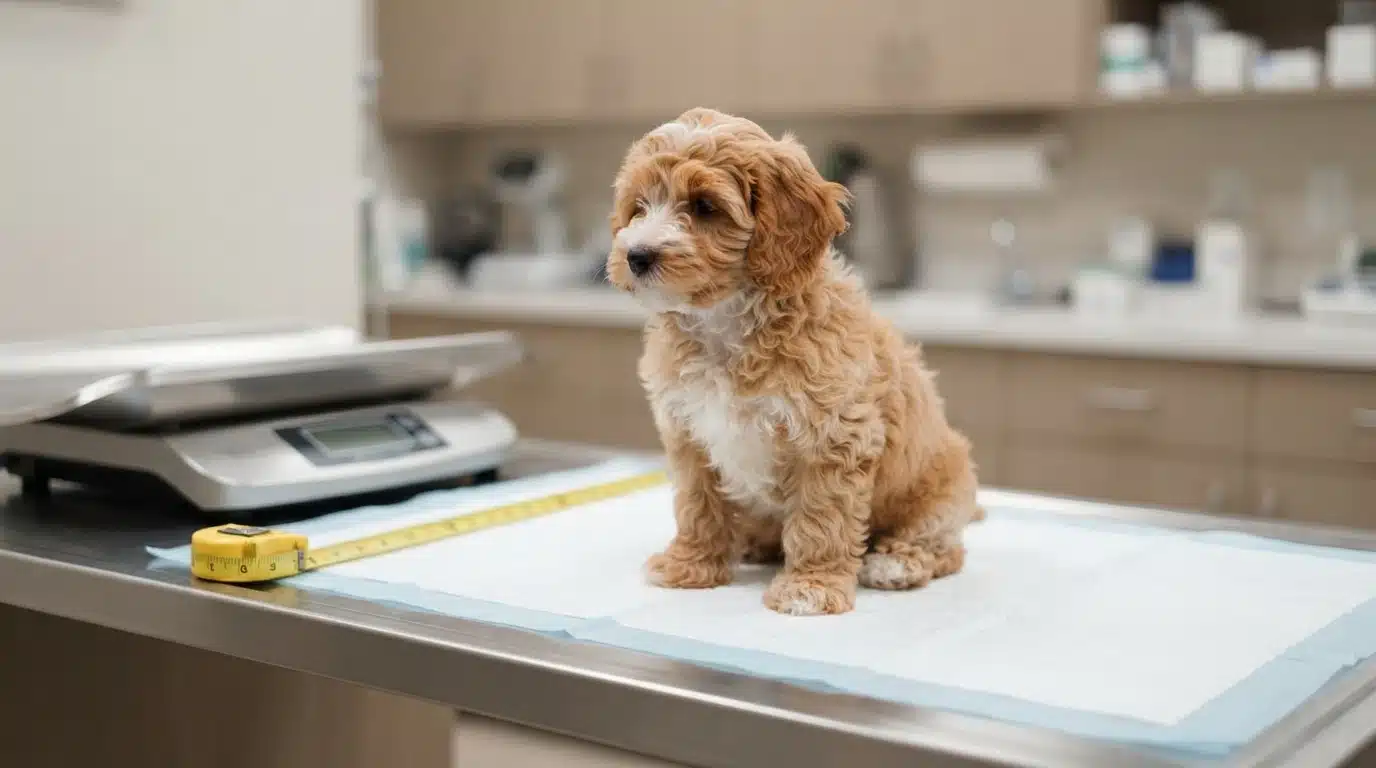
Growth charts give averages. Parents give a better answer. Ask the breeder for the dam’s current weight and the sire’s weight and height, then expect your puppy to fall between them, usually closer to the midpoint. This is standard practice in responsible programs, and it is how we pair litters at Sage Puppies.
Charts assume unrelated dogs of average build. Your puppy’s parents are known, measured dogs. When a chart and the parents disagree, trust the parents.
For a full age-by-age breakdown, the Havapoo puppy size chart by age and breed type shows what to expect at each stage.
Havapoo Size and Growth Chart by Age
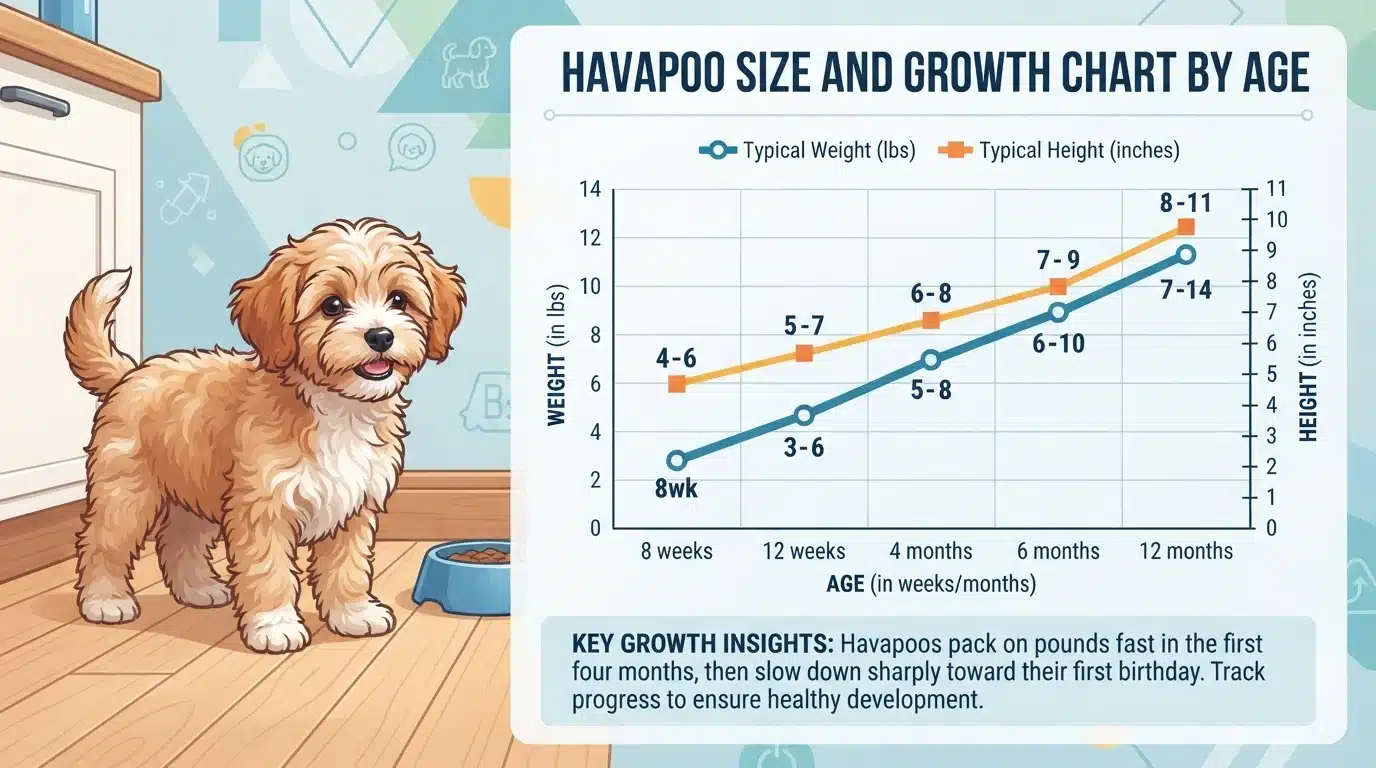
A full-grown Havapoo usually lands between 7 and 15 pounds, and most of that weight arrives in a few short bursts. Growth is not a smooth curve. Puppies pack on pounds fast in the first four months, then slow down sharply as they approach their first birthday. Knowing what happens at each stage helps you spot healthy progress and catch problems early.
| Age | Typical Weight | Typical Height |
|---|---|---|
| 8 weeks | 2 to 4 lbs | 4 to 6 inches |
| 12 weeks | 3 to 6 lbs | 5 to 7 inches |
| 4 months | 5 to 8 lbs | 6 to 8 inches |
| 6 months | 6 to 10 lbs | 7 to 9 inches |
| 12 months | 7 to 14 lbs | 8 to 11 inches |
Newborn to 8 Weeks: The Breeder’s Window
In the first eight weeks, your job is simple: leave the puppy with its mother and breeder. Healthy Havapoo pups are born tiny, often under a pound, and double their birth weight within the first week or two. They gain roughly half an ounce to an ounce per day at first, then settle into steadier gains.
A good breeder weighs each puppy regularly and watches for anyone falling behind the litter. This window matters for far more than size. Puppies learn bite control, handling tolerance, and social basics from their mother and littermates here, which is why responsible breeders keep them until at least eight weeks. When you pick up your puppy, ask for the weekly weights. That record is your baseline for everything that follows.
8 Weeks to 4 Months: The Quick-Growth Phase
This is the fastest growth stretch of your puppy’s life. A puppy that weighed 2 to 4 pounds at eight weeks often reaches 5 to 8 pounds by four months. Expect visible change almost weekly: longer legs, a deeper chest, and a collar that suddenly fits too loose.
Feed a small-breed puppy formula and weigh your pup every two weeks. Weighing at home is easy: step on the scale holding the puppy, then subtract your own weight. Record each number with the date. A healthy curve climbs steadily. A puppy that stops gaining, or gains too fast, deserves a call to your vet. Keep portions measured rather than free-fed, because small breeds gain weight quickly at this stage.
4 to 8 Months: Steady Gain and Body Shape Changes
Growth slows but does not stop. Most Havapoos add 1 to 3 pounds across this stretch, landing around 6 to 10 pounds by six months. Height gains mostly finish here, so the puppy starts to look longer and leggier before it fills out.
Body shape matters more than the scale in this window. Run your hands along your puppy’s ribs: you should feel them under a thin fat layer without pressing hard. Viewed from above, there should be a visible waist. Ribs you can see mean the puppy is too thin; ribs you cannot feel at all mean you should trim portions. Teething also peaks around four to six months, so expect chewing that can affect appetite briefly.
8 to 12 Months: Slowing Toward Adult
By eight months, most of the growing is done. Weight gains taper to a few ounces a month, and the puppy’s frame softens into an adult outline. Most Havapoos reach their adult weight between 9 and 12 months, finishing around 7 to 14 pounds depending on whether a Toy or Miniature Poodle is in the mix.
Small breeds mature faster than large ones, so do not expect a second growth spurt. Switch from puppy food to adult small-breed food near the first birthday, or when your vet agrees growth has finished. Keep weighing monthly. If the number keeps climbing after the frame has stopped changing, the gain is fat, not growth, and portion cuts should start now.
Reading the Chart the Right Way
A growth chart is a starting point, not a verdict. Two dogs from the same litter can weigh a pound apart at four months and both finish perfectly healthy. What matters most is the shape of your puppy’s own curve.
Dated Weight Logs vs Single Checkups
One number on one day tells you very little. Puppies grow in bursts, and a checkup that falls right after a growth spurt can look alarming for no reason. A dated weight log fixes that.
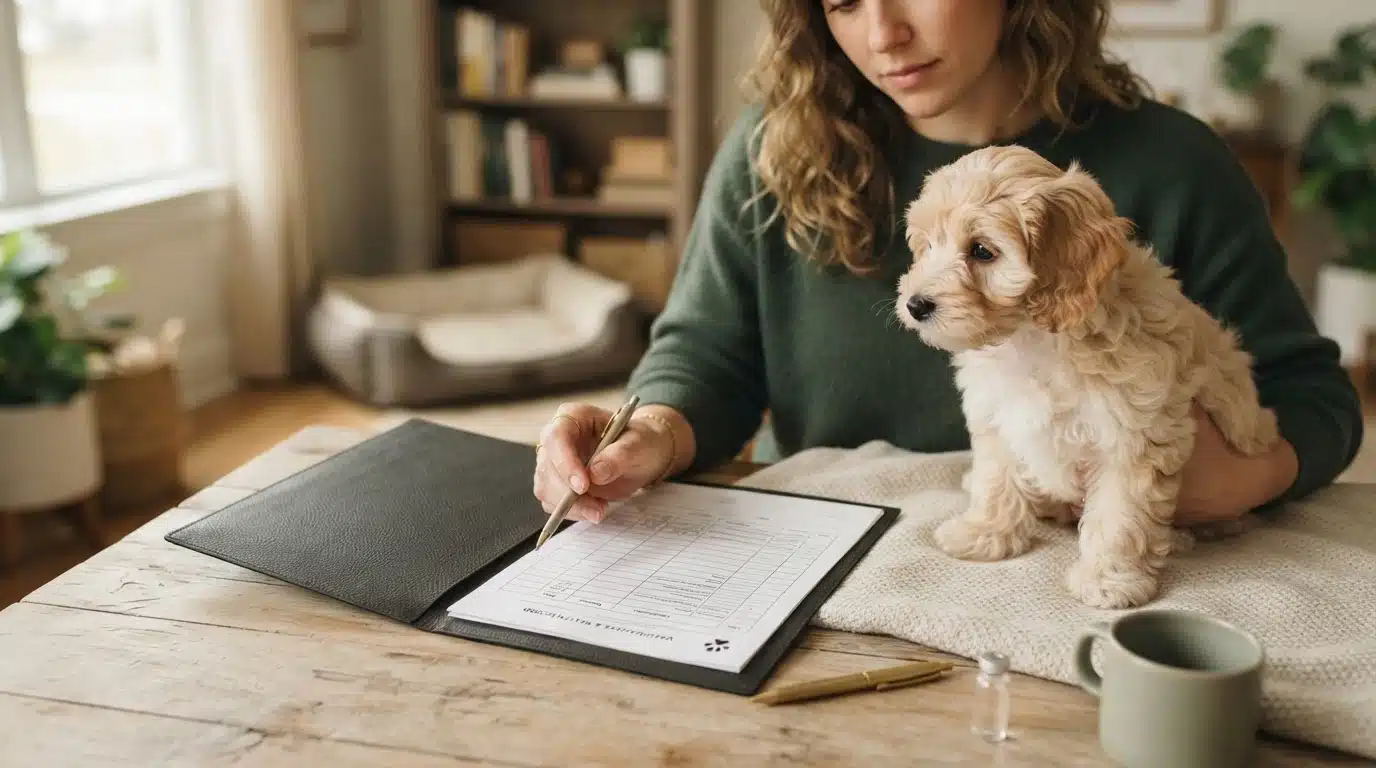
Weigh your puppy weekly at home, on the same scale, and write it down with the date. A bathroom scale works if you hold the puppy and subtract your own weight. After three or four weeks, you will see a pattern instead of a snapshot.
Track your Havapoo against the chart above by trend, not by exact pound. If your 12-week-old sits at 5 pounds when the chart says 3 to 6, that is normal range. If the same puppy doubled in four weeks and keeps climbing, the log has caught something worth discussing.
When a Number Is Worth a Vet Call
Most chart deviations are harmless, but a few patterns deserve a call. Contact your vet if:
- Weight stalls for two or more weeks after four months of steady gains
- Ribs and spine feel sharp with no fat layer at any weight
- Weight climbs fast, leaving your puppy round and sluggish
- Appetite, thirst or energy changes along with the numbers
Rule out worms first; parasites are the most common cause of a puppy that eats well but stays thin. Your first wellness visit is a good time to ask what a healthy curve looks like for your specific dog, and our guide to a Havapoo puppy’s first vet visit covers what to bring.
Body Condition: Why the Scale Can Lie
Pounds only tell you half the story. Two Havapoos can both weigh 9 pounds at eight months, yet one is lean and one is carrying extra fat. A fluffy small breed hides weight well, so vets rely on a body condition score instead of the scale alone. On the standard 9-point scale, 4 to 5 is ideal: ribs you can feel, a visible waist, and a belly that tucks up, as described in VCA Hospitals’ body condition guide.
A Simple Hands-On Check You Can Do at Home
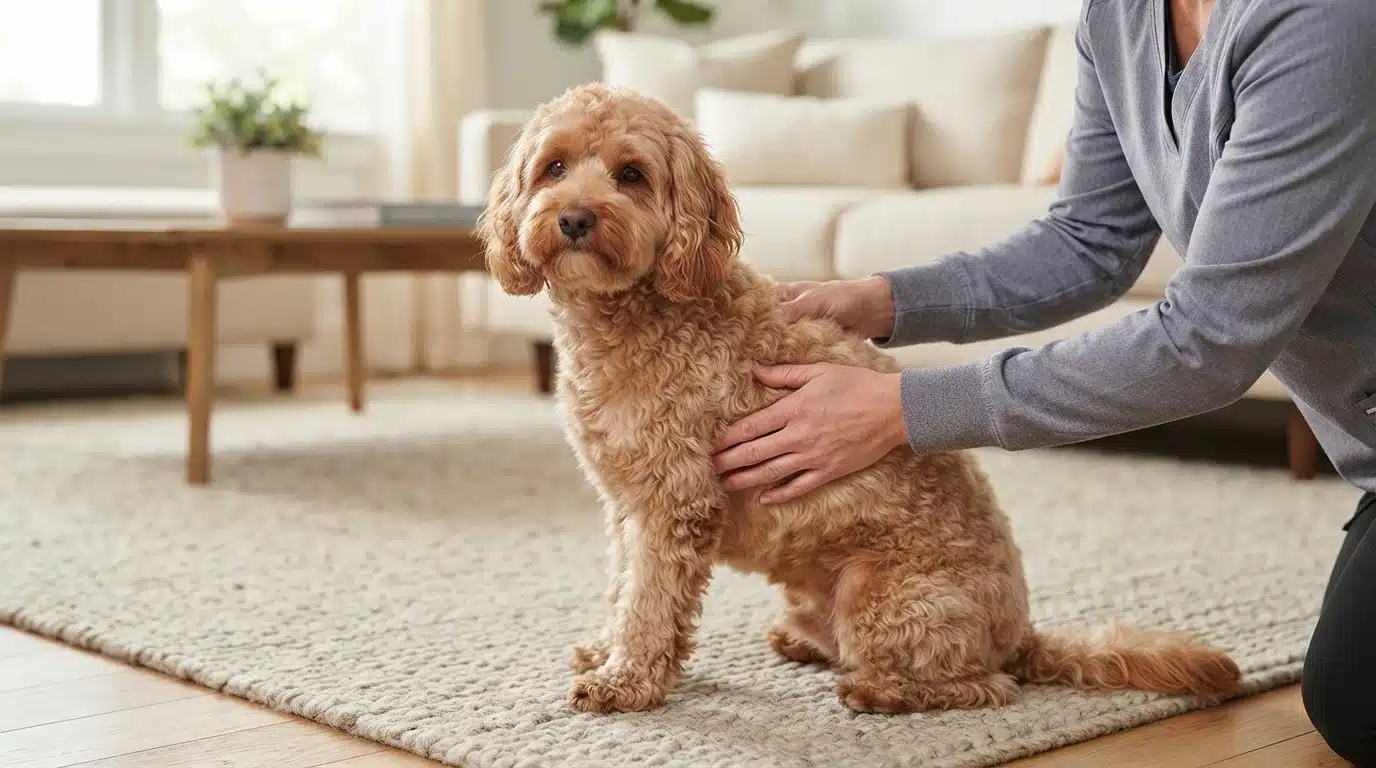
Run your thumbs along the backbone and spread your fingers over the rib cage. You should feel each rib under a thin padding, like the backs of your fingers. Pressing hard to find ribs means too much fat. Seeing them sharply means too little.
Next, look from above. A clear waist behind the ribs is a good sign. Then check the side view: the belly should slope up toward the hips, not hang level. Do this check monthly alongside weigh-ins, and mention anything that changes to your vet.
Coat, Clipping, and How They Distort a Number
That thick Havanese coat adds visual bulk without adding fat, so a freshly clipped dog can suddenly look thin. Scale weight also shifts with a full bladder, a big meal, or a recent haircut, sometimes by half a pound on a 10-pound dog. That is why a growth chart works best with a monthly hands-on check rather than the scale alone, a point worth raising at any Havapoo health questions visit with your vet.
Using the Chart to Plan Equipment and Space
Your puppy’s growth chart doubles as a shopping list. Buy for the adult size the chart predicts, not the puppy in front of you, and you will not replace half your gear at eight months.
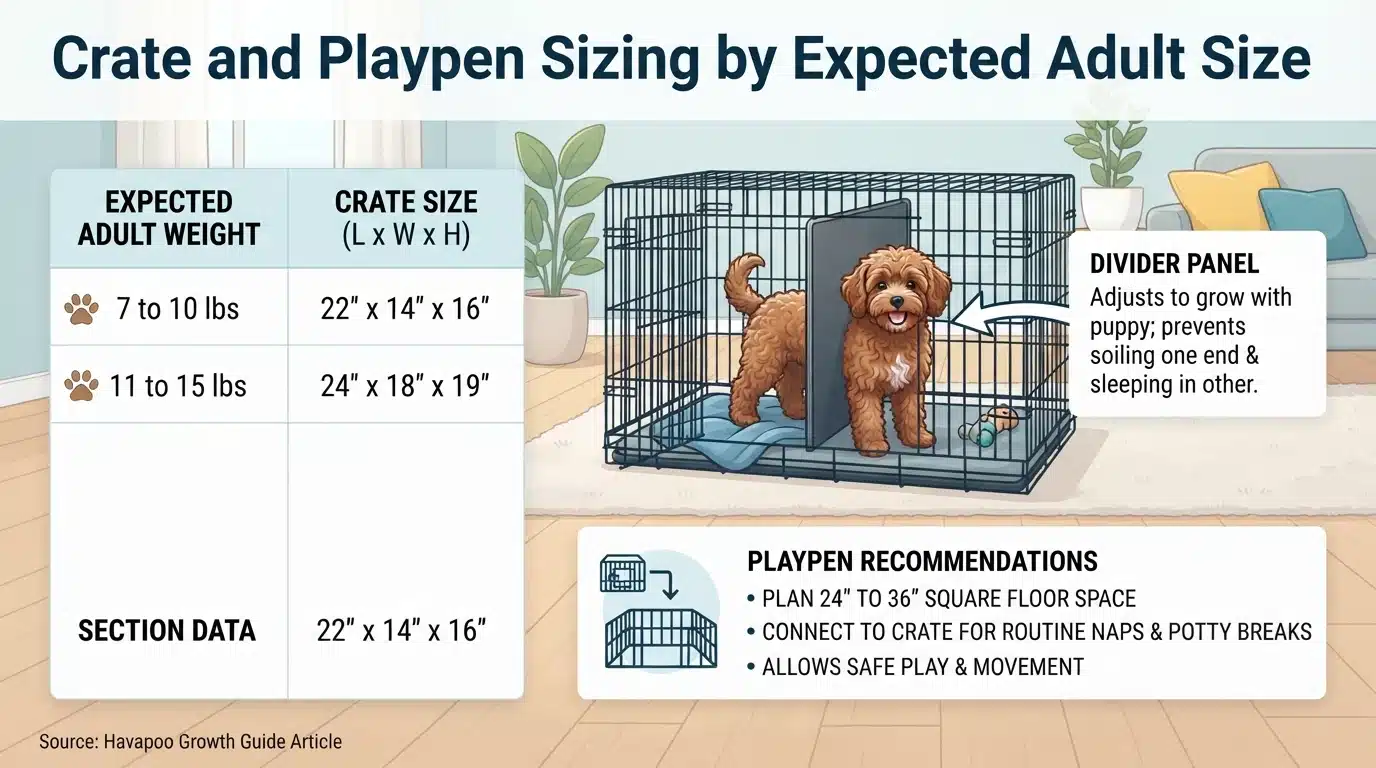
Crate and Playpen Sizing by Expected Adult Size
Crates are sized by length and height, not weight alone. A dog should stand and turn around without touching the sides. According to PetMD’s crate sizing guide, a 22-by-14-by-16-inch crate fits dogs up to roughly 15 pounds, which covers most adult Havapoos.
| Expected Adult Weight | Crate Size (L x W x H) |
|---|---|
| 7 to 10 lbs | 22″ x 14″ x 16″ |
| 11 to 15 lbs | 24″ x 18″ x 19″ |
For a Toy-line puppy projected to finish under 10 pounds, the smaller crate works for life. Mini-line puppies need the larger one by their first birthday. A divider panel lets one crate grow with your puppy, so a young pup cannot soil one end and sleep in the other. For a playpen, plan a 24-to-36-inch square of floor space; connect it to the crate so naps and potty breaks stay routine.
Carrier, Harness, and Travel-Carrier Fit
Harnesses are the one item you cannot buy ahead. At eight weeks, most Havapoo puppies wear an extra-small; by six months, a small. Measure the girth (the widest part of the chest, just behind the front legs) every few weeks during growth spurts, and adjust the straps so you can slide two fingers under the webbing. A harness that fit in March may pinch by May.
For travel, most U.S. airlines cap soft carriers at about 18 by 11 by 11 inches, which suits an adult Havapoo under 12 pounds. Check your specific airline before booking, because limits vary by cabin and aircraft. A carrier sizing chart from PetSmart lists small carriers at roughly 22 inches long and 16 inches tall, roomy enough for a 15-pound Mini-line adult. Add a few pounds of headroom so your dog can shift positions on a long flight, and re-measure near 10 months when growth finishes.
Toy, Mini, and Teacup Labels – What They Actually Mean
Labels vs the Parents Behind Them
Breeders use Toy and Mini to describe which Poodle parent went into the mix, and those labels mean something. A Toy-based Havapoo usually matures around 7 to 14 pounds, while a Mini-based Havapoo lands in the mid-teens. The parent sizes tell you far more than any label on a listing.
Teacup is different. It is not a size class or a breed standard. It is a marketing term for puppies bred to be as tiny as possible, often without regard for health, and vets warn these dogs face higher risks of low blood sugar, fragile bones, and other problems, as covered in PetMD’s guide to teacup dogs.
If a price climbs purely because a puppy is the smallest in the litter, treat that as a red flag rather than a bargain in disguise. Ask which Poodle line the parents are and what they weigh. Honest answers beat clever labels every time.
How Sage Puppies Tracks and Shares Growth
What to Look for in an Individual Puppy Profile
A breed chart gives you the range. An individual puppy’s record tells you where your dog actually sits within it, so weigh the profile itself before you reserve.
Look for dated weights rather than a single birth weight, ideally taken at eight and twelve weeks. Ask whether the dam’s weight and the sire’s lineage (Toy or Miniature Poodle) are listed, because that pairing drives adult size. Consistency matters too: numbers that jump wildly between dates deserve a question.
At Sage Puppies, Cassie keeps litter records current as puppies grow, so families comparing puppies can match each one against the tables above instead of guessing. Bring any profile you receive to your first vet visit and ask the clinic to confirm the scale readings.

Want a Havapoo whose adult size you can plan for? Sage Puppies pairs each puppy with its parents’ weights, so you can estimate growth before you commit. See available litters and start your application at Sage Puppies. Wisely Bred. Beautifully Loved.
Frequently Asked Questions
Q1: havapoo size and growth chart by age
A Havapoo grows fastest before four months, reaches 6 to 10 pounds by six months, and finishes between 7 and 14 pounds around 9 to 12 months, depending on whether the Poodle parent is a Toy or a Miniature.
Q2: How do I predict my Havapoo puppy’s adult weight?
Ask for the dam’s weight and the sire’s weight and lineage, then expect your puppy to land between them, usually near the midpoint. Parents predict better than any chart.
Q3: Is my Havapoo underweight or just small?
Feel the ribs. You should find them under a thin fat layer without pressing. Sharp ribs mean too thin; ribs you cannot feel mean trim portions.
Q4: When is a Havapoo fully grown?
Most reach adult height by eight months and adult weight between 9 and 12 months. Small breeds rarely have a second spurt after that.
Q5: How much should I feed during growth spurts?
Use measured portions of small-breed puppy formula rather than free feeding. Fast growth plus constant food access causes excess gain, which small breeds hide well.
Q6: What crate size fits an adult Havapoo?
A 22-by-14-by-16-inch crate suits Toy-line dogs under 10 pounds. Mini-line puppies landing in the mid-teens need roughly 24 by 18 by 19 inches. A divider panel helps one crate grow with your puppy.
Conclusion
A Havapoo growth chart works best when you read it against the puppy’s own parents. Which Poodle line sits behind the litter, Toy or Miniature, sets the adult range of roughly 7 to 15 pounds, and the dam’s and sire’s actual weights narrow that prediction further than any table can. Weigh weekly, log dates, and judge the trend rather than a single number. Pair the scale with a monthly hands-on check, because ribs and waist reveal what pounds hide. Then use the adult projection to size a crate, harness, and carrier once instead of twice. Know the line, track the curve, and your puppy’s size holds few surprises.