Quick Summary: A breeder’s health packet is evidence, not a promise, so sort it into the puppy’s care record, each parent’s clinical screenings, full DNA reports, and contract paperwork. A CHIC number only confirms required tests were completed and published, while a DNA “clear” result covers only the variants tested. Prioritize current eye and patella exams, check hip grades from OFA, and verify each parent’s registered name and results directly in OFA before buying.
Two families can get the same five-page packet from a Havapoo breeder and walk away with totally different levels of confidence. One family notices that the certificate on page two describes the grandmother’s knees at fourteen months, and that the DNA panel on page four says only “no variant detected” for the conditions it covered. The other family skims past both.
That gap is the whole problem with Havapoo breeder health records. The paperwork is there, but almost nobody teaches first-time owners what the lines actually mean, what a CHIC number proves, and what a clean result quietly leaves out.
This guide walks through a real packet page by page. You will learn to separate the puppy’s own care record from each parent’s screening results, decode DNA terms like variant and clear by parentage, and verify breeder numbers yourself against the Havanese Club of America’s current requirements, so you can judge any Havapoo breeder health records packet on evidence instead of a feeling.
Step 1: Sort the Packet Into Four Kinds of Documents
Most havapoo breeder health records arrive as a folder of mixed pages, so the first task is sorting. Everything in the packet falls into one of four groups: the puppy’s own record, each parent’s clinical screening, DNA variant reports, and paperwork. Each group answers a different question, and each has its own limits.
The Puppy’s Own Exam and Care Record
This covers what has already happened to your puppy: the vet exam date, weight, deworming dates, and which vaccines were given. Read it for completeness, not for promises. A record showing two vaccine entries means little unless you can see the product name and the puppy’s age at the time. Ask which vet performed the exam, because a breeder’s own notes are not the same as a licensed exam.

Each Parent’s Clinical Screening
These are exam results from a veterinary specialist, most often an ophthalmologist or cardiologist. A parent’s eye or heart result tells you about that dog on that day. It does not guarantee the parent will stay clear, and it says nothing about traits a physical exam cannot see. Match every screening page to a named parent and check that the names match across the whole packet.
DNA Variant Reports
A DNA report lists specific gene variants each parent carries or lacks. This is the one document that can predict risk, because it tests inherited variants rather than current health. But a panel only covers the variants on it. A “clear” result means clear for those variants, nothing more. Breeders who test both parents can show you puppy-level results too, which is the standard Sage Puppies follows with documented parent testing.
Administrative and Contract Documents
The last group includes registration papers, microchip details, the sales contract, and any health terms. These pages tell you who is responsible for what. Read the contract before pickup day, and keep your copy with the medical records so the whole packet stays together.
Step 2: Decode the Tests That Carry the Most Weight for Havapoo
DNA results get the attention, but the hands-on clinical screenings tell you more about how a puppy will actually move and see. The Havanese side of a Havapoo carries the strongest testing tradition, so the Havanese Club of America’s health statement is a useful yardstick for any breeder’s paperwork. Focus on three records: hips, patellas, and eyes.
Hips and Patellas: Two Separate Reports
These are not one test. Hips are X-rayed and graded by the Orthopedic Foundation for Animals (OFA), usually at age two or later, because joints keep developing before then. Grades run from Excellent down through Good and Fair, then into dysplastic ranges. For a small breed like a Havapoo, a parent with Fair hips is workable for many families, but you want to see the actual grade, not just “OFA hips done.”
Patellas are different. The kneecap exam is a quick manual check a veterinarian performs, and it is graded from normal down to grade 4 luxation. Patellar luxation is one of the most common small-dog joint problems, so this score matters more for a Havapoo than hip grade does. Because a patella can shift over a dog’s life, the exam should repeat through the parent’s breeding years.
Ask for the parent’s OFA number for each test. You can type that number into OFA.org and read the result yourself.
One more wrinkle: some breeders use PennHIP instead of OFA for hips. That is a legitimate method, but it reports a distraction index rather than a grade, so the numbers will not look familiar.
Eye Examinations and the Annual Question
Eye exams come from a board-certified ophthalmologist under the CAER program, which replaced the older CERF exams. The report lists each eye condition found, and a normal result means no inherited eye disease was seen that day.
The key word is day. The Havanese health testing guide notes that OFA eye certification is one of the breed’s core tests, and responsible programs repeat it annually because some eye diseases appear later in life. So when you read a breeder’s records, check the date. A single eye exam from four years ago is a red flag. Current year paperwork is what you want.
What a CHIC Number Actually Confirms
A CHIC number from OFA means the dog completed a breed club’s required test list. That is all it means. It is not a clean bill of health, and it does not require passing grades, only that the tests were done and results were published. For Havanese, the three core requirements are CAER eyes, hips, and patellas, according to the breed club itself.
Read it as proof of transparency, not proof of health. A CHIC-numbered parent with published Fair hips is a more honest record than an unnumbered dog claimed to be “fully tested.” Look up the number and read every result yourself.
Step 3: Read a DNA Panel Without Overreading It
A DNA panel is the easiest part of a health record to misread. Most breeders use tests like Embark, which screens for more than 270 genetic health conditions with a cheek swab. The results come back with three labels, and each one means something different from what families often assume.
Clear, Carrier, and At-Risk, Translated
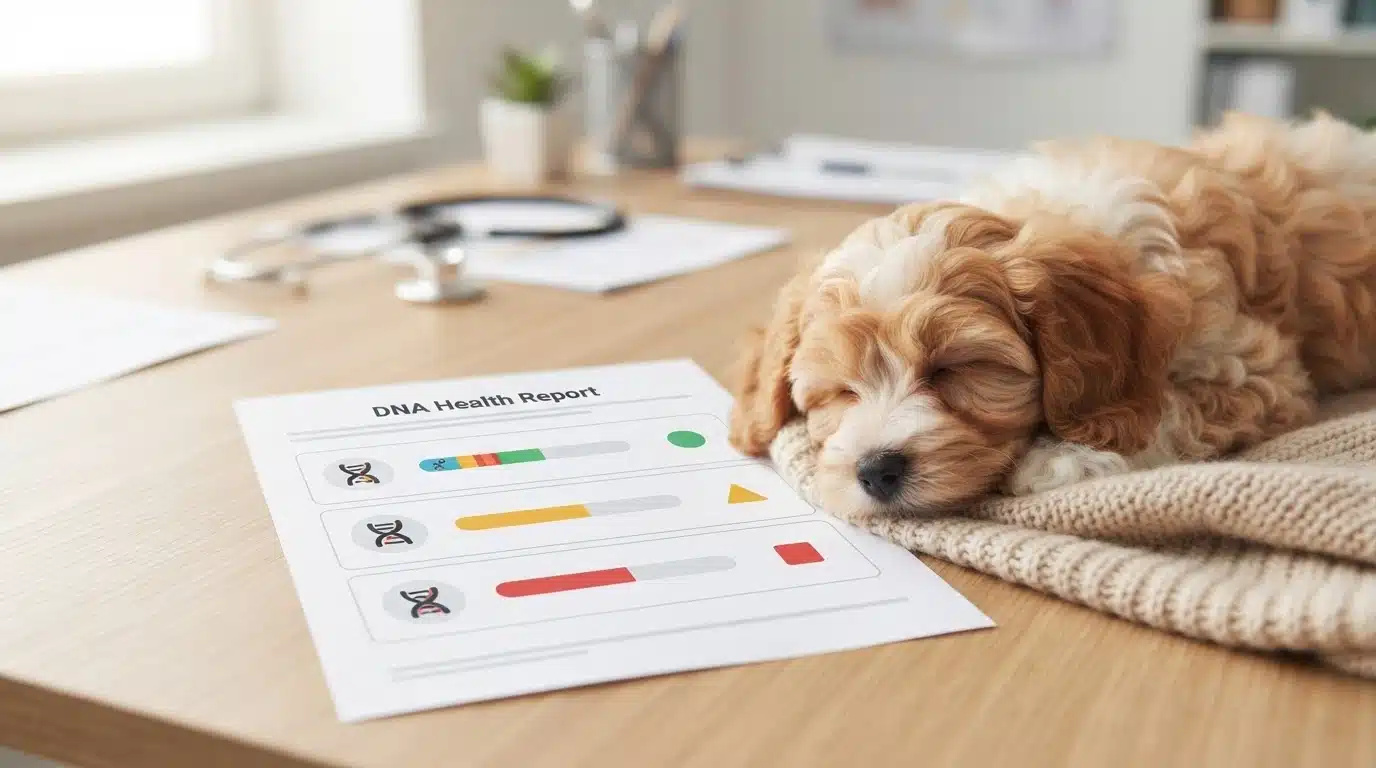
Clear means the dog carries no copies of the variant linked to that condition. Carrier means one copy, usually harmless to the dog itself but relevant if bred to another carrier. At-risk means the dog carries the variant pattern tied to the condition, and per Embark’s own explanation, at-risk is not a diagnosis, only an indicator of elevated risk.
The overread works both ways. A puppy from two carrier parents is not doomed, and “clear” on a panel is not a clean bill of health. It only covers the variants on that test.
Ask Which Conditions Were on the Panel
Not every panel checks the same things, so the number of results means little without the list. For Havapoo puppies, the conditions that matter most are ones common in Havanese and Poodles, such as cardiac issues and patellar luxation, which no DNA test catches. Ask the breeder for the full condition list, not just a summary, and match it against what your vet would screen for. Cornell’s canine health center notes that some dogs show as “clear by parentage,” which means the parents were tested instead of the puppy. That is valid evidence, but you should still see the parents’ actual reports. A good breeder, whether you are comparing programs in Utah or across the country, hands these over without being asked twice.
Where DNA Reports Stop Short
DNA panels cover inherited variants only. They cannot see heart murmurs, kneecaps, eyes, or hips, which is why physical exams still carry so much weight in the record. Treat the panel as one layer of evidence, never the whole picture.
Step 4: Verify the Numbers Yourself
Papers can be copied. Screenshots can be edited. So the last step is to check the breeder’s claims in the public databases where the results live. This takes about ten minutes and it is the part most buyers skip.

Run the Search Before You Fall in Love With a Litter
The Orthopedic Foundation for Animals keeps a free database of health results for millions of dogs. Use the OFA Advanced Search page and enter the parent’s registered name, part of the name, or the kennel name. Exact spelling matters, so ask the breeder to write the names down exactly as registered.
What you want to see:
- Each parent listed with pass results for the tests that fit the breed mix
- A CHIC number on dogs whose breed requires one, which shows required tests were completed and results shared publicly
- Patella and eye entries with dates, since these exams renew over the dog’s life
Results can also appear through labs that submit directly, as the UC Davis VGL explains, so a missing OFA entry is not always a red flag on its own.
When a Result Is Not Public
Some results never reach a public database. DNA panels like Embark often live in the breeder’s own report, not on OFA. In that case, ask for a full report PDF, not a summary. Check that the report shows:
- The tested dog’s registered name, not just “mom” or “dad”
- Dates and a report or registration number
- A clear result for each condition, such as clear or carrier
One common buyer concern is a breeder borrowing another dog’s clean record. Matching the registered name, birth date and kennel name across papers and databases closes that gap. Our guide on verifying a breeder’s health testing walks through the same checks in more detail.
Questions to Take With You
Bring these to any breeder conversation:
- What are each parent’s registered names, so I can look them up myself?
- Which tests were done, and when?
- Can I see the full DNA report, not a summary?
- Does either parent carry a variant relevant to this mix?
A breeder who answers easily and welcomes the lookup is telling you something important before you ever meet the puppies.
Step 5: Know Which Findings Deserve a Second Conversation
Most records you review will look clean. The real skill is spotting the handful of details that warrant a calm follow-up question before you commit. A good breeder expects these questions and answers them easily.
Gaps and Vague Substitutes
The clearest signal is something missing. The OFA database only lists dogs that were screened, so a parent with no listing means one of two things: the testing never happened, or the results were not normal. Both deserve a direct question.
Watch for vague substitutes, too. Phrases like “vet checked,” “healthy lines,” or “parents are on site” sound reassuring but replace actual screening rather than support it. A wellness exam on an eight-week-old puppy tells you nothing about the parents’ hips, knees, hearts, or eyes.
Also ask about timing. Eye exams expire yearly, and patella and cardiac clearances should be current. A certificate from seven years ago is not a current result.
Ask one simple question: “Can you point me to both parents in the OFA database?” A straightforward yes or no tells you a lot.
Results That Contradict Each Other
Contradictions matter as much as gaps. If the breeder’s paperwork says both parents are clear, but the database shows one parent with a carrier result, stop and ask why. Carriers can be bred responsibly to clear partners, so the result itself may be fine. The problem is a story that does not match the record.
The same applies to mixed details: aDNA report showing an at-risk result that the breeder never mentioned, a kneecap grade that differs between documents, or a CHIC number listed for a dog with incomplete testing. Any one of these justifies a second conversation before you move forward.

Reading a health record well is a skill, and you now have it. If you want puppies whose paperwork is as careful as their care, explore Sage Puppies. Cassie’s Havanese and Havapoo program in South Jordan, Utah, offers local pickup and nationwide delivery, and every match starts with a clear application.
Frequently Asked Questions
Q1: How do I read a Havapoo breeder’s health records?
Sort the packet into four groups: the puppy’s care record, each parent’s clinical screenings, DNA reports, and paperwork. Then verify parent names and results yourself in the OFA database.
Q2: What does a CHIC number actually prove?
Only that a dog completed its breed club’s required test list and results were published. It does not require passing grades, so read every result, not just the number.
Q3: How current should a parent’s eye exam be?
Eye certifications expire yearly because some inherited eye diseases appear later in life. Look for a CAER exam dated within the current or past year.
Q4: Is “clear by parentage” on a DNA report acceptable?
Yes, if both parents were tested and you can see their full reports. Ask for the complete PDFs, not summaries.
Q5: Why does patellar luxation matter more than hip grades for Havapoos?
Small breeds develop loose kneecaps often, and no DNA test catches it. Look for a recent, graded patella exam on each parent.
Q6: What red flags should I watch for in a packet?
Missing OFA entries, vague phrases like “vet checked,” outdated exam dates, and results that contradict the breeder’s story all deserve a direct follow-up question.
Conclusion
A breeder’s health record is a set of clues, not a promise. Sort the packet into the puppy’s care record, each parent’s clinical screenings, DNA reports, and paperwork. Then read the results for what they are: a CHIC number proves testing happened, not passing grades, and a DNA “clear” only covers the variants on that panel.
Date checks matter as much as results. Eye exams renew yearly, patella screenings should be current, and hips graded at two or older carry more weight than early X-rays.
Finally, verify everything yourself in the OFA database using each parent’s registered name. Ten minutes of looking replaces pages of reassurance, and a breeder who welcomes the lookup is the one worth trusting.