Quick Summary: Havapoo adult size varies with actual parentage, parent sizes and individual growth. Use the age chart below to track measured weight and questions for your vet, not as a fixed Havapoo weight standard. Generic multiplication formulas are rough estimates. Ask Cassie about the specific puppy and parents; a shared chart cannot promise adult size.

Littermates can grow into different-sized adults. Start with actual parent information and track the individual puppy, especially when size matters for housing, handling or travel.
This guide explains what an age chart can tell you, how Poodle ancestry changes the questions to ask, and why a generation label or calculator cannot promise an exact adult size.
Sage Puppies offers Havapoo, Havanese and Cavapoo puppies from South Jordan, Utah. Ask about actual parents, current measurements and the basis for the specific puppy’s size estimate.
Havapoo Growth Chart by Age: What to Record
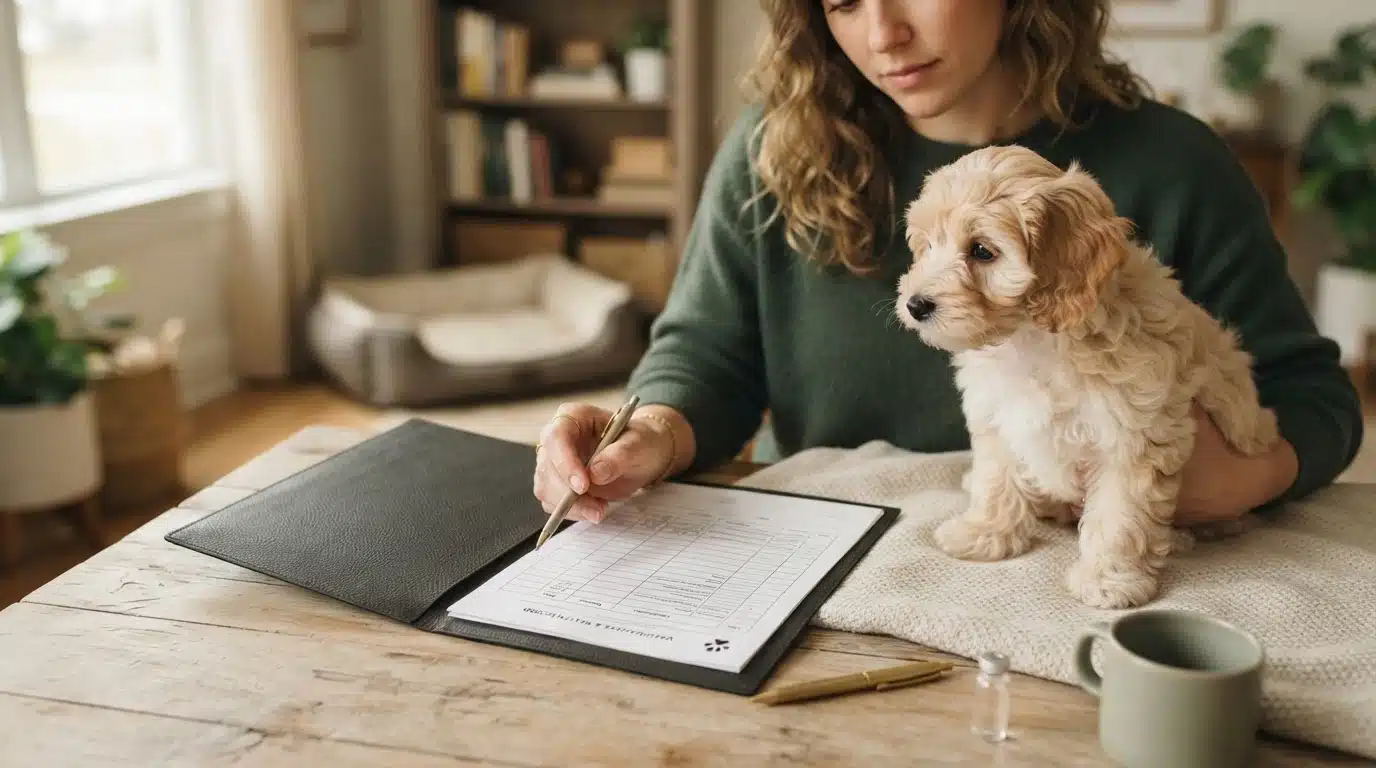
Use this chart as a growth record. Enter measured weights rather than treating a monthly range as a requirement. Healthy growth and adult maturity need individual assessment.
| Age | Record for Your Puppy | Ask at the Next Checkup |
|---|---|---|
| 8 weeks | Birthdate and actual weight, with units | What is known about both parents and growth so far? |
| 12 weeks | Current weight and earlier readings | Is the trend appropriate for this puppy? |
| 4 months | Weight and current body condition | How uncertain is the adult-size estimate? |
| 6 months | Weight trend and equipment fit | Does the individual care plan need adjusting? |
| 9 months | Current measurements and condition | Is this puppy still growing? |
| 12 months | Weight and the vet’s maturity assessment | What adult condition and care are appropriate? |
Wisdom Panel’s veterinary-reviewed size guide rates generic formulas as low accuracy and discusses breed and parentage as additional clues. The chart above is a tracking worksheet, not a validated Havapoo growth standard.
First 12 Weeks: The Weekly Window Most Buyers Track
Ask for the puppy’s birthdate, dated measurements and available parent information. Keep weight units and weighing conditions consistent so later readings are comparable.
Early weight is one data point. It cannot establish adult size or show by itself whether growth is healthy. Review the trend and body condition with your vet.
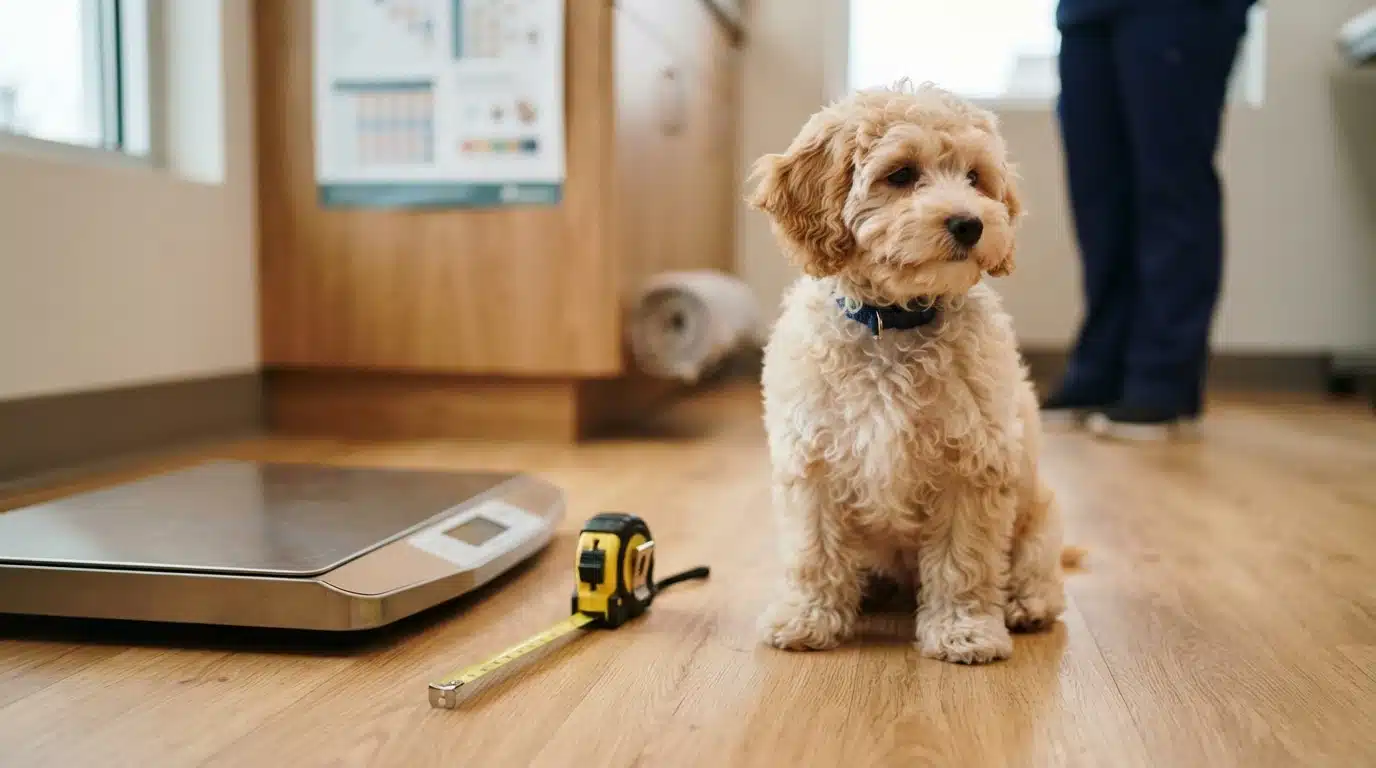
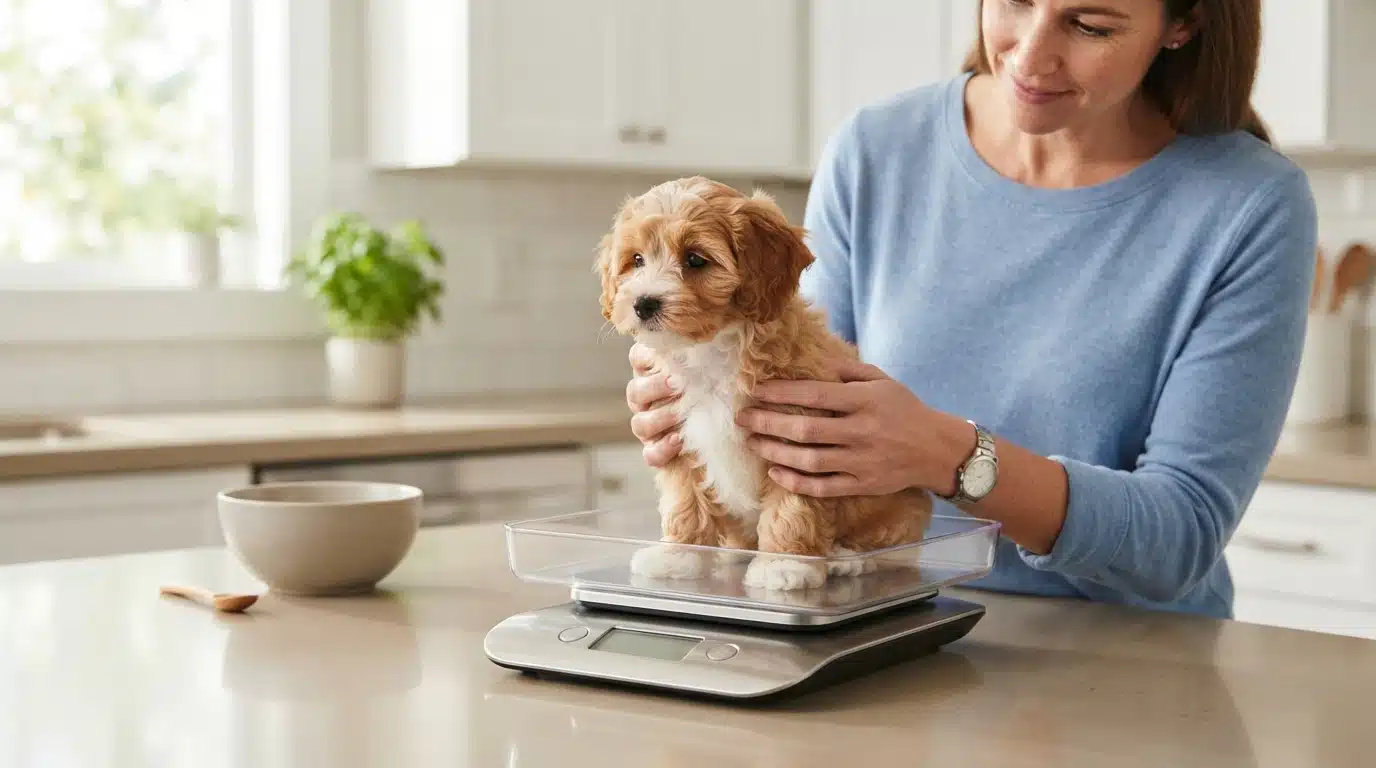
Use a suitable scale and record the date, weight and units under consistent conditions. Share the record at veterinary appointments rather than forcing growth to fit a prediction.
Months 3 to 6: The Fast-Growth Phase
Growth pace varies. Keep dated readings and note changes in appetite, energy and body condition. A fixed pound-per-month rule is not established for Havapoos.
Use a complete puppy diet and an individual feeding plan. Sydney Animal Hospitals cautions against changing food quantities solely because of a calculator result. Ask your vet about unexplained weight changes.
Months 6 to 12: Slowing Down and Filling Out
Continue weighing and checking equipment fit. A single month cannot establish adult height or tell you to stop monitoring growth.
Discuss maturity with your vet. Growth and body condition vary; a birthday alone does not confirm that every Havapoo has reached its final weight.
Both parent lines matter. Parent size supplies context; neither parent’s weight is a guaranteed upper limit for every mixed-breed puppy.
Toy Poodle Parent: Ask About the Actual Pairing
Toy Poodle ancestry does not establish a fixed Havapoo weight band. Ask for that parent’s actual adult measurements and those of the Havanese parent.
Check the dog’s actual length and height, the carrier’s usable dimensions and the transport provider’s current rules. A weight estimate alone cannot guarantee carrier or airline acceptance.
Ask what is documented about the parent dogs and pairing. Have a veterinarian interpret health or breeding concerns rather than relying on size labels.
Miniature Poodle Parent: Size Is Context, Not a Promise
Miniature Poodle ancestry can inform an estimate, but actual parents and individual growth matter. The label alone does not establish a fixed adult Havapoo range.
A larger frame does not make rough handling safe. All dogs need gentle interaction and active adult supervision around children. Our Havapoo and Cavapoo comparison offers related questions.
Standard Poodle Parent: When Havapoos Get Larger
If Standard Poodle ancestry is reported, ask for the actual pedigree and both parents’ adult measurements. Confirm what the breeder means before relying on a small-companion expectation.
Ask directly about the Poodle variety, parent measurements and evidence behind the size estimate. A general label does not substitute for these facts.
F1 vs F1b vs F2: How Generation Changes Havapoo Size
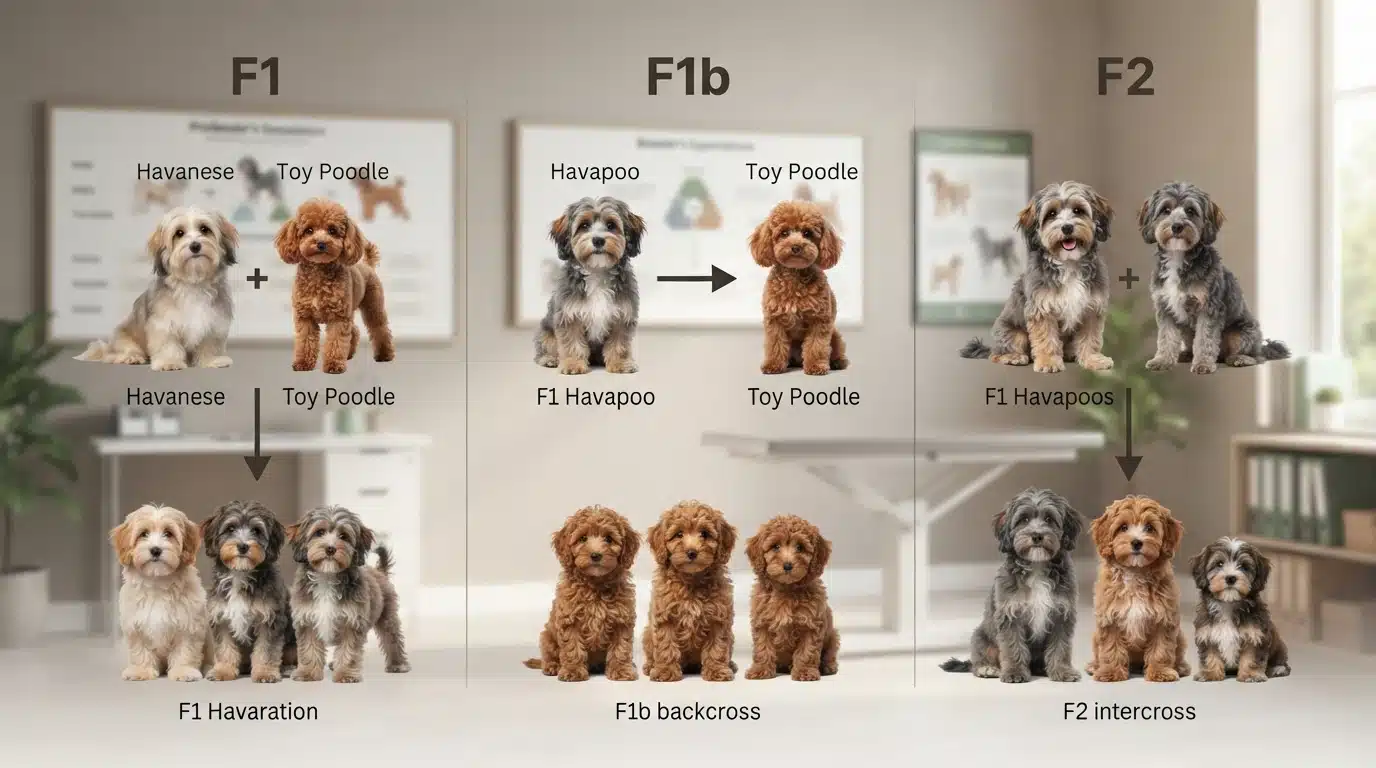
Generation labels describe a pairing. They do not establish a guaranteed adult weight, coat or temperament.
F1 Havapoo: The 50/50 Cross
F1 generally describes a first cross between a Havanese and a Poodle. Confirm the actual parents. An expected adult size remains an individual estimate.
F1b Havapoo: Skewed Toward the Poodle Side
F1b describes a backcross, often to a Poodle; ask which parent breed was used. It does not guarantee adult weight, curl pattern or allergy suitability.
F2 Havapoo: The Widest Variance
F2 generally describes offspring of two first-cross Havapoos. Ask what is documented about the parents and comparable adult relatives. The label does not supply an exact forecast.
Adult Weight Formulas: Rough Estimates
Treat formulas as uncertain planning estimates alongside parent information and growth records. They cannot establish a healthy target weight or guarantee mature size.
The Generic Eight-Week Estimate
Sydney Animal Hospitals’ generic small-breed example multiplies eight-week weight by three. For illustration, 3 lb × 3 gives 9 lb. This is arithmetic based on a broad rule, not a measured Havapoo prediction. The source warns that calculators cannot capture every puppy’s variation.
Double the 16-Week Weight
Wisdom Panel describes doubling four-month weight but rates formulas as low accuracy. A 7 lb puppy yields a 14 lb estimate. Growth rates differ, so review the estimate with your veterinarian.
Use Parent Information Alongside the Growth Record
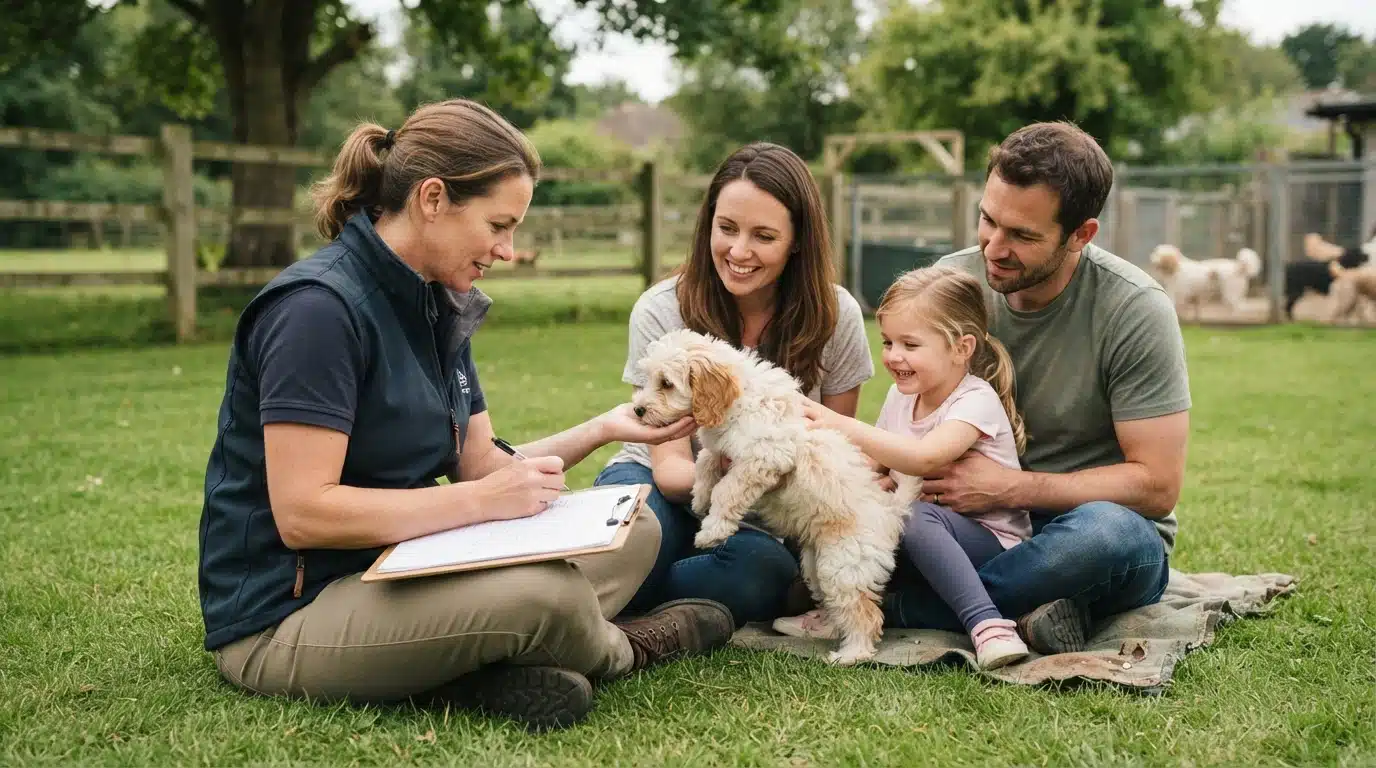
Ask for both parents’ adult measurements and any documented relatives from comparable pairings. Ask Cassie what is available for the specific Sage puppy.
A useful estimate explains its evidence and uncertainty. Bring these questions to your breeder conversation:
- How much did the sire and dam weigh at maturity? Actual weights, not adjectives.
- Was the Poodle parent a Toy or a Miniature, and how tall?
- Is this litter F1 or F1b, and what did previous litters from the same pairing weigh at one year?
- What did this specific puppy weigh at 6 and 8 weeks?
- May I see photos of adult siblings from past litters?
Ask which details are known, estimated or unavailable. Check the Available Puppies page for current listings, and confirm the individual puppy’s measurements and status with Cassie.
Red Flags When a Breeder Quotes a Size
Vague answers deserve caution. Watch for:
- “Small, around 10 pounds” with no parent weights to back it up
- A promise of an exact adult weight, like “she’ll be exactly 8 pounds”
- Refusal to share the Poodle parent’s size or generation
- Quotes based on the runt or the biggest puppy alone
Record answers and dates. An exact adult-weight guarantee deserves caution even when parents’ weights are known.
Matching Adult Size to Your Home, Family, and Routine
Consider possible adult dimensions, daily needs and your household’s capacity. Size is one part of fit, not a substitute for temperament or supervision.
Compact Homes and Travel
Confirm housing rules and current travel or carrier requirements. Ask about actual parents and the puppy rather than choosing from a weight band. Our small-breed puppy guide offers related questions.
Family Homes With Children
AVMA’s dog-bite prevention guidance supports gentle interaction and supervision. No Havapoo weight band establishes tolerance of rough play. Provide a quiet retreat and separate children and dogs when an adult cannot actively supervise.
Active and Outdoor-Minded Homes
Discuss appropriate activity with your vet and assess the individual dog’s comfort and conditioning. A heavier puppy does not automatically have more stamina or readiness for long hikes.
Common Mistakes When Reading a Havapoo Size Chart
A size chart is a guide, not a guarantee. These slip-ups cause the most worry:
- Reading one point instead of the trend. Keep dated measurements.
- Using a parent label as an exact forecast. Ask for actual measurements.
- Expecting littermates to match. Assess each puppy individually.
- Treating a formula as a feeding target. Do not force growth to fit a prediction.
- Ignoring body condition. Ask your vet to assess healthy growth.
Wisdom Panel’s discussion of parentage is additional context, not a guarantee. Review estimates alongside the puppy’s actual measurements and veterinary assessment.

Check current available puppies and ask Cassie about the specific puppy and parents. Use the application for owner-managed next steps when the timing and fit are right.
Frequently Asked Questions
Q1: How big do Havapoo puppies get at full grown?
Adult size varies with actual parentage and growth. Ask for a supported range for this puppy rather than treating Toy, Miniature or generation labels as fixed Havapoo weight bands.
Q2: What is the average weight of a Havapoo by month?
This guide does not establish a Havapoo-specific monthly weight standard. Use the chart to record actual readings and discuss the trend and body condition with your vet.
Q3: How fast does a Havapoo puppy grow in the first year?
Growth rates vary. Keep a dated record and ask your vet when this puppy is approaching adult size.
Q4: Can you tell a puppy’s adult size at 8 weeks?
Only approximately. Generic calculators have substantial uncertainty. Add parent information and later measurements; never change feeding simply to match a prediction.
Q5: Do male and female Havapoos differ in size?
Sex can be one clue, but does not establish an exact weight difference for Havapoos. Actual parent information and growth are more useful than a fixed pound allowance.
Q6: Is an F1 or F1b Havapoo more predictable in size?
Neither label guarantees more predictable adult size. Confirm the actual pairing and ask what supports the specific puppy’s estimate.
Conclusion
Use parent information, a dated growth record and veterinary advice to plan. Treat generation labels and formulas as context with uncertainty. Check equipment against actual dimensions and assess children, activity and travel needs separately from weight.