
A vet inspection paper can feel reassuring, but it is not a promise. Wisconsin DATCP explains that health certificate puppies have had a recent exam, not protection from every future or genetic issue.
Families searching puppies Wisconsin near me need more than a listing and a certificate. They need clear answers about parent testing, home care, records, and help after pickup. Wisconsin puppy laws set basic rules, yet strong breeders often do more.
This review gives you a practical way to assess any puppy seller Wisconsin families consider. You will learn what to request, how to spot gaps in health claims, and what buyer support should look like before the first vet visit. Use it while comparing puppies Wisconsin near me options and Wisconsin puppy laws.
What Wisconsin Puppy Buyers Should Verify Before They Reserve
Local distance is not the same as buyer protection
A nearby listing can feel safer, but location alone does not prove careful breeding or strong support. Search puppies Wisconsin near me, then verify the seller before sending a deposit.
Wisconsin licenses many higher-volume sellers, yet smaller breeders may not need a license. Ask how the puppy was raised, meet by video or in person, and confirm who will guide you after pickup.
Wisconsin requires licensed sellers to provide a veterinary health certificate, but it is not a health warranty, according to DATCP consumer guidance.
A prompt, clear answer is good. A seller who avoids basic records is not.
The five documents and answers worth requesting
Request these before reserving:
- Parent health-test proof and the exact tests completed.
- Puppy veterinary record, including vaccines, deworming, and exam date.
- Certificate of veterinary inspection for the puppy. It shows recent exam status, not lifelong health.
- Written agreement stating deposit terms, health support, and return options.
- Early-care plan: socialization, food, sleep routine, pickup or delivery, and first-vet-visit guidance.
| Ask | Strong answer |
|---|---|
| Can I see the parents’ results? | Clear records tied to each parent |
| What happens after pickup? | Written support and a first-week plan |
Licensed Wisconsin sellers cannot transfer puppies before seven weeks, under state rules.
Also Read: 10 Adorable Havapoo Colors You Need to See (2026)
Wisconsin Puppy Laws: Licensing, Age, and Health Certificates
Who must be licensed in Wisconsin
A Wisconsin seller is not automatically licensed just because they breed puppies. State licensing applies to breeders or breeding facilities that sell 25 or more dogs per licensing year from more than three litters. It also covers certain dealers, larger rescues, shelters, and out-of-state dealers importing 25 or more dogs into Wisconsin.
| Seller type | When Wisconsin licensing applies |
|---|---|
| Breeder or breeding facility | 25+ dogs sold from more than 3 litters |
| In-state dealer | 25+ dogs sold that they did not breed |
| Out-of-state dealer | 25+ dogs imported into Wisconsin |
| Shelter or rescue | 25+ dogs sheltered or fostered yearly |
The licensing year runs through September 30. A small breeder may be legal without a state license, so treat a license as one check, not the whole quality test. Ask about parent health testing, home care, records, and post-placement help. The Wisconsin DATCP licensing rules explain these thresholds.
A seller who falls below the licensing threshold still needs to earn your trust with clear answers and written records.
What a Wisconsin health certificate actually proves
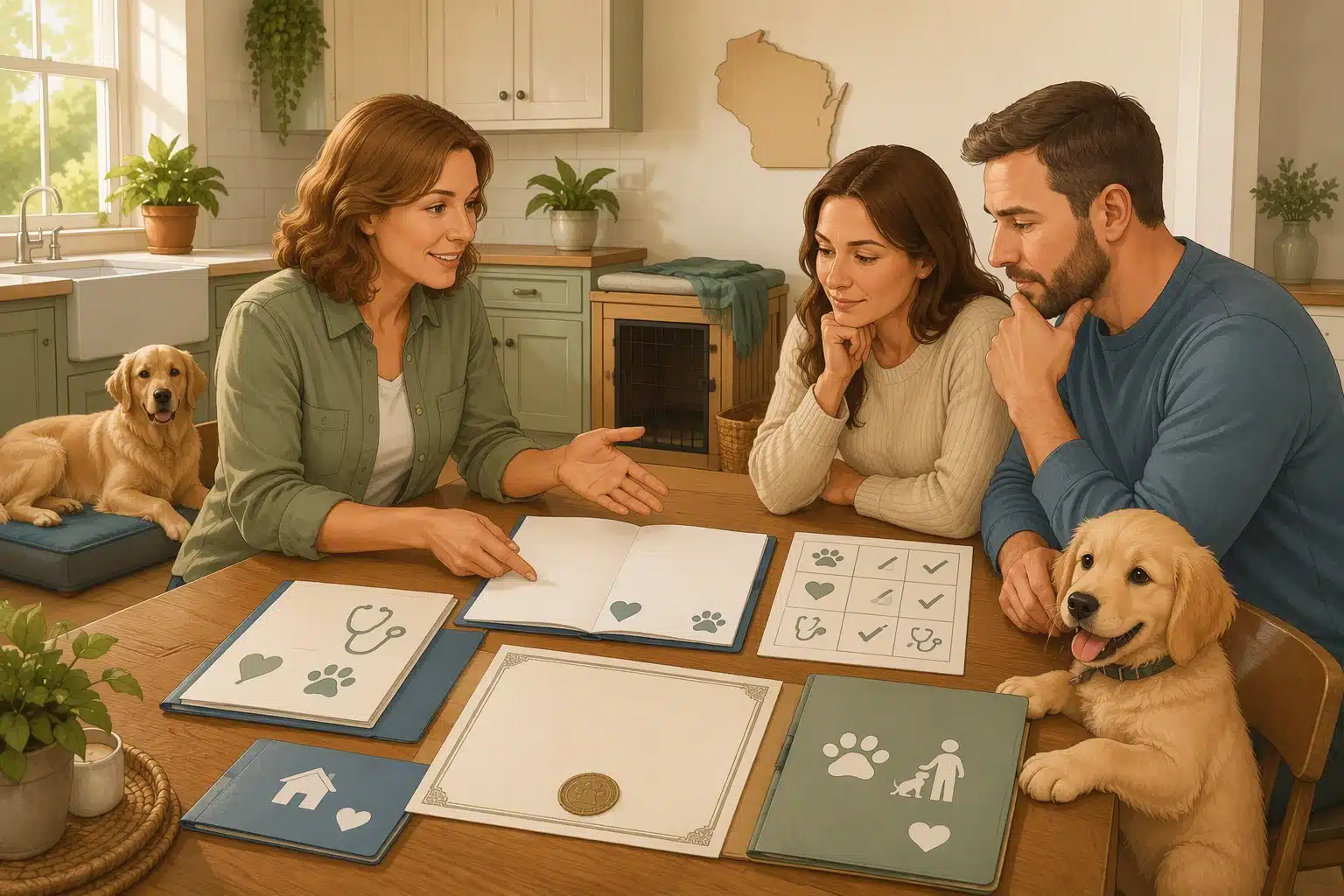
A Certificate of Veterinary Inspection, or CVI, is often called a health certificate. It shows that an accredited veterinarian recently examined the dog, noted its vaccine status, and found no signs of communicable disease at that visit.
It does not prove lifelong health. It does not replace genetic screening, a parent-health review, or your own vet visit after pickup.
| A CVI confirms | A CVI does not confirm |
|---|---|
| Recent veterinary exam | No future illness |
| Apparent freedom from infectious disease | No genetic disease risk |
| Vaccine record and identity details | No temperament guarantee |
Ask for a readable copy before pickup. Then book your own veterinarian visit promptly after your puppy arrives.
Age, validity, and interstate delivery questions
Wisconsin prohibits selling a puppy younger than 7 weeks. Strong breeders may keep puppies longer for maturity and smoother transitions.
A CVI must be completed within 10 days of the exam and stays valid for 30 days from that exam date. Interstate travel needs an interstate CVI, and the destination state may add rules. Confirm those requirements before a delivery date is set. DATCP’s CVI guidance is clear on this point.
Also Read: 10 Must-Ask Questions Before Buying a Puppy Locally
How Sage Puppies Approaches Health Screening for Havanese, Havapoo, and Cavapoo Puppies
Parent screening is different from a puppy exam
A puppy wellness exam checks the puppy’s current condition. Parent screening looks earlier, at health risks that may be passed down through a line. Strong programs need both.
Sage Puppies states that it pairs health-tested parents, then raises puppies in a home setting with early social time. Ask to see the parent records for the exact litter, not a general statement about testing.
The OFA explains breed-specific screening helps breeders make better breeding choices and gives buyers useful health information.
| Check | What it tells you |
|---|---|
| Parent health records | Risks reviewed before breeding |
| Puppy wellness visit | Current health before going home |
| Family history | Patterns that may need follow-up |
Tip: Testing lowers risk. It cannot promise that any puppy will never develop a health concern.
What the published puppy wellness process includes
For a family, the practical proof is clear paperwork and a calm handoff plan. Before reserving, ask what records come with your puppy and when you should book your own vet visit.
A sensible wellness file should cover:
- A recent veterinary exam record.
- Vaccine and deworming history, with dates.
- Feeding details and transition guidance.
- Parent health-testing information.
- Clear contact steps if you have questions after pickup or delivery.

Sage Puppies should be able to walk you through those records before a Wisconsin family commits. Bring the file to your home veterinarian so they have a clean starting point.
Breed-specific questions for Havanese, Havapoo, and Cavapoo families
Ask questions that match the puppy you want. Havanese families may ask about eyes, hearing, and patellas. Havapoos need clear records for both Havanese and Poodle parent lines. Cavapoo families should ask how Cavalier and Poodle parent health was considered.
| Puppy type | Useful parent-record question |
|---|---|
| Havanese | Were eyes, hearing, and patellas reviewed? |
| Havapoo | Which tests were used for both parent breeds? |
| Cavapoo | What heart, eye, and patella records are available? |
Patellar issues can be inherited, and the OFA notes they can affect young dogs. Ask for records, read them, then plan your first vet visit promptly.
Does Sage Puppies Provide the Buyer Support Wisconsin Families Need?
Application and matching before reservation
Sage Puppies starts with an application, which is a strong sign for families who want more than a quick sale. Use it to share your home routine, children, work hours, and breed preference. Then ask how they match each puppy to a family.
A thoughtful match should cover:
- Energy level and temperament
- Grooming needs for Havanese, Havapoo, or Cavapoo puppies
- Your plan for training and daytime care
- Parent health testing and puppy records
A good breeder welcomes careful questions. Wisconsin DATCP also urges buyers to get health terms and seller promises in writing before bringing a puppy home. Read its buyer checklist
Delivery, pickup, and Wisconsin arrival planning
Sage Puppies is based in South Jordan, Utah, so Wisconsin families should confirm the travel plan before reserving. Ask whether local pickup or nationwide delivery fits your situation, who handles each step, and when you receive records.
| Arrival detail | Confirm before reservation |
|---|---|
| Travel method | Pickup or delivery option |
| Timing | Estimated go-home and arrival date |
| Paperwork | Health, vaccine, and travel documents |
| First night | Food, crate, routine, and support contact |
For an interstate arrival, ask for the current health certificate and check Wisconsin requirements with your veterinarian. A CVI shows a recent veterinary exam, but it is not a long-term health warranty, according to Wisconsin DATCP.
Support after go-home day
The real test of buyer support starts at home. Sage Puppies should be easy to reach for practical transition questions, not just reservation updates.
Plan these first steps:
- Book a Wisconsin vet visit promptly.
- Keep food and routine steady at first.
- Save every health record and written agreement.
- Ask early about feeding, crate training, sleep, and grooming.
Do not assume support terms. Confirm what help is available, how to contact the program, and what is covered in writing.
Also Read: Puppy Care Blog & Resources | Sage Puppies
Health Guarantees, Contracts, and the Documents That Control
CVI versus written health guarantee
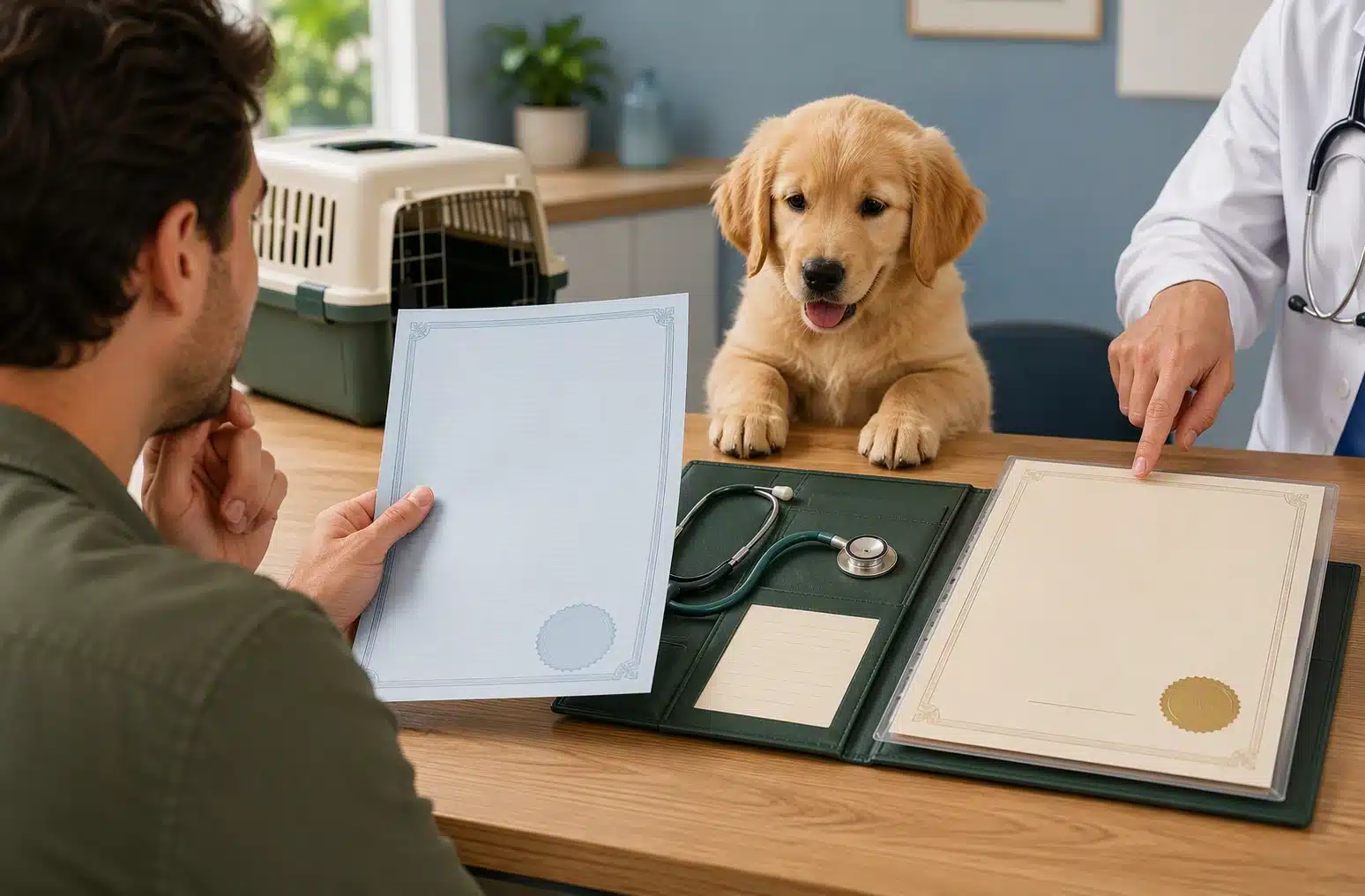
A Certificate of Veterinary Inspection (CVI) confirms a veterinarian recently examined the puppy. It records apparent health, vaccines, and identification. It is not a promise against future illness or inherited conditions. Wisconsin DATCP states plainly that a CVI carries no implied warranty. Review the state CVI guidance before you rely on it.
A written health guarantee is separate. It controls what happens if a covered issue appears after pickup.
| Document | What it proves | What it does not promise |
|---|---|---|
| CVI | Recent vet exam and apparent health | Lifetime health or genetic outcomes |
| Health guarantee | Seller’s stated remedy and conditions | Coverage beyond its written terms |
Terms to read before paying a reservation deposit
Read the full contract first, not on pickup day. Focus on the terms that affect your choices and costs:
- Deposit rules: Is it refundable, transferable, or tied to one litter?
- Coverage window: Note the start date, end date, and required vet exam deadline.
- Covered conditions: Look for clear wording on genetic, congenital, contagious, and pre-existing issues.
- Buyer duties: Confirm vaccine, food, care, and record rules.
- Remedy: Is it reimbursement, a replacement puppy, return, or seller discretion?
- Limits: Check exclusions, claim paperwork, and who pays transport or vet costs.
A vague promise to “stand behind our puppies” is not a health guarantee. Ask for the signed terms in advance.
What Sage Puppies publishes and what buyers must still confirm
Sage Puppies can share its health-testing approach, family-raised care, and process for Havanese, Havapoo, and Cavapoo homes. Still, buyers should confirm the documents tied to their own puppy before reserving.
Ask for the current contract, parent testing records, vaccine and deworming record, CVI timing, and pickup or delivery details. Wisconsin advises buyers to get guarantee terms in writing because state law does not set post-sale remedies. See DATCP’s buyer guidance.
Also Read: Havanese, Havapoo & Cavapoo Puppy Care Blog
Pros and Cons of Choosing Sage Puppies for a Wisconsin Family
Where Sage Puppies is strongest
Sage Puppies suits families who value a small, home-raised start and clear support. Its focus on Havanese, Havapoo, and Cavapoo puppies keeps breed guidance specific.
- Health-tested parents and early social time support a thoughtful match.
- The application process helps avoid an impulse choice.
- Pickup and nationwide delivery give Wisconsin families options.
- A family-first approach can make first-week questions less stressful.

Best fit: A family willing to ask questions, follow a transition plan, and book an early vet visit.
What Wisconsin buyers should clarify
Distance is the main tradeoff. Sage Puppies is based in South Jordan, Utah, so confirm the travel plan, timing, cost, and who handles handoff.
Ask for these items before reserving:
- Parent health-testing records and what each test covers.
- The puppy’s interstate CVI, vaccine record, and feeding routine.
- Written terms for health concerns, delivery, and post-home support.
Wisconsin says an interstate CVI confirms a recent exam, not a long-term health warranty, according to DATCP guidance.
| Strength | Clarify before committing |
|---|---|
| Boutique breed focus | Delivery or pickup logistics |
| Home-raised care | Total price and reservation terms |
| Ongoing buyer support | Written health agreement |
A Wisconsin Buyer’s Final Checklist Before Choosing a Puppy Seller
Use this list before you send a deposit. A polished website is not proof of good breeding.
- Confirm the seller’s status. Wisconsin requires licensing for many higher-volume sellers. Check the DATCP buyer guidance, but remember that a smaller breeder may not need a license.
- Ask for parent health records. Look for breed-relevant testing, not vague claims that parents are “healthy.”
- See how puppies are raised. Request a visit or a live virtual meeting. Meet the mother when possible.
- Read every document. Get the contract, vaccine record, deworming record, and Certificate of Veterinary Inspection before pickup.
- Know the limits of the CVI. It reflects health at the time of exam, not a future health promise. Ask for written terms if illness appears later.
- Plan your first vet visit. Book it soon after arrival and bring all records.
Walk away if a seller rushes payment, avoids direct questions, or will not show where puppies live.
Wisconsin also prohibits selling puppies under seven weeks old, according to DATCP rules for dog sellers.
Also Read: Health-Tested Puppies for Sale Near Me: A Buyer Safety Guide
Is Sage Puppies Worth Considering for Wisconsin Puppy Buyers?
Yes, if you value clear health records, parent testing, and steady support after pickup. Sage Puppies raises Havanese, Havapoo, and Cavapoo puppies in a home setting and offers nationwide delivery from South Jordan, Utah.
For Wisconsin families, ask for the puppy’s health documents, parent-test details, delivery plan, and written terms before reserving. Wisconsin requires health certificates for dogs sold by licensed sellers, but a certificate reflects the puppy’s condition at the exam, not a lifetime health promise, according to Wisconsin DATCP.
| What to confirm | Why it matters |
|---|---|
| Parent health testing | Helps you assess inherited-risk planning |
| First vet visit plan | Gives your own veterinarian an early baseline |
| Delivery details | Prevents stress and last-minute confusion |
A thoughtful breeder welcomes these questions.

Choose a breeder who shares health records, answers hard questions, and supports you after pickup. Sage Puppies pairs health-tested parents with home-raised care for Havanese, Havapoo, and Cavapoo families. View available puppies, then start your application with confidence.
Frequently Asked Questions
Q1: where to buy puppies in Wisconsin
Start with sellers who share parent health records, vet paperwork, and clear pickup details. Avoid rushed deposits or vague answers. Ask how puppies are raised and what support you receive after bringing one home.
Q2: How does Sage Puppies ensure puppies meet Wisconsin’s health screening requirements?
Sage Puppies uses health-tested parents and provides clear puppy records. Wisconsin families should also schedule a local veterinary visit soon after arrival and review all paperwork before finalizing their reservation.
Q3: What health guarantees does Sage Puppies offer for Havanese, Havapoo, and Cavapoo puppies?
Ask Sage Puppies for the current written health guarantee before reserving. Read the covered conditions, time limits, required vet visits, and your duties as a buyer. Keep every record from your first exam.
Q4: Can Sage Puppies provide a Wisconsin Department of Agriculture license verification?
Sage Puppies is based in South Jordan, Utah, not Wisconsin. Ask Wisconsin-based sellers directly for their state license details when required. For delivery, confirm the breeder’s records and transport plan.
Q5: What should I bring to my puppy’s first Wisconsin vet visit?
Bring the breeder’s health record, vaccine history, feeding notes, and any signed agreement. Book the visit promptly, then ask your vet about local parasite risks, safe social outings, and vaccine timing.
Conclusion
A strong Wisconsin puppy seller does more than meet the legal minimum. Ask for clear parent health testing, honest details on early care, complete records, and steady support before and after pickup.
Wisconsin requires many sellers to hold a license, prohibits sales before seven weeks, and requires a veterinary health certificate for covered sales, according to DATCP’s dog seller guidance. Still, a CVI is not a long-term health promise.
Choose the breeder who welcomes careful questions, puts terms in writing, and helps you prepare for your puppy’s first vet visit.



