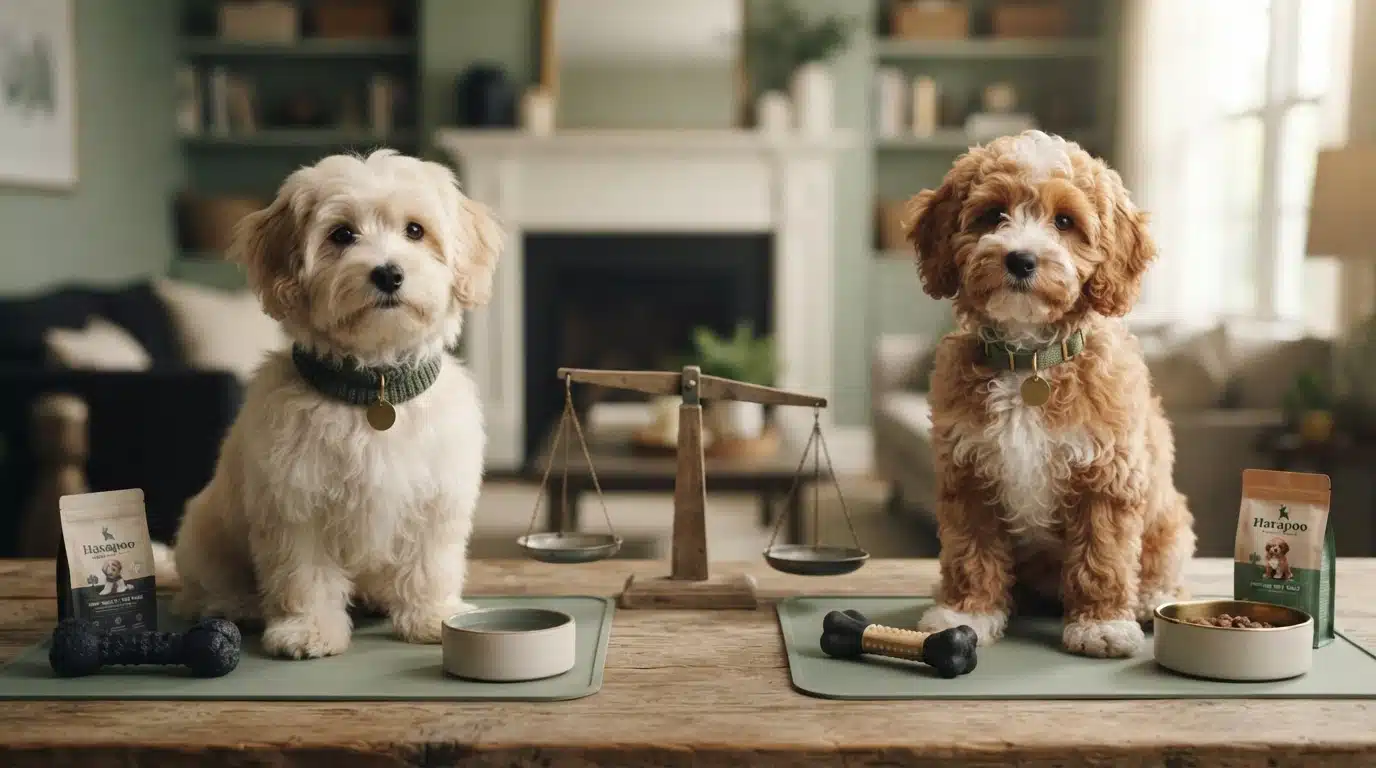
Quick Summary: Small breed puppies need frequent, energy-dense meals to prevent hypoglycemia, plus short play sessions, while large breed puppies need capped calories and calcium to protect their developing joints. Choose based on your schedule and space: small breeds suit busy households and apartments but demand close feeding attention, whereas large breeds need more time, money, space, and patience for controlled growth and low-impact exercise.
Two eight-week-old puppies, both hungry. One is a 12 pound Havapoo who eats four small meals a day, because a missed meal can crash her blood sugar. The other is a Great Dane pup who eats like a horse yet needs large breed feeding rules to slow his growth, since rapid growth strains a giant puppy’s bones. Same age, same house, opposite plans. That surprises first-time owners, who expect one generic routine scaled up or down. It also matters if you are still choosing between a small companion breed and a large one, because generic puppy feeding charts by breed size rarely show what each choice costs in time, money and risk. This guide compares small breed feeding, large breed nutrition, exercise and daily logistics side by side, so you can decide with real numbers. At Sage Puppies in South Jordan, Utah, we raise Havanese, Havapoo and Cavapoo puppies and walk new families through these differences every week.
Small Breed vs Large Breed Puppies: Feeding and Exercise at a Glance
| Small Breed Puppies | Large Breed Puppies | |
|---|---|---|
| Calorie Needs | Roughly 2 to 2.5 times adult calories per pound; a small puppy needs more energy per pound than a large one | More total food but fewer calories per pound; calories are deliberately limited to slow growth |
| Meal Frequency | Three to four small meals a day in early months; hypoglycemia risk highest between 6 and 12 weeks | Up to four meals a day until about 6 months, then two meals a day |
| Food Formulation | Standard small-breed puppy food, energy-dense, no need to limit calcium or calories | Large-breed puppy formula with moderated calcium and fat, about 26 percent protein |
| Exercise Needs | Short frequent sessions, about 5 minutes per month of age, scaled to the individual puppy | Longer, more structured outings and low-impact surfaces; jumps and stairs are limited while the skeleton develops |
| Best For | Apartments, first-time owners, travel, and households with limited daily time | Active, outdoors-oriented households with space, time and a larger monthly food budget |
How Small Breed and Large Breed Puppies Compare
Small Breed Puppies
Small breed puppies are toy and companion dogs such as Havanese, Havapoo and Cavapoo pups. They mature quickly, burn more puppy calories per pound than big dogs do, and depend on frequent meals to avoid hypoglycemia, a blood sugar drop that hits hardest between 6 and 12 weeks. They suit apartments, first-time owners and busy families, and exercise stays short, about 5 minutes per month of age.
Large Breed Puppies
Large breed puppies grow slowly toward a genetically set adult size, so large breed feeding is about control, not volume. Calories, calcium and fat are moderated to protect developing bones and joints, with up to four meals a day until about 6 months. They fit active households with space, time and a bigger food budget.
How Many Calories Does a Small Breed Puppy Need Compared to a Large Breed Puppy?
A small breed puppy needs more calories per pound than a large breed puppy, often 2 to 2.5 times an adult dog’s per-pound needs, while a large puppy eats more total food with a tighter calorie cap. Here’s the per-pound comparison:
- Small breeds: Higher energy per pound to fuel fast growth and small stomachs
- Large breeds: Fewer calories per pound, kept in a controlled range to slow bone growth
- Both: Calculated from lean weight, not age alone, then adjusted by body condition
The Per-Pound Math Behind Each Size
Vets use resting energy requirement (RER), the calories a body burns at rest: 70 times body weight in kilograms raised to the 0.75 power. Puppies add a multiplier on top. Under 4 months, that multiplier is about 3; after 4 months, it drops to about 2, per Hemopet’s feeding calculations. A 4-pound Havanese pup therefore needs roughly 200 calories a day. Because smaller dogs burn more per kilogram, a chart based only on total pounds will overfeed a big puppy and underfeed a tiny one. That’s why any puppy feeding chart by breed size should be a starting point, not a rule.
Why Large Breed Puppies Get Fewer Calories on Purpose
Large breed feeding is deliberately cautious. When calories run high, a big puppy grows fast, and fast growth stresses hips, elbows and joints before they finish forming. Slower growth reaches the same adult size on a safer timeline. That is why large breed puppy formulas moderate calcium and fat, so calcium drives the pace rather than the amount of food, guidance echoed in the Royal Kennel Club’s puppy nutrition advice. Small breeds like our Havanese, Havapoo and Cavapoo puppies carry none of that risk, which is why they get energy-dense food instead. You can read more about raising small breed puppies before pickup day.
Meal Frequency: Why Four Small Meals Change Your Week
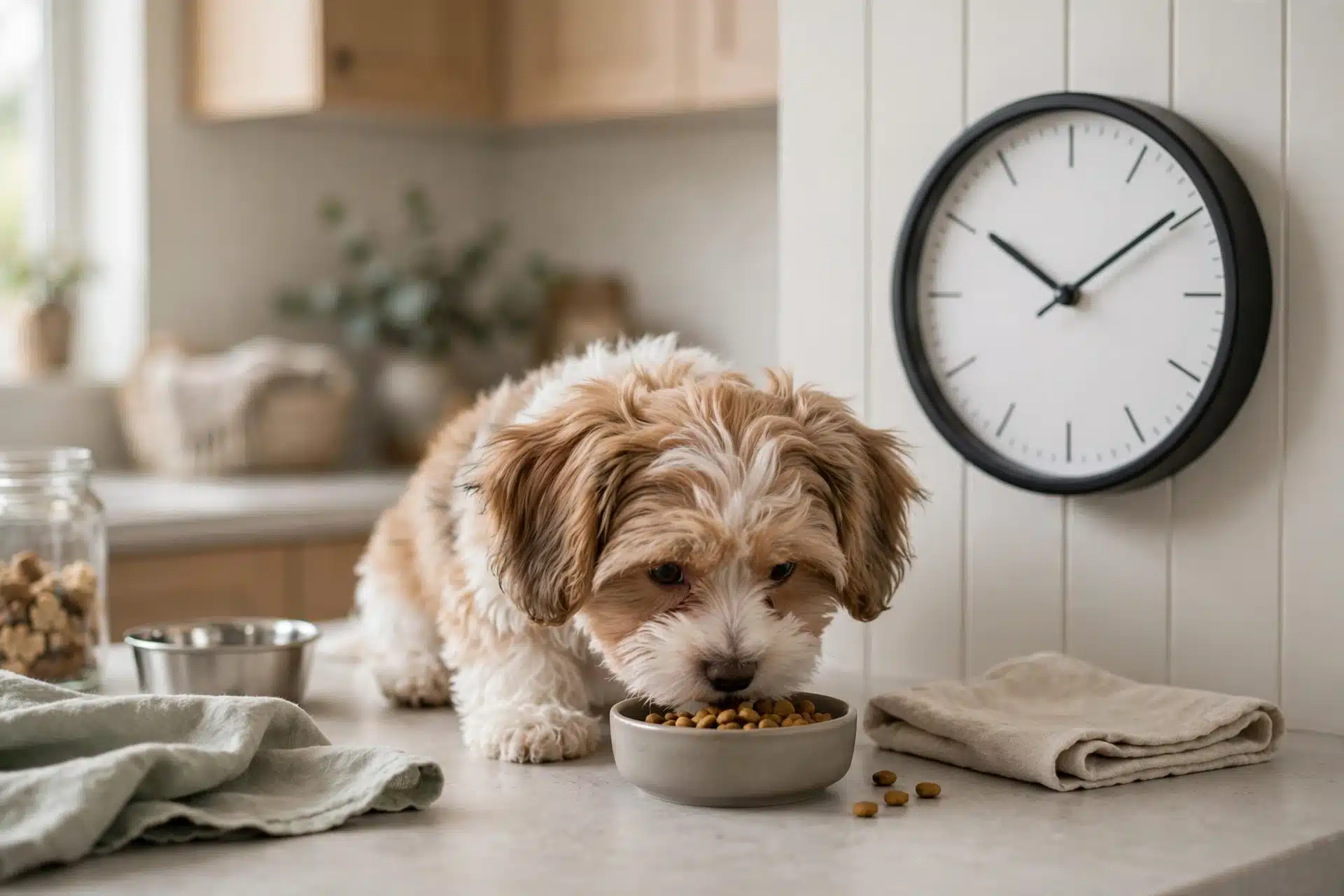
A small breed puppy should eat three to four small meals a day until about 6 months, then drop to two. The schedule matters more than the brand of food, because gaps between meals are what cause trouble. Here is a sample daily timeline: 7 a.m., 11:30 a.m., 4 p.m., and 8 p.m., with the last meal shortly before bedtime to carry your puppy through the night.
The Hypoglycemia Clock in Small Breed Puppies
Tiny puppies have little glucose stored in their livers, so a skipped meal can crash their blood sugar within hours. The risk peaks between 6 and 12 weeks, which is exactly when most puppies move to a new home. Watch for weakness, wobbling, or a puppy who seems drowsy and cold. Purina’s feeding guidance recommends four or more meals daily for small and toy breeds under 4 months, and consistent timing protects against hypoglycemia better than anything else you can do. Set phone alarms for the first month; your puppy cannot wait until your schedule is convenient.
Feeding a Two-Dog Household on Different Schedules
If an adult dog eats twice a day and your puppy eats four times, feed them apart. Use separate rooms or crates, because free-feeding lets the older dog steal the puppy’s food, and puppy food is too rich for most adults. Families preparing for a new arrival can follow a week-one feeding schedule built for small breeds, then shift toward the household’s two-meal rhythm around 6 months.
Food Formulation: What Actually Differs in the Bag
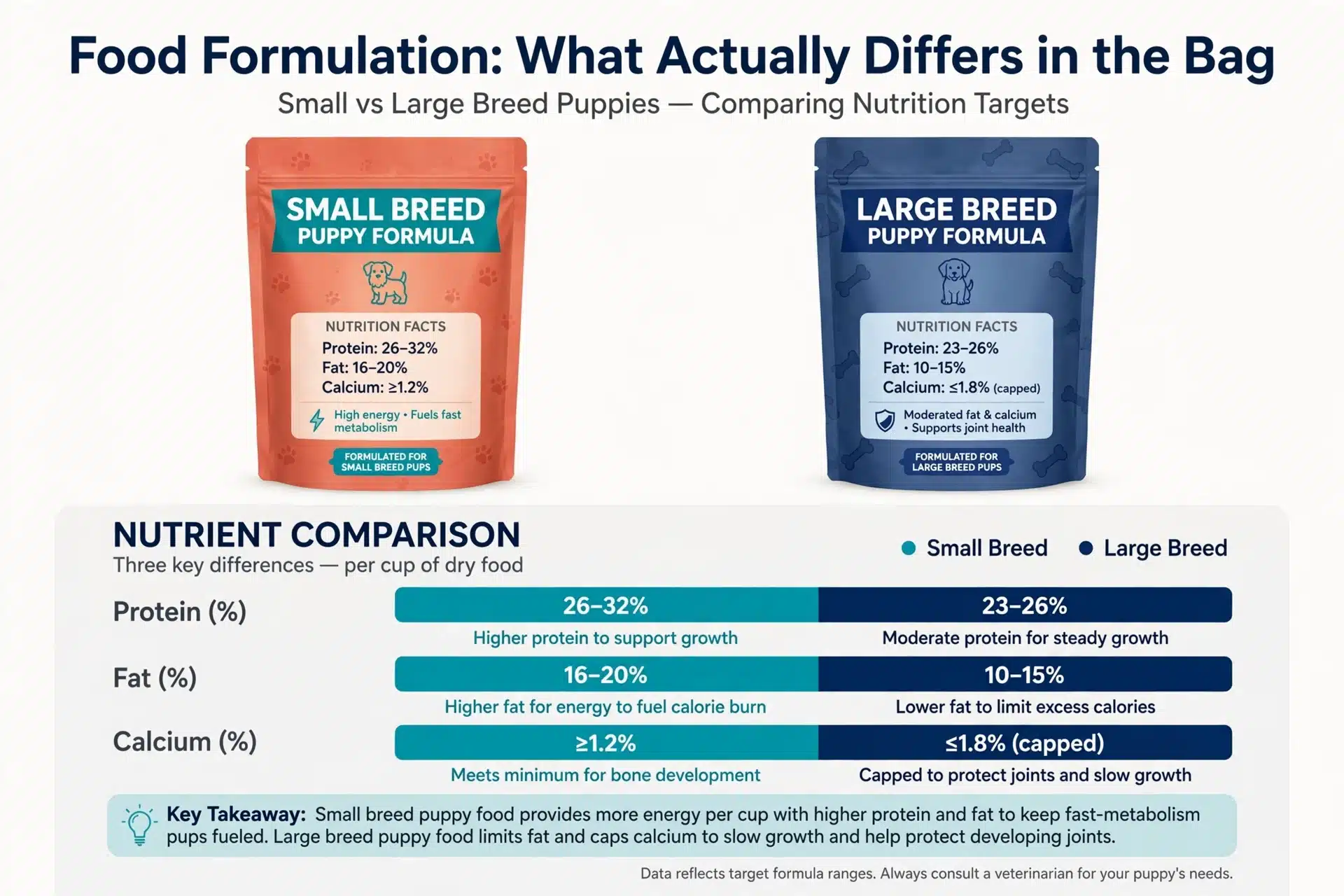
No, small and large breed puppies should not share the same food. Large breed puppy formulas use moderated calcium and fat to slow rapid growth and protect joints, while small breed formulas pack more energy per cup for pups that burn calories fast. Here is how the targets compare:
| Nutrient | Small Breed Puppy Food | Large Breed Puppy Food |
|---|---|---|
| Protein | 26 to 32 percent | 23 to 26 percent |
| Fat | 16 to 20 percent | 10 to 15 percent |
| Calcium | 1.2 percent or more | Capped at 1.8 percent |
Reading a Label Without Guessing
Start with the nutritional adequacy statement. It tells you the food is complete and balanced for growth, per AAFCO’s labeling guide. For a large breed puppy, the wording must specifically say it supports growth, including large size dogs expected to weigh 70 pounds or more as adults. Skip anything that only says “all life stages” if your puppy is a giant breed, because it may carry too much calcium. Then compare guaranteed analysis numbers between bags, not just the pretty breed illustrations on the front.
Calcium, Joints and the Large Breed Formula
Calcium is the big one. AAFCO sets a growth minimum of 1.2 percent calcium and a maximum of 1.8 percent for large breed puppy formulas, per its nutrient profiles. Growing large dogs that take in too much calcium can develop hip dysplasia or other joint problems later. Small breed puppies like a Havanese or Cavapoo face no such cap, so a standard puppy food works fine. If you are raising both sizes, feed them separately.
Exercise Needs: Same Rule of Thumb, Very Different Reality
You have probably heard the 5-minutes-per-month rule: a 3-month-old puppy gets 15 minutes, a 4-month-old gets 20. It is a reasonable starting point for both sizes, but how you spend those minutes is where small and large puppies part ways.
Small Breed Puppies: Short, Often, and Mind the Jumping
How much exercise does a small breed puppy need daily? Two to three short play sessions, roughly 5 minutes per month of age each, plus free play indoors. A 3-month-old Havanese does well with two 15-minute sessions, broken up rather than one long walk.
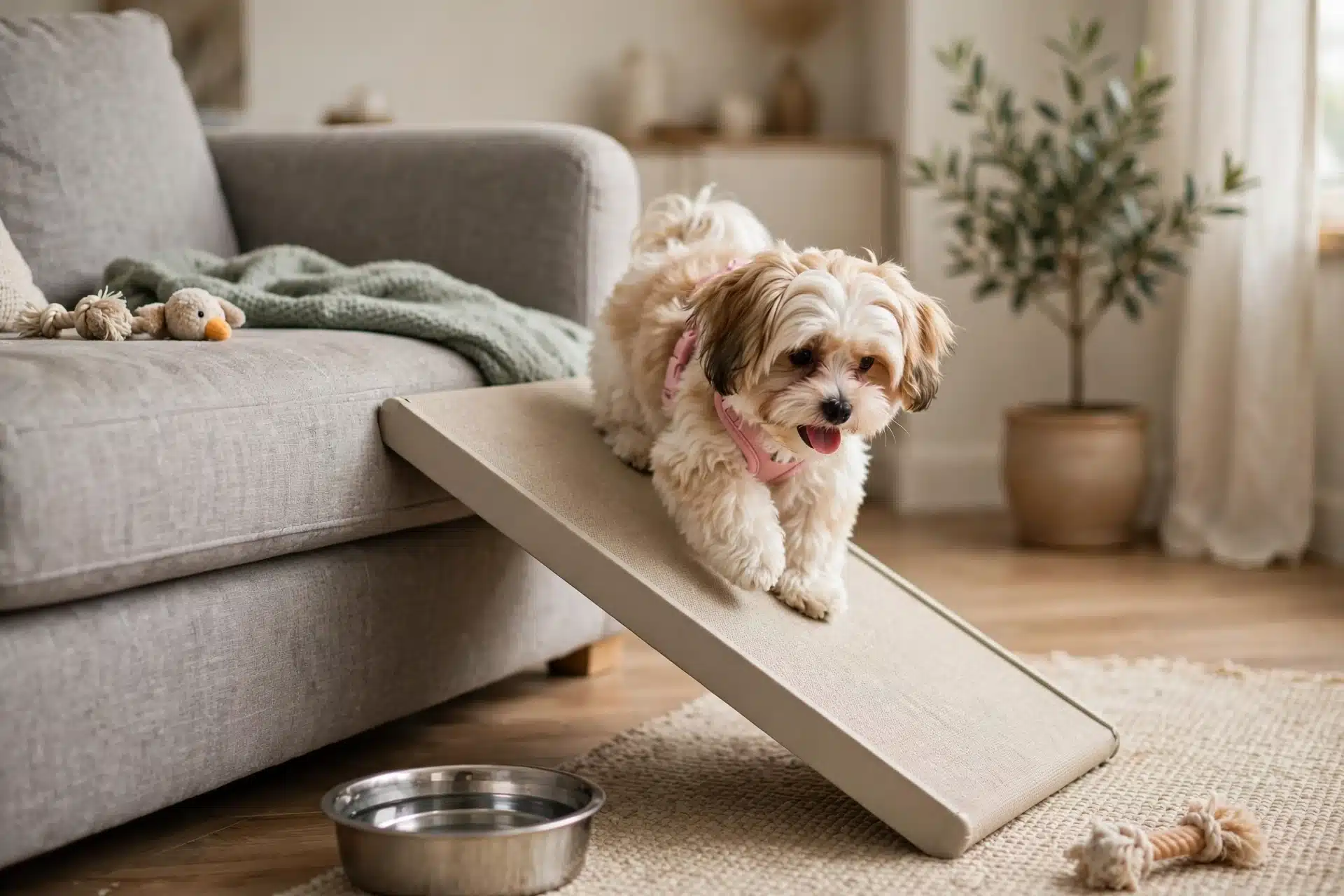
Because they burn puppy calories so fast, small pups work in short bursts and rest often. Watch their energy: panting or lying down mid-play means break time. Protect the joints by keeping them off couches and stairs, and skip high jumps. Small dogs face patellar luxation (a slipping kneecap) and collapsed trachea later in life, so avoid collar tugging on walks now; use a harness instead.
Large Breed Puppies: Distance, Not Impact
Large pups need more total time, but the goal is easy mileage, not intensity. Sniffy neighborhood walks and free play build muscle without stressing the joints. Forced exercise, like running alongside a bike or jogging at an adult pace, is the real risk before growth plates close, according to Veterinary Partner. In large breeds those plates can stay open past a year, so hold off on sustained running, stairs and slick floors. Choose grass over concrete, and let your puppy set the pace; if it stops, the session is over. Short frequent play works better than one long workout for both sizes, just on different terrain.
Health Risks That Come With Each Size
Every puppy size carries its own risk profile, and most problems trace back to growth speed. Small puppies grow fast but stay fragile. Large puppies grow slowly, and that long growth window is exactly what stresses their joints.

Small Breed Watch List
Tiny puppies face a short but sharp list of risks. Patellar luxation, a kneecap that slips out of place, shows up most often in small breeds and can cause early arthritis. Tracheal collapse is common in toy dogs, so use a harness instead of a collar.
Hypoglycemia is the most urgent one. Low blood sugar can hit a puppy under 12 weeks within hours of a missed meal, showing as weakness, wobbling or trembling. Quick rubs of corn syrup on the gums help, then call your vet. Dental crowding and retained baby teeth round out the list.
Large Breed Watch List
Big puppies trade sudden crashes for slow-building joint trouble. Hip and elbow dysplasia lead the list, and rapid growth from too many calories or too much calcium raises the risk. That is why large-breed formulas cap calcium and calories.
Bloat, a life-threatening stomach twist, appears in deep-chested adults. Other watch items include panosteitis, growing pains in long bones, and early arthritis. Keep exercise low-impact and hold jumps until growth plates close.
The Everyday Cost and Gear Difference
Food, Equipment and Monthly Spend
Food is where size shows up fastest in your wallet. Rover’s cost breakdown puts small-breed puppy food at roughly $1.85 to $2.43 per day, while large puppy formula averages about $6.43 per day. Over a month, that is a labeled example of about $55 to $75 for a toy breed versus nearly $200 for a large pup. Gear scales with weight too. A harness, crate and car setup rated for 70 pounds costs more than one built for a 12-pound Havanese, and large dogs destroy cheaper versions faster.
Where Time Costs More Than Money
Big puppies cost more in hours, not just dollars. They need longer walks, more yard space and heavier handling as they grow, and a young dog pulling on leash is real labor. Small breeds cost more in attention: more frequent meals, close watching for hypoglycemia in the early weeks and gentler surfaces around the house. Families weighing what a Havanese or Havapoo costs to bring home can see how the upfront price compares with monthly care. Either way, budget for the routine, not just the receipt.
Which Should You Choose: Small or Large Breed Puppy?
There is no universal right answer here. The better choice depends on your schedule, your space and how much patience you have for a slow, careful growth phase. Match the puppy to the life you actually live, not the one you hope to have someday.
Choose Small When Your Days Are Full
A small breed puppy fits busy households because the daily system is compact. Meals are frequent but tiny, so feeding takes minutes. Exercise stays short, roughly 5 minutes per month of age, and much of it happens indoors. A Havanese or Cavapoo can burn off energy with a hallway game and a short walk.
Small pups also travel well. They fit in a carrier, ride calmly in a car and handle apartment living without complaint. First-time owners often find the stakes feel lower: a training mistake or missed walk is easier to recover from with a 10-pound dog than an 80-pound one.
The trade-off is vigilance. Toy breeds under 12 weeks need watched feeding times, because hypoglycemia can develop fast. If nobody is home for 8 hours straight, plan for a midday check.
Choose Large When You Have Room, Time and Patience
A large breed puppy rewards families with space and a steady routine. Expect bigger grocery bills, a yard for play and longer structured outings. Exercise matters more, and so does how your pup moves: keep sessions low-impact and limit jumping and stairs while joints mature.
Patience is the real requirement. Large pups grow slowly, sometimes for 18 months, and controlled growth protects hips and elbows. You will feed a large-breed formula, watch weight closely and hold off on intense activity until the vet clears it.
If a fenced yard, flexible schedule and commitment to slow training sound realistic, a large breed will fit beautifully. If not, a smaller companion may suit you better. For many Utah families, a Havanese, Havapoo or Cavapoo hits the sweet spot between the two.

Feeding a small breed puppy is mostly about rhythm, and you don’t have to figure it out alone. The team at Sage Puppies matches families with Havanese, Havapoo and Cavapoo puppies and shares the feeding plan each pup already knows. Apply today and start day one with confidence.
Frequently Asked Questions
Q1: How many calories does a small breed puppy need compared to a large breed puppy?
Small breeds need more calories per pound, often 2 to 2.5 times an adult dog’s needs. Large pups eat more total food, but calories stay capped to slow growth.
Q2: How much exercise does a small breed puppy need daily?
Two to three short sessions, about 5 minutes per month of age each, plus indoor free play. Stop when your pup pants or lies down.
Q3: Should small breed puppies eat the same food as large breed puppies?
No. Large breed formulas moderate calcium and fat to protect joints. Small pups do fine on energy-dense standard puppy food.
Q4: When should a puppy switch from four meals to two?
Most small breeds drop to two meals around 6 months, once hypoglycemia risk fades. Keep timing consistent through the transition.
Q5: Can I walk a large breed puppy before growth plates close?
Yes, with limits. Stick to grass, sniffy walks and free play. Hold off on jogging, stairs and jumps until your vet clears hard exercise.
Conclusion
Small and large breed puppies need opposite systems. Small pups run on frequency: four meals a day, quick play sessions of about 5 minutes per month of age, and close watching for hypoglycemia before 12 weeks. Large pups run on restraint: capped calories and calcium, low-impact exercise and patience through a long growth window. Neither size is easier, just different in what it asks of you. If your days are full and your space is snug, a Havanese, Havapoo or Cavapoo gives you the small-breed routine without the giant-breed risks. Match the puppy to the life you actually live, and the daily rhythm falls into place.