
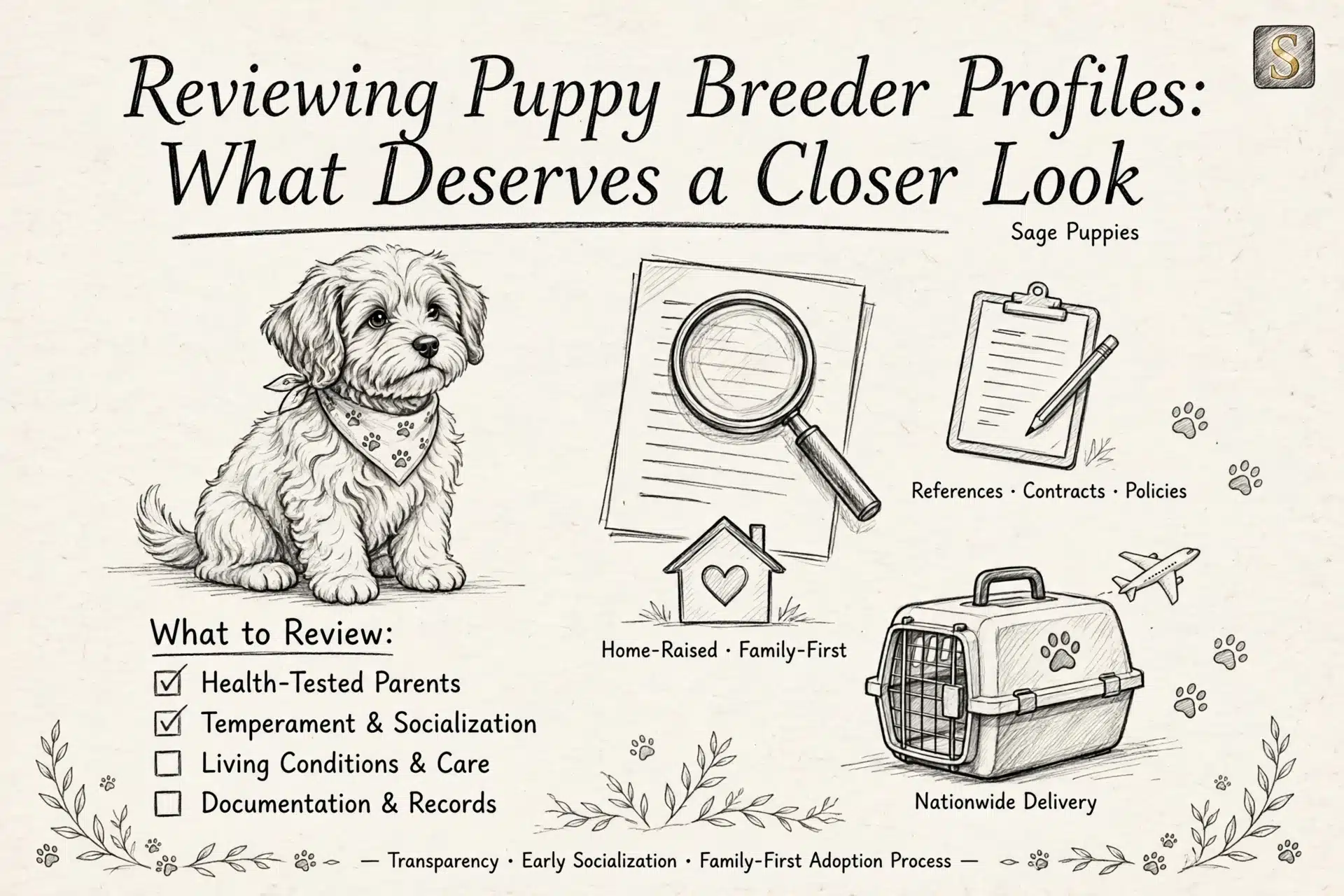
Quick Summary: A breeder profile is only a starting point, not proof of quality, so buyers must separate marketing claims from verifiable evidence like named health tests and OFA links. The guide urges checking for specific parent testing, home-raising details, and two-way buyer screening, while flagging red flags like payment pressure and no video calls. It uses Sage Puppies as an example of a transparent breeder, but the checklist applies to any breeder. Ultimately, a profile should spark deeper questions, not replace in-person verification.
When a puppy profile claims the parents are health tested, the polished photos tell you little. What matters is whether the breeder names the tests and shows results you can verify. That gap between marketing language and real evidence is the problem this guide solves.
Here, you will learn to review puppy breeder profiles with a clear framework: how to read health records, spot red flags in listings, ask better screening questions, and compare pickup and delivery details. The advice draws on the standards used at Sage Puppies, a home-raised program in South Jordan, Utah, focused on Havanese, Havapoo, and Cavapoo puppies, so you can judge any breeder, including us, against the same checklist.
How to Review a Breeder Profile Before You Reach Out
A breeder profile is a first impression, not a proof of quality. Anyone can write “health-tested parents” or “lovingly raised.” Your job is to read the profile, note what it claims, and sort those claims into two piles: things stated and things shown. The AKC advises asking to meet breeders in person or by video and requesting proof of health screenings like OFA certificates. The profile tells you what to ask for next.
Separate a claim from evidence
When you review puppy breeder profiles, read every sentence as a claim until it’s backed by something you can check.
A claim sounds like: “Our dogs come from champion lines.” Evidence looks like: registration numbers, health test results with the dog’s name attached, or dated photos of real litters.
| Claim in the profile | What evidence would look like |
|---|---|
| “Health-tested parents” | OFA or CAER results listed by the parent’s name |
| “Home-raised puppies” | Photos or video of puppies inside a real home |
| “Well-socialized” | Descriptions of daily handling, sounds, and play |
| “Lifetime support” | A written policy on their process page, not just words |
Run this check on any breeder you’re considering, including us at Sage Puppies. A good profile should give you specifics you can verify later.
Use the profile to decide what to verify next
The profile should hand you a question list. As you read, jot down anything stated but not shown. Those become your follow-up questions.
- Health records: “May I see the parents’ health test results?”
- Puppy care: “Where do the puppies sleep and play? Can I see them on video?”
- Process: “How do pickups and delivery work, and when can puppies go home?”
- Screening: “What do you ask of buyers?”
Watch how the breeder responds. Responsible breeders ask you questions too, because they want the right fit, not just a sale. The AKC notes that if a contact ignores your questions or shows no interest in the puppy’s future life, look elsewhere.
Also Read: Havanese, Havapoo & Cavapoo Puppy Care Blog
Health Testing Claims: What a Profile Should Help You Check
When you review puppy breeder profiles, “health tested” is the phrase you’ll see most often. It’s also the easiest one to fudge. The difference between a real claim and a marketing line comes down to two things: named tests and named dogs.
Look for named tests and identified parent dogs
A strong profile names both parents and lists their specific screenings. Vague wording like “parents are health tested and vet checked” tells you almost nothing. A routine vet visit is not a hip X-ray, an eye exam, or a DNA panel.
Here’s what a verifiable profile looks like:
- Registered or kennel names for the sire and dam, so you can search them yourself
- Specific tests by name: patellas, cardiac, CAER eye exams, and DNA panels
- A CHIC number or OFA link you can click and check
The OFA runs the main public database for canine health results, and its CHIC program requires that every breed-recommended test be completed and released publicly before a number is issued. One warning: OFA states a CHIC number only confirms tests were done and posted, not that every result was normal. Read the actual results.
Also watch for the DNA-only shortcut. Some breeders run a genetic panel and call it full testing. DNA screening alone skips orthopedic and eye exams, so treat that claim as incomplete.

Verify records and ask about family history
Once you have the parents’ names, spend ten minutes checking them. The OFA database is free to search by registered name, and breed clubs advise buyers to verify claims there rather than take a listing at its word. If nothing appears, either the dog isn’t tested or the name is wrong. Either way, ask.
Good follow-up questions:
- Can you send the OFA links for both parents?
- Have any dogs in this line had patella or heart issues?
- For a Havapoo or Cavapoo, were both parent breeds tested?
A confident breeder answers fast and happily. At Sage Puppies, we share each parent’s testing details up front, because the profile should give you proof, not promises.
Also Read: 10 Signs a California Puppy Listing Is a Scam – Sage Puppies
Puppy-Raising Details and Individual Profiles
A good breeder profile tells you how puppies are raised, not just that they exist. This is where marketing words end and real information begins.
Prefer concrete descriptions over temperament labels
Words like “sweet,” “cuddly,” or “best personality in the litter” are opinions. They can be true, but they don’t help you compare puppies. Descriptions of daily life do.
The most valuable puppy-raising details to look for:
- Where puppies live. A home with the family beats a kennel run every time.
- Handling routines. Daily gentle handling from the first days shapes calmer, more confident adult dogs.
- Exposure to sounds and surfaces. Vacuums, stairs, grass, tile, and door slams all teach puppies to recover from surprises.
- Contact with people. Children, men with deep voices, hats, and visitors build a puppy’s comfort with strangers.
- Age at pickup. Puppies should stay with their mother and littermates until at least 8 weeks.
This matters because the socialization window, roughly 3 to 12 weeks of age, has a lasting effect on later behavior, as AKC breeder guidance explains. Research on puppy socialization programs found that puppies given small early challenges startled less and solved problems faster than their littermates.

At Sage Puppies, this is what home-raised means in practice: puppies grow up amid family noise, handling, and routines, not in a separate building.
Check what each puppy listing actually tells you
Individual puppy pages are a different test. A thin listing shows one photo and a gender. A useful listing goes further.
Look for these details in each profile:
- Birth date and current age, so you know what stage the puppy is in.
- Multiple recent photos, ideally showing the puppy standing and moving.
- Parent information, including health testing results.
- Weight estimates, helpful for planning around adult size.
- Current training progress, such as crate exposure or litter habits.
- Vaccination and deworming records kept up to date.
- Clear pricing without hidden fees.
Compare a few listings from the same breeder. Consistency across all of them is a stronger signal than one polished page.
Also Read: 7 Puppy Breeder Red Flags First-Time Dog Owners Should Know
Transparency, Buyer Screening, and Practical Fit
Look for a two-way matching process
A good breeder profile does more than list puppies. It invites a conversation. Responsible breeders interview buyers as carefully as buyers interview them, often with a written questionnaire or phone call about your home, schedule, pets, and experience level, according to AKC guidance on screening buyers.
That should not feel like an interrogation. It should feel like matching. Watch for breeders who:
- Ask why you chose the breed and what your daily routine looks like
- Want to know who will care for the puppy and how long it will be alone
- Are honest about breed quirks, grooming needs, and energy level
- Will say no, or point you elsewhere, if a puppy is a poor fit
The OFA breeder interview guide puts it plainly: the right breeder asks you just as many questions as you ask them. A breeder who only wants a deposit is not matching. They are selling.

Confirm price, contract, and travel details before payment
Transparency shows up in writing. Before any payment, the profile and follow-up emails should clearly state the price, what it covers, and the terms. AKC breeder guidance notes that a sales contract should be available for review before you commit, and should spell out health terms, spay or neuter expectations, and who to contact after pickup.
Ask these questions in writing:
- What exactly does the price include?
- May I read the contract before reserving?
- What happens if I cannot keep the dog?
- How does pickup or delivery work, and who covers travel?
At Sage Puppies, families review pricing, contract terms, and pickup or delivery options before reserving. That order matters: clear terms first, payment last.
Profile Red Flags and Questions That Deserve Follow-Up
Notice patterns, not one missing detail
One missing photo rarely means anything. A pattern of gaps means a lot. Watch for clusters like these:
- No live conversation. A seller who only emails and avoids phone or video calls is a top warning sign. Legitimate breeders want to talk, and the AKC’s scam guide lists this as a classic fraud signal.
- Pressure to pay fast. Wiring money, gift cards, or app payments for a “puppy ready to ship today” should stop you cold.
- Too-good pricing. A deeply discounted Havanese or Cavapoo usually costs you more later.
- Recycled photos and text. If a listing appears on several sites, the “breeder” may not exist.
- No buyer screening. Good breeders interview you. As one group of breeders told the AKC, a buyer in a hurry worries them as much as anything else.

Use focused questions to resolve uncertainty
When something feels unclear, ask a short, specific question and watch how the answer comes back:
- Can I see the health test results for both parents?
- Where do the puppies live, and who handles them daily?
- What happens if my situation changes and I can’t keep the dog?
- Can we do a video call to meet the litter and the mother?
A confident breeder answers easily and asks plenty back. At Sage Puppies, for example, every application includes a conversation, because the right home matters more than the fastest deposit. Vague answers or irritation are your cue to keep looking.
Also Read: How to Evaluate Iowa Breeder Reviews and Puppy Buyer Feedback
What Sage Puppies’ Online Profile Lets Families Review
Follow the claims to the relevant details
A breeder’s website can only tell you so much, but a good one should let you verify each claim instead of just reading slogans. The AKC’s breeder guide stresses checking for documented health testing, not just statements about healthy dogs.
On Sage Puppies’ profile, you can trace every major claim to a detail page:
- Health testing – parent dog records and the screens used before breeding.
- Raising method – how puppies are raised in the home in South Jordan, Utah, with early socialization.
- Individual puppies – current listings with photos, ages, and temperament notes.
- Process clarity – how the application works, what pricing includes, and pickup or nationwide delivery steps.
This structure matters. Cornell’s veterinary college notes that responsible breeders test breeding dogs for the conditions their breed clubs recommend and share those results openly. A profile organized around verifiable details makes that check easy.
| Claim | What to verify |
|---|---|
| Health-tested parents | Test records and dates |
| Home-raised | Photos and descriptions of the setting |
| Socialized puppies | Daily routine and handling details |
| Clear logistics | Delivery and pickup policies in writing |
If a breeder’s site makes claims without supporting pages, ask for the details directly.
Also Read: Guides – Sage Puppies
Is a Breeder Profile Enough to Choose a Puppy?
Short answer: no. A profile is a starting point, not proof. Anyone can post cute photos and friendly copy, and experts agree you need to go deeper. The AKC advises meeting the breeder in person or by video call, seeing the puppy’s parents, and reviewing medical history before you commit.
Think of a profile as the first interview, not the final decision. What it can show you:
- Photos and videos of the parents and puppies
- Which health tests the breeder claims to run
- How puppies are raised and socialized
- Delivery and pickup options
What it cannot show you is how the breeder answers hard questions or how the dogs behave in person. Cornell’s veterinary college recommends verifying that breeders test for the conditions their breed club recommends and offer lifelong support after the puppy goes home.
The right profile makes you want to ask more. The wrong one makes you want to walk away.
Also Read: 10 Red Flags to Avoid When Visiting a Local Puppy Breeder

Use this checklist on any breeder profile you’re considering, including ours. At Sage Puppies, you’ll find health-tested parents, home-raised Havanese, Havapoo, and Cavapoo puppies, and clear pickup or nationwide delivery options. Browse our available puppies and start your application today.
Frequently Asked Questions
Q1: How do I evaluate a puppy breeder profile before contacting them?
Look past photos. Check for health testing on parents, daily puppy care details, temperament notes, and clear pickup or delivery terms. A profile that invites questions, like Sage Puppies does, usually signals transparency.
Q2: What health records should a good breeder share?
Ask for parent health test results, vaccination dates, deworming history, and a recent vet check for each puppy. Confirm these in writing before you reserve.
Q3: Do breeder profiles prove a puppy was raised well?
No. A profile is a starting point. Ask for videos of puppies at home, meet the mother if possible, and read reviews from past families.
Q4: What questions should I ask a breeder directly?
Ask how puppies are socialized, when they go home, what food they eat, and what support you get after pickup. Clear answers matter more than polished marketing.
Q5: How can I spot a puppy scam in a listing?
Watch for very low prices, no video calls, generic photos, and pressure to pay fast. Legitimate breeders welcome video calls and never rush your decision.
Conclusion
A breeder profile is a starting point, not a verdict. The strongest signals are the ones you can verify: health testing on both parents, puppies raised in the home, socialization from day one, and a breeder who screens you as carefully as you screen them – a practice the Orthopedic Foundation for Animals calls a hallmark of responsible breeding. Cornell’s veterinary college echoes this: good breeders test for breed-specific conditions and offer lifelong support after your puppy goes home. Marketing photos are easy. Paperwork, parent dogs, and honest answers are harder to fake. Whether you’re comparing listings for a Havanese, Havapoo, or Cavapoo, apply this framework to every profile the same way. The extra hour of checking protects twelve or more years with your dog.



