
Quick Summary: A Minnesota puppy search is a starting point, not proof of quality, because search rankings reflect marketing effort, not animal care. The state only licenses commercial breeders with 10 or more adult intact dogs producing over five litters yearly, so small home programs like Sage Puppies operate legally without a license. To verify any breeder, check the state’s licensed breeder list, ask for OFA or vet records on parents, request a video call, and get adoption terms in writing. Treat testimonials as marketing, not evidence, and judge breeders on how openly they answer direct questions about health testing and puppy socialization.
Searching for Twin Cities puppies turns up polished breeder pages, business profiles, and glowing owner stories fast. The problem is that these results are not equal evidence. A testimonial is an opinion. A state license is a record. A Minnesota puppy search cannot tell you which is which unless you know what to look for.
This review breaks down what those results actually show, where they mislead, and how Minnesota dog breeders are regulated, including the state’s commercial breeder threshold. You will get a simple way to verify claims before you call anyone. We have spent years evaluating breeder practices and reviewing search experiences for families, so the goal here is practical: help you separate proof from praise.
What Twin Cities Puppy Search Results Actually Tell You
Type “Twin Cities puppies” into Google and you’ll get pages of listings, review sites, and breeder pages. The results look authoritative. Most of them are not proof of anything.
Search rankings measure marketing effort, not animal care. A paid ad can outrank a careful, health-testing breeder who spends her budget on vet bills instead of ads. Treat every result as a lead, not an answer.
Discovery Is Not the Same as Verification
Finding a breeder online is discovery. It tells you who exists and who markets well. It does not tell you who raises healthy, well-socialized puppies.
Here’s the key detail most first-time owners miss: Minnesota requires a commercial breeder license only for programs with 10 or more adult intact dogs producing more than five litters per year, according to the Minnesota Board of Animal Health. That means many small, high-quality programs operate legally without a state commercial license. And a license alone, where one exists, says the breeder met a legal threshold. It says nothing about temperament, socialization, or how the puppy was raised.
So you need two different steps: find candidates through search, then verify each one separately.
Read Each Source for What It Can Prove
Every source in your results has a limit. Match your questions to what it can actually show:
| Source | What it can prove | What it cannot |
|---|---|---|
| Testimonials | Happy past buyers | Independent records |
| Breeder website | Practices described | That they’re true |
| License listing | Legal standing | Puppy quality |
| Health test records | Parent dog health | Daily care |
Ask for documents you can check. Request the licensed breeder list match if a breeder claims state licensing. Ask to see OFA or vet records, and photos or video of the home where puppies live. Breeders who welcome questions and share records, the way we do at Sage Puppies, make verification easy. Hesitation is a signal.
Also Read: Puppy Care Blog & Resources | Sage Puppies
How to Verify Minnesota Breeder Reviews
A search result can look impressive and still tell you very little. Testimonials on a breeder’s own site are marketing, not proof. To size up reviews for any breeder serving Twin Cities puppies, treat them like evidence and check three things: detail, consistency, and what happens when you ask questions.
Look for Specific, Dated Buyer Experiences
Real reviews name the puppy, the timing, and the process. “We brought home our Cavapoo in March and got vet records at pickup” means far more than “great puppies!” Fake reviews tend to be vague, glowing, and clustered within a few weeks. The FTC advises searching a seller’s name with words like “review,” “scam,” or “complaint” before you pay anyone. Do that for every breeder on your short list.

Check for Consistency Across Sources
| Where you look | What strong reviews show | What raises a flag |
|---|---|---|
| Breeder’s website | Named families, dated updates | Only short, anonymous praise |
| Google or BBB listings | Mixed but honest feedback | No profile, or a burst of 5-star posts |
| Breed groups and forums | Repeat buyers, breeder references | Same testimonial text copied across sites |
Michigan’s consumer protection team points out that scammers often reuse the same email and the same testimonial text across websites, so search a phrase from a review in quotes and see where else it appears.
Ask Reviewers and Breeders Useful Follow-Up Questions
If the breeder offers references, call them. The AKC and Better Business Bureau recommend requesting references, especially when the breeder is far away. Useful questions:
- How did the puppy’s health check go in the first month?
- Did the breeder answer questions before and after pickup?
- Was the delivery or pickup process clear, with no surprise fees?
Also ask the breeder for a video call. A legitimate program will happily show you the puppies and their mother. If someone refuses visits, video chats, or phone calls, walk away.
Also Read: 7 Puppy Listing Details to Check Before You Reach Out
Check Minnesota Commercial Breeder Records Carefully
Minnesota has one of the clearer breeder laws in the country. If you know how the licensing system works, you can use state records to sort serious breeders from vague websites. Here is what the law actually requires.
Know the Commercial Breeder Threshold
Not every breeder in Minnesota needs a state license. The law kicks in at a specific size. Under Minnesota Statutes 347.57, a commercial breeder is anyone who owns or has an interest in breeding animals, has ten or more adult intact (unspayed or unneutered) dogs, and whose dogs produce more than five litters of puppies per year. Breeders below that line are not required to hold a state commercial license, according to the Minnesota Board of Animal Health.
Licensed commercial breeders must pass an initial inspection, keep an approved veterinary care program, renew every year, and display their license number in ads for the animals they sell, per state statute.
| Requirement | Commercial Breeder Threshold |
|---|---|
| Adult intact dogs | 10 or more |
| Annual litters | More than five |
| Inspections | Initial plus ongoing |
| License display | Required at facility and in ads |
Use the State List as One Check, Not a Quality Seal
The Board posts a list of licensed commercial breeders. Check it. But read the result carefully, in both directions.
- On the list means licensed and in good standing. It does not tell you how puppies are raised or how well socialized they are.
- Not on the list might mean a small home program under the 10-adult, 5-litter threshold. That is legal, not a red flag.

So treat the state list as one data point, not a quality seal. A license confirms the facility met inspection standards on inspection day. It does not confirm temperament, health testing of parents, or how the first eight weeks went.
The strongest verification combines three things: the state record, health testing proof for both parents, and a conversation or visit. Ask small programs why they stay small. Ask licensed facilities for their latest inspection date. Any breeder, large or small, should answer both without hesitation.
That is the same standard we hold at Sage Puppies, and it is the one we suggest every Minnesota family apply before reserving a puppy.
Assess Care, Health Evidence, and Adoption Terms
Once you’ve narrowed your list, dig into the three things a search result can’t show you: how the parents’ health was verified, how the puppies are raised, and what the sale terms actually say.
Request Parent Health-Testing Details
Ask every breeder for proof of health testing on the mother and father. “Vet checked” is not the same as genetic testing. Responsible breeders test parent dogs for breed-specific conditions before breeding them at all.
For the small companion breeds Minnesota families usually want, useful records include:
- OFA or CHIC numbers you can look up yourself on the Orthopedic Foundation for Animals site
- Patella (knee) evaluations, since small breeds are prone to luxating patellas
- Eye exams by a board-certified ophthalmologist
- DNA panels for inherited conditions common to the breed
A confident breeder sends these records without being asked twice. Hesitation, excuses, or screenshots instead of registry numbers are a signal to keep looking.
Ask How Puppies Are Raised and Matched
Where a puppy spends its first eight weeks shapes its temperament for life. Ask specific questions and listen for specific answers.
- Where do the puppies live? A home environment with everyday sounds and handling beats a kennel run.
- How are they socialized? Look for descriptions of handling by adults and children, car rides, and new surfaces.
- How do you match puppies to families? Good breeders ask about your lifestyle, not just your payment.
- What’s the weaning and potty-start routine?
Breeders who raise puppies in their own homes, the way Sage Puppies does with its Havanese, Havapoo, and Cavapoo litters, can usually answer all four in a sentence or two.

Get the Practical Details in Writing
Verbal promises fade. Before you place a deposit, get the essentials in writing, whether by email summary or contract:
- Total price and what it includes
- Deposit terms and whether it’s refundable
- Health guarantee length and what it covers
- Vaccination and deworming schedule provided
- Pickup or delivery method and cost
- Spay or neuter requirements, if any
Read the contract yourself. If a breeder pressures you to pay before you can review terms, walk away.
Also Read: Puppies for Sale in Minnesota: Compare Breeder Communication Before Choosing
What the Search Experience Gets Right and Where It Falls Short
Typing “Havanese puppies Minnesota” into Google gets you further than it used to. The results surface real breeder websites, review pages, and directory listings with photos, prices, and locations upfront. Sites like Puppies.com let you filter by breed, location, and age, and message breeders directly before committing to a phone call. That kind of transparency saves weeks of back-and-forth.
The search also reveals patterns. When one breeder’s name shows up with consistent reviews and detailed health information while others hide behind stock photos, that contrast tells you something.
But the experience falls short in ways that matter for your family:
- Paid listings rank first. The top results are often ads or marketplace placements, not the best breeders. Small home-based programs rarely bid on keywords.
- Reviews are hard to verify. Testimonials on a breeder’s own site are marketing. You cannot tell a real family’s story from a copied one.
- Location labels mislead. A “Minnesota breeder” may be a broker shipping puppies from out of state. The search result rarely says so.
- Marketplaces mix sourcing models. Sites such as Pawrade describe pre-screening and health guarantees, but a listing platform is still not the same as meeting the family who raised your puppy.
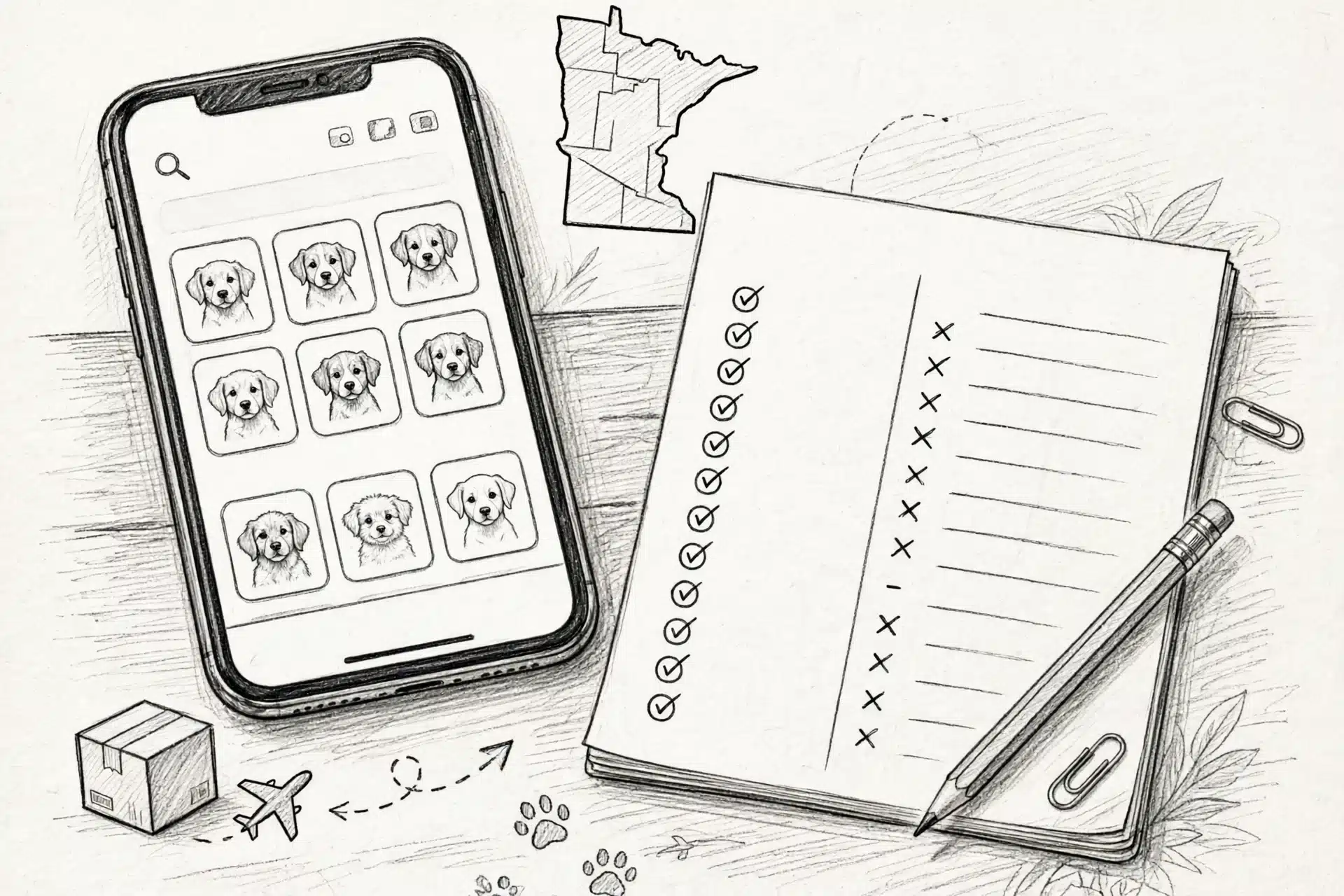
So treat search as a starting filter, not a verdict. Rank tells you who markets well. Verification tells you who breeds well.
Also Read: 7 Puppy Breeder Red Flags First-Time Dog Owners Should Know
Is a Minnesota Puppy Search Enough to Choose a Breeder?
A search results page is a starting point, not a verdict. It tells you who markets well online. It does not tell you how a breeder cares for dogs.
The same caution applies in reverse. A strong search ranking is not proof of quality, and a small footprint is not proof of a problem. Many excellent home-based programs have modest websites. That is why Minnesota families should treat any search results, including reviews of breeders, as a shortlist rather than a final answer.
Minnesota does give you one useful public record. State law defines a commercial breeder as someone with 10 or more adult intact animals who produces more than five litters per year, and requires those breeders to hold an annual state license (Minnesota Board of Animal Health). The Board keeps inspection and licensing information on file, and licensed breeders must include their license number in advertising (MN Statutes 347.58).
Here is the key distinction for families:
- Testimonials tell you what a breeder’s buyers experienced.
- State records confirm a breeder met baseline legal standards at inspection time.
- Neither one guarantees the puppy is right for your home.
A boutique program like Sage Puppies sits below Minnesota’s commercial threshold by design, which is common for small, family-raised programs nationwide. So verify what you can, ask direct questions, and judge breeders on how openly they answer.
A license shows compliance. Transparency shows character. You want both.

You’ve learned how to look past search rankings and verify breeders the right way. If you’d rather skip that homework, Sage Puppies makes it easy: health-tested parents, family-raised Havanese, Havapoo, and Cavapoo puppies, plus nationwide delivery. Visit our Available Puppies page, review how it works, and submit an application today.
Frequently Asked Questions
Q1: What should I look for in a Minnesota puppy breeder?
Look for health testing on the parents, a clean home environment, and a breeder who asks you questions too. Honest breeders share vet records, welcome visits, and never rush a reservation.
Q2: How do I find reputable puppy breeders in Minnesota?
Search Minnesota-specific terms, then check the state’s commercial breeder license list. Programs like Sage Puppies, Blue Star Pups, and Crockett Doodles show how transparency looks: photos, health records, and clear next steps.
Q3: How can I verify a puppy breeder’s reviews in Minnesota?
Treat testimonials on a breeder’s site as marketing. Cross-check with independent sources like the BBB, Google reviews, and Minnesota’s consumer complaint records before you send a deposit.
Q4: Do Minnesota breeders need a license?
Commercial breeders with 24 or more adult dogs and 500 or more puppies yearly need a state license. Smaller home programs are not covered, so check records yourself.
Q5: Should I choose a Minnesota breeder or out-of-state delivery?
Both can work. Many families pick a small breed program elsewhere and use ground delivery or flight nanny services, as long as health records travel with the puppy.
Q6: When should I reserve a puppy?
Good breeders often have waiting lists. Reserve once you’ve verified health testing and read the contract, usually weeks or months before litter pickup.
Conclusion
A search result tells you a breeder exists. It does not tell you if they are good. Testimonials, photos, and rankings are all marketing until you confirm them against independent records. Minnesota makes that easy: any breeder with 10 or more adult intact dogs producing more than five litters a year must hold a license and pass inspections from the Minnesota Board of Animal Health, and you can check that list yourself. A small home program may fall under that threshold, so ask direct questions either way. License numbers, health testing records, and a real conversation about how puppies are raised separate careful breeders from polished websites. Take the extra hour to verify. Your puppy’s first eight weeks shape the dog you will live with for years.



