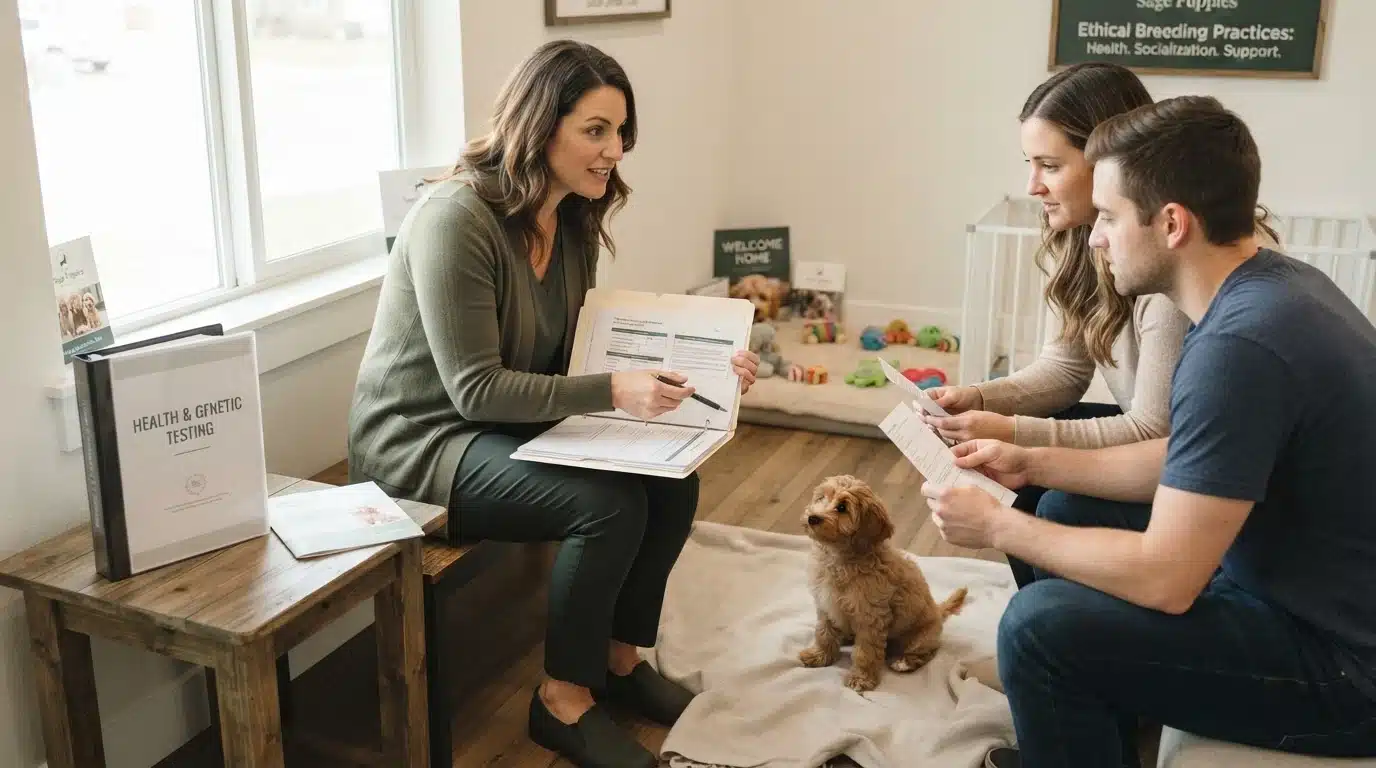
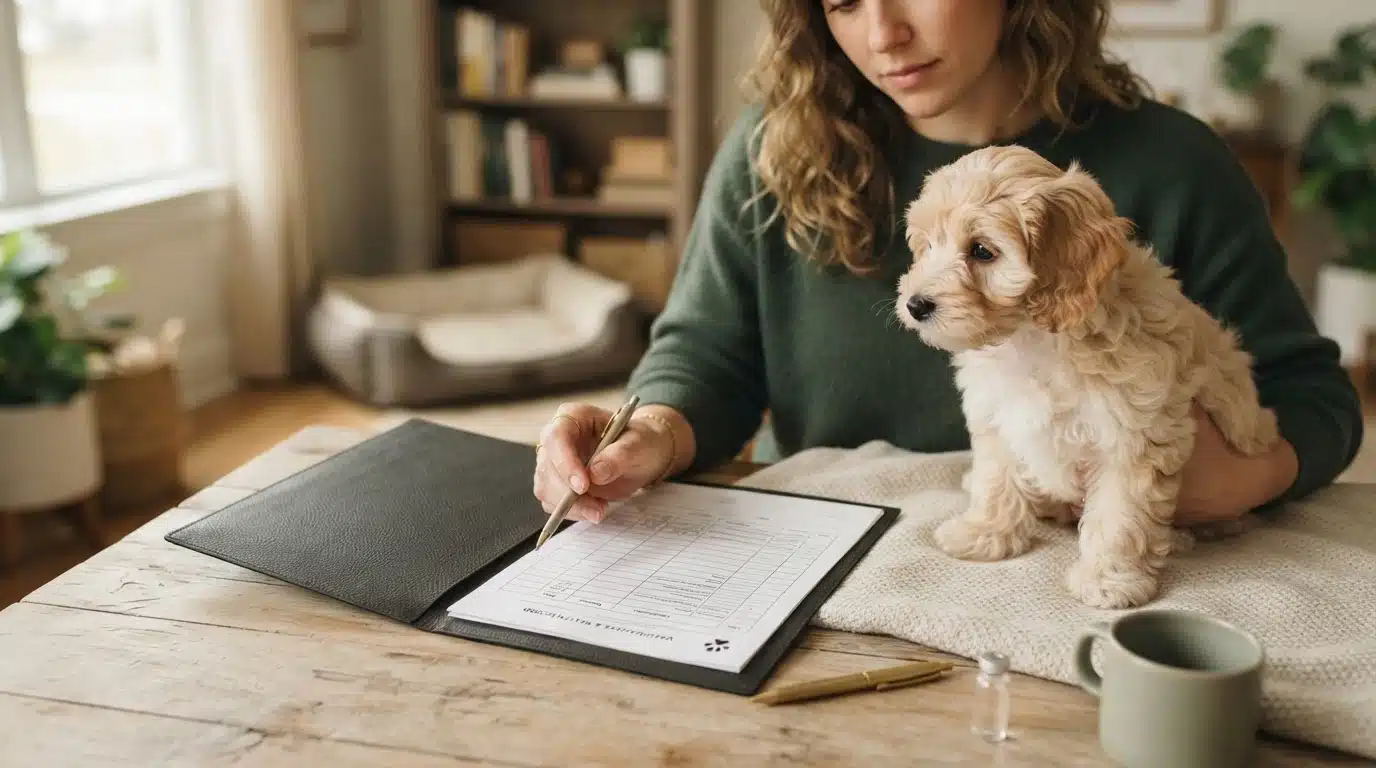
Quick Summary: A real breeder vet check sits on three layers: the puppy’s own exam and vaccine record, each named parent’s clinical screenings (eyes, heart, patellas, hips), and DNA variant results. Ask for all three in writing before any deposit moves, then confirm the puppy’s identifiers and dates against the actual dog, call the listed clinic to verify the visit, and look up each parent in the OFA database by registration number. A health certificate only proves the puppy looked healthy on exam day, not that it will stay healthy, so treat it as one layer of proof and have your own vet read the full file. Sage Puppies, a small South Jordan, Utah program raising Havanese, Havapoo and Cavapoo puppies, builds its workflow around sharing each puppy’s care record and both parents’ screening and DNA results upfront so families can verify everything with their own vet before committing.
A breeder can hand you a folder that looks exactly right: a vaccination card with a signature, a deworming chart, and a page of test results. Two of those documents can still be decades old, belong to a different litter, or name a parent the puppy does not have. That is why a real breeder vet check deserves more than a glance. This guide walks you through vet check verification in three layers: the puppy’s own care record, each named parent’s clinical screening, and DNA variant results. You will learn how to verify breeder vet paperwork step by step, spot documents copied from another litter, and understand what a health certificate honestly proves before you send a deposit. As a small program raising Havanese, Havapoo and Cavapoo puppies in South Jordan, Utah, we built this workflow from the records we keep and the questions families ask us.
Step 1: Separate the Three Record Layers Before You Ask
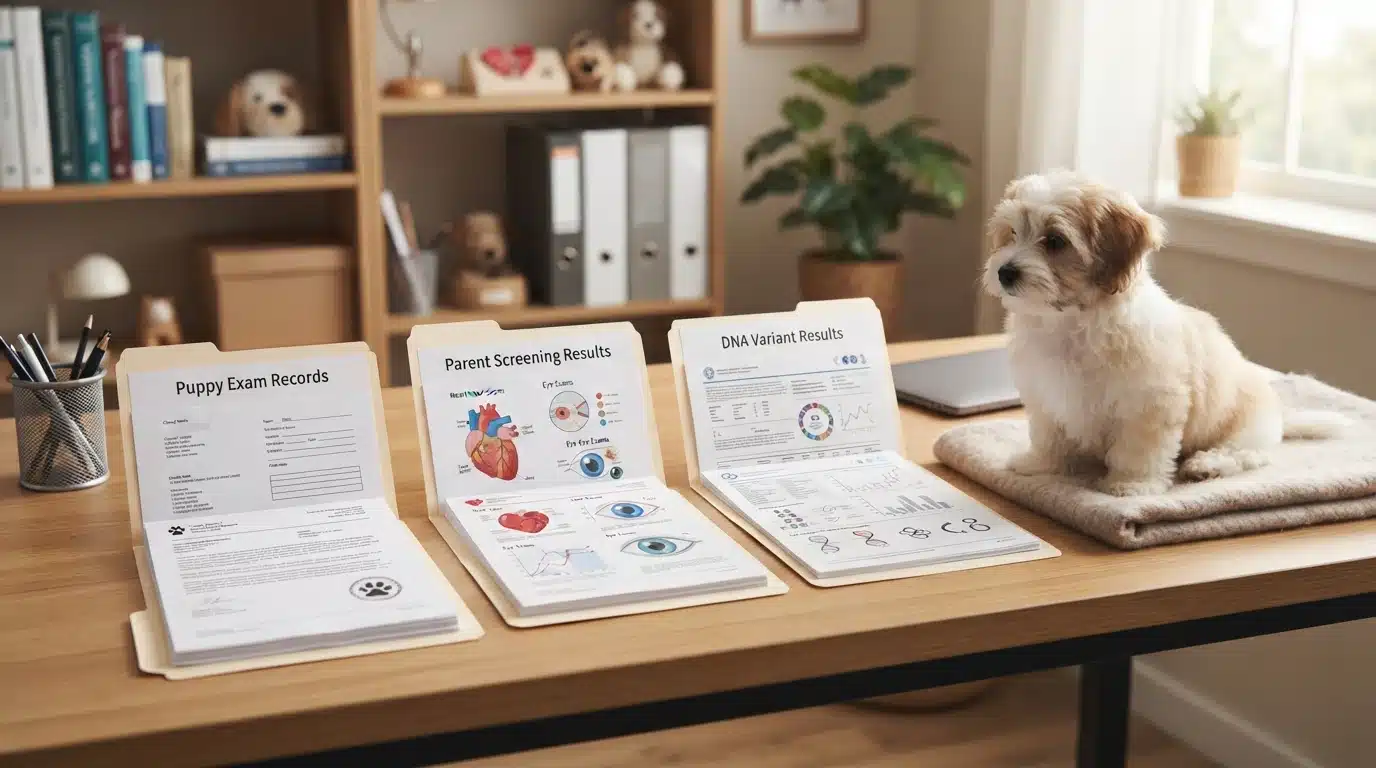
A single “vet checked” answer hides more than it shows. Before you call a breeder, know that real documentation comes in three layers: the puppy’s own exam record, each parent’s clinical screening, and DNA variant results. A strong breeder vet check covers all three, and each one answers a different question. This mirrors what you’ll see in any honest puppy health screening conversation.
The puppy’s own exam and care record
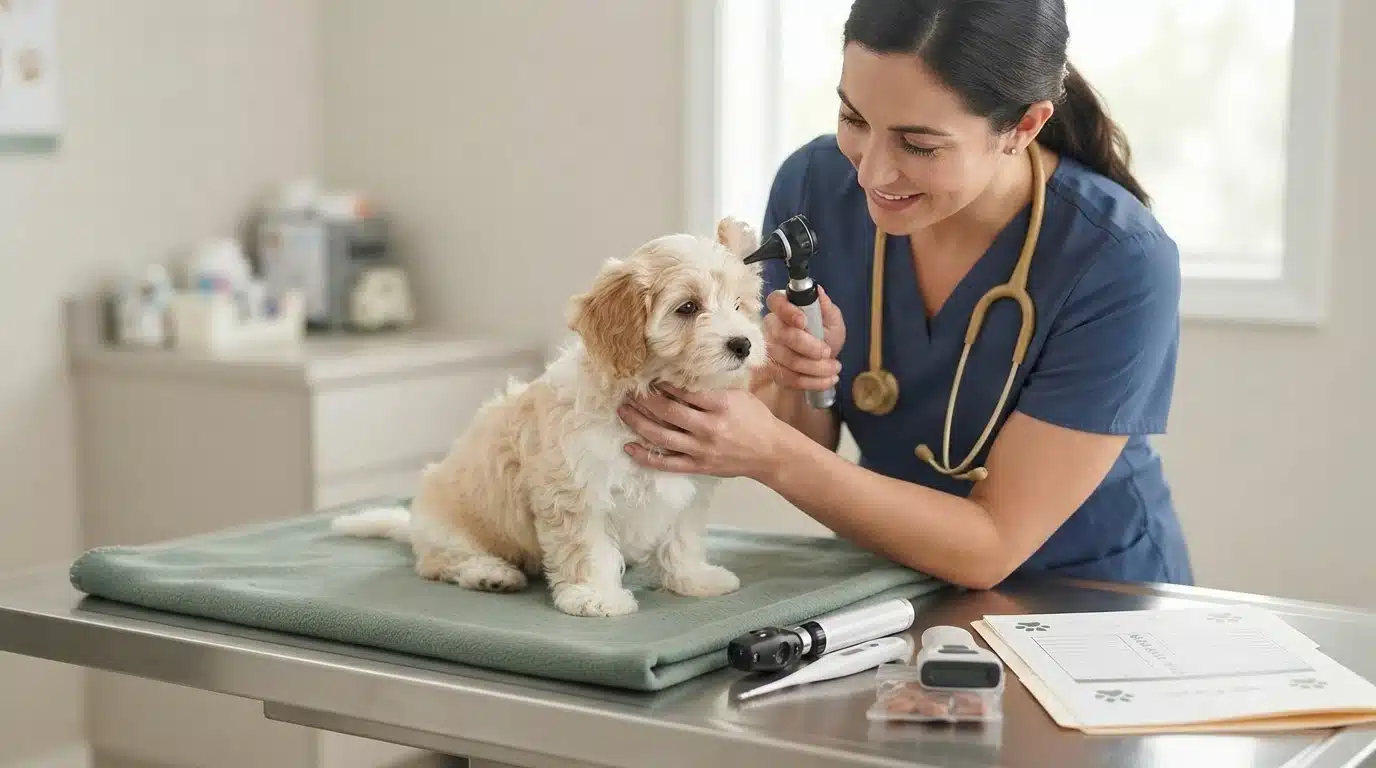
This layer proves what happened to this puppy. It should show a physical exam by a licensed veterinarian, deworming dates, and vaccinations given so far. A certificate of veterinary inspection is an official document issued by an accredited veterinarian after examining the animal. Ask for the puppy’s ID, exam date, and the clinic’s name. Vague summaries without dates or a clinic letterhead are the first red flag.
Each parent’s clinical screening
This layer looks forward. It covers eyes, hearts, patellas, and hips on the dam and sire, usually through exams like OFA eye and cardiac checks. A puppy can look perfect at eight weeks while carrying a heart condition a parent exam would have caught. So ask which screenings each named parent has, when they were done, and at what age. Results should be tied to each dog by name or registration number, not bundled as “parents are healthy.”
DNA variant results
The third layer is genetic. DNA panels test for inherited disease variants common in the breed mix, such as those relevant to Havanese, poodles, and Cavalier King Charles spaniels. Ask which lab ran the panel, which variants were tested, and whether each parent is clear, carrier, or affected. Carrier pairings can still be responsible if the match is planned.
Tip: When you ask, name the layers out loud. “May I see the puppy’s exam record, each parent’s screening, and the DNA results?” Breeders with real paperwork answer quickly.
Step 2: Ask for the Records in Writing Before You Pay
A breeder vet check only counts if you can read it yourself. Get the documents by email or text before any money changes hands, and keep the message thread. A written record protects you later if something in the file turns out to be missing or unclear.
The request to send
Keep the ask short and specific:
- “Please send the puppy’s care record with deworming dates and the first vaccine.”
- “Please send each parent’s vet exam results and the clinic name, if allowed.”
- “Please send the DNA test results for both parents, with the lab’s name.”
Email it, then ask for the files in a reply. Three documents, three requests. A breeder who keeps good paperwork answers the same day. If you want a refresher on what each file should contain, the breakdown of parent screening, DNA tests and puppy records walks through all three.
Before deposit, not at pickup
Timing matters more than tone. Once you pay a deposit, your leverage drops to almost nothing, because the breeder has your money and other families on the list. Ask for records while you are still choosing. Good breeders expect the question and answer it without drama. Some clinics restrict what they share about a parent dog, and that is fair. A summary signed by the clinic, plus DNA results from the lab, still gives you plenty to review. If the full file “isn’t ready yet,” ask for a date in writing.
If the answer is “there is no vet record”
Some answers are honest red flags. “The vet checked them all at once, I don’t have separate papers” means you cannot verify anything. “I’ll email everything after pickup” means you would buy blind. Neither is workable for a family paying several thousand dollars. Walk away and keep looking, because plenty of breeders document every visit.
Step 3: Check the Puppy’s Record Against the Puppy in Front of You
A paper that says all the right things still has to describe one real dog. At pickup, or over video if delivery is involved, hold the record in one hand and the puppy in the other. You are looking for two things: proof that the document matches this animal, and proof that the dates and names inside it make sense.
Match the identifiers to one specific dog
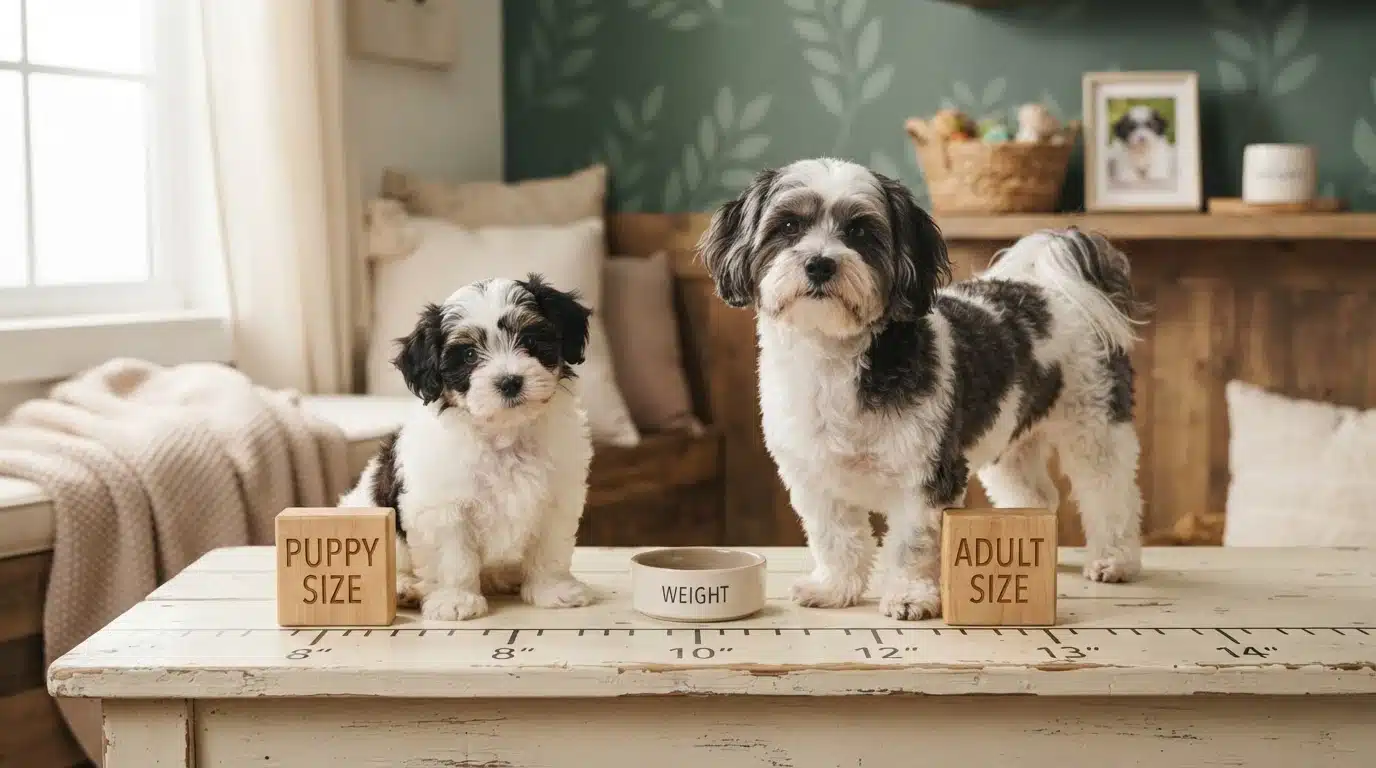
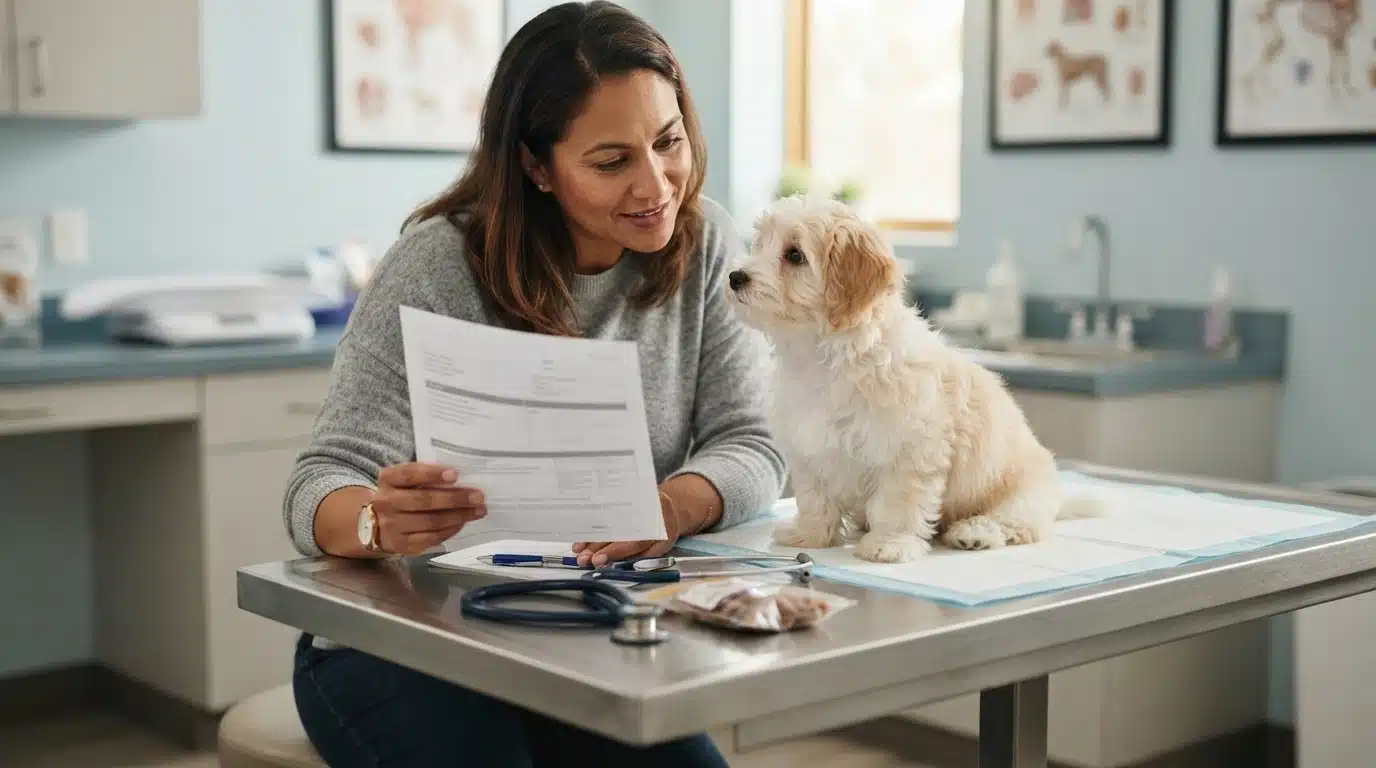
Real records name one dog, not a litter in general. Look for a puppy name or ID, date of birth, breed or mix, and coat description. If a microchip number appears, ask to scan the puppy on the spot; the number should match. Weight helps too. A record dated last week listing a five-pound dog should look wrong next to a chubby ten-pound puppy. Any mismatch does not have to mean fraud, but it deserves a plain question before money moves. Legitimate breeders expect it, and our matching process at Sage Puppies pairs each family with one puppy’s own documented history for exactly this reason.
Read the dates as a sequence
Puppy care follows a timeline. Deworming usually starts around two weeks and repeats every two weeks, and the first round of vaccines lands near six to eight weeks. Check that exam and vaccine dates line up with the birth date and with pickup day. Gaps of weeks, dates written in the same pen, or a first shot dated after the puppy left the litter all warrant a closer look.
Look for a real practice and a real signer
The clinic block matters as much as the findings. A genuine record shows the practice name, address, phone number, and the signer’s name and license. Call the clinic to confirm the visit happened; clinics keep records, and you can request a copy directly. Shaky letterhead, a cell number instead of an office line, or a signer Google cannot find are reasons to slow down. Some states also issue official health certificates through a verified digital portal, which makes confirmation easier.
Step 4: Verify Parent Screening and DNA Results Against Public Sources
Look up the parent’s screening by registration number
Ask the breeder for each parent’s AKC registration number and registered name, then search the records yourself. The OFA database covers millions of dogs, and you can search by name, kennel, or registration number to see every recorded screening result. Match the photo, birth date, and breeder name on the dog’s page to the paperwork you were sent. A scammer can pass off a healthy stranger’s dog by using its name, so the details have to line up. If a parent has no record at all, ask why before you pay anything.

Match requirements to the actual parent breeds
Screening needs differ by breed, so check what the parent actually is. For a purebred Havanese, look for results for patellar luxation, cardiac exams, hearing, and eye conditions. For a Havapoo or Cavapoo, screen both sides: the Havanese or Cavalier parent, and the Poodle parent. Each breed club publishes which tests matter most, and a CHIC listing shows that required tests were completed. One parent’s clean record does not cover the other side of the pair.
Read a DNA report for what it does not cover
A DNA report is a list of tested variants, not a promise of total health. Ask for the full report, not a summary screenshot, and check the lab’s name and the dog’s ID. Many breeder panels test only a handful of conditions, so a clear result can still leave risks untested. Ask which variants were screened and which were not.
Tip: Keep every parent document you receive. If a claim changes later, your own copies settle it. This same habit of checking records yourself applies throughout finding an ethical puppy breeder.
Step 5: Have Your Own Veterinarian Read the Records
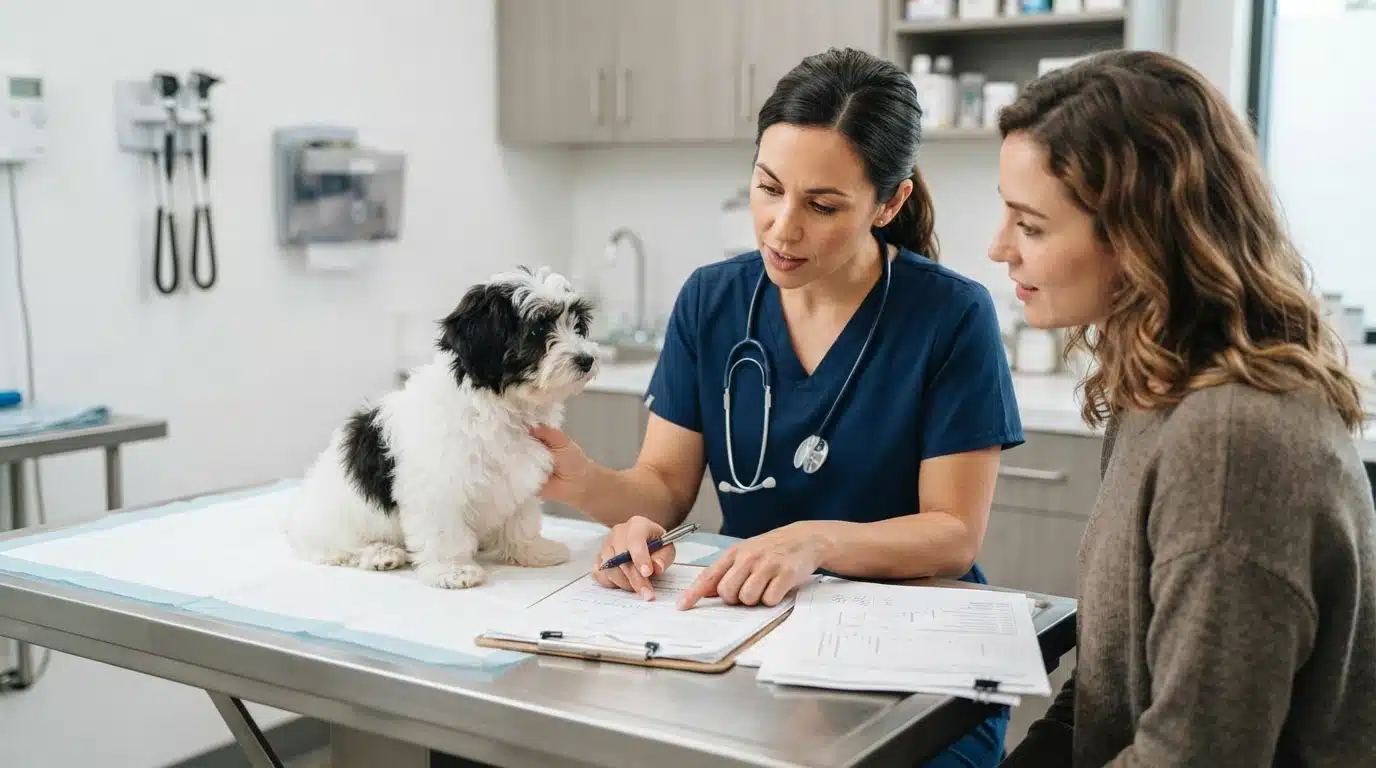
Your vet is your best translator. Hand over everything the breeder sent: the puppy’s exam record, each parent’s screening results, and the DNA report. A licensed vet can spot red flags a first-time buyer would miss, like a heart murmur noted in passing or a parent tested for only one breed’s problems.
How to ask without overstepping
A good breeder expects this step, so ask plainly: “I’d like my vet to review these records before I send the deposit. May I have the full puppy exam record and the parents’ screening results?” Reputable programs, including boutique breeders like Sage Puppies, treat the request as a normal part of matching a puppy to a family. Hesitation or excuses deserve a closer look.
Questions worth asking your vet
Bring a short list so the appointment stays focused:
- Do these exam findings look normal for the puppy’s age?
- Is anything here a red flag, such as a murmur, hernia or low weight?
- Are both parents screened for conditions common to this breed?
- What do the DNA results rule out, and what don’t they?
- What should the puppy’s first vet visit include?
Your vet’s read of the paperwork, plus a fresh exam within days of pickup, gives you the clearest picture before you commit.
What a Health Certificate Can and Cannot Tell You
A clean exam is a snapshot
A health certificate, often called a certificate of veterinary inspection, is a document a licensed vet signs after examining your puppy. It confirms the puppy looked healthy that day and lists current vaccines and exams. That is all it does.
It cannot predict the future. Heart conditions, eye disease, and joint problems often show up months or years later, long after the exam. A certificate also says nothing about the parents’ DNA screening or the conditions the puppy was raised in. So treat it as one layer of proof, not the whole picture. If the paperwork is thin, ask what else the breeder checks; our Cavapoo health records guide shows the fuller set of documents worth requesting.
Reading guarantee and contract terms
The health guarantee is a separate document, and breeders write it differently. Some cover genetic disease for a year or two. Others only promise the puppy was free of illness on pickup day, giving you a short window, sometimes 72 hours, to have your own vet look.
Read it before you pay the deposit. Check what triggers a claim, whether your vet’s written diagnosis is required, and whether the remedy is a refund, a replacement puppy, or vet bill help. A guarantee that no vet could ever satisfy is worth nothing.
Ask the breeder to send a sample contract early. A confident breeder will share it without hesitation.
Walk Away Signs Worth Taking Seriously
Patterns rather than single lapses
One missing document is a question. Several missing documents are an answer. If a breeder can’t show the puppy care record, won’t name the vet who saw each parent, and offers no DNA results, you’re not looking at a paperwork problem. You’re looking at a breeder who may have skipped the care those records would prove. Other patterns worth walking away from: pressure to pay a deposit before you’ve seen any records, excuses that change each time you ask, and a refusal to let your own vet examine the puppy. When a breeder refuses or cannot provide these records, it may point to neglect or absent care. A careful program expects these questions and answers them easily, so treat friction as information.
Legitimate reasons a record may be hard to get
Some delays are honest. A vet clinic may need a day to print records, or the breeder may wait until your application is approved before sharing files that include personal details. Small programs sometimes scan records by hand. Give a reasonable deadline, then judge the response. What is not reasonable: refusing outright, claiming records “don’t exist,” or saying you must pay first. If no records surface, assume there are none, and keep looking elsewhere.
Common Mistakes to Avoid
Even careful buyers slip up when checking health records. Here are the missteps we see most.
- Trusting a photocopy. Ask for the original or a vet-signed PDF, not a blurry photo of a form.
- Accepting records without a clinic name. A real exam lists the practice, address and phone number you can call to confirm the visit happened.
- Confusing a health certificate with screening. A certificate only says the puppy looked healthy that day, sometimes just within a 72-hour window for your own exam.
- Skipping parent records. Ask to see each named parent’s testing, not just the puppy’s paperwork.
- Paying the deposit first. Verify everything before money changes hands.
Ask questions early, and any honest breeder will welcome them.

Check every record before you send a deposit, and expect a breeder who welcomes it. At Sage Puppies, we share each puppy’s care record, both parents’ screening results and DNA findings up front, so you can verify with your own vet, worry-free. Wisely Bred. Beautifully Loved.
Frequently Asked Questions
Q1: How do I verify a breeder’s vet records?
Ask for records in writing before paying a deposit. Then confirm each one: match the puppy’s ID and dates, call the clinic to confirm the visit, and search the OFA database for each parent’s results.
Q2: What vet checks should a breeder do before selling a puppy?
Expect a puppy exam, deworming and first vaccines, parent screenings for eyes, hearts, patellas and hips, and DNA variant testing on both parents matched to the breed mix.
Q3: What health documents should a puppy come with?
A care record with exam, vaccine and deworming dates, a certificate of veterinary inspection, each parent’s screening results, and the full DNA report showing the lab and tested variants.
Q4: Can a health certificate guarantee my puppy stays healthy?
No. It only confirms the puppy looked healthy on exam day. Genetic and joint problems can appear years later, so treat it as one layer of proof.
Q5: What if a breeder refuses to share records before the deposit?
Walk away. Refusing outright, claiming records don’t exist, or demanding payment first are red flags no responsible breeder would show.
Q6: Should my own vet review the breeder’s paperwork?
Yes. Send the puppy’s record, parent screenings and DNA report to your vet, then book a fresh exam within days of pickup.
Conclusion
Verifying a breeder vet check comes down to three layers: the puppy’s own care record, each parent’s clinical screening, and DNA variant results. Get the documents in writing before any deposit changes hands, then match names, dates and clinic details to the actual puppy. Search the OFA database for each parent yourself, and let your own vet read the full file. Remember that a health certificate only proves the puppy looked healthy on one day, so it is one layer of proof, never the whole picture. Expect a breeder to welcome every question, because honest programs keep records they are proud to share.