Quick Summary: Before choosing a Cavapoo puppy, check two separate sets of records: the puppy’s own dated vaccine, deworming, and vet exam paperwork, and the parents’ health clearances for heart, eyes, patellas, and DNA. The puppy’s record should identify that specific dog by microchip or markings, and the parents’ results should be verifiable by name on the OFA database. Confusing puppy-level records with parent-level testing is the main way buyers miss red flags. Sage Puppies shares full parent test results before a family reserves a puppy.
A Cavapoo puppy’s folder often holds a vaccine sticker, a vet-check note, and test results for the parents. Those papers document three different things, and mixing them up causes most of the confusion at pickup time.
The real question is simple: do the records identify your puppy, show dated care, and give your veterinarian a usable starting point? Puppy-level paperwork should list a clear Cavapoo vaccines schedule with dates and product names. Parent-level paperwork should show a verified Cavapoo health clearance, like heart and eye exams. Confusing one for the other is how families miss red flags.
This guide walks you through both, step by step, as a practical Cavapoo puppy checklist. We raise Cavapoos in our South Jordan, Utah home, and we built this review from the questions real puppy families ask us every week.
Start With the Puppy’s Own Veterinary Record
Before you fall for a fluffy face, ask to see the puppy’s own paperwork. A responsible breeder will have it ready, and reading it carefully tells you more about the puppy’s first eight weeks than any photo ever could. This is the record of what the puppy has actually received so far: exams, dewormings, and the first round of the Cavapoo vaccines schedule. Treat it like a report card. Most of it should look routine, and the details are what matter.
Confirm the Record Identifies the Puppy
The first thing to check is simple: does this record describe this puppy? Mixed-breed litters can look alike, so match the identifiers before you trust anything else on the page.
Look for these details:
- Breed and date of birth, which should match what the breeder told you
- Sex and coat color or markings that fit the puppy in front of you
- Microchip number, if the puppy is chipped yet
- A named clinic with an address and phone number, not a blank line
If the paper says “one brown female” with nothing else, ask questions. A complete record usually includes the visit date, the examining veterinarian’s name, and a short description that lets you connect the document to a specific pup.
Tip: Snap a photo of the record during your visit or video call. You will want it later when your own veterinarian compares notes at the puppy’s first checkup.
Here is a quick reference:
| Detail on Record | What It Confirms |
|---|---|
| Date of birth | Age lines up with the shot schedule |
| Description or microchip | The record belongs to your puppy |
| Clinic name and vet | A real exam happened, not a handwritten note |
| Visit date | Care was recent and age-appropriate |
Read the Veterinary Examination as a Dated Snapshot
Every exam entry is a snapshot of one day. A puppy can look perfect at six weeks and still need a follow-up, so read the notes with dates in mind.
A healthy exam note usually mentions clear eyes and ears, a clean heart and lung check, no hernia, good weight, and a normal bite. Write down anything flagged, even minor items like a soft stool. Then ask the breeder what happened next. Good breeders document the answer. At Sage Puppies, every puppy visit goes home with the family, so nothing gets lost between our home and yours.
Check the Cavapoo Vaccination Record and Next Due Date
A good breeder hands over a vaccination record the day you pick up your puppy. That record is your map for the next few months, so read it before you leave.
Verify Each Vaccine Entry
Go line by line. Each entry should show the vaccine name, the date given, and the dose number. Most puppies arrive home with one or two rounds of the core combination shot, usually listed as DA2PP or DHPP. Those letters cover distemper, adenovirus, parvovirus, and parainfluenza, the backbone of any Cavapoo vaccines schedule.
Watch for three things:
- Dates that match the puppy’s age. The first DA2PP dose lands at 6 to 8 weeks, with follow-ups every 2 to 4 weeks until about 16 weeks.
- A clinic or breeder name on each entry. Anonymous entries are hard for your vet to trust.
- Consistent puppy identification. The record should match your puppy, not a littermate.
If an entry says “8 weeks” but the record shows two shots five days apart, ask why. Honest breeders answer questions like this easily and calmly.
Understand Why the Series Continues After Pickup
Many families are surprised to learn their puppy is not “done” with shots at eight weeks. That is normal, not a red flag.
Puppies carry antibodies from their mother’s milk. Those antibodies protect early on, but they also block vaccines from working fully. So the series repeats: doses land roughly every 2 to 4 weeks until 16 weeks, when most puppies get their final DA2PP booster and a rabies shot, which is required by law in nearly every state.
Your job after pickup:
- Book a vet visit within the first few days.
- Bring the breeder’s record so your vet can plan the next dose.
- Ask your vet to confirm the due date for each remaining shot.
Until your vet says otherwise, skip dog parks and areas where unknown dogs roam. Two weeks after the final booster, your puppy is usually cleared for fuller social life.
Keep the paper record safe and ask your vet to log each dose in their system. If your puppy arrives by delivery, request photos or copies of the record before travel day.
A clear record and a planned follow-up schedule mean you can focus on bonding, not paperwork.
Review Parasite Prevention, Microchip, and Care Notes
Beyond shots, a good puppy record shows three more things: a deworming history, an ID number, and notes on daily care. These entries tell you how much attention the puppy actually received before joining your family.
Match Prevention Entries to Dates and Products
Puppies pick up worms easily, so breeders deworm them on a set schedule, often starting around two weeks of age and repeating every two weeks. The record should list each treatment with three details: the date, the product name, and the dose.
Check that the dates follow a steady rhythm. Random gaps or a single entry can mean skipped treatments. Also read the product names. Broad dewormers like pyrantel or fenbendazole are common and safe for young puppies. If the record only says “dewormed,” ask which product was used.
A clean log looks simple: one line per treatment, dated, with a product you can look up. When a breeder keeps records this tidy, it usually reflects how they handle everything else, from feeding to socialization. Our own program keeps this same standard of dated, specific entries for every puppy here in South Jordan, Utah.
Confirm Identification and Written Handoff Details
Every puppy should have a form of identification. Most breeders place a microchip, though some use a small ear tattoo. Either way, the number must appear on the health record exactly as it appears in the puppy. Before you accept delivery, ask the breeder to scan the chip in front of you and match it to the paperwork.
The handoff packet should also include written care notes: the food the puppy eats, the feeding schedule, and the date of the next vaccine due. This detail matters more than it sounds. A puppy switched to new food overnight often gets an upset stomach during an already big week.
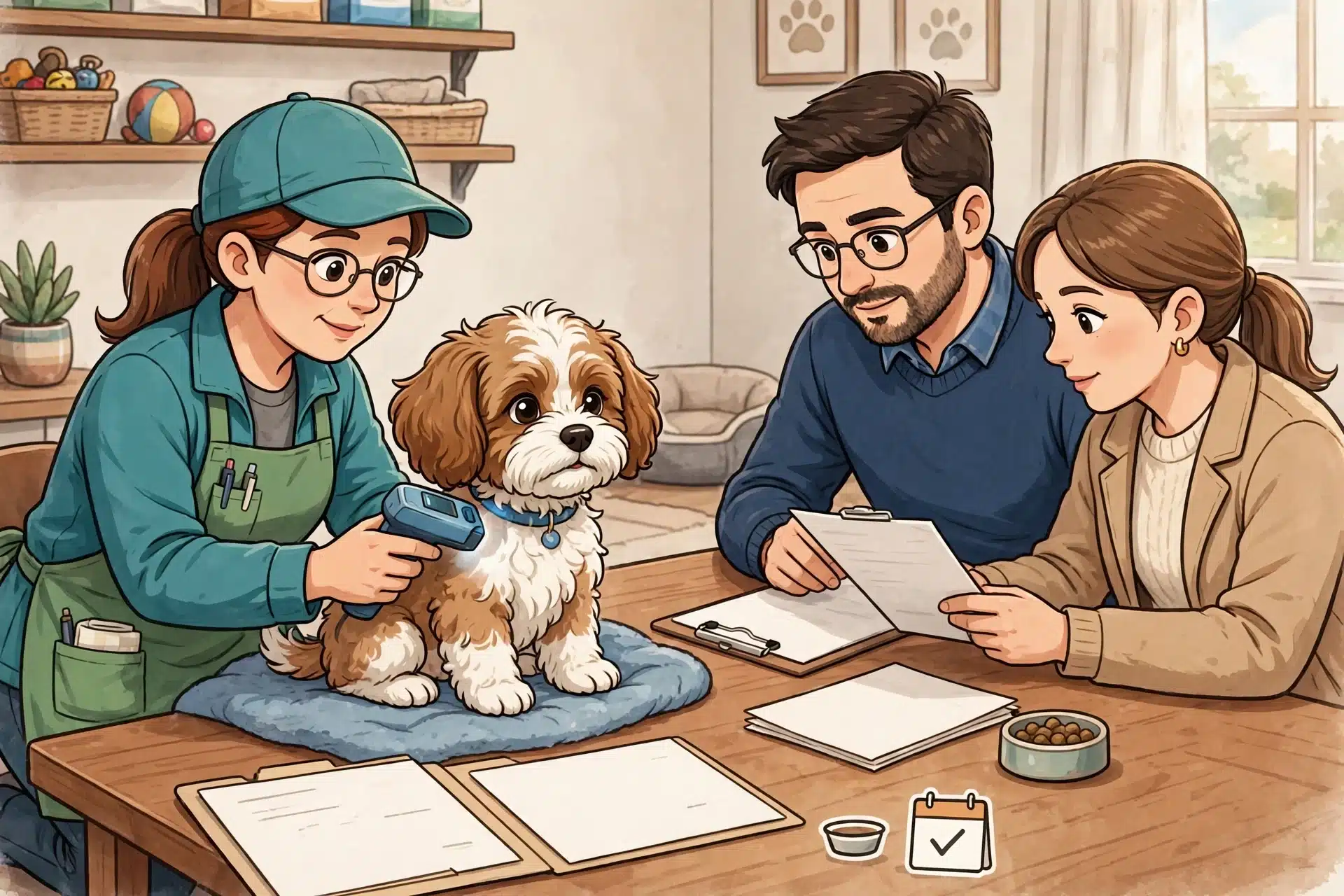
Keep these notes and share them with your vet at the first visit. A written handoff shows the breeder planned for the puppy’s next home, not just the sale.
Quick check: Ask for the chip number, the food brand, and the next due date before pickup day. If any of the three is missing from the paperwork, request it in writing.
Verify Health Testing for Both Parents
Puppy records tell you about the last eight weeks. Parent records tell you about the next 15 years. A Cavapoo inherits health risks from both sides, so the Cavalier King Charles Spaniel mother and the Poodle father each need their own testing. Ask to see both, not just one.
Request Specific Tests and Original Results
“Health tested” means nothing on its own. Ask the breeder exactly which tests each parent completed and request copies of the actual reports, not summaries in a text message.
For a Cavapoo pairing, the core tests to ask about are:
- Heart clearance from a veterinarian, since Cavaliers carry mitral valve disease risk
- Eye exam results, ideally through a board-certified ophthalmologist
- Patellar luxation evaluation, common in small breeds
- DNA panels for conditions known in each parent breed
Ask two follow-up questions for every test. First, who performed it? A general vet visit and a specialist exam are not the same thing. Second, what was the exact result? “Cleared” should appear on paper with a date.
Be careful with breeders who only show DNA results. DNA screening is useful, but it skips the physical exams that catch heart, eye, and knee problems. If a breeder says “fully health tested” and produces nothing but a genetic panel, that is a gap worth pressing on.
A good breeder welcomes these questions and sends documents the same day. Hesitation, vague answers, or claims that testing is “in progress” are reasons to slow down. At Sage Puppies, every parent’s results are shared before a family reserves a puppy, because we think trust starts with paperwork you can actually read.
Match Parent Details in OFA
Paperwork can be edited. The OFA database cannot, at least not by you. OFA is a nonprofit that has tracked canine health results since 1966, and buyers can search it for free to confirm what a breeder claims. The CHIC program exists specifically so buyers can see a breeder’s testing results in one place.
Here is your verification checklist:
- Get each parent’s registered name and OFA number from the breeder.
- Search that name at ofa.org.
- Confirm the results match the copies you were shown.
- Check the test dates. Hip and elbow results are final only at 24 months or older. Eye and heart exams renew yearly, so older results mean the parent has not been rechecked.
- Look for the -VPI suffix on hip numbers, which means the dog was verified by microchip or tattoo. That confirms the test belongs to that specific dog, not a look-alike name.
Watch for two red flags. If a search returns nothing, either the spelling is wrong or the dog was never tested. If a parent has no CHIC number, the breeder completed only partial testing for that breed’s requirements. Neither one is automatically disqualifying, but both deserve a direct question.
If any detail does not line up, ask the breeder to explain it before you commit. Honest breeders expect this and will walk you through the record. For a deeper list of what to ask, see our questions about health-tested puppy parents.
Use This Cavapoo Health Records Checklist Before Choosing
Paperwork tells you more about a puppy than photos ever will. Before you put a deposit down, gather the records, read them closely, and compare what you see with what the breeder tells you. A confident breeder welcomes the questions. Here’s how to work through them.
Ask These Questions Before You Commit
Bring this list to your first real conversation with the breeder. Write down the answers.
- Which vaccines has my puppy received, and when? You want dates, not just “up to date.” Puppies need a series of shots, so ask what’s done and what remains.
- Has a veterinarian examined the puppy? Ask for the exam date and a written health check you can take to your own vet.
- Has the puppy been dewormed? Ask which product was used and on what schedule.
- Can I see the parents’ health test results? Ask for clearances for both the Cavalier King Charles Spaniel and Poodle parents.
- How do you verify identity between records and puppy? Microchip numbers and birth dates should match every document.
- What happens if my vet finds a problem? A clear, written answer here tells you a lot.
Ethical breeders answer these without hesitation. Our health testing approach shows what complete documentation looks like, and it’s a fair standard to expect anywhere.
Know When to Request Clarification
Some answers deserve a follow-up before you commit.
- Vague dates. “Shots are current” is not a date. Ask for the exact records.
- Missing parent test results. If a breeder says testing “was done somewhere,” ask for proof you can verify yourself.
- Records that don’t match. A puppy whose microchip, birth date, or breed mix differs from the paperwork needs explaining.
- Refusal to share. Transparency is standard practice for good breeders. Hesitation is a signal to slow down.
Ask once, politely. Most issues clear up with a simple request. The ones that don’t tell you everything you need to know.

You know what healthy paperwork looks like now. At Sage Puppies, every Cavapoo comes from health-tested parents with records you can review before you commit. Browse our available puppies, ask us anything, and choose local pickup in South Jordan or nationwide delivery. Your well-started companion is one clear step away.
Frequently Asked Questions
Q1: What health records should a Cavapoo puppy come with before pickup?
A responsible breeder provides vaccination and deworming records with dates, a recent vet wellness exam note, and parent health test results. At Sage Puppies, families receive a complete written history so nothing is a surprise.
Q2: How do I verify a Cavapoo breeder’s health testing on the OFA database?
Search the OFA website by the parent’s registered name. Look up hearts, patellas, hips, and eyes, and confirm results match what the breeder told you. Any breeder should gladly share registered names.
Q3: Which vaccinations should a Cavapoo puppy have before going home?
Most puppies leave at 8-10 weeks with their first round of DHPP (distemper, hepatitis, parvo, parainfluenza). Rabies comes later, usually 12-16 weeks. Records should list each vaccine with dates and the vet’s details.
Q4: Should a Cavapoo puppy be microchipped before pickup?
It varies by breeder. If not chipped yet, ask when it will happen, and make sure the chip number appears in writing on your records.
Q5: What health problems should parent dogs be tested for?
For Cavapoos, expect testing for heart issues, patellas, hips, and inherited eye disease. Ask how each parent scored and verify the results yourself rather than relying on a summary.
Q6: Can I get the puppy’s vet exam results before deciding?
Yes. Ethical breeders share the wellness exam details upfront. If a breeder hesitates or promises paperwork “later,” treat that as a sign to keep looking.
Review the Records, Then Plan the Next Step
Good paperwork tells you two separate stories. The puppy’s record covers shots, deworming, and vet checks. The parents’ records cover DNA tests and eye and heart exams that predict the dog’s future health. Check both, match the names and dates, and ask calm follow-up questions when something looks unclear.
You don’t need to be a vet to spot a strong record. You just need to know what should be there. If you want a deeper dive on parent testing, see what to ask about health-tested puppy parents.
Take your time with our health testing approach, compare a few litters, and trust a breeder who welcomes every question.