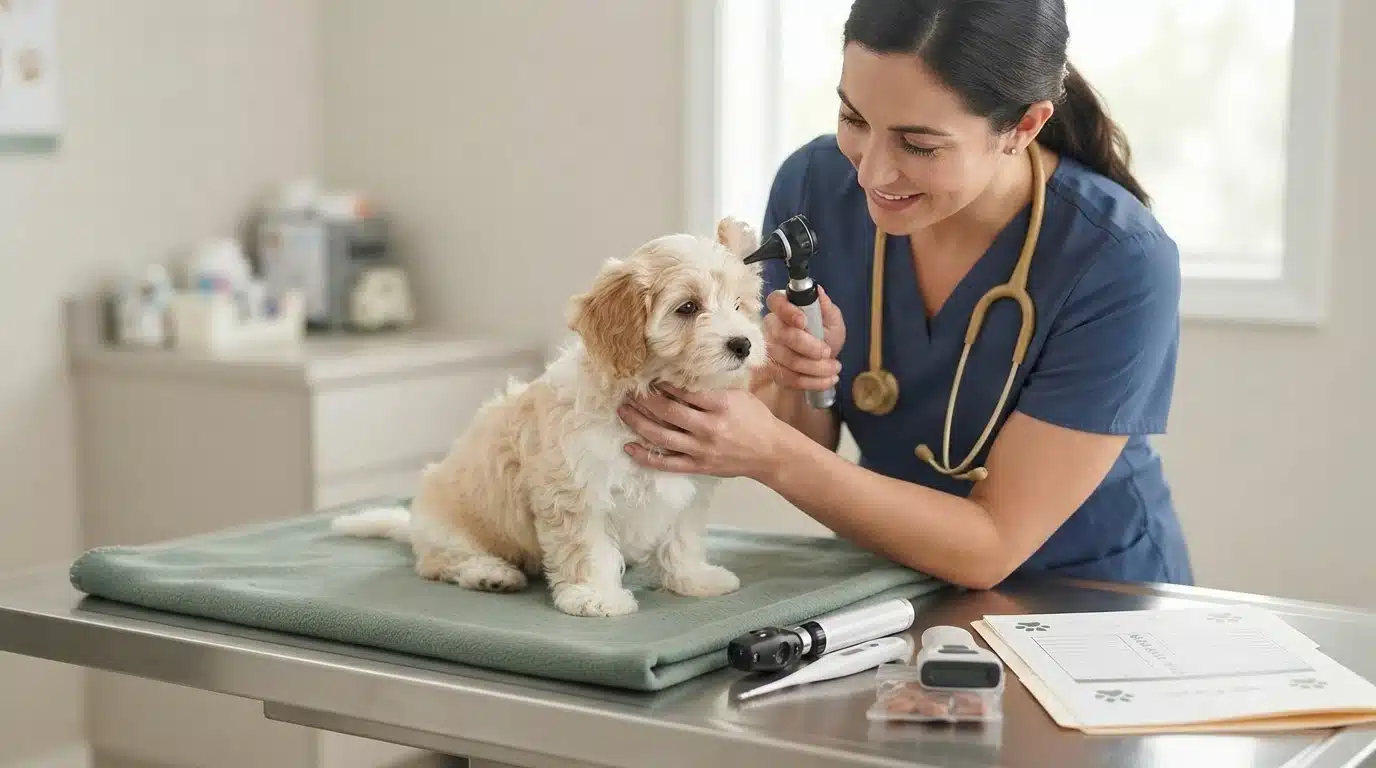
Quick Summary: Health testing and coat testing are not the same thing, and the terms get blurred on purpose in breeder marketing. Health testing covers vet exams, OFA imaging, and DNA disease panels on parent dogs; coat testing only maps color and trait loci like B, E, D, A, K, and MC1R, so a pretty color report tells you nothing about hips, eyes, or heart. Before you reserve, ask which diseases were screened, confirm parent ages and results in the OFA database, and keep the two result types in separate files. Sage Puppies documents both test families for every pairing and shares the records, so buyers can verify claims against breed club standards instead of taking a label at face value.
If a breeder hands you a printout of your Havapoo’s coat colors and calls it a health test, you have been given the wrong document. This is the core of health testing vs coat testing: two separate families of genetic work, and only one screens for disease.
Buyers comparing puppies near them hear both terms used loosely, so it gets hard to know which paperwork actually lowers the risk of a bad diagnosis years from now. This guide lines the two up side by side, explains what each can and cannot tell you about a Havanese, Havapoo, or Cavapoo, and closes with questions worth asking any breeder before you reserve. At Sage Puppies, documented parent testing is part of every pairing, and you can see the details on our health testing page.
Health Testing vs Coat Testing at a Glance
| Health testing (parent clinical screening and DNA variant panels) | Coat testing (coat color and trait DNA panels) | |
|---|---|---|
| Primary Purpose | Reduce the risk of known inherited disease in the next generation | Predict and confirm coat color, pattern, and a few visible traits |
| What It Screens For | Joint, eye, heart, and DNA-linked conditions named by the parent breed clubs | Loci like B, E, D, A, K, MC1R, and a small set of trait modifiers |
| Sample Type | Vet exams, OFA imaging, and cheek-swab DNA panels run by accredited labs | Single cheek-swab sample sent to a coat color DNA lab |
| Who Gets Tested | Parent dogs (and sometimes the individual puppy for DNA variant status) | Parent dogs and individual puppies, often for marketing or confirmation |
| Useful For | Pairing decisions, lifetime health planning, and breeder transparency | Predicting litter appearance and confirming a puppy’s visible traits |
| What It Cannot Do | Guarantee a disease-free dog or rule out every possible condition | Predict allergies, shedding amount, disease risk, or future health |
How Health testing (parent clinical screening and DNA variant panels) and Coat testing (coat color and trait DNA panels) Compare
Health testing (parent clinical screening and DNA variant panels)
Health testing is a layered screening approach. It pairs physical exams and OFA imaging with DNA variant panels to lower the risk of inherited disease in parent dogs and their litters. Breeders use it for pairing decisions and lifetime health planning, while buyers use it to judge a breeder’s transparency. For programs like Sage Puppies, it forms the core of what “health tested” should actually mean.
Key strengths
- Screens joint, eye, heart, and DNA-linked conditions named by the parent breed clubs
- Tests parent dogs, and sometimes individual puppies for DNA variant status
- Cannot guarantee a disease-free dog or rule out every possible condition
Coat testing (coat color and trait DNA panels)
Coat testing is a single cheek-swab DNA panel that maps the genes behind coat color and pattern, plus a few visible trait modifiers. Breeders run it on parents and puppies to predict what a litter will look like and to confirm each puppy’s appearance. It tells you nothing about disease risk, shedding amount, or allergies, so it answers a different question than health testing.
Key strengths
- Covers loci like B, E, D, A, K, and MC1R
- Predicts litter appearance and confirms visible traits
- Works as one simple swab sent to a coat color DNA lab
Why These Two Terms Get Confused
Where the overlap happens in breeder marketing
Both kinds of testing are DNA tests, so the phrase “genetically tested” is technically true for either one. That is exactly where buyers get misled. A coat panel screens for color genes like B, E, D, A, K, and MC1R, while health testing screens for inherited disease. A breeder can say “DNA health screened” and mean only coat traits, and the wording stays accurate.
The confusion is not accidental. “Fully tested,” “health tested lines,” and “genetically cleared” sound like the same promise, but they point to very different lab work. The AKC defines health testing as a comprehensive evaluation of breeding dogs, not a single swab. Experts also stress that a good breeder will show you the actual results and explain them, not just use the label.
Ask one question to cut through it: which tests were run, and what did each one look for? A coat color report is a nice extra. It is not a health screening, and knowing the difference protects your puppy.

This is why we break down what each test actually covers on our health testing page.
What Health Testing Actually Screens For
Health testing looks for inherited disease, not appearance. A breeder’s health claims should map to three kinds of checks, and each one catches problems the others miss. Knowing what each layer screens for is what lets you judge whether a “health tested” parent really was.
The three layers: exams, imaging, and DNA
The first layer is a physical exam by a veterinarian, often an eye exam by a board-certified ophthalmologist and a heart check by a cardiologist. The second is imaging, mainly X-rays for hips and elbows, plus a manual patella (kneecap) check for small breeds. The third is DNA: a cheek swab screened for gene variants tied to specific diseases. The OFA’s CHIC program tracks these results, and dogs must be 24 months old for hip and elbow certification, with cardiac and patellas at 12 months, so timing matters when you read paperwork. A quick explanation of how these results fit together appears on why health testing matters, and the breed-by-breed requirements are listed in the OFA’s CHIC browse-by-breed database.
How breed backgrounds change the test list
Purebred parents get a set list. Breed parent clubs decide which tests a breed needs, so a Havanese parent faces a different panel than a Cavalier: each breed’s CHIC requirements name the exact screens, from cardiac and patellas to DNA-based disease tests. Mixed breeds like Havapoos and Cavapoos inherit the test list of both parent breeds, so a responsible breeder screens each parent against its own breed’s standards. Ask which tests were done for each parent, and why.
What Coat Testing Actually Screens For
A coat panel reads the genes that switch pigment on and off, not the genes that cause disease. The core loci are well mapped: the E locus (MC1R) controls whether a dog can make black pigment at all, and the K locus decides whether that black pigment shows as a solid coat, as explained by the UC Davis Veterinary Genetics Laboratory. The A locus then sorts out where red or tan appears, B turns black to brown, and D dilutes both.
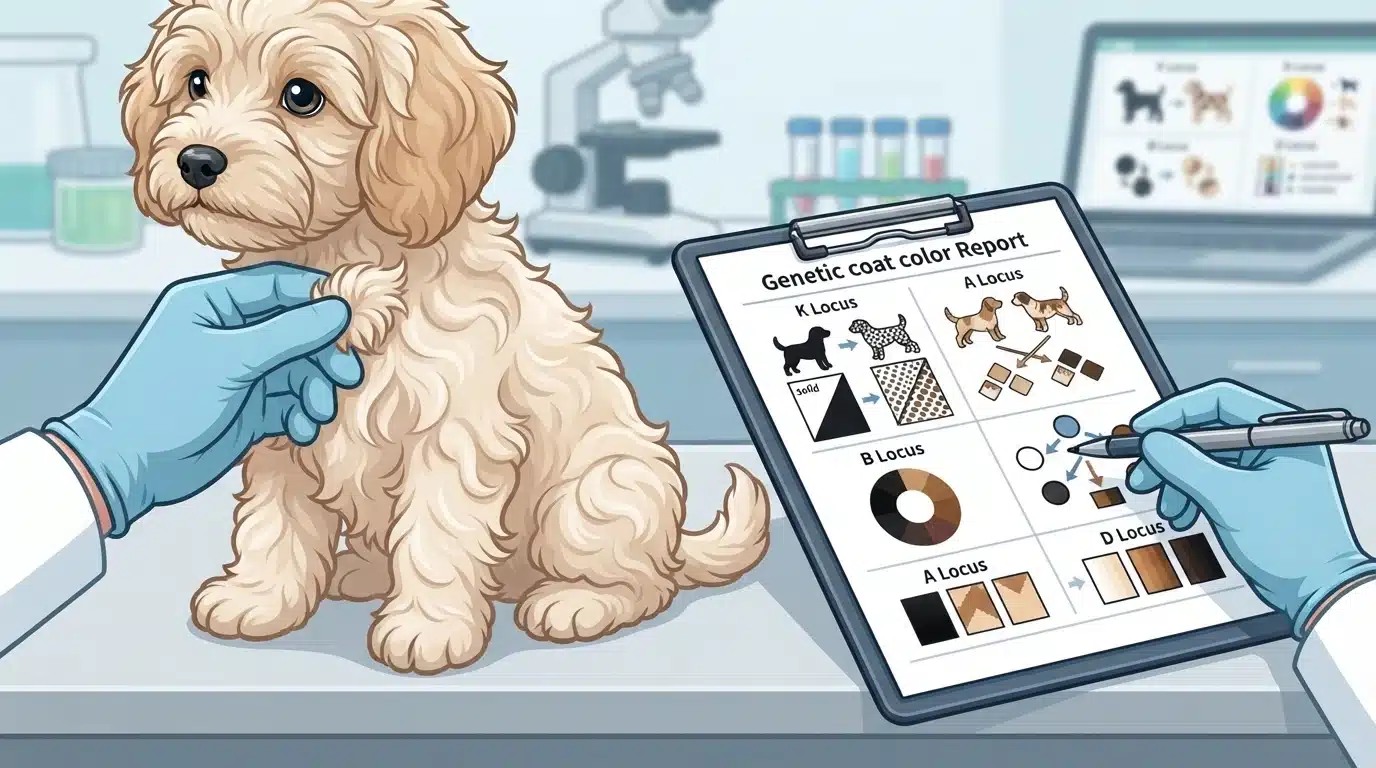
The loci behind color and pattern predictions
Each locus carries one or two variants, one from each parent. Match them up and you can predict a litter’s likely colors before pups are born. A brown-and-tan Havanese pairing works differently from a sable one because the parent genotypes differ. Breeders use the Embark-style E, K, A, B, and D locus results to forecast chocolate, parti, or cream puppies. For how this plays out in one breed, see our Havanese coat and testing overview.
What a coat panel is honest about, and what it isn’t
Coat tests are good at genotype, weaker at the finished look. Known loci explain most base color, but modifiers, fading, and grooming still shape the adult coat, so a “predicted” color is a probability, not a promise. And a coat panel says nothing about hips, eyes, or heart. Treat it as a bonus, never a substitute for health testing.
How the Two Tests Fit Together in a Real Program
Pairing decisions start with health, not color
A responsible breeder runs the health tests first. Hips, eyes, hearts, and inherited disease panels decide whether two dogs should be bred at all. If a pairing carries risk for a breed-relevant condition, coat color never enters the conversation. Once a pairing passes on health, the coat panel becomes a planning tool: it predicts whether the litter will express particolored, sable, or solid patterns that families have asked for. The order matters. Color goals should shape which approved pairing gets used, not whether one happens. At Sage Puppies, Cassie runs both panels on every parent before any breeding decision, so families see the full picture for both test families.

Why the paperwork still belongs to two different files
Keeping the results separate protects everyone. Health clearances usually live in public registries tied to the parent breed club’s standards, and a buyer can often verify them independently. Coat panels come from a DNA lab and describe appearance traits, not disease risk. When a breeder blends the two into one summary sheet, the labels blur, and a color result can look like a health clearance. Ask for the documents listed in the health testing records guide and check which category each one falls in. A cardiac clearance is not a coat report, and a B locus result says nothing about hips.
How to Read a Breeder’s Claims Without Getting Misled
Most breeder websites are honest. Some are just vague, and vague wording can make a coat panel sound like a clean bill of health. The fix is simple: read the claims closely, then verify them in a public database.
Three phrases that deserve a second look
“Health tested” is the biggest one. Ask what tests, on which dogs, with what results. A statement without names and dates is a claim, not a record.
“DNA tested” often means a coat color panel, not disease screening. Remember that loci like B, E, D, A, K, and MC1R describe color and traits, not inherited illness.
“OFA tested” can mean one X-ray, not the full set of exams a breed club recommends. Good breeders welcome the question, and you can check results yourself in the OFA database.

A simple framework for any breeder document
Work through any claim in three steps.
- Name it. Is the claim about health, coat, or temperament? They are different test families.
- Verify it. Look up the parent dog by its registered name. The OFA’s CHIC program publishes real results buyers can read.
- Compare it. Match the tests against the breed parent club’s recommendations for Havanese or the doodle crosses.
If a breeder shares records without hesitation, that says as much as the records themselves. At Sage Puppies, we hand over full parent health and coat documentation before you commit.
Where Each Test Falls Short
Limits buyers most often miss in coat testing
A coat panel tells you what a puppy will look like, nothing more. It cannot predict adult coat texture, how much a doodle will shed, or whether the curl gene really expresses the way a breeder claims. Results also interact: the same B, E, and K loci combine in ways that surprise even experienced breeders, so a “guaranteed” color can still shade or fade as the coat matures. Treat the panel as a forecast, not a promise, and ask how predicted colors match the breed’s written standard.
Limits buyers most often miss in health testing
A clear health panel is stronger evidence, but it has edges too. Some tests report only carrier or affected status for a few DNA variants, while joint, eye, and heart problems have many genetic and environmental causes no panel covers. Age limits matter as well: the CHIC program requires dogs to be 24 months old for hip and elbow certification, so a year-old parent’s “clear hips” may just mean “not yet x-rayed.” A negative result rules out one variant, not all inherited disease.
Walking Away With a Clearer Buying Checklist
The five things to confirm in writing before reserving
Ask for these five items by name, and get answers in writing:
- Health test results for both parents, including eye, heart, and patella clearances, with dates.
- Parent ages, so you can check timing. Hip clearances require the dog to be 24 months old.
- DNA panel reports that separate disease genes from coat genes.
- What the puppy price covers, such as vet exams, first vaccines, and microchips.
- A written health record from the puppy’s own vet visit, not just the breeder’s word.
A program like Sage Puppies’ health testing page lays out what responsible testing looks like for these breeds.
The red flags that mean a coat test is being used as a health screen
Some breeders point to a color DNA report and call the parents “fully tested.” Watch for these moves:
- A single DNA report offered in place of eye, heart, or joint exams.
- The words “health guaranteed” with no named tests behind them.
- Results that list only coat loci like B, E, D, A, K, or MC1R, which describe color, not illness.
- Vague answers when you ask which diseases were screened.
- Pressure to reserve before you see paperwork.
Color results can sit alongside real health testing. They cannot replace it. If a breeder confuses the two, that confusion usually runs deeper than one missing exam.
Which Should You Choose: Health Testing or Coat Testing?
When each test is the right one to ask about
It is not really a choice. Health testing matters for every puppy, because it screens the parents for inherited disease. If you can only verify one thing before you buy, verify this. The health testing records a breeder shares should name the actual conditions their breed club requires, not just “DNA tested.”
Ask about coat testing only when color or coat type shapes your decision. If you specifically want a parti Havanese, a red Cavapoo, or an apricot Havapoo, a coat panel explains what colors a litter can produce. It tells you nothing about hips, hearts, or eyes.
So treat coat results as a bonus, never a substitute. A breeder who leads with “all puppies are health tested” while listing only coat loci like B, E, D, K, or MC1R is showing you color science and calling it health. Read which panel each result came from. That one habit filters most confusing breeder claims.

Want proof, not promises? At Sage Puppies, every parent’s health testing is documented and shared, so you can compare real results against breed club standards. Ask your questions, review the records, and apply when the answers hold up.
Frequently Asked Questions
Q1: What is the difference between health testing and coat testing for puppies?
Health testing screens parents for inherited disease using exams, imaging, and DNA panels. Coat testing predicts color only.
Q2: Can a coat DNA test tell me if my puppy will shed?
No. Coat panels map color loci like B, E, and K, but cannot predict shedding or allergies reliably.
Q3: At what age should parent dogs have hip clearances?
Twenty-four months for hip and elbow certification under OFA CHIC rules. Cardiac and patella checks start at twelve months.
Q4: Is “DNA tested” the same as “health tested”?
No. Both use DNA, but “DNA tested” often means only a coat color panel. Ask which diseases were screened.
Q5: How do I verify a breeder’s health test claims?
Search the parent’s registered name in the OFA database and compare results against your breed club’s CHIC requirements.
Bringing It All Together
Health testing and coat testing answer two different questions. Health testing screens parents for inherited disease through exams, imaging, and DNA panels. Coat testing predicts color loci like B, E, D, A, K, and MC1R, which describe appearance, not illness. When a breeder shares paperwork, sort each result into its own file and match the health tests against your breed’s CHIC requirements. Verify names and dates yourself in the OFA database, and treat any color report as a bonus, never a substitute. Breeders who document both test families clearly, as Sage Puppies does on its health testing page, make that comparison easy.