
Quick Summary: Buyers should demand dated, traceable health records for both parents-matching registered names, test types (like OFA eye/heart/hip exams), and results to the actual sire and dam-before trusting a ‘health-tested’ puppy claim. For example, a Havanese puppy’s parents need current eye and patella evaluations, while a Cavapoo requires cardiac records from the Cavalier parent. Sage Puppies emphasizes this transparency, letting families verify records whether picking up in South Jordan or arranging nationwide delivery. A single ‘health-tested’ label without parent-specific proof leaves room for outdated or missing tests, so always ask for original reports tied to the dogs’ identities.
A promising Havanese, Havapoo, or Cavapoo litter can look reassuring online, especially with the words health tested nearby. The key question is simpler: can the breeder show dated, traceable records for both parents?
Many families searching for health tested puppies see broad claims but never review the proof. That leaves room for missed tests, old results, or records that do not match the parent dogs.
This guide shows you how to check health records before you reserve a puppy. You will learn what parent testing should cover, how to confirm names and dates, and which questions deserve a clear answer.
Sage Puppies works with families in South Jordan, Utah, and across the country who want health tested puppies with a transparent start. Good records help you choose with calm confidence, not guesswork.
Start With the Two Documents That Matter Most
Parent Clearances Versus the Puppy’s Veterinary Record
Ask for two different sets of proof. They answer different questions.
Parent clearances show whether the sire and dam received relevant health screens before breeding. For health tested puppies, look for records tied to each parent’s registered name, microchip, or test number. The OFA database includes screenings such as eyes, heart, patellas, hips, and DNA-based tests.
The puppy’s veterinary record shows care for the puppy in front of you. It should list exam dates, vaccines, deworming, weight, and any findings.
| Document | What it tells you |
|---|---|
| Parent clearances | Risk screening completed before the litter |
| Puppy veterinary record | The puppy’s own early care and exam history |

A clean puppy exam does not replace health testing on both parents. Parent records and puppy records work together.
Ask for Records for Both the Sire and the Dam
Do not accept a general claim that a litter comes from tested lines. Ask to see records for both parents.
- Match each document to the sire or dam’s full name.
- Check the breed, test type, date, and result.
- Confirm that the records apply to the actual litter parents.
- Search available results yourself when possible.
The OFA buyer guidance says breeders should readily provide parent health records, including for an off-site parent. This matters in Havanese, Havapoo, and Cavapoo litters alike.
- Ask what each result means in plain language.
- Flag cropped screenshots with no dog identity or lab details.
- Save copies before sending a reservation.
Sage Puppies families can use this same document check whether they choose South Jordan pickup or nationwide delivery.
Also Read: Puppy Care Blog & Resources | Sage Puppies
Match the Records to the Breed or Parent Breed
A health record only helps if it fits the dog behind it. Ask for each parent’s registered name or microchip number, the test date, and the actual result. The OFA CHIC program uses breed-specific screening plans, so one generic DNA panel does not cover every concern.
Havanese Records to Look For
For a Havanese puppy, review records for both parents, not only the puppy’s wellness exam. Look for current eye and patella evaluations, plus relevant DNA results. Confirm that the name on every report matches the named sire or dam.
- Check the test type, result, date, and issuing lab.
- Ask whether a specialist completed eye or heart exams.
- Treat “clear by parentage” as supporting information, not a replacement for parent records.
A normal result lowers risk. It cannot promise that a puppy will never have a health problem.
Havapoo Records Require Looking at Both Parent Breeds
A Havapoo has Havanese and Poodle heritage. Request the Havanese parent’s records and the Poodle parent’s records separately. Do not accept a single sheet labeled “health tested” without proof tied to each dog.
| Parent breed | Record check |
|---|---|
| Havanese | Eyes, patellas, relevant DNA |
| Poodle | Eyes, patellas, hips where appropriate, relevant DNA |

Use the OFA breed record search guidance to compare names and results when public records are available. If a test is missing, ask why before you reserve.
Cavapoo Records Should Include Cavalier and Poodle Context
Cavapoo records need the same two-side review. Ask for cardiac and eye records for the Cavalier King Charles Spaniel parent, alongside patella and relevant DNA results. The Poodle parent should have breed-fit eye, patella, and DNA records.
- Check the dog’s identity on every report.
- Ask when cardiac screening occurred.
- Review results, not just certificates or logos.
A careful breeder welcomes clear record questions. Good proof should be easy to follow.
Also Read: 10 Must-Ask Questions Before Buying a Puppy Locally
Read the Certificate, Not Just the Sales Phrase
“Health-tested” is a sales phrase until you see records for both parents. Ask for clear copies before you reserve a puppy. A good breeder should welcome careful questions.
Check Identity and Traceability
Match each record to the actual dam or sire, not a similar name.
- Check the registered name, breed, sex, and date of birth.
- Compare the microchip or tattoo number when shown.
- Search the parent in the OFA public database by registered name or kennel name.
- Ask which parent produced your specific litter.
| Record detail | What you want to see | Red flag |
|---|---|---|
| Dog identity | Full registered name and permanent ID | “Mom tested” with no record |
| Parent link | Both dam and sire named | Only one parent is shown |
| Source | Issuer, certificate number, and result | Cropped image with key details missing |
A screenshot of a sales page is not a health certificate.
Check the Test Type, Result, and Evaluator
Read the full result, not just the word clear. DNA screening, orthopedic exams, eye exams, cardiac checks, and patella exams answer different questions. A DNA panel cannot replace a hands-on patella or eye exam.
Look for:
- The exact condition screened
- A final result, such as normal, clear, or passing
- The testing lab or evaluator
- An official report number
OFA explains that its records can include DNA results, hips, patellas, eyes, cardiac exams, and more, with test methods set by veterinary experts in each field. See how OFA records work.
Check Dates and Recurring Screening Requirements
Confirm the test occurred before breeding and that it still fits the test type. Some DNA results stay valid for life. Other screenings may need repeat exams or have age rules.
Ask:
- What date was each parent tested?
- Was the result final or preliminary?
- Is repeat screening due before the next litter?
- Which tests came from each parent breed in a Havapoo or Cavapoo?
If a breeder cannot explain a record plainly, pause the process. Clear proof should make your decision easier, not harder.
Use OFA and CHIC as Verification Tools
Search the Exact Parent in the OFA Database
Ask for each parent’s registered name and OFA number. Then use the OFA Advanced Search to match the record yourself. A kennel name or a puppy photo is not enough.
Check these details:
- Registered name and breed
- Sex and age at each exam
- Test type, such as patella, heart, eyes, or DNA
- Result and date
- Permanent ID suffix, if shown
For a Havapoo or Cavapoo, search the named Havanese, Cavalier, and Poodle parents separately. The database is a record check, not a guess.

Tip: Save the record link or screenshot before placing a reservation. Names can be similar, and a small spelling change may show a different dog.
Understand What a CHIC Number Does and Does Not Mean
A CHIC number shows that a dog completed every health screen its parent breed club requires and that the results were made public, according to the OFA CHIC program.
That is strong proof of openness. It is not a promise that every result was normal or that a puppy cannot develop a health issue.
Use it as a starting point:
- Open the parent’s full OFA record.
- Read each result, not just the CHIC badge.
- Confirm the tests fit that parent’s breed.
- Ask how the breeder used results when planning the pairing.
Know the Limits of Public Databases
A missing OFA record needs a clear answer. Some results may not be public, and some testing may come from another lab.
OFA notes that normal submitted results are public, while owners may choose whether to release some abnormal results. Ask for the original report, parent identity, and test date.
Do not treat a database search as a health guarantee. Treat it as one useful layer of proof.
Also Read: 10 Signs a California Puppy Listing Is a Scam – Sage Puppies
Separate Genetic Results From Physical Examinations
What DNA Testing Can Tell You
DNA testing looks for specific gene variants. It can show whether a parent is clear, a carrier, or affected for a tested condition. That helps a breeder plan pairings that avoid producing affected puppies.
Ask for the full lab report, the parent’s registered name, and the test date. A DNA panel does not replace physical screenings. The OFA explains that DNA tests are best for known disease genes, while many other health risks need other methods.
What Orthopedic, Eye, and Cardiac Exams Can Tell You
Physical exams show how a dog’s body looks and works at that time. They cover risks a DNA panel may not capture.
| Exam type | What it checks | Proof to request |
|---|---|---|
| Orthopedic | Hips, elbows, patellas | Registry result and image or report |
| Eye | Visible inherited eye concerns | Current specialist eye exam |
| Cardiac | Heart murmur and heart structure | Exam report and examiner details |
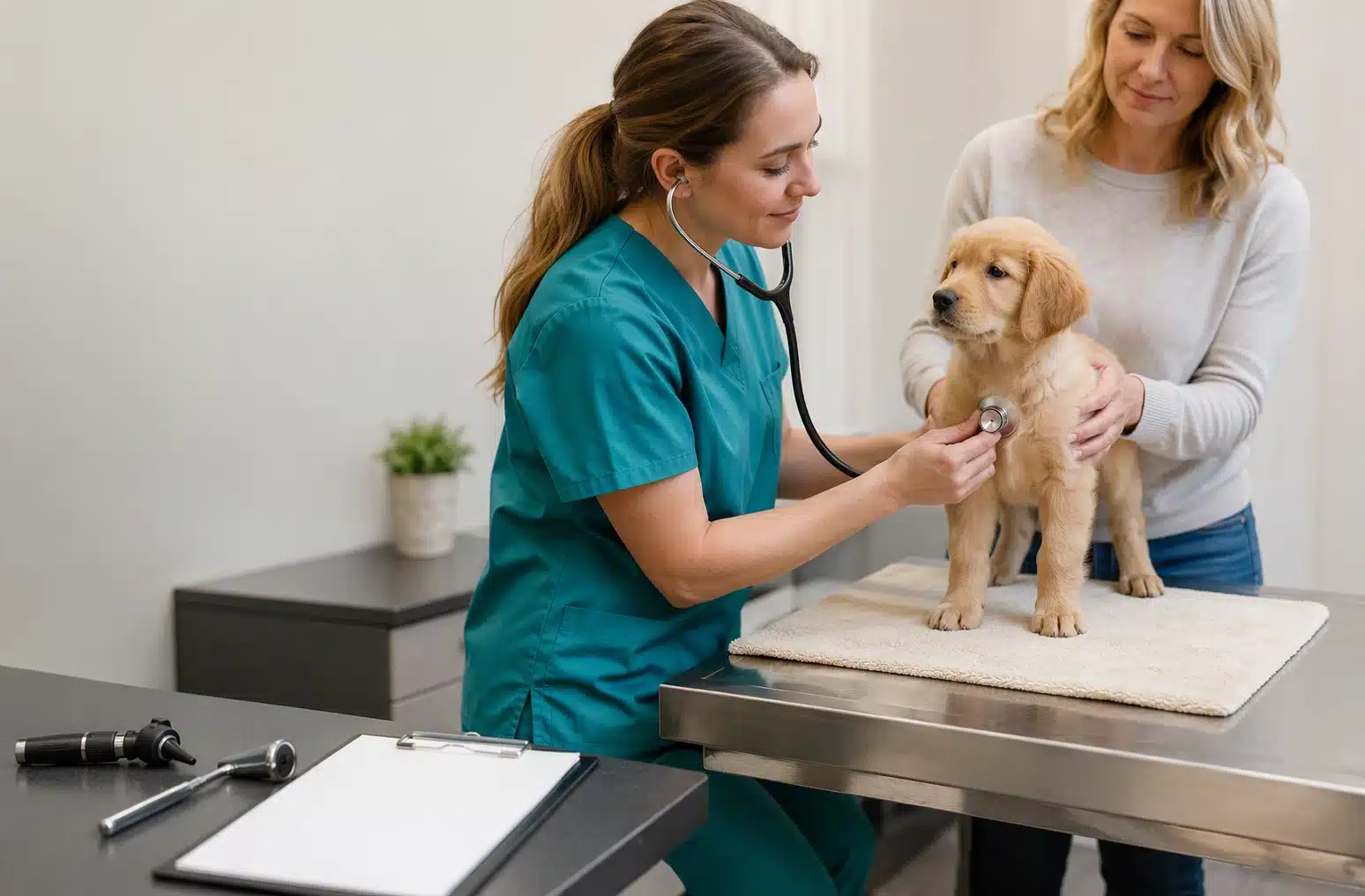
For eye clearances, ask who performed the exam. OFA eye certifications are done by board-certified veterinary ophthalmologists, and they assess the dog’s visible clinical state. See the OFA eye screening overview.
Tip: Match every record to the actual sire or dam. Check the registered name, date of birth, microchip, or registry number.
Why a Normal Result Is Not a Lifetime Guarantee
A normal result lowers risk. It does not promise a puppy will never develop a health issue.
Some conditions appear later. Others involve several genes, or have no available DNA test. Cardiac clearances for adult-onset disease also need renewal because changes can occur after a normal exam.
Choose breeders who use both DNA results and current physical clearances. That is stronger proof than either record alone.
Also Read: Puppies for Sale Near Me: How to Spot Healthy Litters
Ask These Questions Before You Pay a Deposit
A deposit should follow clear answers, not replace them. Ask for records before you commit. A careful breeder should expect thoughtful questions and should ask about your home, too.
Questions About the Parents and the Litter
Ask these questions in writing:
- Who are the sire and dam, and can I see their registered names?
- Which health screens did each parent complete?
- Can I review the actual reports, not just a health-tested claim?
- Where are the puppies raised, and how are they socialized?
- Why was this specific pairing chosen?
- When can the puppy go home?
For a parent who lives elsewhere, request the same proof. The OFA buyer guidance advises buyers to review records for both parents.
Questions About Results and Exceptions
Testing lowers risk. It does not promise a puppy will never get sick. Ask:
- Which results were normal, carrier, affected, preliminary, or pending?
- Are the records tied to the parent’s name and microchip or registration number?
- Can I verify published results through OFA or the testing lab?
- If a parent is a carrier, how was the match planned to avoid affected puppies?
- Were any results not public? Why?
A CHIC number means a dog completed required breed screens with results made public. It does not mean every result was normal, so read the reports yourself. OFA explains this distinction.
Questions About the Contract and Ongoing Support
Read the contract before sending funds. Ask what the deposit holds, when it is refundable, and what happens if the breeder cannot place the selected puppy.
| Contract point | Question to ask |
|---|---|
| Health terms | What is covered, for how long, and what proof is needed? |
| Pickup or delivery | Who handles timing, cost, and travel changes? |
| Return plan | What support applies if my family cannot keep the dog? |
| First weeks home | Can I contact you for feeding, grooming, and training guidance? |
Do not pay until the answers, price, and next steps match the written agreement.
Recognize Strong Proof and Warning Signs
Signs of Strong Documentation
Strong proof ties every result to the actual sire and dam. Ask for registered names, test dates, test type, and the lab or registry record.
- Parent names match the pedigree and puppy paperwork.
- Results show clear pass, normal, or clearance status.
- You can check records yourself through the OFA dog search.
- The breeder explains what each screen covers and its limits.
A health-tested parent lowers risk. It does not promise a puppy will never develop a health problem.
Signs the Evidence Is Incomplete
Be careful with vague claims such as “vet checked,” “DNA tested,” or “healthy lines” without reports. A puppy wellness exam is useful, but it does not replace parent screening.
| Warning sign | Why it matters |
|---|---|
| Cropped screenshots | Names, dates, or results may be missing |
| Results for one parent only | Both parents shape inherited risk |
| No way to verify records | The claim cannot be checked |
| Pressure to reserve first | Good questions should not be rushed |
The OFA advises buyers to ask for parent records and verify them independently.
What to Do When Something Is Unclear
- Ask for the original report or registry number.
- Confirm the dog’s name, microchip, and test date match.
- Pause your deposit until answers are clear.
A careful breeder welcomes reasonable questions. If proof stays vague, choose another litter.
Also Read: 10 Adorable Havapoo Colors You Need to See (2026)
Turn Verified Records Into a Confident Next Step
Your Five-Minute Record Review
Match each parent’s registered name and test number to the report. Check the test type, result, date, and permanent ID. OFA advises buyers to verify parent health records before choosing a puppy.
- Save copies of every record.
- Ask about unclear or missing results.
- Review the written agreement before reserving.
A record should identify the actual parent, not just list a general health claim.
Choose Pickup or Delivery With the Same Clarity
After records check out, choose the handoff that fits your family.
| Option | Confirm before committing |
|---|---|
| South Jordan pickup | Date, meeting details, and take-home paperwork |
| Nationwide delivery | Travel plan, timing, costs, and who handles the puppy |
Ask Sage Puppies to explain the next step in writing, then submit an application when you feel ready.

Ready to review real health records before you choose? Sage Puppies offers home-raised Havanese, Havapoo, and Cavapoo puppies with health-tested parents and a clear family adoption process. View available puppies, ask for the proof that matters, and choose local pickup or nationwide delivery.
Frequently Asked Questions
Q1: What health records should puppy buyers ask for?
Ask for parent health-test results, veterinary records, vaccination and deworming details, and any genetic screening relevant to the breed. Names, dates, and the testing provider should be clear.
Q2: Are genetic test results enough?
No. Genetic results matter, but they are only one part. Ask how the breeder uses results, whether parents were examined, and what care the puppy received before going home.
Q3: Can I verify records myself?
Yes. Check that parent names match the records. Review dates and test types. Ask direct questions if anything is missing, unclear, or does not match the breeder’s explanation.
Q4: Should I meet the puppy’s parents?
Meeting the mother can help you assess her temperament and living conditions. If distance prevents a visit, request current photos, video, and clear details about both parents.
Q5: Does local pickup make verification easier?
Often, yes. A South Jordan pickup lets you review records in person and ask questions. Nationwide families should request the same documents before arranging delivery.
Conclusion
A health-tested puppy search should end with proof, not promises. Review both parents’ records, match each report to the dog’s name or ID, and confirm the test type, date, and result. Ask about breed-relevant screens for Havanese, Havapoos, or Cavapoos, plus early care and the puppy’s own vet records.
A clean report lowers risk, but no breeder can promise a puppy will never face a health issue.
The OFA advises buyers to review parental health screenings and research the breeds they choose. Clear records, direct answers, and careful placement are the signs that matter most.




