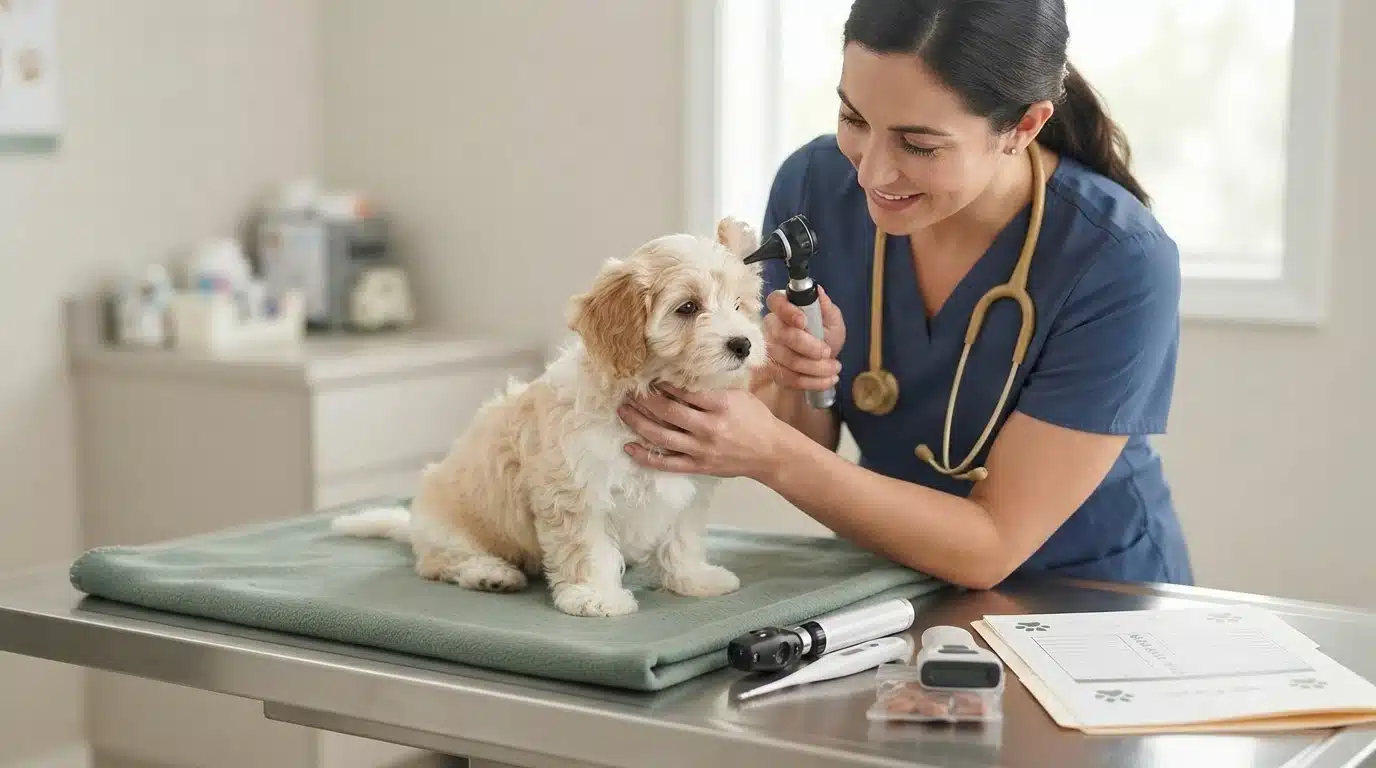
Quick Summary: “Health tested” is only a claim unless you request the puppy’s vet record, both parents’ DNA reports, and their clinical screening results. For Havanese, verify hip, patella, and current eye exam records in the free OFA database, but remember that a CHIC number confirms completion, not necessarily normal results. Crossbreeds need records from both parent lines, and any cropped, outdated, vague, or unverifiable paperwork is a reason to walk away.
When a listing for DNA tested puppies shows up in your search, that phrase covers one piece of documentation, not the whole file. A complete health picture rests on three separate records: your puppy’s own vet exam, each named parent’s clinical screening, and puppy DNA results. Most listings attach only the last one.
That matters because families shopping for a Havanese, Havapoo or Cavapoo are often making a several-thousand-dollar decision based on a single word. Testing is genuinely meaningful, but the vocabulary is unfamiliar, requirements differ by breed, and outdated advice still circulates online.
This guide separates the two approaches you are really choosing between, names the current Havanese screening requirements as a concrete model, and shows which records to request and how to confirm them in an OFA database, so OFA certified puppies are verified, not just advertised. The difference takes about five minutes to check.
DNA Testing vs Parent Clinical Screening: What Each One Actually Proves
| DNA tested puppies | OFA-certified parent screening | |
|---|---|---|
| What it examines | Specific DNA variants identified through a commercial genetic panel | The dog’s actual anatomy and organs through radiographs, patella certification and eye examinations |
| What it can detect | Documented single-gene or named-variant risks for breeds and crosses where markers are validated | Structural and clinical conditions such as hip dysplasia, patellar luxation and eye disease |
| What it cannot rule out | Heritable conditions with unknown genes, multiple-gene conditions and issues that appear later in life | Conditions with no recommended screen, and it lowers rather than eliminates inherited risk |
| How to verify it | Request the lab report with the individual dog’s name and ask how the panel results were interpreted for this breed | Search the dog’s name in the OFA public database; OFA cautions against unverifiable results |
| Breed-specific requirements | No parent-club requirement list; panel content varies by lab and by breed mix | Havanese CHIC calls for an annual eye exam, a hip x-ray and patella certification; BAER was removed |
| Best for buyers who | Want a quick marker check and understand its scope limits | Want documented, independently checkable proof about both parents |
How DNA tested puppies and OFA-certified parent screening Compare
DNA tested puppies
Listings that lead with “DNA tested puppies” are selling a genetic panel result, not a full health picture. The report names specific variants, which is useful for breeds where markers are validated, but it cannot rule out conditions with unknown or multiple genes. Ask for the lab report with the individual dog’s name on it.
- Quick marker check with clear scope limits
- Panel content varies by lab and breed mix
OFA-certified parent screening
This is the breed-club-recommended clinical screening of the sire and dam, recorded in the OFA database and summarized by a CHIC number where requirements are met. It examines actual anatomy through hip x-rays, patella certification and eye exams. Current Havanese CHIC requirements call for an annual eye exam, a hip x-ray and patellas, with BAER removed.

Key strengths
- Independently checkable results in the public OFA database
- Detects structural and clinical conditions such as hip dysplasia and eye disease
What DNA Results Actually Tell You
The questions that make a DNA report useful
A DNA report answers three questions, and each one tells you something different. First, does this puppy carry the variants linked to known diseases in its breed? Second, are the parents clear of those same variants? Third, what do the results not cover, because no panel screens for every condition.
Start with the variant list. Havanese breeders most often test for genes tied to heart muscle disease, cataracts and skeletal problems. A report should name each variant and state a result: clear, carrier, or affected. “Clear” means the puppy has no copies of the variant. “Carrier” means one copy, usually harmless in the puppy itself, but worth knowing before any future breeding.
Then look at the parents. A puppy can only inherit what the parents carry, so a breeder who tests the parents and shows you the results has answered the question before the puppy was born. If a parent is a carrier, the breeder should explain how the pairing avoids producing affected puppies. Ask to see those parent reports, not just a summary.
Finally, ask what the panel does not test. No DNA kit predicts temperament, allergies, hip dysplasia risk with certainty, or lifespan. Those come from pedigree, parent screening and how the puppy is raised.
Here’s what health testing covers in practice, and why it sits alongside, not instead of, clinical screening.
A useful DNA report is specific, tied to named variants, and backed by parent results you can verify.
What Parent Clinical Screening Shows That DNA Cannot
A DNA panel reads a dog’s genes. It cannot see a knee, a hip or an eye. That’s what clinical screening covers: a veterinarian examines the actual parent and records what the body looks like today. Genes load the gun, but an exam shows whether the disease has appeared.
The current Havanese requirements, and what changed
To earn a CHIC number, a Havanese parent needs three things: an OFA hip evaluation, an OFA patella (kneecap) exam, and an annual eye exam by a veterinary ophthalmologist. In May 2022, the Havanese Club of America removed the BAER hearing test from the list, because deafness is rare in the breed, as their own policy page explains.
So if a breeder advertises “four tests,” ask which four. A current, complete record shows hips, patellas and eyes. Hips require the dog to be at least 24 months old, so a young sire may simply be too young to have finished, according to OFA’s own guidance.
Why cross breeds need a different standard
Havapoos and Cavapoos have no CHIC list of their own. Good breeders borrow the parent breeds’ standards instead. That usually means checking poodle lines for eyes and patellas, plus the Havanese or Cavalier requirements on the other side. Ask for paperwork from both parents, not just one.
What a CHIC number does and does not mean
A CHIC number proves the dog completed the required tests. It does not prove the results were normal, since OFA’s CHIC program issues numbers even when some results fail. Always open the dog’s OFA page and read each score yourself.
Asking the right questions about a puppy’s parents makes that step much faster.
How to Check What You Are Being Shown
A certificate or screenshot is only as good as the details on it. Before you take a breeder’s word for anything, look for four things on every document they hand you.
The four details to check on every certificate
First, the dog’s registered name. It should match the dam or sire the breeder described, not a different dog. Second, the registration number (AKC, PAL, or similar). This is what lets you verify everything later. Third, the date of the test and the dog’s age at the time. Hips, for example, cannot be certified until the dog is at least 24 months old. Fourth, the result itself, spelled out clearly: normal, clear, carrier, or affected. If a breeder sends a photo of a certificate with the name or result cropped out, ask for the full document.

Confirming records in the OFA database
Verification takes about five minutes. The OFA runs a free public search, and you can enter a dog’s registered name or registration number in the Advanced Search tool to pull up its results. You do not need an account. If you know the exact spelling of the dog’s name, the lookup is straightforward, as shca.org’s guide explains.
Check three things once the record appears: that the name matches the parent you were told about, that each listed test (eyes, hips, patellas) shows a result rather than a pending status, and that the dog has a CHIC number, which confirms it completed the breed’s required panel. A CHIC listing also records the age at which each test was done.
If a dog does not appear in the OFA database at all, the results were never submitted. That is not a paperwork delay. It is a red flag.
Questions to ask about the dam and sire
Ask the breeder these questions directly, and expect clear answers:
- What DNA variants did each parent test for, and what were the results? Clear, carrier, or affected, per variant.
- Have the parents passed their clinical eye exam by a veterinary ophthalmologist? DNA results do not catch every eye condition.
- How old are the parents, and which screenings are still pending? A young sire may simply be too young for finished hip results, so ask what is done instead.
- Can I see the actual certificates, not summaries? Screenshots with names or results cropped should be a dealbreaker.
- Is there a CHIC report for each parent? It consolidates the tests, results, and ages in one record.
A breeder who has done the work answers these without hesitation and hands over documents the same day. Hesitation, deflection, or “my vet said they’re fine” tells you what you need to know. When you are comparing programs in person or online, the willingness to be checked is itself a health signal, and it is a fair standard to hold any Utah breeder to before you visit a litter.
Where Health-Testing Claims Go Wrong
Most failed purchases do not start with a sick puppy. They start with a listing that looked healthy. The words were right, the paperwork was thin, and the buyer found out too late. Here is where those claims usually break down.
Outdated and recycled health information
Health claims age. A parent’s eye exam from five years ago says nothing about the dog today, because eye certifications must be renewed yearly. Listings also copy old text: a breeder retires one dam, lists the next litter, and forgets to update the parents’ names or test dates. Recycled pages can show testing that was never done on these specific dogs at all.
Check dates before anything else. If a certificate is older than the current litter’s conception, ask which parent it actually covers.

Vague claims and unverifiable paperwork
“Health tested parents” is a claim, not evidence. So is “vet checked,” which often means one quick exam, not screening for inherited disease. The strongest listings name the tests, name the parents, and give you something you can check yourself, such as a registration number you can enter in the OFA database.
Ask for the actual documents: DNA panel results, eye certificates, and hip and patella reports. A breeder who can name each test but not produce results is waving a red flag. The same goes for screenshots with names cropped out, or a “health guarantee” that only covers the first 72 hours. Paperwork you cannot verify on your own is decoration, and our guide to checking puppy listings walks through the verify health testing on puppy listings steps in order.
If a breeder will not share a registration number, assume the test does not exist until proven otherwise.
What a responsive breeder looks like
Good breeders answer slowly and completely, not quickly and vaguely. They explain why each test matters, admit what a parent has not finished yet, and expect you to look them up. For a deeper checklist, see which genetic health tests every puppy should have.
Which Approach Fits Your Situation
You now know the three layers of proof: DNA variant results on the parents, clinical screening through OFA, and the puppy’s own care record. The right question for any breeder depends on which breed you are buying and how the litter was raised.
When to insist on clinical screening
Purebred Havanese litters deserve the full workup. The breed’s CHIC requirements currently call for OFA hip and patella evaluations plus an annual eye exam, after the hearing test was dropped in 2022, according to the Havanese Club of America. Ask for the parents’ CHIC numbers and verify them yourself in the OFA database before you place a deposit. If a breeder says testing is “in progress,” remember that hips cannot be finalized until the dog is at least 24 months old. A very young sire may honestly have nothing to show yet, so ask what the grandparents passed.
Working with a cross-breed breeder
Cavapoos and Havapoos complicate things, because poodle mixes do not have their own CHIC list. A good hybrid breeder still proves both parent lines: Havanese or Cavalier parents with purebred screening records, and poodle parents with their own OFA and DNA results. Ask which health issues each parent breed carries and what was tested for. DNA panels cover known variants, but eye and knee exams catch problems no panel predicts.

Where to go next
Whichever path you choose, the checklist is the same. Verify parent records independently, read the puppy’s own care and vaccination history, and walk away from anyone who resists either. Breeders like Sage Puppies in South Jordan, Utah, work exactly this way with Havanese, Havapoo and Cavapoo litters, so use that standard when you compare. The next section walks through the questions to ask, word for word.

You now know how to read DNA results, OFA listings and puppy records, so use that checklist on every breeder you talk to. If you want Havanese, Havapoo or Cavapoo puppies raised with that same documented care, meet Sage Puppies. Review the health proof yourself, then start the application when you’re ready.
Frequently Asked Questions
Q1: What health tests should I ask to see for Havanese and Havapoo puppies?
For Havanese parents, ask for OFA hip and patella evaluations plus a current annual eye exam by a veterinary ophthalmologist. For Havapoos, request equivalent records from both parent lines, since crosses have no CHIC list.
Q2: What questions should I ask a breeder about the dam and sire’s health testing?
Ask which variants each parent tested for, request actual certificates with names visible, ask whether each parent has a CHIC number, and confirm test dates, since eye exams must be renewed yearly.
Q3: How can I tell if a puppy listing is health tested or a scam?
Look for registration numbers you can verify yourself in the OFA database. Cropped screenshots, “vet checked” wording, and no OFA listing are red flags.
Q4: Do I still need a puppy vet exam if the parents are tested?
Yes. Parent screening covers inherited risk only. Your puppy’s own exam confirms current health, vaccination status and parasite treatment.
Q5: What does a CHIC number actually guarantee?
Only that the dog completed the breed’s required tests. Numbers are issued even when results fail, so open the OFA record and read each score yourself.
Conclusion
“Health tested” is a claim; documents are proof. A complete file has three layers: DNA variant results on both parents, clinical screening through OFA, and the puppy’s own vet and vaccination record. For Havanese parents, that means hips, patellas and an annual eye exam, with the BAER hearing test dropped in 2022. For Havapoos and Cavapoos, ask for records from both parent lines, since crosses have no CHIC list of their own.
You can check almost all of it yourself in the free OFA database in about five minutes. Match the dog’s name, read each result, and confirm the CHIC number. A breeder who welcomes that check has told you something no listing can.