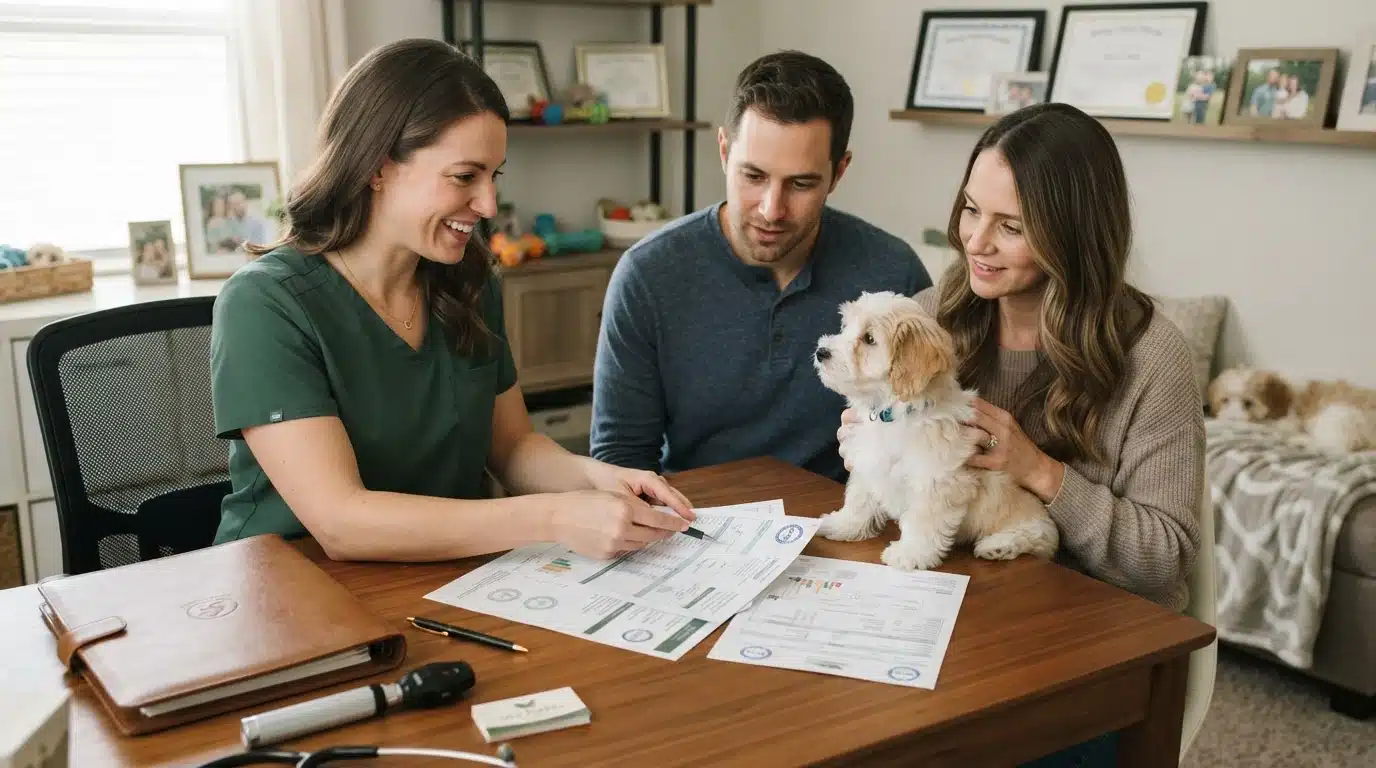
Illustrative veterinary discussion; this is not a Sage Puppies appointment or a record of its parent dogs.
Quick Summary: Parent health screening adds costs before a litter is born, but a price tag does not prove which tests were completed. This guide separates OFA registry fees from an illustrative clinic budget and explains which records to request. A CHIC number confirms required testing and public release of results, not normal results. Confirm the actual tests, dates and results for each parent rather than assuming that an educational article contains Sage Puppies parent records.
Sage Puppies’ current general puppy purchase range is $3,500–$4,500 for Havanese, Havapoo and Cavapoo puppies. When comparing that range with another listing, ask what is documented and included. A higher or lower advertised price alone does not establish testing, health or breeder quality.
This guide explains screening questions, published registry fees and a labeled sample budget. OFA’s filing fees are different from a veterinarian’s charges for exams, imaging, sedation or laboratory work. The clinic amounts below are illustrative planning inputs, not verified local quotes, market averages or Sage Puppies’ expenses.
What ‘Health-Tested’ Actually Covers in a Small-Breed Program
“Health-tested” should identify specific screening completed on the parent dogs, with dated results that can be checked. Ask which tests are relevant to each parent’s breed, size, age and history. Some results can be verified in a public registry; other records may come from the testing laboratory or examining veterinarian.
Records to Ask About for Each Parent
Relevant records may include orthopedic, eye, cardiac, hearing or DNA screening, depending on the dogs involved. There is no single three-test package for every small breed or cross. Use OFA/CHIC resources and veterinary guidance to understand the appropriate screening, then ask for the actual results. A puppy’s routine veterinary check is different from parent screening. Our guide for new owners explains that distinction.
Breeder examining parent dog health certificates and OFA records
What a CHIC Number Does and Does Not Tell You
When a dog finishes its breed’s required tests and the owner posts the results publicly, OFA issues a CHIC number. Here is the catch: the number confirms the tests were done, not that they passed. As the Siberian Husky Club notes, a CHIC number alone implies no normal results. Read the actual scores.
Why Testing Reduces Risk Rather Than Promises Health
No breeder can guarantee a puppy will never get sick. Genetics shuffle, and some conditions have no test yet. What screening does is stack the odds: clear parent DNA tests lower the chance of inheritable disease, and healthy hips and eyes in both parents lower them further. Think of testing as risk reduction you can verify, which is why honest breeders talk in probabilities, not promises.
Breed-Specific Screening Panels That Drive the Higher Price
The screening questions differ with the ancestry and individual parents. Treat the sections below as questions to discuss with a breeder and veterinarian, rather than a current, universal required panel. Confirm the applicable breed-club and registry recommendations before evaluating a pairing.
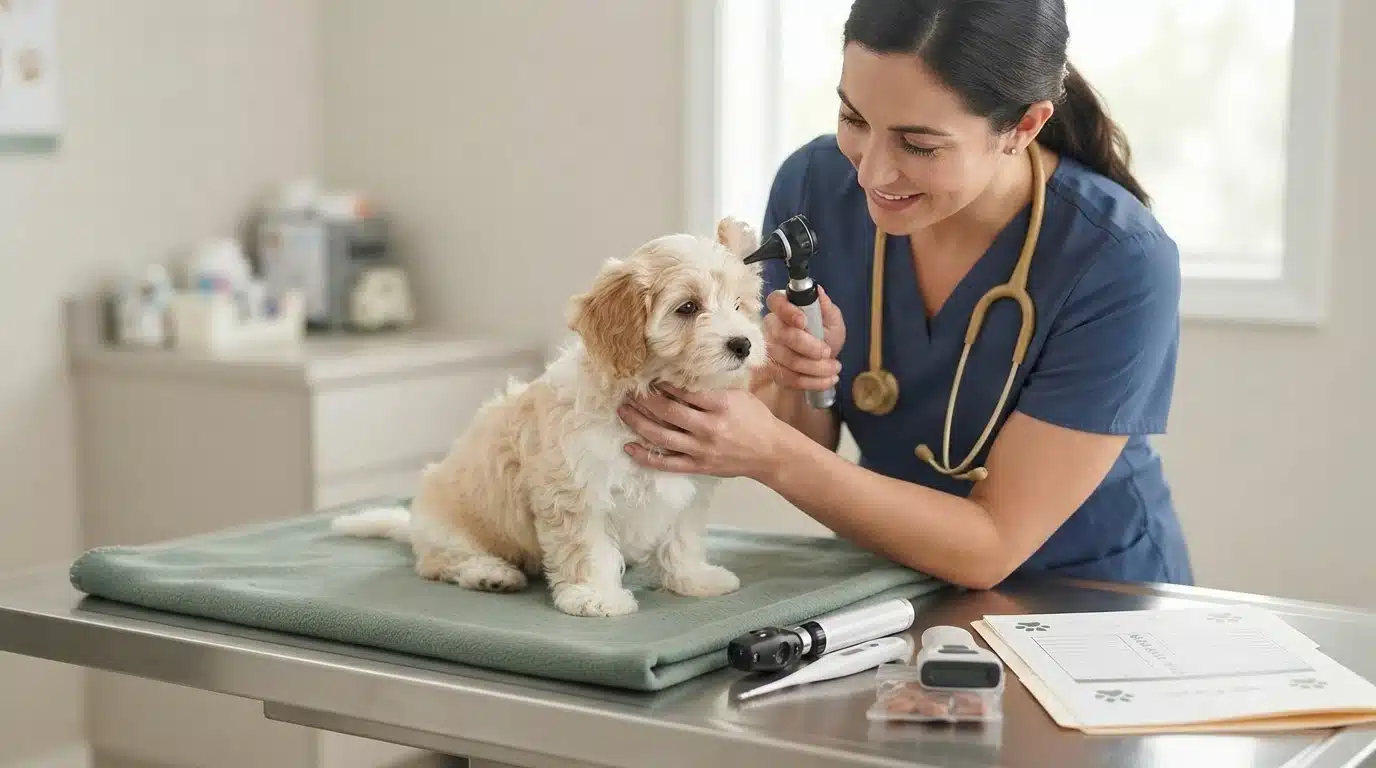
Veterinarian examining a Havanese’s knees
Havanese Parent Screening: Confirm Current Recommendations
For a Havanese parent, ask which current Havanese breed-club and OFA recommendations were followed and request the relevant dated reports. Confirm which evaluations need repeating and how age affects interpretation. The illustrative imaging and eye-exam allowances later in this guide are not a verified Havanese testing package or evidence of Sage spending.
Havapoo Parent Panel: Two Breeds in the Pedigree
For a Havapoo, discuss the actual parents’ Havanese and Poodle ancestry, including Poodle size where relevant. Ask which screening and inherited-variant tests are appropriate for those dogs and why. An ancestry label or a commercial DNA panel alone does not establish that all relevant risks were assessed.
Cavapoo Parent Panel: Cavalier and Poodle Together
For a Cavapoo, ask about screening relevant to both Cavalier and Poodle ancestry, including cardiac questions and the individual parents’ history. A veterinarian can explain the appropriate methods, specialists and repeat intervals. The $150–$300 cardiac-exam allowance used below is a sample budget input, not a verified clinic quote or universal charge.
PennHIP vs OFA: Which Hips and What Age
OFA and PennHIP evaluate hips in different ways. The 24-month minimum discussed here applies to final OFA hip certification; it is not a minimum age for every health test or registry. Preliminary hip evaluations and other screening programs have their own rules. Ask the examining veterinarian to explain the method, timing and result. Our breed health comparison offers further questions to discuss.
What Each Test Actually Costs the Breeder
Separate the clinical work from any optional or applicable registry filing. A veterinary or laboratory invoice and a public registry entry are different records. OFA’s published schedule lists its submission fees; it does not establish all clinic charges.
Radiographs and OFA Submission Fees
The veterinarian determines the imaging and sedation plan and quotes those charges. In the sample budget below, imaging and sedation use a hypothetical $400–$700 allowance. Separately, OFA’s fee schedule lists $45 for a final hip submission and $35 for a preliminary hip submission.
Patellar Luxation, Cardiac, and Eye Evaluations
OFA’s published individual filing fees include $15 each for patellar luxation, basic or advanced cardiac registration, and the Eye Certification Registry. Those fees do not include the clinical examinations. The $150–$300 cardiac and $100–$150 eye-exam amounts below are illustrative allowances, not verified prices or repeat schedules.
DNA Panels for Breed-Relevant Variants
Ask for the laboratory, named tests, results and an explanation of what each result means for the proposed pairing. A panel does not cover every inherited condition, and a result must be interpreted for the condition and inheritance pattern involved. OFA lists a $15 filing fee per DNA-based test result; the laboratory’s testing charge is separate.
Illustrative Budget: One Parent Dog, Selected Costs
This arithmetic example uses these hypothetical inputs: imaging and sedation, $400–$700; OFA hip filing, $45; three $15 registry entries, $45; cardiac exam, $150–$300; eye exam, $100–$150; and DNA testing, $200–$400. The sum is $940–$1,640. It is not a market average, a minimum required panel or Sage Puppies’ cost record. It may omit other examinations, travel and repeat work; obtain actual quotes for the relevant tests.
The Hidden Costs Buyers Rarely See in a Price Tag
Health testing is only the part you can look up. A breeder’s real expenses run for years before a single litter is born, and they explain most of the gap between a $4,000 puppy and a $1,200 one.
Keeping a Dam Across Multiple Heat Cycles
Breeders support their dogs before, between and after litters, with timing and care guided by the individual dog and veterinarian. The 24-month rule in this guide concerns final OFA hip certification in either sex. It does not mean that a female cannot have any health screening before that age, and it establishes no Sage breeding schedule. The AKC’s responsible breeding guide provides broader planning context.
Dogs Who Screen Out and Never Produce a Litter
Screening is a gamble the breeder always pays for. A dog can fail hips, flunk a cardiac exam, or carry a gene the panel flags, and then never produces a puppy. That dog still cost the same to buy, feed, test, and train. Those sunk costs get spread across the litters that do happen, which is why healthy litters carry the weight of the ones that never came.
Breeder training a young Havanese in a sunny backyard
Prenatal Care, Whelping Support, and Early Socialization
Once a litter is confirmed, the spending climbs. There are pregnancy ultrasounds, x-rays to count puppies, and often a c-section for small breeds. Whelping means weeks of night checks, deworming, first vaccines, and a vet visit for each puppy. The ASPCA’s breeder criteria also call for daily handling and early socialization, which takes hours of a person’s time every single day.
Why Cutting These Corners Drops the Price
Every skipped step removes cost and risk from the breeder, not from you. Skip the eye exam, breed every heat, or crowd puppies without handling, and the price drops fast. But the risk lands on your family as a sick puppy or inherited disease. Breeders who price their puppies honestly are covering work you would otherwise pay for later, in vet bills and heartache.
How Health Testing Lands in the Price of a Havanese, Havapoo, or Cavapoo Puppy
The testing bill is only half the story. The other half is whether the results actually exist, and a serious breeder makes them easy to check.
Couple reviewing puppy listings at kitchen table
What a Buyer Should Be Able to See in a Real Listing
Ask how to obtain each parent’s identifying details, relevant test dates and actual results. Where results have been published, verify the record directly rather than relying on a screenshot. OFA’s prospective-owner resources explain public-record checks. This article does not establish which Sage parent records are public or when a particular record will be supplied; ask the owner about the individual pairing.
Five Questions That Separate Testing From Marketing
Ask for these five answers before you send a deposit:
Question
What a good answer sounds like
What is the parent’s OFA number?
The parent’s identity and a dated result for the relevant test
Which DNA panel was used?
A named panel with results by disease
When was the last eye exam?
A dated report and the applicable repeat-screening recommendation
Can I verify this myself?
A public entry where available, or a way to verify the laboratory or veterinary report
Why was this pairing made?
Specific health reasons, not “great bloodlines”
Each “we’ll send that later” costs you leverage. Answers should arrive before payment, not after.
What This Guide Does Not Promise
Health screening can inform decisions and reduce risk for the conditions assessed, but it cannot guarantee a puppy’s future health. A sample budget or a large invoice is not proof that an appropriate test was performed or that a result was normal. Read the actual reports and discuss uncertainties with a veterinarian.
Reading OFA Records the Way a Breeder Reads Them
Search by Registered Name, Not by Call Name
Open the OFA search page and type the parent’s full registered name, such as Sunrise Acres Sweet Magnolia. A call name like “Maggie” won’t return anything. If you only have the call name, ask the breeder for the registered name and match the birth year. The right record should show the breed, sex, and owner’s region you’d expect.
Preliminary vs Certified, and What the Codes Mean
Read the dog’s identity, test name, age at evaluation, date and actual result. A preliminary hip evaluation is different from final OFA hip certification, which requires an age of at least 24 months. Other tests have different requirements. Use OFA’s explanations for the specific record rather than treating every code or missing entry as the same finding.
What CHIC Means on the Public Record
A CHIC number appears when a dog completes its breed club’s required tests and the owner agrees to publish results, pass or fail, per OFA’s CHIC program. So a CHIC number proves testing happened and stayed public, not that every result passed. Check each entry’s grade before you celebrate.
Common Mistakes Buyers Make When Comparing Health-Tested Prices
The math only helps you if you read it right. These four mistakes cause buyers to overpay for paperwork or undervalue real screening.
Mistake 1: Treating “Health-Tested” as a Single Label
Ask “tested for what?” and compare the actual work and results for each parent. One DNA panel is different from a broader screening history, but no single package or spending amount proves quality. The $940–$1,640 figure above belongs only to the illustrative budget and must not be presented as every breeder’s cost.
Mistake 2: Trusting Screenshots Over Public Records
A screenshot of an OFA result is easy to fake or crop. Real certifications live in OFA’s public database, searchable by the dog’s registered name or number. Type it in yourself. If the breeder cannot or will not share the registered names of both parents, treat that as a red flag and keep looking.
Mistake 3: Reading CHIC as a Clean Bill of Health
A CHIC number does not mean the dog passed everything. The Canine Health Information Center simply confirms the required tests were done and results were released, good or bad. A dog can carry a failing hip score and still hold a CHIC number. Open each individual result, not just the badge.
Mistake 4: Letting a Deposit Lock You Out of Reports
Some buyers pay the deposit first and ask for paperwork later. Reverse that order. Verify the parents’ records before money changes hands, and skip any seller who releases health reports only after you commit.
Where to Go From Here If This Matches What You Want
If health-tested parents and honest pricing are what you’re after, three steps move you forward.
Step 1: Read the Health-Testing Guide
Our educational health-testing guide explains documentation questions. It is not an individual-parent results database or proof that a specific test was completed. Request the actual records relevant to the pairing you are considering.
Step 2: Browse Current Availability
Litters are small and planned, so the current puppy availability list changes often. Check which puppies are ready now versus coming soon, and note whether a Havanese, Havapoo, or Cavapoo fits your home.
Step 3: Complete the Application
Use the puppy application to share your household, schedule and preferences. Completion time varies. The owner can explain current availability, documentation and next steps; an application is not a promise of approval or a reservation.
Sage Puppies homepage
That math explains the price gap. If a health-tested Havanese, Havapoo, or Cavapoo fits your family, see how our application and matching process works at Sage Puppies, then ask any breeder the same screening questions.
Frequently Asked Questions
Q1: why health-tested puppies cost more
Screening adds clinical, laboratory and possible registry costs, along with ongoing care. This guide’s $940–$1,640 total is one illustrative set of inputs, not a verified average or Sage expense record.
Q2: How do I verify a breeder’s health testing?
Ask for the parent’s identity and dated test reports. Verify publicly listed OFA results where available, and ask how to confirm other laboratory or veterinary records.
Q3: Does a CHIC number mean the puppy is healthy?
No. CHIC only confirms required tests were done and published, pass or fail. Read each individual result.
Q4: What questions should I ask before paying a deposit?
Ask which tests are relevant to each parent, when they were performed, what the results mean, how to verify them, and which written purchase terms apply.
Q5: Is PennHIP better than OFA for hips?
Final OFA hip certification has a 24-month age minimum. Preliminary evaluations and other programs have different rules; ask a veterinarian about the appropriate method and timing.
Q6: Can a health-tested puppy still get sick?
Yes. Screening cannot predict every illness or inherited condition and does not replace ongoing veterinary care.
Conclusion
Compare documented screening and written terms alongside price. Sage Puppies’ general puppy purchase range is $3,500–$4,500, while the budget in this guide is only a hypothetical cost example. Ask which tests were appropriate for the actual parents, read the dated results and verify the records where possible. Testing provides information about particular risks; it does not guarantee a healthy puppy.