Quick Summary: A buyer’s guide to decoding puppy health paperwork, breaking down OFA hip numbers, DNA panel results (Clear, Carrier, Affected), and CHIC certificates so prospective owners can verify a litter’s genetic testing themselves. The article warns that a puppy’s vet exam only shows current health and cannot predict inherited conditions, and it stresses building a one-page comparison sheet before committing to a deposit. Sage Puppies in South Jordan, Utah, is cited throughout as a breeder that publishes full parent clearances and explains each result line by line for their Havanese, Havapoo, and Cavapoo litters.
You open the PDF a breeder sent over and see a string like HAV-194G26F-VPI next to the word “hips,” then a DNA lab sheet listing Clear, Carrier, or Affected across thirty rows. None of it is secret or shady. It is just a language most puppy buyers were never taught, and this guide translates it. We walk through OFA hip reports, PennHIP scores, DNA variant panels, and CHIC numbers line by line, so you can judge any litter’s genetic testing for dogs with confidence. At Sage Puppies in South Jordan, Utah, we raise Havanese, Havapoo, and Cavapoo and document every result, because genetic testing for dogs only matters when you can actually read it.
Step 1: Separate the Three Documents in a Health Packet
Any breeder can hand you a thick folder. What matters is knowing which papers prove what, because each document answers a different question about a different dog. A complete health packet has three parts, and mixing them up is how buyers end up relying on paperwork that proves almost nothing.
The Puppy’s Own Vet Exam and Vaccine Record
This document tells you how the puppy is doing right now. It should list the exam date, the vet’s license number, the vaccines given with lot numbers, and any deworming dates. Read it for red flags like a heart murmur notation, an undescended testicle, or a rushed ten-minute exam. What it cannot tell you is anything inherited. A clean puppy exam says nothing about the parents’ hips, eyes, or heart.
Parent Clinical Screening: OFA, PennHIP, Cardiac, Eye, Patella
Clinical screening tests the parents’ bodies, usually scored by specialists and posted publicly to the Orthopedic Foundation for Animals. For Havanese, Havapoo, and Cavapoo parents, look for OFA numbers for hips, patellas, cardiac exams by a cardiologist, and an ophthalmologist eye exam. PennHIP measures hip looseness with a compression radiograph and gives a percentile. Ask for each parent’s OFA number, then look it up yourself on the OFA website rather than trusting a photocopy.
Parent DNA Variant Panels: What Embark, GenSol, and Wisdom Panel Report

DNA panels are the third document, and this is where real genetic testing for dogs earns its keep. Companies like Embark, GenSol, and Wisdom Panel check a dog’s DNA for inherited disease variants, such as the cardiac and skeletal conditions that show up in these three breeds. A panel reports each parent as clear, a carrier, or affected for each variant. If one parent is a carrier, the other must be clear, or puppies can inherit the disease. Ask which panel was used and match the tested dog’s registered name to the paperwork.
For the full framework behind these documents, Sage Puppies explains its program on the health testing approach page.
Every OFA clearance number follows the same pattern. Take HAV-100E24M-C-VPI, a real-format Havanese hip number. Once you can read each block, you can verify any parent’s results yourself on OFA’s number interpretation page.
The Breed Code, Numerical ID, and Phenotypic Rating
The first letters name the breed. HAV means Havanese; PO means Poodle, which matters for Havapoo and Cavapoo parents. Next comes the database code (hips, elbows, cardiac) and a number showing where that dog falls in its breed’s sequence. A letter then grades the hips: E is Excellent, G is Good, F is Fair. All three pass. Anything lower was never issued a number at all.
Age at Testing, Sex, and Restraint Codes
After the rating, read the dog’s details. In our example, 24 is the age in months at testing and M is the sex. Hip evaluations under 24 months are preliminary, not final, so always check that number. A restraint letter follows: C means chemical restraint, P physical, and U unspecified. This detail tells you how the X-ray was taken.
The VPI, PI, NOPI, and CBP Suffixes You Will See Most Often
The ending matters most for fraud prevention. VPI means the dog’s microchip or tattoo was verified and signed by the attending vet. PI means permanent ID exists on record. NOPI means the dog had no permanent ID when tested, which makes results harder to confirm. CBP, or Certified By Parentage, appears when offspring inherit clear status from fully tested parents; treat it as supporting evidence, not a substitute.
| Suffix | What It Confirms | Confidence Level |
|---|---|---|
| VPI | Vet-verified microchip or tattoo | Highest |
| PI | Permanent ID on record | High |
| NOPI | No permanent ID given | Verify further |
| CBP | Clear by tested parents | Supporting only |
When you compare breeders, ask for the actual numbers rather than the word “OFA tested.” A program like ours that shares each parent’s full clearances lets you decode every line yourself before you commit.
Step 3: Read a DNA Variant Panel Through the Clear / Carrier / Affected Lens
What “Clear,” “Carrier,” and “Affected” Actually Mean
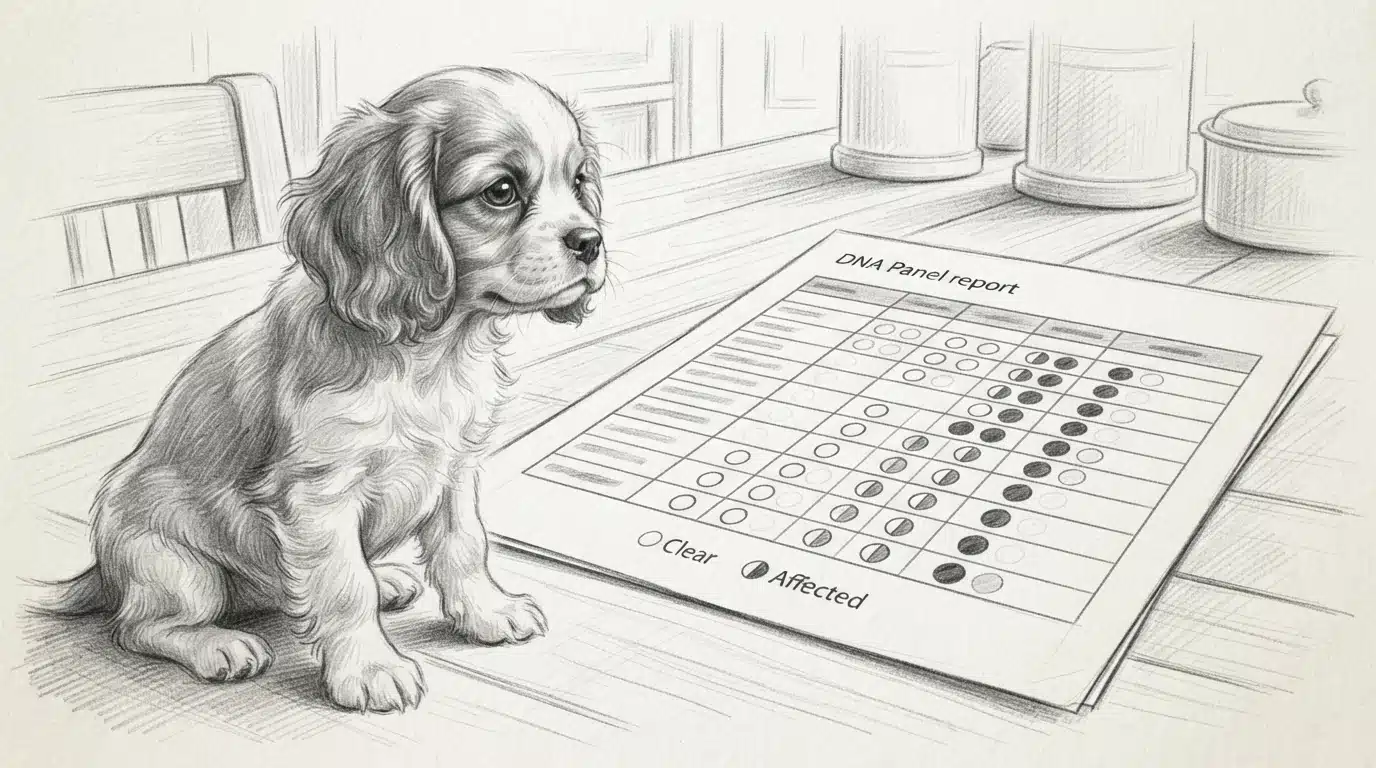
A DNA panel reports each gene variant it tested. Clear means no copies of the variant. Carrier means one copy, and as Embark explains for veterinarians, carriers are usually healthy because the condition needs two copies. Affected (or “at risk”) means two copies, so the dog may develop the disease. For a puppy buyer, a carrier parent is not a red flag on its own. What matters is the pairing.
Why the Same Result May Look Different Across Labs
Labs do not all test the same variant list, and no outside body approves these tests, as a Tufts review points out. So one lab may show “clear” while another flags a variant it checks and the first does not. Ask which lab ran the panel and how many variants it covered. At Sage Puppies, parents’ panels come from named labs, so you can compare results line by line.
Reading a Strategic Mate Choice on a Report
Good breeders pair a carrier only with a clear mate. That match produces no affected puppies, according to breeding guidance on DNA results. Two carriers of the same variant should never be bred. Ask how each parent pair was chosen.
Step 4: Read a CHIC Certificate Without Overreading It
CHIC Is a Reporting Program, Not a “Clean Bill of Health”
A CHIC number looks impressive on a breeder packet, and it does mean something real. The Canine Health Information Center, run by OFA with parent clubs, certifies that a dog was screened for every disease its breed club recommends and that the results are public. Here’s the part buyers miss: the dog does not need to pass. A Havanese with fair hips can still hold a CHIC number, because the goal is honest data, not a guarantee.
Current Havanese CHIC Requirements Per the 2025 Health Statement
For Havanese, the required tests are straightforward. According to the Havanese Club of America, a Havanese needs an OFA hip evaluation, an OFA patella (kneecap) exam, and a yearly eye exam by a veterinary ophthalmologist (CERF) to earn CHIC certification. Annual eye exams mean the requirement repeats, so check that the most recent one is current, not four years old. When you open a Havanese parent’s record on OFA, confirm all three entries exist and note the actual results. Normal patellas matter in this breed because small dogs are prone to slipping kneecaps. If a breeder’s packet lists a CHIC number but skips the eye exam date, ask for it.
Cross-Breed Parents: Havapoo and Cavapoo Do Not Have a CHIC Number

CHIC is breed-by-breed, so a Havapoo or Cavapoo parent cannot earn one. That’s normal, not a red flag. For mixed-breed parents, judge each test on its own merit: hip and patella results, a current eye exam, and DNA panels for conditions common to both parent breeds. Every Sage Puppies parent is tested this way, and we explain each result line by line.
A CHIC number tells you a breeder tests openly. The individual results tell you whether the breeding was wise.
Step 5: Cross-Check the Puppy’s Vet Exam Against the Parent Records
The parent records tell you what a puppy could inherit. The go-home vet exam tells you how the puppy looks today. You need both to match.
Items You Should See on a Healthy Go-Home Record
Ask for a one-page exam sheet signed by a licensed veterinarian. It should list the date, the puppy’s weight, heart and lung sounds, eyes, ears, teeth, skin, and a patella check for these small breeds. Look for a fecal result, current vaccine entries, and deworming dates. A clean bill here plus healthy parent clearances is the combination you want.
Vaccine and Deworming Schedule vs. Parent DNA Status
Keep the two documents separate in your mind. The vaccine and deworming schedule covers Parvo, Distemper, and common parasites; it protects the puppy now but has no link to genetics. The parent DNA status covers inherited variants, such as cardiac or patellar risks in Havanese lines. If a parent carries one copy of a variant, ask whether the puppy was DNA tested or cleared by parentage before you commit.
What the Puppy Exam Does Not Tell You
A young puppy’s exam cannot rule out later-onset conditions. Eye disease, some cardiac issues, and luxating patellas often appear between one and three years of age, so the parent records carry that weight. This is exactly why a written health agreement matters; it pairs today’s clean exam with the breeder’s long-term screening commitments.
Bring both documents to your puppy’s first vet visit. A good vet will review them together in minutes, and if anything does not line up, you will want answers before day one. Sage Puppies sends both sets of records with every go-home packet for this reason. When you are ready to compare litters, browse the available puppies or start an application.
Step 6: Build a One-Page Comparison Sheet Before You Sign Anything
When you are comparing two or three litters, memory fails. Put every breeder’s claims on one page and the gaps show up fast. A single sheet keeps deposits safe, because you compare facts instead of charm.
Columns to Fill in for Each Parent and the Puppy
Give each program one column. Across the top, list the same rows for both parents and the puppy: OFA registration numbers, hips and elbows results, eye exam dates, Patella rating, cardiac status, DNA panel results for each variant, CHIC number, and the breeder’s contract terms on health guarantees. Leave a blank where a breeder did not answer. Blanks tell you as much as numbers do.
Red Flags Worth Flagging in Your Notes
Watch for these as you fill in the sheet:
- “Vet checked” offered in place of OFA or DNA results. A checkup is not genetic testing.
- Parents tested at under two years old, before final hip clearings exist.
- Results that only appear as screenshots, with no verifiable registration numbers.
- A guarantee that requires returning the puppy to collect.
- Pressure to wire a deposit the same day you ask for paperwork.
Any one of these is worth a direct question. Two or more usually means you should keep looking.
When the Document Is Complete, Move Forward with Sage Puppies
Once a breeder’s column fills in cleanly, you can commit with confidence. Sage Puppies publishes full parent health results for every Havanese, Havapoo, and Cavapoo litter, so your sheet completes itself from our records. Review our reservation process and submit your application when you are ready.
Step 7: Know When to Ask a Vet or the Breed Club Instead of the Breeder
A good breeder answers a lot. But some questions belong to other experts, and knowing who to call saves you time and stress.
Your Own Vet for Anything That Affects Your Puppy’s Care This Week
If your question touches vaccines, parasites, appetite, loose stool, a limping paw, or when to schedule a spay or neuter, call your vet. Ask for the puppy’s health records before go-home day, then book a checkup within the first week. Bring your breeder’s packet with you so your vet can review the OFA and DNA results directly. Breeders can share history, but only a vet who has examined your puppy can guide care decisions.
Breed Health Coordinators for Breed-Specific Edge Cases
For deeper questions, each breed club has a health coordinator. The Havanese Club of America lists contacts who can explain heart testing, eye conditions, and how to read a CHIC number in context. These volunteers know the breed’s long-term patterns, so ask them when results look borderline or a condition appears in the pedigree. Ask your breeder for the right contact, then compare answers side by side.
Common Mistakes to Avoid When Reading Health Reports
Even careful buyers misread breeder paperwork. Watch for these three traps before you place a deposit.
Treating a Puppy Exam Like Parent Health Testing
A vet check at eight weeks confirms a puppy looks healthy today. It cannot rule out inherited conditions that appear at two or five years. The OFA results of the parents matter far more. Ask for both, and never accept one as a substitute for the other.
Equating a CHIC Number with a “Clean Bill of Health”
A CHIC number from the OFA means a dog completed required tests, not that every result passed. Dogs can earn CHIC status with fair ratings or as carriers of a variant. Read the individual results behind the number every time.
Reading a Cross-Breed Panel Like a Single-Breed Panel
Breed-specific screening lists assume one breed. Havapoos and Cavapoos inherit risks from both sides, so ask whether both parent lines were tested. At Sage Puppies, Cassie reviews each parent’s panel against the risks of both breeds in the pairing. A breeder who skips the second half of a cross leaves gaps that the paperwork won’t show.

Reading lab results before you commit is the whole game. If you want a Havanese, Havapoo, or Cavapoo backed by documented testing and honest answers, meet the families’ dogs at Sage Puppies, then start your application today.
Frequently Asked Questions
Q1: how to read and understand health testing reports
Start with the dog’s registration number on OFA. Check each result says Normal, Clear, or passing. Then confirm DNA panel results list the specific variants tested, not just “panel complete.”
Q2: What does a CHIC number actually tell me?
It confirms the dog completed the required tests for its breed. It does not mean results were normal, so read each individual result too.
Q3: Do mixed breeds like Havapoos need both parent breeds tested?
Yes. Ask for Havanese results on one parent and Poodle results on the other. Each parent should be tested for its own breed’s risks.
Q4: Should I see results before paying a deposit?
Absolutely. A good breeder shares the full packet up front. At Sage Puppies, parent test results are part of the application conversation.
Q5: What if a test result says “carrier”?
A carrier has one copy of a variant but stays healthy. Ask which partner’s status matters and whether the pairing avoids producing affected puppies.
Q6: Are eye and heart exams really necessary?
Yes. Conditions like cataracts and heart murmurs don’t show in DNA tests. Annual OFA eye and cardiac exams catch them.
Conclusion
Reading a lab packet comes down to four checks: OFA or PennHIP results for hips, knees, eyes and cardiac, a DNA panel that rules out breed-specific variants, a CHIC number proving tests were completed, and a contract that stands behind all of it. Any breeder, including Sage Puppies, should hand these records over without prompting. Compare every packet line by line with the pillar page on health testing, and let the paperwork, not the puppy photos, guide your choice. A well-tested litter is the closest thing to peace of mind a buyer can get.