Quick Summary: Border Collie listings in Louisiana must show specific health records for both parents-hip scores, eye exams, and DNA tests-before you pay a deposit. Vague claims like ‘health tested’ are useless; ask for dated reports tied to the parents’ names, cross-check them in the OFA database, and confirm the breeder explains how results affect breeding decisions. For example, a carrier for Collie Eye Anomaly isn’t automatically disqualified if paired with a clear mate, but the breeder should prove that pairing. Sage Puppies and similar breeders emphasize this same transparency for their small companion breeds, using clear parent records and straightforward contracts as their standard.
Before sending a deposit, ask for the sire and dam records. Louisiana puppy listings that claim Border Collie health checks should show proof, not vague promises. The AKC recommends hip and eye tests, and the Border Collie Society of America urges buyers to get both parents’ documents.
For families comparing Louisiana puppy breeders and Louisiana dog breeders, DNA panels, eye exams, hip scores, vet checks, and guarantees mean different things. This guide helps Louisiana puppy breeders and Louisiana dog breeders verify records, read results, and compare transparent programs, including Sage Puppies’ Havanese, Havapoo, and Cavapoo puppies.
Why Border Collie Health Checks Are Changing How Buyers Read Louisiana Listings
The Recommended Baseline for Border Collies
A listing should show more than “health tested.” Ask for each parent’s records. A solid Border Collie review includes hip screening, a current eye exam, and DNA results for breed-relevant risks such as Collie Eye Anomaly.
The OFA screening guidance helps buyers see which tests matter by breed. Louisiana puppy breeders who share parent names and dated reports make verification far easier.
| Record to request | What it helps verify |
|---|---|
| Hip evaluation | Inherited hip risk screening |
| Eye exam | Current visible eye health |
| DNA report | Inherited variant status |
| Parent identity | That records match the breeding pair |

A health-tested claim is only useful if you can see the actual result, date, and dog name.
Why One Badge or Panel Is Not Enough
A CHIC number means a dog completed its breed-required screens with public results, but it does not promise every result was normal. Read the reports themselves. The OFA explains CHIC criteria and public records clearly.
Louisiana dog breeders should not treat one DNA panel as a replacement for hips or an eye exam. Each test answers a different question.
The Questions Louisiana Buyers Should Ask First
Ask Louisiana puppy breeders:
- Can I see both parents’ full reports?
- What test date and lab issued each record?
- Are the parents searchable in OFA?
- How do you use results when planning litters?
Good Louisiana dog breeders answer directly, without vague labels or pressure.
Also Read: Havanese, Havapoo & Cavapoo Puppy Care Blog
Which Health Tests Should Louisiana Border Collie Breeders Perform?
Ask for records for both parents, not a sentence that says “health tested.” A sound Border Collie breeding plan includes hip screening, a formal eye exam, and DNA tests that match the dogs’ lines.
Hip Evaluation: A Structural Screen
Breeders should submit hip X-rays for an official evaluation, commonly through OFA or PennHIP. This looks for hip dysplasia risk before a dog enters a breeding program.
Ask to see the result, the dog’s registered name, and the date. A casual vet opinion is not the same as a recorded screening. OFA notes that hip scores in both parents relate to the risk seen in offspring, so records from close relatives also add useful context.
- Confirm both sire and dam were screened.
- Check that the report matches the listed parents.
- Ask whether results are public in a health database.
A “vet checked” puppy visit does not replace parent hip evaluations.
Ophthalmologist Evaluation: More Than a Casual Eye Check
A routine wellness visit cannot stand in for a CAER eye exam. A board-certified veterinary ophthalmologist performs this focused screening after pupil dilation. It checks for visible eye concerns that may affect breeding decisions.
OFA explains that CAER exams are screening exams, not a full eye-health workup. They still give buyers a far stronger record than a breeder’s verbal claim that the parents have “good eyes.” Request the eye form and make sure it is current.
| What to request | Why it matters | Red flag |
|---|---|---|
| CAER exam record | Shows a specialist performed the screen | “Our vet looked at them” |
| Parent identification | Links the record to the actual dog | No registered name or microchip |
| Exam date | Confirms the record is current | An old, undated document |
DNA Testing for Line-Specific Risks
DNA panels should support, not replace, hip and eye screening. For Border Collies, ask which inherited risks were tested and why those tests fit the parents’ pedigree.
Collie Eye Anomaly (CEA) is one useful example. OFA lists Border Collies among affected breeds and explains that the NHEJ1 variant is recessive. A DNA result helps a breeder plan pairings before puppies are born.
Ask for the actual lab result for:
- CEA
- Primary lens luxation, where relevant to the line
- Any other condition flagged by pedigree, breed-club guidance, or prior family history
A long DNA panel is not proof of a careful program. The breeder should explain each result in plain terms.
When a Carrier Result Can Still Be Managed Responsibly
A carrier is not automatically an unhealthy dog or an unsuitable parent. For recessive conditions, a responsible breeder can pair a carrier only with a DNA-clear mate for that same variant. OFA gives this approach for CEA, which prevents affected puppies from that pairing.
Still, buyers deserve full disclosure. Ask for both parents’ reports and a simple explanation of the planned match.
Use this quick check:
- Verify the condition and result for each parent.
- Confirm the non-carrier mate tested clear.
- Ask whether any puppies could be carriers.
- Keep the records with your puppy file.
Transparent records let families compare listings calmly and choose based on proof, not promises.
Also Read: Sage Puppies vs Happytail Puppies: Which Louisiana Breeder Is Better?
How to Verify Health Records Before You Reserve a Louisiana Puppy
Ask for records before you send a deposit. A good listing names both parents and lets you match each result to a real dog.
Match Every Result to the Correct Parent
Request the sire’s and dam’s full registered names, date of birth, microchip or registration number, and each test report. Then compare those details line by line.
- The dog name should match the listing and report.
- The breed and sex should make sense.
- The test date should be before the breeding.
- A photo alone is not a health record.
Warning: A report for “our dogs” is not proof for your puppy’s parents. Ask which exact dam and sire produced the litter.
Use the OFA Database as a Cross-Check
Search each parent in the OFA health-tested dog database. Look for the same name, number, and test type shown on the breeder’s files. OFA records can include hips, elbows, eyes, heart, patellas, and some DNA results.
OFA says normal results submitted to its database are public, while owners may choose whether to publish abnormal results. A missing record is a reason to ask questions, not proof that a dog is clear.
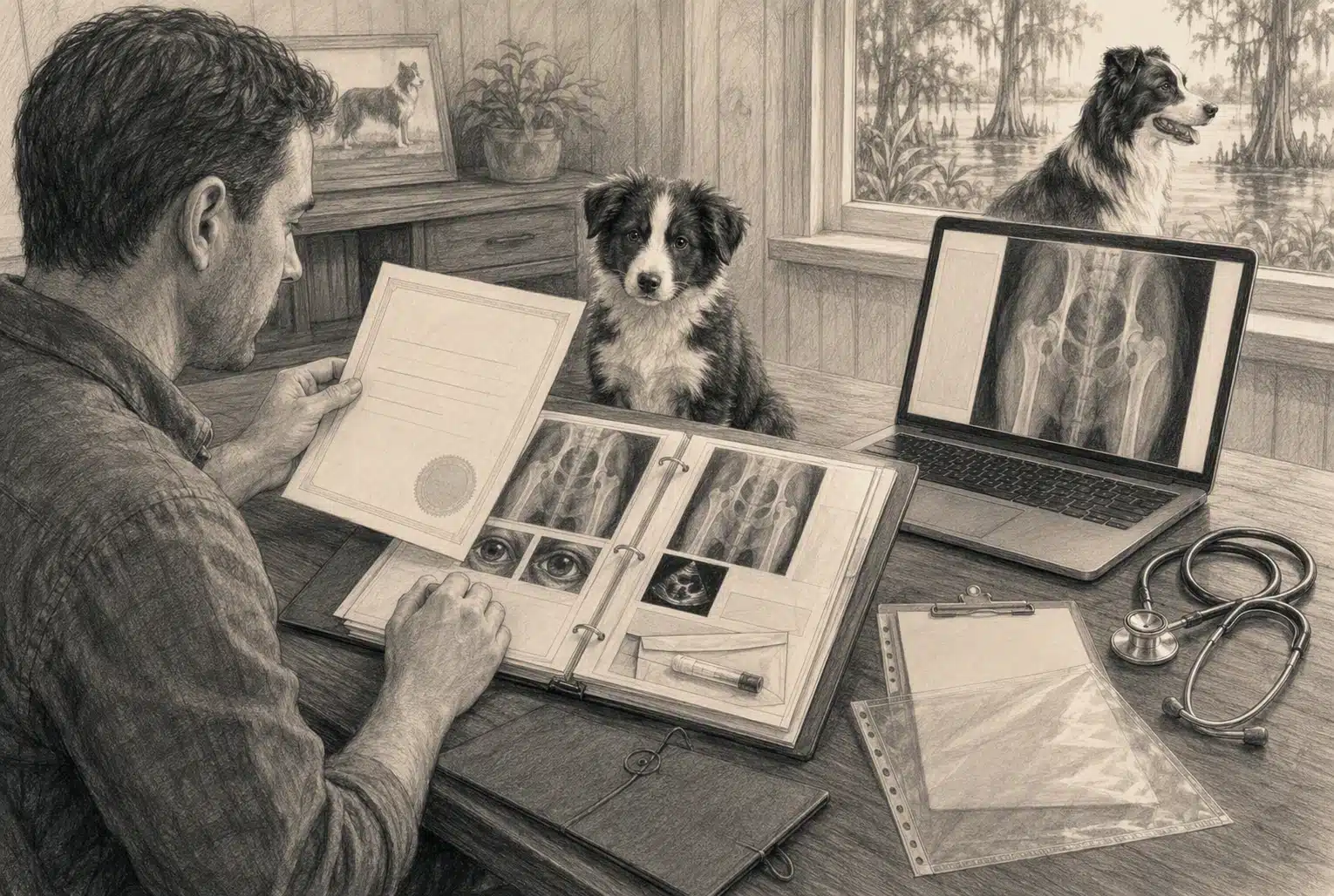
| Check | What to confirm | Reason |
|---|---|---|
| Parent identity | Name and registration or microchip number | Avoids mixed-up records |
| Test result | Test type, date, and final result | Shows what was actually screened |
| Database entry | Same parent appears in OFA search | Adds an outside cross-check |
Read DNA Results as a Breeding Pair
DNA results need context. For a recessive disease, a carrier is not automatically a poor breeding dog. The key question is whether the other parent can pass on the same variant.
- Get the full result for both parents.
- Check the disease name, not just “clear panel.”
- Ask the breeder how the pairing avoids affected puppies.
OFA explains that a puppy may be listed as clear by parentage only under specific DNA, identity, and parentage rules. Read its clear-by-parentage policy before treating that label as a direct puppy test.
Separate the Health Guarantee From the Health Testing
A health guarantee is a contract promise. Health testing is proof of work done before breeding. You want both, but they answer different questions.
- Read what conditions the contract covers.
- Check the time limit and required vet exam.
- Confirm what remedy applies if a problem appears.
- Keep copies of parent reports and your signed agreement.
Sage Puppies uses a transparent, family-first process for its Havanese, Havapoo, and Cavapoo families. That is the standard to look for in any Louisiana listing: clear parent records first, plain contract terms second.
Also Read: 10 Signs a California Puppy Listing Is a Scam – Sage Puppies
What a Transparent Louisiana Puppy Listing Should Show
Specific Parents, Specific Records
A trustworthy listing names the actual sire and dam. It does not stop at “health-tested parents.” Look for each parent’s registered name, breed, age, and direct records or report numbers.
For Border Collies, ask which tests apply to that pairing and see the results. The OFA advises buyers to research both parents and review health screenings, not just accept a breeder’s summary.
Use this quick check:
| Listing detail | What you should see | Why it matters |
|---|---|---|
| Parent identity | Full names and clear photos | Confirms who produced the litter |
| Health records | Test type, date, and result | Lets you check the claim |
| Record source | OFA link, certificate, or lab report | Gives you a trail to verify |
| Litter details | Birth date, sex, price, and status | Prevents vague or recycled listings |

Tip: Search the parents in the OFA public database using the exact name. A missing result deserves a calm, direct question, not an assumption.
Clear Limits and Honest Language
Health testing lowers risk. It does not promise a puppy will never become ill. A clear Louisiana puppy listing says that plainly.
Watch for broad claims like “DNA clear” with no test name, lab, or parent result. Also ask whether a result applies to the puppy, one parent, or both parents. A breeder should explain what records mean and what they cannot predict.
Look for honest wording about:
- Known breed risks
- Vaccines and deworming already given
- A veterinary exam or planned check
- Any concern found in the litter
- The written purchase terms
Warning: “Vet checked” is care information, not proof of inherited-disease screening.
Care Details Still Matter
Records are only one part of a sound start. A useful listing also shows where puppies are raised, how they meet people, and what support families receive before pickup or delivery.
Ask these questions:
- Where does the puppy sleep and play?
- What social contact has it had?
- What food and routine does it know?
- What comes home with the puppy?
Sage Puppies applies this same plain-spoken approach for its Havanese, Havapoo, and Cavapoo families from South Jordan, Utah, including clear pickup and nationwide delivery steps.
Also Read: Louisiana Puppy Prices: Breeder Deposits vs Total Cost
What This Means for Families Comparing Border Collies With Small Companion Breeds
Health Testing Should Follow the Breed
Do not use one breed’s test list as a shortcut for another. Border Collies and small companion breeds have different health risks, so the parent records should match the puppy’s breed or mix.
The OFA explains that CHIC screening plans are set by each breed’s parent club, not by a one-size-fits-all rule. Review the breed-specific screening guidance before you compare listings.
| Family is considering | Ask the breeder to show |
|---|---|
| Border Collie | Parent records for the breed’s recommended eye, joint, and DNA screens |
| Havanese, Havapoo, or Cavapoo | Parent records relevant to each breed in the mix, plus clear identity details |
| Any puppy | Actual reports, parent names, test dates, and the lab or registry used |

Warning: “Health tested” is not enough. Ask which tests were completed and request the reports before reserving.
A Calm Next Step for Qualified Puppy Families
Start with fit, then verify health. A Border Collie may suit an active home with time for daily training and work. A small companion breed may better fit families seeking a close, home-centered dog.
Use this short check:
- Compare the parents’ records against breed needs.
- Ask how puppies are raised and socialized.
- Confirm pickup or nationwide delivery details in writing.
- Choose only when the breeder answers plainly.
Sage Puppies in South Jordan focuses on Havanese, Havapoo, and Cavapoo puppies, with health-tested parents and a transparent, family-first process. Review available puppies when your home and timing feel right.
Also Read: 10 Adorable Havapoo Colors You Need to See (2026)
How Health Databases and Breed Recommendations Fit Together
The Role of AKC Parent Clubs
Start with the breed’s AKC Parent Club, not a seller’s broad claim that parents are “health tested.” These national breed clubs set recommendations for the sire and dam, including DNA tests and exams such as hips, eyes, or heart checks. The AKC Parent Club health statements explain which screens apply to each breed.
For a Louisiana Border Collie listing, ask the breeder to name each recommended test and show the parent records.
- Match the registered name to the report.
- Check test dates and results.
- Ask about any result that is not clear.
A puppy wellness visit does not replace health clearances for both parents.
What OFA and CHIC Records Add
OFA records give buyers a place to check health results beyond a listing screenshot. CHIC combines OFA records with breed-specific screening protocols set with parent clubs. A CHIC number means the required tests were completed and released publicly. It does not mean every result was normal, as AKC explains.
| Record | What it confirms | Buyer action |
|---|---|---|
| OFA entry | A named dog’s submitted result | Verify the parent |
| CHIC number | Required screens were completed | Read each result |
Also Read: Puppy Care Blog & Resources | Sage Puppies
Frequently Asked Questions About Louisiana Border Collie Health Checks
Do “health-tested parents” prove a puppy is healthy? No. Testing lowers known inherited risks. Ask for each parent’s named results, test date, and permanent ID. OFA explains that CHIC status requires all breed-recommended screens and public results, not simply a breeder’s claim of testing.
Which records should I request?
| Record | What to check |
|---|---|
| Parent results | Names match the listing |
| OFA record | Searchable ID and clear result |
| DNA report | Lab name, result, and parent ID |
Is a carrier parent always a deal-breaker? Not by itself. A carrier can be bred responsibly to a clear mate. Ask the breeder to show both results and explain the pairing.
Why ask about eye and drug tests? Border Collies can be affected by CEA and MDR1-related drug sensitivity, according to OFA’s CEA guidance and MDR1 overview.
A screenshot alone is not proof. Verify the parents’ records before sending a deposit.
Also Read: Health-Tested Puppies for Sale Near Me: What Records Matter
Choose Documentation Before a Deposit
Do not send a deposit based on a listing that only says “health tested.” Ask for both parents’ full names, test dates, results, and the registry or lab that issued them.
The OFA database helps buyers research parent dogs and breed-specific screening needs. Match every document to the parent’s registered name or microchip ID.
| Ask for | What to check |
|---|---|
| OFA or specialist reports | Parent name, result, date, ID |
| DNA results | Condition tested and clear, carrier, or affected status |
| Vet records | Puppy exam date and clinic details |
A screenshot without identifying details is not proof. Pause the purchase until records are clear.

Ready for a puppy listing with clear health records? Sage Puppies gives families a transparent, family-first path to a Havanese, Havapoo, or Cavapoo, with health-tested parents and thoughtful early care. View available puppies, ask questions, and choose pickup or nationwide delivery with confidence.
Frequently Asked Questions
Q1: puppies for sale in Louisiana
Ask for parent test records before sending a deposit. A listing should name the breeder, show the puppy’s age, and explain vet care. Avoid sellers who only offer vague claims like “healthy lines.”
Q2: What health tests should Louisiana Border Collie breeders perform before selling puppies?
Ask about hip, eye, and genetic screening relevant to Border Collies. Request parent results, not a verbal summary. A puppy exam helps, but it does not replace proof that both parents were tested.
Q3: How do I verify a Louisiana puppy seller’s health guarantees for Border Collies?
Read the full agreement before payment. Check what it covers, the time period, exclusions, required vet visits, and remedy. Match each parent’s name on records to the names given in the listing.
Q4: Are there ethical Border Collie breeders in Louisiana with transparent health records?
Yes, but transparency should be easy to check. Ethical breeders answer direct questions, share records, welcome screening conversations, and care where each puppy goes. Pressure to pay quickly is a warning sign.
Q5: Should I buy a Border Collie without meeting the breeder?
Not without strong proof. Use a live call, request current puppy updates, review records, and confirm pickup or delivery details. A careful process protects both your family and the puppy.
Conclusion
A Louisiana puppy listing should give you proof, not broad promises. Ask for each parent’s full name, test type, result, date, and permanent ID. Then match those details to the right breed-based screening list and check public records yourself.
The OFA database lets buyers research health-tested dogs by name and other details. Keep in mind that health testing lowers risk, but it cannot promise a problem-free puppy.
A breeder who welcomes clear questions and shares records is easier to assess than one who relies on vague claims.
For Border Collies and small companion breeds alike, careful records, honest context, and a good family fit matter most.