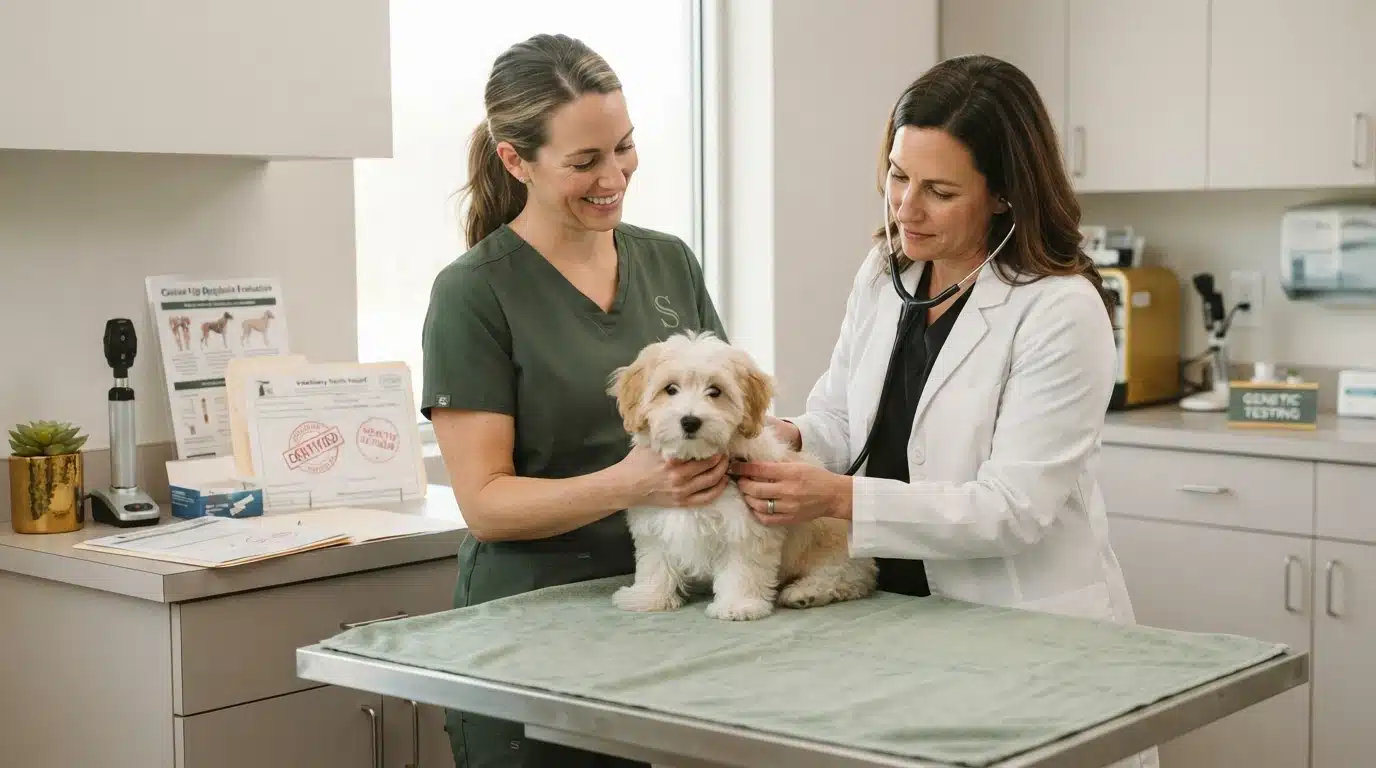
Quick Summary: Choose a puppy with both veterinary exams and DNA screening, because exams reveal current problems such as heart murmurs or patellar issues, while DNA tests predict inherited risks such as PRA-prcd. Before paying a deposit, request a signed puppy exam record, parent OFA health results with verifiable registry numbers, and DNA results for both parents. Sage Puppies supports this approach by pairing documented parent screening with pre-delivery wellness checks for Havanese, Havapoo, and Cavapoo puppies.
A Havapoo breeder near you can email a puppy exam sheet and a DNA panel in the same message, and both can look equally convincing. They answer different questions. The vet check describes the puppy in front of you today; the DNA results describe inherited variants the puppy carries. Buyers who compare vet checked vs DNA screened puppies using only one document end up with an incomplete picture of health.
That gap matters whether you are choosing between breeders in Utah or across the country. Terms like vet checked, DNA tested, and health guaranteed sound similar but describe very different evidence, and your deposit depends on telling them apart.
This guide defines what each screening measures, shows where each one fails, and translates both into requirements for Havanese, Havapoo, and Cavapoo puppies, ending with a checklist you can use before reserving.
Vet-Checked vs DNA-Screened Puppies: At a Glance
| Vet-checked puppies | DNA-screened puppies | Sage Puppies | |
|---|---|---|---|
| What it examines | The living puppy: growth, heart and lung sounds, patellas, eyes, coat, and structural movement, plus radiographs and cardiac exams on parents | Specific inherited variants, such as progressive retinal atrophy (PRA-prcd), degenerative myelopathy, and episodic falling syndrome | Parent health and temperament review, breed-appropriate screening for the specific parents in each litter, plus veterinary wellness checks before go-home |
| Typical timing | Wellness exams begin in the first weeks; hip radiographs and patellar certification require age-appropriate timing, generally 12 months and 24 months respectively | Any age for a sample, but most panels run on parents before breeding; consumer results commonly take about one to eight weeks | Parent screening before pairing, wellness checks and age-appropriate vaccine and deworming records through the weeks before pickup or delivery |
| What it cannot rule out | Late-onset or multifactorial conditions, recessive variants the puppy carries silently, and temperament outcomes | Complex conditions such as hip dysplasia or mitral valve disease that involve multiple genes and environment | No breeder can promise a puppy will never experience a health issue, and screening reduces known risk rather than eliminating it |
| Record to request | Copies of the puppy exam and vaccine records, and OFA or equivalent parent results with dates, body part, method, and actual result | The laboratory report itself, with the lab name, test list, and each dog’s clear, carrier, or at-risk status | Health testing details on the health testing page, current puppy availability, and pricing and reservation terms |
| Best for | Buyers who want to know the condition of the specific puppy before it leaves the breeder | Buyers who want predictable hereditary risk information that stays with the dog for life | Utah families picking up locally and nationwide families seeking Havanese, Havapoo, or Cavapoo companions |
| Relative cost | Ongoing per-puppy care and veterinary time; parent radiographs and cardiac screening are the larger breeder expense | Consumer panels commonly run from about $60 to $200 per dog, while breeder panels through veterinary laboratories cost more per test | Puppies priced in the $3,500 to $4,500 range with reservation terms published before commitment |
How Vet-Checked and DNA-Screened Puppies Compare
Vet-checked puppies
A vet-checked puppy has been examined hands-on by a veterinarian, with parents also screened through tests like OFA hip radiographs. It suits buyers who want proof of the specific puppy’s condition before go-home.
DNA-screened puppies
DNA screening uses cheek-swab samples to test parents, and sometimes puppies, for inherited variants such as PRA-prcd. It suits buyers who want hereditary risk information that stays with the dog for life.
Sage Puppies
Sage Puppies is a boutique Utah breeder offering Havanese, Havapoo, and Cavapoo puppies with breed-appropriate parent screening plus pre-go-home wellness checks. It fits Utah and nationwide families wanting both layers of evidence in one program.

Key strengths
- Parent screening completed before pairing
- Vaccine and deworming records through pickup or delivery
- Priced $3,500 to $4,500 with terms published up front
What Vet Checks and DNA Screens Actually Measure
The Clinical Record: What an Examination Can and Cannot Tell You
A vet check is a snapshot. The veterinarian listens to the heart, checks the patellas, eyes, ears, and teeth, and records weight and temperature. It confirms the puppy looks healthy today. It cannot reveal inherited disease that appears later, such as progressive retinal atrophy, because those conditions develop with age. Serious breeders document these visits, and knowing what good breeders actually show you helps you judge the paperwork.
The Genotype: What a DNA Panel Confirms
A DNA panel reads fixed facts. A cheek swab goes to a lab, which tests for known gene variants like PRA-prcd, the SOD1 variant behind degenerative myelopathy, and BCAN, linked to episodic falling syndrome. Results say whether the puppy carries, is clear of, or is affected by each variant, per UC Davis. It predicts inherited risk, not current wellness.
Why Buyers Conflate the Two
Breeders often present both documents together, so families assume one covers the other. It does not. A clean exam says nothing about genes; clear DNA results say nothing about today’s heart murmur. A genetic test screens risk, while the exam verifies condition. You need both, matched to the breed.
Should I Choose a Vet-Checked or DNA-Screened Puppy?
The Direct Answer for Most Buyers
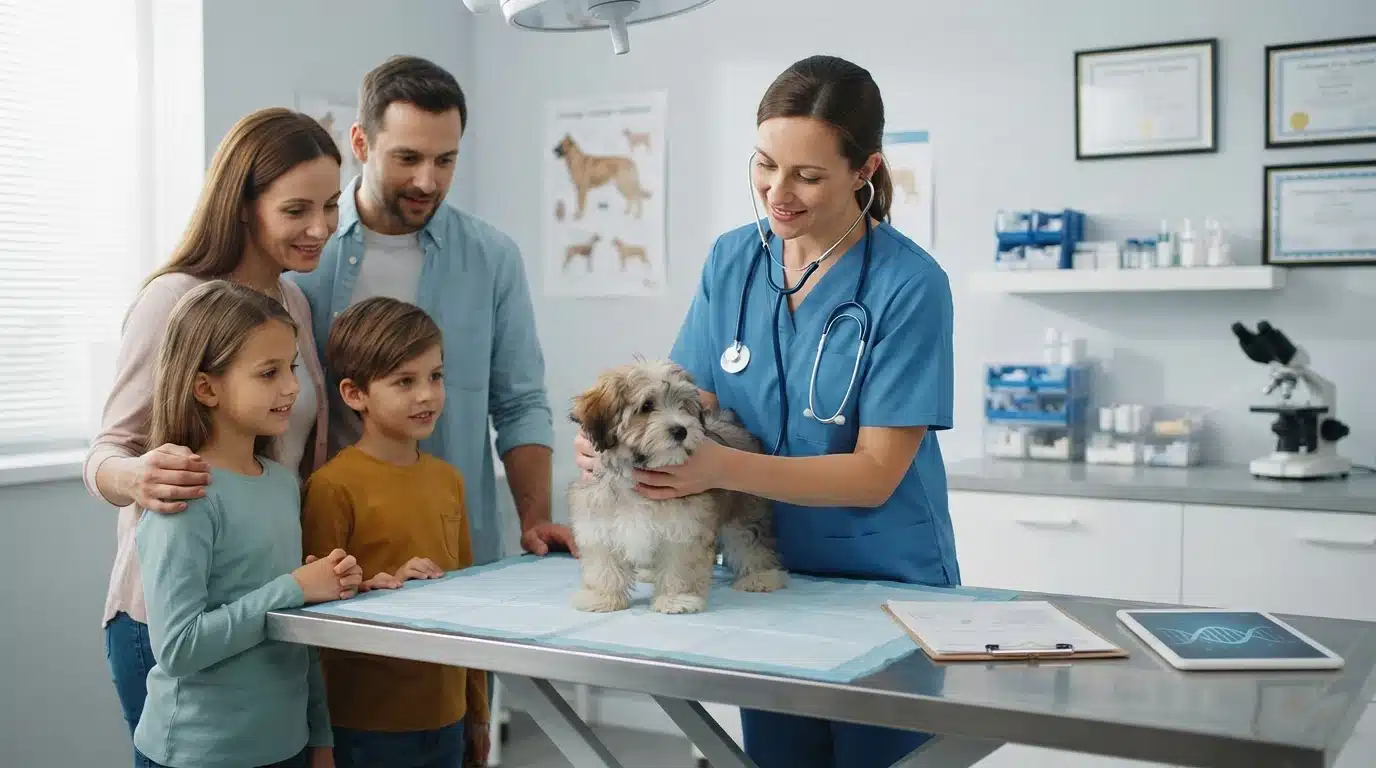
Choose both. A vet check and a DNA screen answer different questions, so the strongest purchase combines them. The veterinary exam catches what a puppy shows today, like a heart murmur or a soft patella. The DNA panel predicts inherited risk that no stethoscope can find yet, such as the PRA-prcd variant behind progressive retinal atrophy. If you must describe an ideal puppy in one line, it is this: examined by a vet, cleared by genetics, and documented in writing.
If a Breeder Can Only Offer One
Take the vet check first, then verify the parents’ DNA results yourself. A puppy exam confirms the animal in front of you is healthy on that day, which matters most at pickup. But many serious conditions come from genes, not from anything visible in an eight-week-old. Ask whether the sire and dam were tested, and look up the results publicly. A breeder who tests parents but skips the puppy exam is a different risk than one who does the reverse, and parent testing usually tells you more about the adult dog your puppy will become.
When the Puppy’s Own Condition Should Decide
Let the puppy’s current health tip the scale when the two options genuinely conflict. A confirmed murmur, an undescended testicle, or a grade 2 or higher patellar luxation on exam is a present problem with present costs. A carrier result on one gene, with a clear mate on the other side, rarely means a sick dog. Match the choice to the risk you can actually see. When you review paperwork, treat the exam record and the DNA report as two separate documents and ask for both before you commit.
Breed-Specific Screening for Havanese, Havapoo, and Cavapoo Puppies
Eyes, Hips, Patellas, and What CHIC Does Not Say
Havanese health testing requirements focus on four checks. Parent dogs should have OFA hip radiographs, patellar luxation certification, a cardiac exam, and an eye test for progressive retinal atrophy. A CHIC certificate proves the breeder completed those tests, not that the results were clean. Read the numbers on the public OFA result lookup before you trust the certificate alone.
Two Parent Lines, Two Different Answers
Cavapoos and Havapoos add a second parent breed, so each line needs its own screening. A Cavalier parent should show testing for myxomatous mitral valve disease risk markers and syringomyemia history. A Poodle parent carries its own eye and hip panel. Ask for both sides separately. Blending breeds does not blend the paperwork, and it never cancels a parent’s result.
Where DNA Panels Are Weakest
A DNA panel reads inherited gene variants from a cheek swab. It cannot see structural problems. Patellar luxation, hip dysplasia, and heart murmurs come from body structure, not single genes, so labs miss them. Some risk markers also appear in healthy dogs. That is why Havanese and Cavapoo genetic health tests work best beside a real exam, never instead of one.
Why One Generic Panel Does Not Fit Every Breed
Breeds carry different variants, so Havapoo breeder health screening should match the mix. Clear panels list each breed’s specific tests rather than one bundle. Breeders who assign the right tests per parent line, as we do at Sage Puppies, give you cleaner answers than any generic screen.
Reading the Paperwork: Records to Request Before You Pay a Deposit
Good breeders hand over records willingly, so hesitation is a signal in itself. Before you send any deposit, ask for three things in this order:
- The puppy’s veterinary exam record, dated and signed by a licensed vet
- Parent health clearances, including OFA results and a CHIC certificate where the breed qualifies
- DNA test results for both parents, showing variants like PRA-prcd, the SOD1 variant, and BCAN

Verifying What You Are Given
Paperwork alone proves little, because documents can be forged or borrowed. Match the exam record’s date to the puppy’s age and make sure the clinic contact details are real. For parent clearances, look each dog up on the OFA results database by registered name or number. A legitimate entry shows the test date, the evaluating vet or lab, and any findings. If a breeder sends photos of certificates, ask for the registry numbers instead and verify them yourself.
Getting a Second Set of Eyes
Bring the full packet to your own veterinarian before the deposit clears, or at minimum before pickup. Your vet can spot a murmur note, a skipped vaccine, or a patellar comment that an excited first-time buyer might miss. A breeder who resists this step is telling you something. When reviewing any puppy health records before buying, also read the contract for health guarantee terms, since vague promises replace real documentation. Programs like Sage Puppies that publish health testing up front make this review straightforward; the checklist is there to protect you when a seller does not.
Limits of Each Screening Type
What a DNA Panel Misses
Short answer: no, a DNA test cannot rule out health problems in a puppy. It only screens for known gene variants. It cannot see structural or late-onset disease. A clear panel still misses:
- Heart murmurs and mitral valve disease
- Luxating patellas and hip structure
- Eye problems with no linked marker
- Any condition with no identified gene
What an Exam Cannot Promise
A veterinary exam captures one moment in time. It can confirm a healthy heart sound, straight patellas, and clear eyes on that day. It cannot predict a disease that appears at age three or five. Conditions like progressive retinal atrophy often show signs only years later, which is why parent DNA results matter alongside the puppy’s own checkup.

Reading Guarantees and Marketing Language
Watch the wording in a breeder’s paperwork. “Health checked” may mean one quick puppy exam with no parent screening at all. “DNA tested” may cover a single variant, or neither parent. Ask which tests were run, on which dogs, and request the OFA result lookup so you can verify the claims yourself. A solid puppy health guarantee lists specific conditions and timeframes, not vague promises that the puppy is “healthy.” Review the contract before you pay a deposit, and walk away when terms stay undefined.
At Sage Puppies, documented parent DNA results and exam records come with every puppy, so you can read the evidence before you commit.
Cost, Timing, and Logistics of Screening
What Screening Costs the Breeder
Health screening is a real line item for any program. OFA charges its own fees, starting at $35 for preliminary hips and $45 for final hip evaluations, plus the vet visit and sedation for radiographs. A multi-test DNA panel for parents adds more, so a fully screened dam and sire can cost well over a thousand dollars before the first litter. You can check current fees on OFA’s fee schedule. That cost is partly why a screened puppy carries a higher price than an unscreened one.
Timelines That Affect Your Purchase
Parent screening happens years before a litter exists, so ask for results up front. A puppy’s own wellness exams start in the first weeks, while final hip and patellar certifications wait until the dog matures. DNA results move faster: a cheek swab reaches the lab, and turnaround is usually one to three weeks. If you reserve a puppy before final paperwork lands, get the timing in writing.
Budgeting the Whole First Year
The purchase price of $3,500 to $4,500 is only the start. Plan for the first veterinary visit, vaccines, spay or neuter, food, grooming, and training classes; a small breed’s first year often runs $1,500 to $3,000 beyond the puppy itself. Our pricing and reservation page breaks down what is included, so you can compare it honestly against what a lower quote leaves out.
Vet-Checked vs DNA-Screened Puppies: Which Should You Choose?
The Ranking, and Why
Choose a puppy with both, in this order of weight. Parent DNA screening comes first because it predicts inherited disease before a puppy is born; Cornell’s canine health center notes DNA testing can pinpoint risk for genetic conditions a physical exam will miss. The vet exam comes second, since it catches present problems like heart murmurs and patellar luxation. One without the other leaves a real gap, which is why the two should be read together rather than ranked as rivals.
When to Choose Each One
Lean on DNA screening when a breed carries known variants: PRA-prcd, the SOD1 variant behind degenerative myelopathy, and BCAN all matter in Havanese and doodle lines. Lean on the vet exam when you need answers about this puppy today: weight, teeth, heart sounds, testicles, and knees. The exam cannot rule out future genetic disease, and DNA results cannot rule out a current illness. Ask for both sets of records; a breeder confident in their lines will share them without prompting.
Next Steps with a Reputable Breeder Near You
When you search for a reputable puppy breeder near me, compare what each program documents, not just what it promises. The Royal Kennel Club’s health screening guidance frames the standard: DNA testing, screening schemes, and careful pairing, done together. Expect parent DNA results, exam records, and a contract you can review before reserving. Our own program pairs parent screening with vet exams on every litter, so bring both documents home. Review the step-by-step puppy matching process to see what paperwork arrives with each puppy.

You now know the difference: a vet check catches today’s problems, while DNA screening predicts tomorrow’s ones. Ask any breeder for both records. Ready to meet Havanese, Havapoo, or Cavapoo puppies raised with either proof? Browse Sage Puppies and submit your application to start.
Frequently Asked Questions
Q1: Should I choose a vet-checked or DNA-screened puppy?
Choose both when you can. The vet check confirms this puppy’s condition today; the DNA screen predicts inherited risk for life. If a breeder offers only one, take the exam first and verify parent DNA results yourself.
Q2: Can a DNA test replace a veterinary exam?
No. A panel reads gene variants like PRA-prcd but misses heart murmurs, patellar luxation, and hip structure, which no single gene predicts.
Q3: Which parent results matter most for a Cavapoo?
Ask for both lines separately: Cavalier testing for mitral valve disease markers and syringomyemia history, plus the Poodle parent’s eye and hip panel.
Q4: What records should I request before paying a deposit?
Three documents: the signed puppy exam record, parent health clearances with OFA registry numbers, and DNA results for both parents showing each variant’s status.
Q5: Does a CHIC certificate mean a puppy is healthy?
No. It confirms the breeder completed the required tests, not that results were clean. Read the actual OFA results yourself.
Q6: How long do puppy DNA results take?
Most consumer panels return in one to eight weeks; cheek-swab results often arrive within one to three weeks after the lab receives the sample.
Conclusion
Vet checks and DNA screening answer different questions, so the choice is never one or the other. The exam records how a puppy looks today: heart sounds, patellas, eyes, and weight. The DNA report predicts inherited risk that stays with the dog for life, like the PRA-prcd variant behind progressive retinal atrophy.
Before you pay a deposit, request three documents: the signed puppy exam record, parent health clearances with OFA registry numbers you can verify, and DNA results for both parents. Match the tests to the breed, since a Havanese, Havapoo, and Cavapoo each carry different risks.
A breeder who documents both layers of evidence, as Sage Puppies does, gives you the fullest picture of the puppy you are bringing home.