A puppy temperament test shows how a seven-week-old puppy reacts in a brief, new situation. It cannot predict exactly how that dog will act at one year old in an Oklahoma home or after delivery across state lines.
That gap can make breeder reports hard to judge. Some Oklahoma puppy breeders use clear notes and real observations. Others rely on broad labels like calm or confident without explaining what they saw.
This review helps families assess breeder temperament testing with a practical eye. You will learn what a useful puppy temperament test report includes, which claims need follow-up questions, and how test results should guide a family match. A thoughtful report is evidence, not a promise.
What Is a Puppy Temperament Test and How Is It Done?
A puppy temperament test is a short set of controlled observations. It helps a breeder describe how a puppy responds at that moment, not promise the adult dog they will become.
What the Common Exercises Actually Measure
A breeder may test puppies around seven weeks old. Common exercises include:
- Greeting an unfamiliar person
- Following a person
- Retrieving a toy
- Hearing a mild new sound
- Exploring a new surface or object
- Brief, gentle handling
These tasks can show early patterns in social interest, curiosity, recovery after surprise, play drive, and handling comfort. A puppy that pauses at a noise, then investigates, may show a different response than one who runs away and stays withdrawn.
| Exercise | What to watch | What it does not prove |
|---|---|---|
| Toy retrieve | Interest in play and engagement | Future training skill |
| New object | Curiosity and recovery | Lifelong confidence |
| Gentle handling | Comfort with touch | Adult tolerance in every setting |
| Person greeting | Social approach | A guaranteed family fit |

A score is a conversation starter, not a label. Avoid reports that call a young puppy “dominant,” “perfect,” or permanently shy.
The AKC review of puppy temperament tests notes that current puppy tests do not reliably predict adult behavior.
Why the Testing Conditions Matter
A useful report explains the setting, not just the result. Ask whether the puppy was rested, fed, healthy, and tested alone in a familiar, quiet space. A tired puppy may look calm. A puppy removed from littermates for the first time may seem less bold than usual.
Check these details:
- Ask for the puppy’s age on test day.
- Request notes or video, not scores alone.
- Compare the test with daily breeder observations.
- Ask how the puppy reacts after a brief startle.
- Discuss your home, children, schedule, and travel plans.
For Havanese, Havapoo, and Cavapoo families, steady daily care and kind social exposure matter more than a single test sheet.
Early behavior changes with health, home routines, training, and social experiences. Treat a thoughtful breeder report as one piece of a full match, alongside parent temperament and ongoing support.
Also Read: 10 Signs a California Puppy Listing Is a Scam – Sage Puppies
How Accurate Are Puppy Temperament Tests?
What the Research Supports
A puppy temperament test is a snapshot, not a forecast. It can show how a puppy responds to handling, a new sound, gentle restraint, people, play, and a brief change in setting. That makes it useful for comparing littermates on the same day.
A well-run report should describe what the tester actually saw, not label a puppy as “perfect for children” or “guaranteed calm.” Research supports structured behavior tools for assessing traits in dogs, but a score works best alongside real-world observations from the people raising the litter. A JAVMA validation study found that detailed behavior questionnaires can reliably assess several traits, but no single test captures every setting a dog will face.
| A helpful report includes | Treat with caution |
|---|---|
| Specific reactions and recovery time | One-word personality labels |
| Notes from several days | A score from one short session |
| Littermate comparison | A promise about adult behavior |
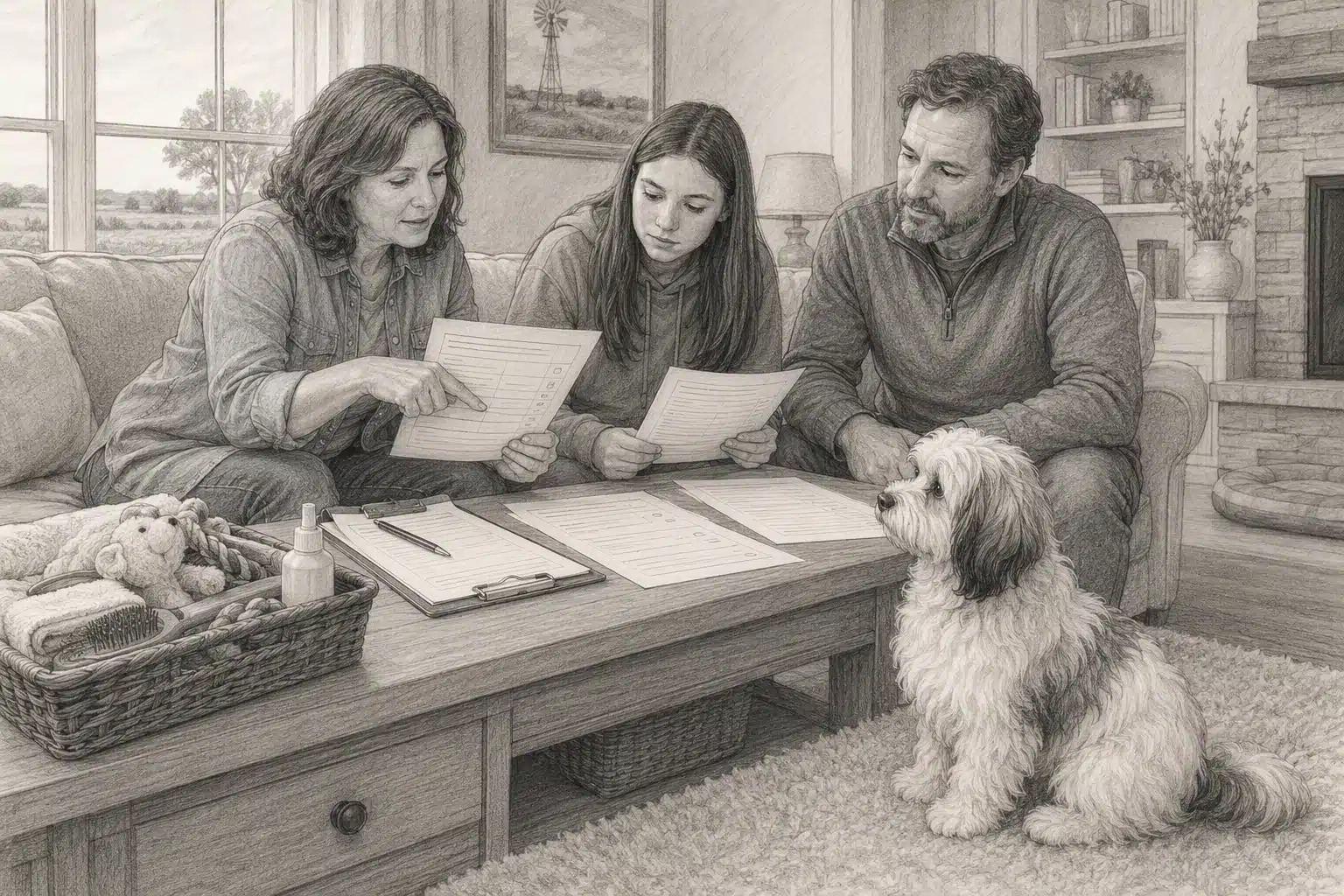
Ask the breeder:
- What happened during each test?
- Was the puppy tired, hungry, or newly awake?
- Do daily notes match the test result?
- How do the parents act with guests and handling?
Tip: Give more weight to clear examples than a numbered score. “Recovered quickly after a dropped pan” tells you far more than “8 out of 10 confidence.”
Why a Puppy Can Change as It Grows
Growth, health, training, home routine, and social exposure all shape behavior. A bold eight-week-old puppy may become cautious in a noisy new home. A quieter puppy may gain confidence through kind, steady practice.
The early window matters. The AVMA notes that puppies are especially open to learning from unfamiliar dogs from roughly 3 to 14 weeks, and positive exposure should continue after they join their family. Their socialization review also warns that fear can grow when puppies lack safe exposure to people, places, and everyday sounds.
Use the report as one part of your choice:
- Match the puppy’s current style to your household.
- Ask about parent temperament and early care.
- Plan calm social outings, reward-based training, and rest after pickup.
- Expect normal stages, including a shy day or a busy adolescent phase.
Also Read: How to Choose the Right Puppy Breed for Oklahoma Families
How to Read a Breeder’s Temperament Testing Report
Start With the Basic Test Record
Ask for the full record, not a single score or a claim that a puppy is “perfect.” A useful report names the puppy, date, age, tester, setting, and each activity used.
Check whether the breeder tested every puppy under similar conditions. A puppy tested after a long nap may react very differently from one tested after a busy play session.
| Record detail | Why it matters |
|---|---|
| Puppy age and test date | Shows the stage of development observed |
| Test setting | Helps you judge distractions and stress |
| Activities used | Explains what each reaction relates to |
| Written notes | Gives context beyond a number or label |
A temperament test is a snapshot, not a promise. Current evidence summarized by the AKC finds that puppy tests cannot reliably predict adult behavior.
Look for Specific Observations, Not Just Personality Labels
“Confident,” “sweet,” and “laid-back” sound nice, but they do not tell you what the puppy actually did. Ask for plain notes tied to real moments.
Look for observations such as:
- Approached a new person after a brief pause
- Startled at a sound, then returned to play
- Carried a toy away instead of engaging with it
- Accepted gentle handling or pulled away
- Explored a new surface with interest or caution

A thoughtful report also notes recovery. A puppy that pauses at a dropped object, then investigates it, may be showing normal caution and good bounce-back.
Be wary of reports that call a puppy “dominant” or “submissive” without describing the test and response.
Ask How the Results Affected the Match
The key question is not, “Which puppy got the best score?” Ask, “Why is this puppy a fit for our home?”
Share real details: young children, work hours, other pets, travel plans, apartment living, and your past dog experience. Strong breeders use their daily knowledge of the litter alongside the report.
Use this short match checklist:
- Ask which puppy best fits your household pace.
- Ask which behaviors need support after homecoming.
- Confirm how the breeder will help you continue socialization.
- Treat color, sex, and a test score as secondary to fit.
A responsible match can change as puppies develop. That is a sign the breeder is watching closely, not a reason to rush the decision.
Also Read: Oklahoma Puppies: How to Verify Breeder Availability Online
Red Flags in Oklahoma Breeder Temperament Testing Claims
Claims That Sound Stronger Than the Evidence
Treat any report that promises a puppy will be perfect with children, non-shedding in every home, or permanently calm with care. A temperament screen captures behavior on one day. It cannot predict an adult dog with certainty.
The AKC notes that current puppy tests do not reliably predict adult behavior. Genetics, health, early care, training, and your home all shape the dog.
| Claim | What a responsible report says |
|---|---|
| “Guaranteed therapy-dog temperament” | “Shows gentle, social responses today” |
| “No behavior issues possible” | “Here is what we observed and how we socialize” |
| “Highest score means best puppy” | “This puppy may fit your household needs” |
A breeder should explain both a puppy’s strengths and the areas that need patient training.
Questions to Ask Before Sending a Deposit
Ask for details, not labels. A score without the test conditions has little value.
- Which test did you use, and at what age?
- Who performed it, and can I see the full notes?
- What did the puppy do around new people, sounds, touch, and play?
- How quickly did the puppy recover after a mild surprise?
- What social experiences have you provided so far?
- May I meet the parents or view recent videos of them?
- Which puppy best fits our children, work schedule, and activity level?
A useful report includes real observations, not just a pass or fail.
Walk away if an Oklahoma breeder will not discuss a puppy’s limits, refuses to share records, or pressures you to pay before your questions are answered.
Also Read: Puppy Care Blog & Resources | Sage Puppies
Pros and Cons of Using a Puppy Temperament Test
A puppy temperament test can help you compare littermates, but it cannot predict an adult dog with certainty. Treat breeder notes as one useful data point, not a promise.
| What a test can help show | What it cannot prove |
|---|---|
| A puppy’s response that day to handling, noise, toys, and new surfaces | How the puppy will act after moving homes |
| Relative confidence or caution among littermates | A lifelong absence of fear, barking, or anxiety |
| Which puppy may fit a quiet home, active family, or first-time owner | The effect of training, health, routine, and social exposure |
Benefits include:
- It gives breeders a consistent way to watch each puppy.
- It can start a better match conversation with your family.
- Written observations reveal whether the breeder knows each puppy well.
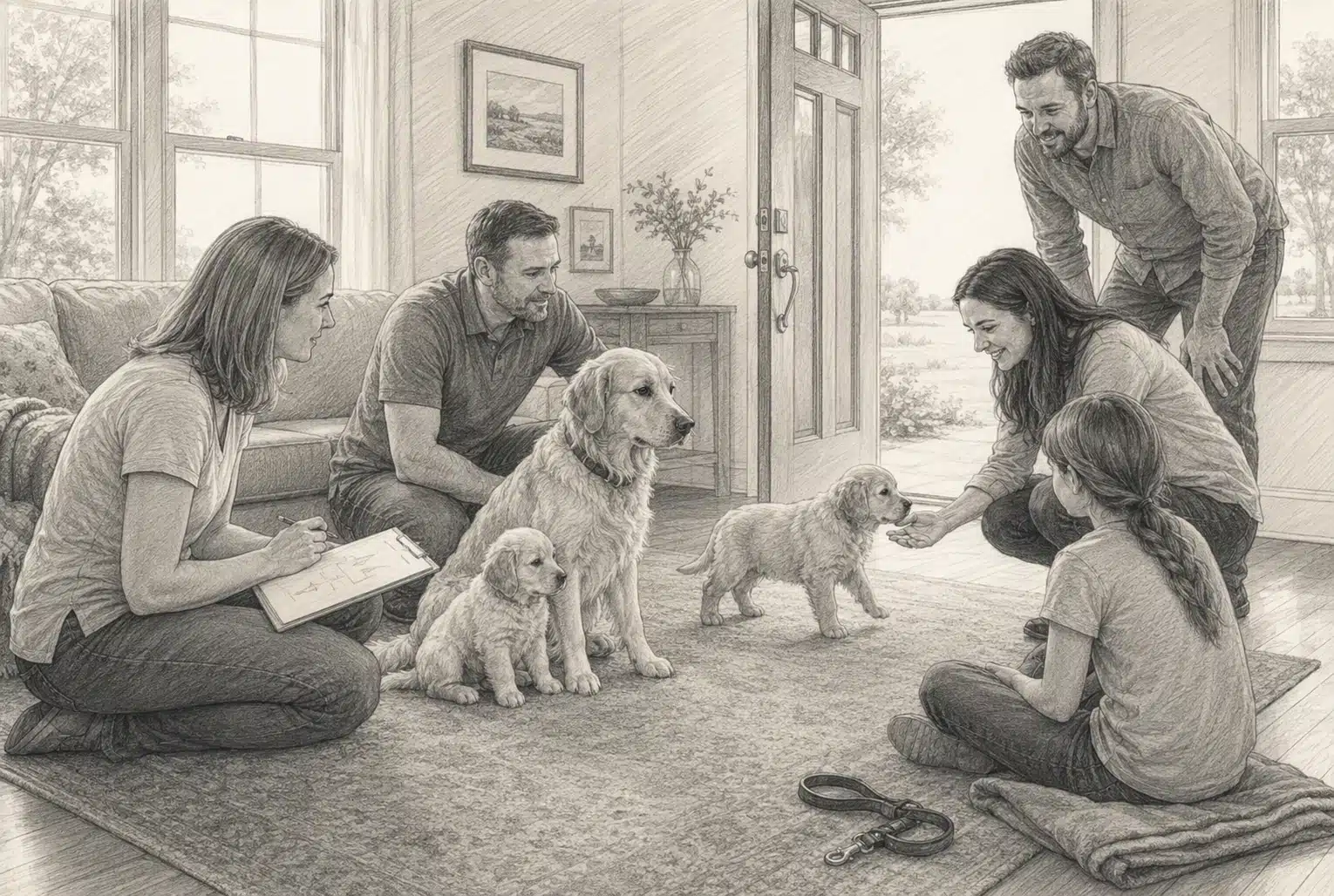
Limits matter just as much. A puppy may be sleepy, hungry, overstimulated, or having an off day. The AVMA notes that early, positive exposure strongly shapes later behavior, so a score at eight weeks cannot replace continued socialization and kind training at home. See the AVMA socialization review.
Ask for examples, not labels. “Cautious with a new toy, then returned to play” is more useful than “medium energy.”
Research also warns against relying on a single behavior evaluation as the sole decision-maker. AVMA coverage of shelter assessments highlights limits in predicting individual behavior.
Also Read: 10 Red Flags to Avoid When Visiting a Local Puppy Breeder
What Families Should Evaluate Alongside the Report
Parent Information and Early Development
A temperament report is one useful snapshot, not a promise. Ask for information on both parents: their size, everyday nature, health testing, and how they behave around familiar people and new visitors.
Also ask what the puppy has experienced so far. Gentle handling, normal home sounds, safe crate time, grooming touch, and calm exposure to new people all matter. The AKC notes that early positive exposure helps shape how a puppy responds to the world.
Use this short check:
- Can the breeder explain each parent’s temperament plainly?
- Can they share health records relevant to the breed or mix?
- What social experiences has the puppy had?
- How does the puppy recover after a new sound or brief surprise?
A puppy who pauses, then re-engages, may be showing more useful resilience than one who never reacts at all.
Your Household and the Practical Match
Be honest about the life you can offer. A gentle puppy may still need patient training, daily play, grooming, and quiet rest. A bold puppy may suit an active home but feel like too much for a family seeking a very calm companion.
| Household factor | Ask yourself | Why it matters |
|---|---|---|
| Young children | Can adults guide every interaction? | Puppies need safe, calm handling |
| Work schedule | Who handles midday care and training? | Routine helps puppies settle |
| Other pets | Are they social and well managed? | Introductions should be gradual |
| Travel or delivery | Can you plan a quiet first week? | Transition affects early adjustment |
Share these details with the breeder. Good matching is a two-way conversation, and current puppy tests cannot reliably predict adult behavior on their own, according to AKC guidance.
Also Read: Oklahoma Puppies for Sale: Questions That Protect New Buyers
Is a Puppy Temperament Test Worth Relying On?
Yes, as one clue. No, as a promise. A breeder’s test can show how a puppy responded on one day to handling, noise, play, or a new person. It cannot predict every adult behavior.
A useful report should explain what the breeder saw, not simply assign a label such as “perfect family dog.” The AVMA advises families to choose a dog that fits their home and lifestyle, including energy, grooming, and training needs.
| Report detail | What it can tell you | What it cannot guarantee |
|---|---|---|
| Response to handling | Current comfort with touch | Lifelong ease with grooming |
| Reaction to new sounds | Current recovery after surprise | No future fear response |
| Play style | Present energy and interest | Adult exercise needs |
| Human focus | Early social interest | Instant bonding with every person |
Ask the breeder:
- What situations did you observe?
- Did the puppy recover quickly after being unsure?
- How has the puppy changed across several weeks?
- What social experiences has the litter had?
A shy puppy is not a “bad” puppy. Calm, patient exposure and reward-based training matter greatly after pickup.
Early positive exposure is especially meaningful. The AVMA’s literature review notes that puppies are highly open to new experiences during early development. Use the report to start honest conversations, then plan for the puppy’s continued learning at home.

Ready to compare breeder reports with clearer eyes? Sage Puppies shares a transparent, family-first process for home-raised Havanese, Havapoo, and Cavapoo puppies. Review available puppies, ask direct temperament questions, and choose local South Jordan pickup or nationwide delivery with confidence.
Frequently Asked Questions
Q1: What is puppy temperament testing and how is it done?
A breeder observes a puppy’s response to handling, sounds, people, play, and mild new situations. Tests should be brief, gentle, and paired with daily notes from the litter.
Q2: How accurate are puppy temperament tests in predicting adult behavior?
They offer clues, not promises. A puppy’s genes, early care, training, health, and new home all shape adult behavior. Use results to guide questions, not to select by score alone.
Q3: What should I look for in a breeder’s temperament testing report?
Look for plain observations, test age, context, and limits. Strong reports explain both strengths and needs, rather than labeling one puppy “perfect” for every family.
Q4: Can a shy puppy become confident?
Yes. Patient socialization and kind training can help. Avoid forcing new events, and ask whether the puppy recovers after a brief startle.
Q5: Should first-time owners choose the calmest puppy?
Not always. Choose a puppy whose energy, handling comfort, and recovery style fit your home and daily routine.
Conclusion
A breeder temperament report is a useful snapshot, not a promise. Read the score beside the puppy’s age, test setting, parent temperaments, health records, and early home experiences. Ask what each label means and whether the breeder can explain the puppy’s reactions in plain terms.
Choose the puppy whose needs fit your real home, not the one with the most flattering score.
Good breeding includes both careful parent selection and early social growth. The AVMA’s breeding guidance highlights temperament screening, health testing, and early training as key parts of responsible care. Your steady, positive support after pickup or delivery will still shape who your puppy becomes.