Quick Summary: If your puppy eats Halloween candy, call your vet or a poison control line immediately, even before symptoms appear, since risk depends on the candy type, amount, and your puppy’s weight. Dark chocolate, xylitol, and raisins are the most dangerous, and small breeds like Havanese or Havapoo puppies face higher risk from smaller amounts. Keep the wrapper, note the time, and share your puppy’s weight to help the vet decide on treatment. Never induce vomiting at home, and watch for signs like vomiting, shaking, or weakness for up to 24 hours.
Your puppy ate chocolate from the candy bowl. Now the clock matters, because risk depends on the type, the amount, and your puppy’s weight. If a puppy ate chocolate, veterinarians at Cornell and the ASPCA agree on the first move: call your vet or an animal poison-control line right away, even if your puppy seems fine. When a dog ate candy, symptoms can take hours to show, and small breeds face more risk from less. This puppy Halloween safety guide covers what to do, what details to collect, and when to seek urgent help.
What to Do First After Your Puppy Eats Candy
Move fast, but don’t panic. Most candy scares end well when you act in the first hour.
Secure the scene and save the packaging
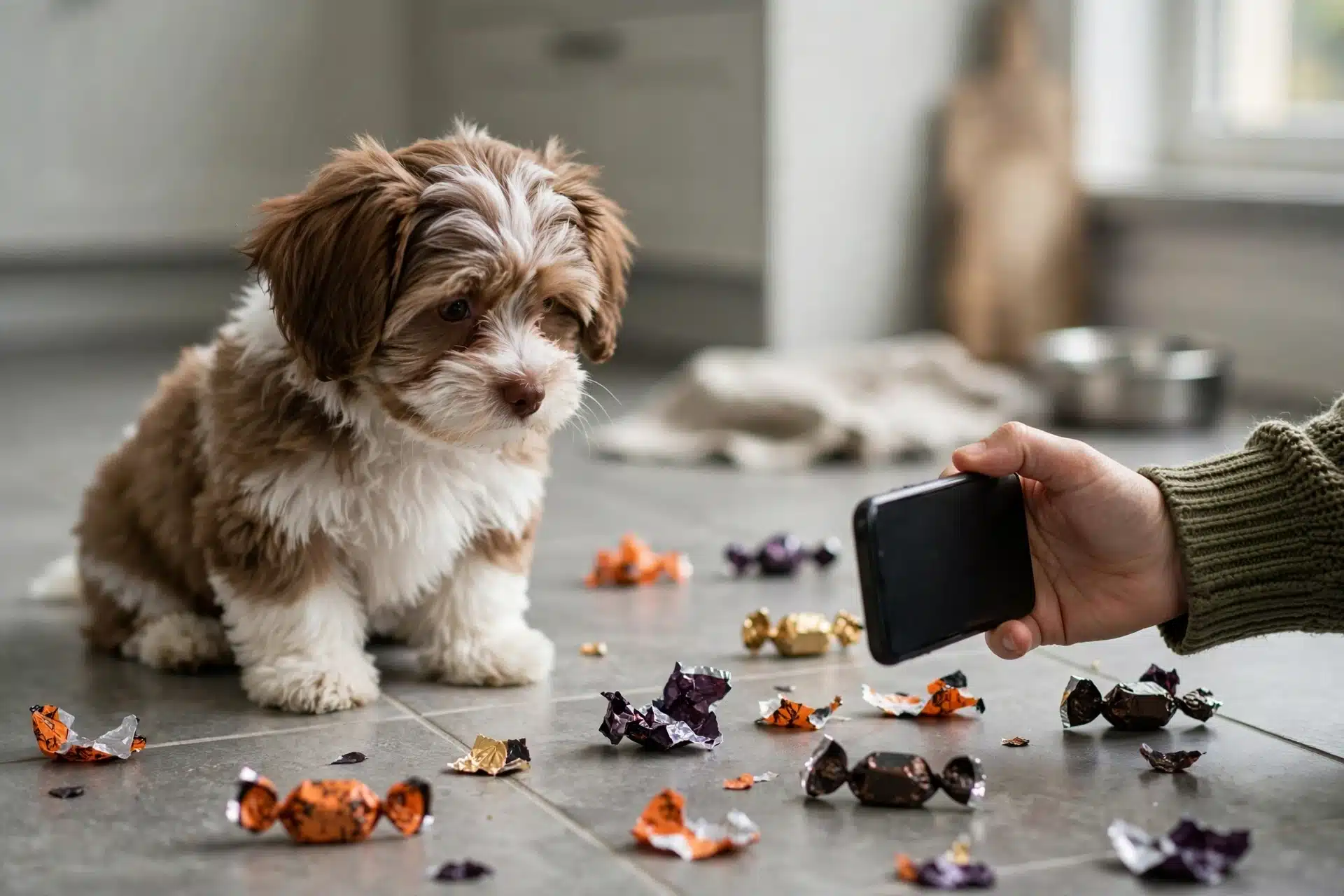
First, get the candy out of reach. Put your puppy in a safe spot, then sweep the area for wrappers, dropped pieces, and anything else they might grab next.
Next, find the packaging. This matters more than most new owners realize. The wrapper tells you:
- What your puppy ate – chocolate type, sugar-free gum, raisins, or something harmless
- How much – package weight helps your vet estimate the dose
- Key ingredients – cocoa percentage, xylitol, caffeine
Snap a photo of the label with the ingredient list showing. If a wrapper is torn, count the pieces left so you can guess how many are missing.
Keep a note of the time your puppy ate the candy. Vets use that window to decide on treatment.
Write down your puppy’s weight too. It’s one of the first questions any poison hotline will ask. Small breeds need far less toxin to get into trouble, so accurate weight matters. If your puppy ate chocolate, the darker the candy and the smaller the dog, the faster you should call.
Call before symptoms appear
Do not wait for vomiting or shaking. By the time symptoms show, treatment gets harder. Call your veterinarian or a pet poison hotline right away, even if your puppy seems fine.
Have this ready before you dial:
- Your puppy’s breed, age, and weight
- The candy type and estimated amount
- The time the candy was eaten
- Any symptoms you’ve already seen
If your regular vet is closed, call the nearest emergency animal hospital or the ASPCA Animal Poison Control line. They will tell you whether to watch at home or come in now.
Never make your puppy vomit unless a professional tells you to. Some ingredients cause more harm coming back up.
Also Read: Guides – Sage Puppies
Why a Small Puppy Can Face a Different Risk
A fun-size candy bar is a snack for you. For a five-pound puppy, it can be a real dose of theobromine, the compound in chocolate that dogs process slowly. Puppies also have immature livers, so they clear toxins less efficiently than adult dogs. That is why small breeds like Havanese, Cavapoos, and Havapoos sit in a higher-risk group, even when the amount eaten looks tiny to you.
Chocolate type changes the calculation
Not all chocolate carries the same load. Baker’s chocolate and dark chocolate pack far more theobromine per ounce than milk chocolate. White chocolate has almost none, though the fat and sugar can still upset a puppy’s stomach.
Here is the rough risk ranking, from most to least dangerous:
| Chocolate Type | Theobromine Level | Relative Concern |
|---|---|---|
| Baker’s chocolate | Very high | Serious, even in small amounts |
| Dark chocolate | High | Warrants a vet call for small dogs |
| Milk chocolate | Moderate | Dose depends heavily on weight |
| White chocolate | Negligible | Stomach upset possible |
So a puppy who steals a square of dark chocolate needs attention sooner than one who licks a milk chocolate coin. The type tells you how worried to be. The next factor tells you the rest.
Weight and amount matter together
Vets estimate chocolate risk by dividing the amount eaten by the puppy’s body weight. The same candy bar that barely registers for a 60-pound Labrador can push a 4-pound Havapoo puppy into the danger zone.
The math works against small dogs twice. They eat the same piece of candy, but they carry far less body weight to absorb it. A puppy who also ate the wrapper faces a second problem, since foil or paper can block a tiny intestine.
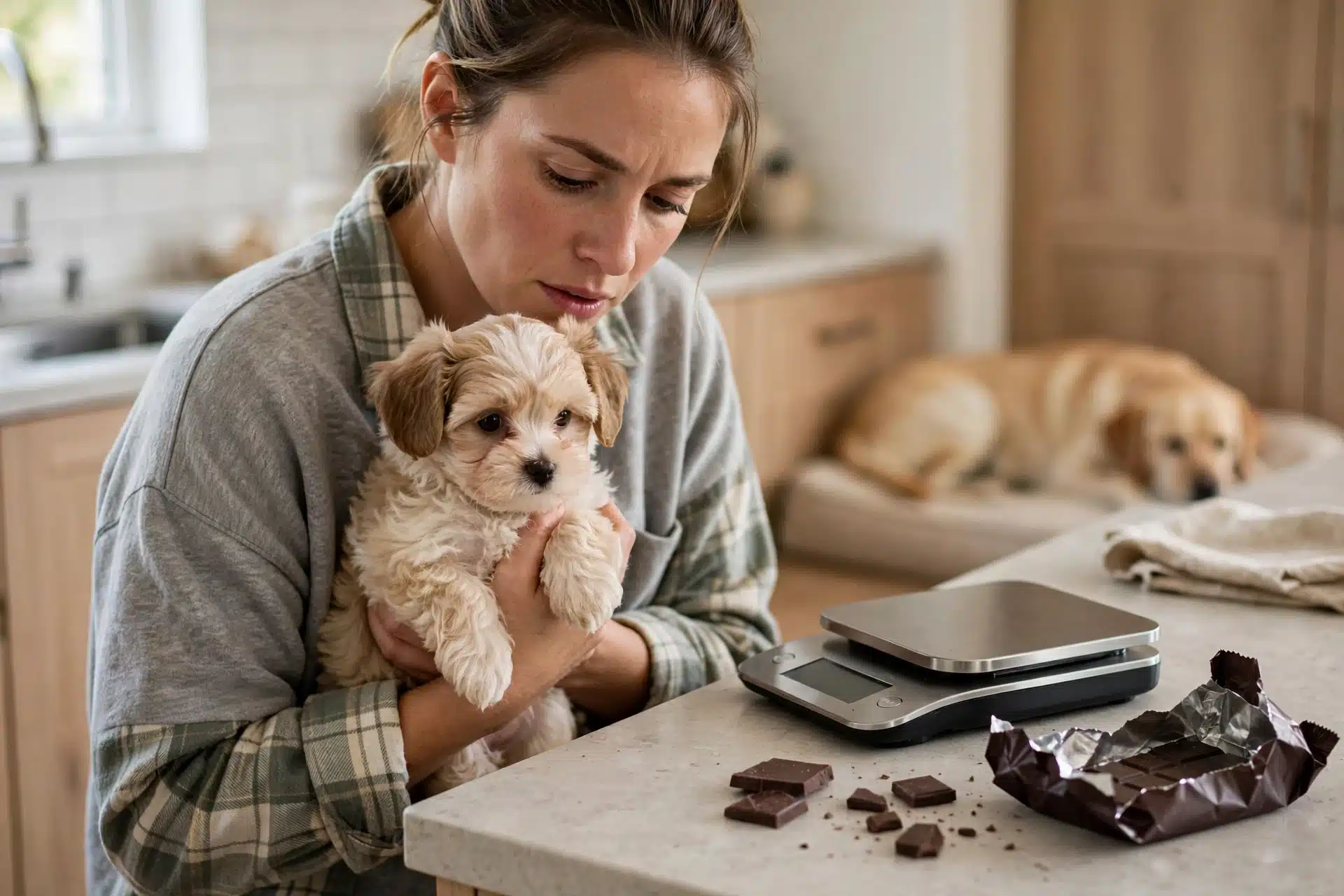
Track three things before you call: your puppy’s weight, the chocolate type, and the estimated amount eaten. Write them down. Your vet will ask for exactly these numbers.
Also Read: 10 Signs a California Puppy Listing Is a Scam – Sage Puppies
Candy Ingredients That Change the Urgency
Not all candy is equal. Two things decide how fast you call the vet: what the candy contains and what else came with it. Flip the wrapper over before you panic.
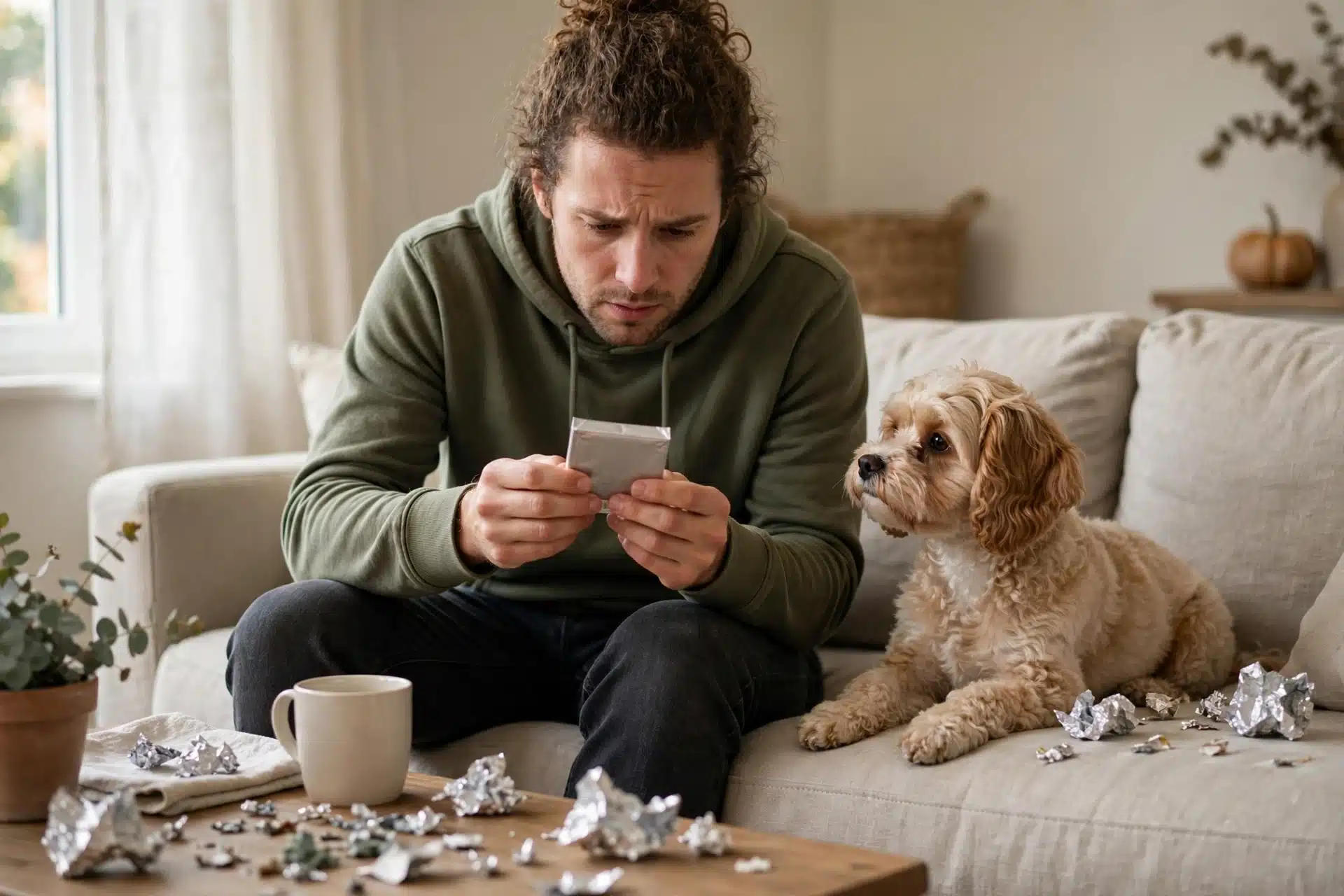
Check for xylitol and sugar-free labeling
Xylitol is the ingredient that turns “my puppy ate candy” into an emergency call, even when the treat has no chocolate at all. It hides in sugar-free gum, mints, hard candies, some peanut butters, and many “low sugar” snacks. In dogs, it triggers a fast drop in blood sugar and can cause liver failure. Small breeds feel the effects at tiny doses, so a Havapoo puppy who swallows a few sticks of gum needs vet care right away, not a wait-and-see approach. Scan the label for the words sugar-free, xylitol, or birch sugar. No wrapper? Call the vet anyway and describe the candy. Cornell’s veterinary guidance warns that signs like vomiting, weakness, or wobbling can appear within 30 minutes to 12 hours.
If the wrapper says sugar-free, treat it like a chocolate emergency. Call the vet or the ASPCA Animal Poison Control line immediately.
Look for fillings and wrappers too
Candy fillings raise the stakes as much as the outer shell. Raisins and grapes in snack boxes can cause kidney failure, and some vets rank them above chocolate for danger. Macadamia nuts, nougat, and raisin-filled bars all warrant a call.
Foils and wrappers bring their own risk. Puppies swallow them whole, and the packaging can block the gut. Watch for vomiting, drooling, or straining to poop over the next day or two. Vomiting and toy breeds have lower margins for error, so err toward the call.
Also Read: 10 Red Flags to Avoid When Visiting a Local Puppy Breeder
Symptoms to Watch For, and Why Waiting Is Risky
Early signs may look nonspecific
Most candy problems start small, and the first signs rarely point to one cause. A puppy may vomit once, seem tired, refuse dinner, or drink more water than usual. These symptoms fit many problems, from an upset stomach to something more serious like chocolate toxicity.
That is exactly why timing matters. Small breeds such as Havanese, Havapoo, and Cavapoo puppies have tiny bodies, so a dose that seems minor can hit them hard. Theobromine and caffeine from chocolate build up over several hours, and xylitol can drop blood sugar fast.
Watch your puppy closely for the first few hours and jot down what you see:
- Vomiting or diarrhea, especially more than once
- Restlessness, pacing, or trembling
- Fast breathing or a racing heartbeat
- Unusual thirst or frequent urination
- Weakness, wobbling, or hiding
Note the time the candy was eaten, the type, and roughly how much. That record helps your vet act quickly instead of guessing.
Treat severe signs as an emergency
Some symptoms mean you should call a vet or emergency clinic right away, not wait until morning:
- Repeated vomiting or diarrhea
- Tremors, muscle twitching, or seizures
- Stumbling, collapsing, or trouble standing
- Very fast heart rate or pale gums
- Extreme sluggishness or unresponsiveness
Xylitol poisoning is the clearest example of why waiting is risky. According to ASPCA guidance on xylitol, low blood sugar can appear within 30 to 60 minutes, and liver damage can follow. Seizures can come quickly after that.
Merck’s veterinary guidance on chocolate toxicosis notes that serious signs often develop within 6 to 12 hours, which is a long window to lose.
The rule is simple. Mild signs still get a phone call. Severe signs get the car. With a small puppy, hours matter more than confidence, and no one regrets calling too early.
What the Veterinary Team May Ask and Do
When you call, the person on the line works from details. Have them ready and the call moves faster.
Have the facts ready for the call
Before you dial, write down a few things. The vet clinic will ask for them right away, and clear answers help them decide how worried to be.
- Your puppy’s weight. Small breeds like a Havanese or Cavapoo face higher risk because the same amount of candy hits a small body harder.
- What was eaten and how much. Name the candy, the wrapper size, and your best count. A photo of the package helps.
- When it happened. Timing matters a lot. Theobromine and other toxins build over hours.
- Symptoms you have seen. Vomiting, shaking, restlessness, or a racing heart all change the plan.
- Your puppy’s age and health history. A young puppy or one with a known condition may need faster care.
Keep this list by the phone during Halloween week. It saves minutes when minutes count.
Treatment decisions belong to the clinician
The vet, not you, decides what happens next. Depending on the candy, the amount, and the timing, the team may induce vomiting, give activated charcoal, run bloodwork, or start IV fluids. Chocolate cases often need monitoring for heart rhythm changes, since theobromine stresses the heart and nervous system.
Do not try any of these steps at home. Home remedies can push a mild problem into an emergency, and they waste the window a clinic can use well.
Trust the process. A clinic that sees candy calls every October knows exactly what to check.
Also Read: Puppy Weather Safety Guide for Heat, Cold, and Severe Storms
How to Reduce the Chance of Another Candy Scare
Most candy scares happen in the first ten minutes after trick-or-treating ends. A dropped piece, an open bag on the couch, a toddler sharing. Close those gaps and you remove most of the risk.
Practical steps that work:
- Set a candy zone. Keep all treats in one closed room or high cabinet. Puppies and candy never share a floor.
- Do a sweep after trick-or-treating. Check hallways, entryways, and under the couch for dropped pieces.
- Brief the kids. Make “the puppy never gets candy” a house rule, same as “we look both ways.”
- Trade, don’t scold. Teach a solid “leave it” using a treat your puppy is allowed to have.
- Offer a distraction. A stuffed chew toy keeps a puppy busy while the family sorts candy.
- Watch the trash. Lollipop sticks and wrappers matter as much as the chocolate.
Small breeds like Havanese, Havapoo, and Cavapoo puppies reach counters and couches faster than families expect, so puppy-proof early.
One scare is usually a fluke. Two usually means an access problem you can fix tonight.
Also Read: Puppy Care Blog & Resources | Sage Puppies
Why Chocolate Advice for Puppies Needs Context
“How much chocolate is dangerous?” has no single answer, and that trips up worried puppy families. Three things decide the risk: the type of chocolate, the amount eaten, and your puppy’s weight.
Dark and baking chocolate carry far more theobromine than milk chocolate, and theobromine is the compound that harms dogs. The FDA notes that baking chocolate holds about 364 mg of theobromine per ounce, while milk chocolate holds around 57 mg. Same bite size, very different stakes.
Puppies sit at the sharp end of this. A 5-pound Havanese puppy processes the same piece of candy as a 60-pound Lab, so a “small amount” from a big dog’s perspective can be serious for a small breed.
The safest rule: treat any chocolate eating by a puppy as worth a phone call, not a wait-and-see. Cornell’s veterinary team recommends calling a vet right away.
That context matters more for the small-breed puppies we raise at Sage Puppies, where a tiny body leaves little room for error.

A calm, well-socialized puppy is easier to protect on hectic nights like Halloween. At Sage Puppies, our home-raised Havanese, Havapoo, and Cavapoo puppies come well-started and family-prepped. Browse available puppies or start your application today.
Frequently Asked Questions
Q1: What should I do if my puppy eats Halloween candy?
Note what your puppy ate and how much, remove remaining candy, and call your vet or the ASPCA Animal Poison Control Center. Watch for vomiting, tremors, or restlessness, and follow their guidance closely.
Q2: Which Halloween candies are toxic to puppies?
Dark chocolate, baking chocolate, sugar-free candy with xylitol, raisins, and candy containing macadamia nuts are the biggest risks. Milk chocolate is milder but still dangerous in larger amounts. Wrappers can also cause blockages.
Q3: How much chocolate is dangerous for a puppy?
It depends on your puppy’s weight and the chocolate type. Darker chocolate is riskier, and small breeds reach toxic doses faster. When you call, share your puppy’s weight so the vet can assess the real risk.
Q4: Should I make my puppy vomit at home?
No. Inducing vomiting yourself can cause harm. Let a vet or poison control expert decide if it’s needed and how to do it safely.
Q5: Can a single fun-size candy bar hurt my puppy?
For most puppies, one milk chocolate fun-size bar causes mild upset at worst. Dark chocolate or xylitol candy is different, so treat any of those as urgent.
Q6: How long should I watch my puppy afterward?
Watch closely for 12 to 24 hours. Chocolate symptoms often appear within 6 to 12 hours, while xylitol can cause low blood sugar within an hour.
What to Do Next
A puppy’s candy bite almost always comes down to three things: what was eaten, how much, and how much your puppy weighs. Chocolate and xylitol need a vet call right away. Keep the wrapper, note the time, and let the poison hotline or your vet guide you. Skip home remedies entirely. Small breeds like Havanese, Havapoos, and Cavapoos react to far less candy than big dogs, so treat any unknown amount as urgent. Store the treat bowl high, tell the kids why, and Halloween stays fun for everyone, two-legged and four.