
Quick Summary: Michigan puppy deposits typically range from $300 to $700 and count toward the total price, but the real protection comes from a written contract that spells out refund terms, pickup details, and what the deposit covers. Since Michigan has no specific deposit refund law, buyers forfeit money if they back out, but they may get refunds if the breeder cancels or the puppy is sick. Before paying, verify the breeder with a live video call, check health records, and use a credit card to avoid scams.
A Michigan family shopping for a Havanese or Cavapoo often sees a $300, $500, or higher puppy deposit beside a sweet photo. But the number alone tells you little. Is it fair? What does it reserve? Can you get it back? This guide answers those questions. We break down typical puppy deposit cost ranges, how the puppy deposit refund process works, and the red flags that separate ethical breeders from scams. You will also learn what a written contract should cover before you send money. Written by the team at Sage Puppies, a small-breed program known for health-tested parents and transparent adoptions, this article helps you pay with confidence, not guesswork.
What a Typical Michigan Puppy Deposit May Cost
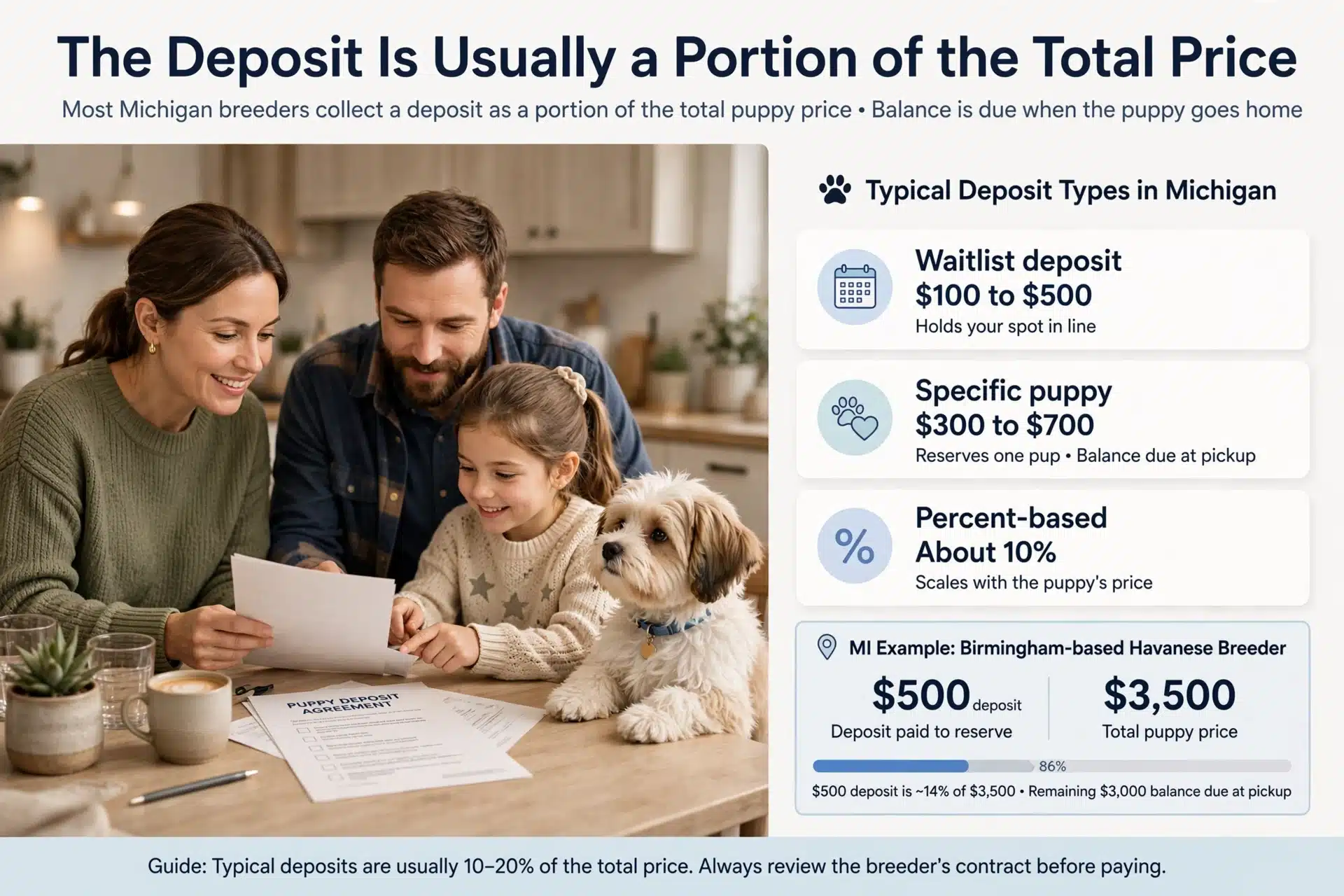
The Deposit Is Usually a Portion of the Total Price
Most Michigan breeders ask for a deposit between $300 and $700, which comes off the total purchase price rather than sitting on top of it. For context, a Cavapoo from a responsible breeder often runs $1,500 to $4,000, with many listings near $2,000 to $2,500, and the deposit is simply the first slice of that number according to Petful’s 2026 Cavapoo price guide.
Real examples look like this:
| Breeder Type | Typical Deposit | How It Works |
|---|---|---|
| Waitlist deposit | $100 to $500 | Holds your spot in line |
| Specific puppy | $300 to $700 | Reserves one pup; balance due at pickup |
| Percent-based | About 10% | Scales with the puppy’s price |
One Michigan example: a Birmingham-based Havanese breeder’s deposit agreement lists a $500 deposit against a $3,500 puppy, with the remaining balance due when the puppy goes home (see Carneys Havanese Haven’s deposit agreement).
Why Deposit Amounts Differ Between Breeders
Deposit size varies for a few honest reasons:
- Breed and demand. Havanese, Havapoo, and Cavapoo puppies carry different price points.
- Waitlist vs. specific puppy. Holding a spot often costs less than reserving one exact pup.
- Breeder structure. Some use flat fees, others use a percentage.
- Program quality. Health testing and early socialization cost money, and pricing reflects it.
A Deposit Should Not Be a Surprise Charge
A trustworthy breeder states the deposit amount, what it applies to, and refund terms in writing before you pay. If the number only appears after you send money, keep looking. Clear, written terms are the norm for programs like ours, and they protect both sides.
Also Read: 10 Red Flags to Avoid When Visiting a Local Puppy Breeder
What a Puppy Deposit Should Cover
A deposit is not just money down. It should buy you something clear: a defined spot in line, a written agreement, and a plan for pickup or delivery. Before you pay, make sure the breeder spells out each piece below.
A Defined Reservation or Place in the Selection Process
Your deposit should secure one of two things: a specific puppy or a specific pick position in a litter. A good agreement names the puppy’s breed, sex, color, date of birth, and microchip number if assigned. For planned litters, it states your pick order and when you’ll choose. The AKC-referenced guidance on deposit contracts stresses that both parties should sign and date the document, and that the total price and refund terms belong in writing too.
| Deposit Should Cover | Deposit Should NOT Replace |
|---|---|
| Written puppy or pick identification | The full sales contract |
| Total price and balance due date | Health guarantee terms |
| Refund and forfeiture conditions | Vet exam requirements |
Time, Care, and Communication Before Pickup
Between deposit and go-home day, the breeder owes you updates: photos, weight checks, vaccination dates, and deworming records. At Sage Puppies, deposits sit inside a transparent process with regular litter updates before pickup or nationwide delivery. Ask any breeder how often you’ll hear from them. Silence during those eight weeks is a red flag.
What the Deposit Does Not Automatically Cover
Deposits usually do not include the remaining balance, delivery or flight costs, starter supplies, or health guarantees. Those live in the sales contract.
Tip: Never pay a deposit before you’ve read the full contract. Some terms, like health remedies, only appear there.
Also Read: Puppy Care Blog & Resources | Sage Puppies
How to Read the Deposit Agreement Before Paying
Never pay a deposit on a puppy you haven’t seen in writing. Ethical breeders, including family programs like Sage Puppies, share the full agreement before money changes hands, and the AKC notes a contract should never be a last-minute surprise. Here’s how to read one in three passes.
1. Identify the Parties, Puppy, and Total Price
Start with the basics and check each one:
- Both parties: full legal names, addresses, and contact details for the breeder and you.
- The puppy: breed, sex, birth date, color, markings, and microchip number if assigned.
- The money: total purchase price, deposit amount, remaining balance, and when it’s due.
If any field says “TBD” or “similar puppy,” stop and ask for corrections. Vague identity details are the number one source of disputes later.
2. Confirm Reservation, Pickup, and Delivery Terms
Next, confirm exactly what the deposit holds. Does it lock your spot in the pick order, or just one specific puppy? Look for the expected go-home age, a grace period if the litter runs late, and how travel works. If you’re arranging delivery from Michigan or Utah to your state, the agreement should name who books transport, who pays, and when payment in full is required. Ask questions in writing and save the answers.
3. Read the Refund, Transfer, and Cancellation Clauses
This page matters most. Most deposits are labeled non-refundable, and state-by-state guides confirm courts enforce that language when the buyer backs out. But read for the exceptions: if the breeder cancels, the litter is small, or no puppy matches your reservation, a full refund or transfer to a future litter should be spelled out.
If the refund clause is vague or missing, ask for it in writing before you pay. Any breeder worth your deposit will make that easy.
Are Puppy Deposits Refundable in Michigan?
Most Michigan puppy deposits are only refundable in specific situations, and the answer usually comes down to one thing: your written contract. Michigan has no dedicated puppy deposit refund law, so the contract terms and general contract rules govern the deal.
When Buyers Commonly Risk Losing the Deposit
Expect to forfeit your deposit in these cases:
- You change your mind after reserving a specific puppy.
- The contract clearly states the deposit is non-refundable, and you signed it.
- You miss the final payment or pickup deadline without contacting the breeder.
- You walk away after the breeder turned down other buyers for your puppy.
Non-refundable clauses are generally enforceable, though a cap on deposits can still apply under commercial sale rules, as explained in this overview of non-refundable puppy deposit contracts.
When a Refund or Alternative May Be Available
You have a stronger case for money back when the problem sits with the breeder, not you:
- The puppy arrives sick or has a serious hereditary issue, and vet records back it up.
- The breeder cancels, the litter shrinks, or your pick never becomes available.
- The breeder misrepresents the puppy, or turns out to be a scammer.
Note that Michigan is one of the states without a pet purchase protection (“lemon”) law, so buyers here rely mostly on contract terms. Many breeders still offer choices like a full refund or a transfer to a future litter when they can’t deliver, and the Michigan Attorney General’s puppy scam alert urges buyers to keep every record of the refund policy before paying.
What to Do If a Refund Dispute Arises
- Re-read your contract. Highlight the refund, health, and cancellation clauses.
- Put your request in writing and stay calm and factual.
- Gather proof: payment records, texts, photos, and vet notes.
- If the breeder refuses, file a complaint with the Michigan Attorney General’s Consumer Protection Team.
- Paid by credit card? Ask your card issuer about a dispute.

Also Read: Havanese, Havapoo & Cavapoo Puppy Care Blog
How to Verify a Breeder Before Sending a Puppy Deposit
A deposit is trust in cash form. Verify the breeder first, then pay.
See the Puppy, Mother, and Breeding Environment
A real breeder wants you to meet the puppy. Ask for a live video call where you see the specific puppy moving, plus the mother and the home where the litter lives. Pre-recorded clips don’t count. Ask the breeder to interact with the puppy in real time, since stolen videos can’t respond to a live request. Legit breeders encourage visits or video chats, and the FTC warns that anyone who avoids calls or meetings should be crossed off your list. If the puppies or the mother seem anxious, cramped, or unkempt, walk away.

Verify Health, Identity, and Communication Records
Responsible breeders share parent health testing results, vet exam dates, vaccination records, and deworming history without hesitation. Ask for the seller’s full name, phone number, and address, then search that name with the word “scam” or “complaint.” The AKC also recommends confirming registration papers with the registry directly, since fake breeders often quote numbers that don’t exist. Do a reverse image search on puppy photos to see if they show up on other sites. Slow, clear communication is a good sign. Pressure to pay today is not.
Use Secure Payment Practices and Watch for Escalating Fees
Pay by credit card whenever possible. Refuse gift cards, wire transfers, Zelle, and crypto requests. After the deposit, expect nothing extra. Sudden fees for crates, insurance, or “customs” signal a scam.
Also Read: Maine vs Out-of-State Puppy Deposits: Which Offers Better Protection?
Michigan Pickup, Utah Pickup, and Nationwide Delivery Considerations
Your deposit secures a spot in line. How you actually get your puppy depends on where you live and what the contract says.
If You Are Picking Up in Michigan
Some Michigan breeders keep deposits local, so you can drive to meet the litter in person. If that is your plan, confirm the pickup location and age-at-pickup in writing. Puppies generally should not travel across state lines before eight weeks old, per interstate transport guidance, so plan around that timeline.
If You Are Picking Up in South Jordan or Arranging Delivery
If your puppy is coming from Sage Puppies in South Jordan, Utah, you can pick up locally or arrange delivery nationwide. Delivery is usually handled by ground transport or a flight nanny who carries the puppy in-cabin, and nanny services typically run $350 to $800 depending on distance. Ask who books the transporter and whether the deposit includes it – most do not.
Do Not Confuse Reservation With Guaranteed Timing
A deposit holds your place in line. It does not promise a birth date, litter size, or exact handoff day. Get the refund and reschedule terms in writing so a delayed litter never leaves you stuck.
A Practical Puppy Deposit Decision Checklist
A deposit should feel like a calm, well-documented step. Use this quick checklist before you send money.
Proceed When the Key Terms Are Clear
Go ahead when the answers are in writing:
- Deposit amount, what it covers, and the full puppy price
- Whether the deposit is refundable, transferable, or applies only to that puppy
- Pickup or delivery date, location, and who pays travel costs
- A written contract with health records and, if applicable, the breeder’s guarantee terms
- A payment method with buyer protection, like a credit card
The State of Michigan’s consumer team advises keeping every document, from the ad to the contract, in case you ever need to prove a dispute.
Pause When You Feel Pressured or Uncertain
Stop and ask more questions if you notice pressure tactics. The FTC warns that scammers push you to “act fast” and often demand gift cards, payment apps, or wire transfers, which are nearly impossible to reverse. Also pause if the seller refuses a video call, the price seems too good, or you have not seen the puppy live. Ethical breeders, including home-raised programs like Sage Puppies, welcome questions and video visits.
Also Read: Guides – Sage Puppies
Common Puppy Deposit Mistakes to Avoid
Most deposit problems come down to three simple slips. They are easy to avoid once you know them.
Paying Before Reading the Full Terms
A deposit is a binding agreement, so the terms should be explained in writing and clearly understood before money moves. Ask what it covers, when it applies to the price, and what happens if plans change. Experts on deposit agreements advise knowing what your deposit covers first.
Budgeting Only for the Deposit
Deposits are usually partial payments, not the full price. Most buyers still owe the balance at pickup, plus vet visits, supplies, and delivery costs. Before reserving a puppy from any program, including Sage Puppies, map the complete first-year cost, not just the deposit.
Assuming Non-Refundable Means Every Situation Is the Same
“Non-refundable” usually means you lose the deposit if you back out. It does not cover every case. If the breeder cancels or cannot provide the agreed puppy, you are typically owed a refund no matter what the contract says, since breeder cancellation triggers different rules than a change of heart. Ask for those scenarios in writing.
Also Read: 10 Signs a California Puppy Listing Is a Scam – Sage Puppies

Ready to reserve a puppy with confidence? At Sage Puppies, you’ll see transparent deposit steps, health-tested parents, and clear pickup or delivery options before you pay a thing. Browse our available Havanese, Havapoo, and Cavapoo puppies today and submit your application.
Frequently Asked Questions
Q1: How much is a typical puppy deposit in Michigan?
Most Michigan breeders ask $200 to $500 to hold a puppy. Smaller home-based programs often sit at the lower end. Treat anything far above that range as a flag worth questioning.
Q2: Are puppy deposits refundable in Michigan?
It depends entirely on the breeder’s written policy. Some refund if the litter or health check changes; most apply the deposit to the purchase price. Always get the terms in writing before you pay.
Q3: What should a puppy deposit cover?
A deposit should reserve a specific puppy or pick position and count toward your total price. It should not cover vaccines, registration, or other add-on fees. Ask for an itemized receipt.
Q4: Should I pay a deposit before seeing the puppy?
Ask for recent photos, a video call, and parent health testing records first. If you have not seen the puppy or talked to the breeder live, do not send money.
Q5: How do I avoid puppy deposit scams?
Watch for prices too good to be true, pressure to pay by gift card or wire, and no verifiable address. Ethical programs like Sage Puppies offer calls, references, and clear pickup or delivery options.
Q6: When is the balance due after my deposit?
Usually at pickup or delivery day. Confirm the accepted payment methods, remaining balance, and any delivery fee in writing so nothing surprises you at handoff.
Conclusion
A puppy deposit in Michigan usually runs between $300 and $800, often set at a quarter to a third of the total price, and most breeders apply it directly to your final balance. The number matters less than the paperwork behind it. A written agreement should spell out the deposit amount, refund terms, and pickup date before you pay. As Good Dog’s buyer guide explains, clear written terms protect both sides. Ask questions first, confirm refund scenarios, and review contract terms carefully. Ethical breeders welcome this.





