Quick Summary: Before sending a deposit for a Havanese, Havapoo, or Cavapoo in Delaware, verify the seller’s license type and ask for the breeder’s USDA license number if a store is involved. A kennel license only proves legal compliance, not breeding quality, so request parent health test records and visit where the puppy is raised. Starting January 23, 2027, new retail pet stores cannot sell dogs, though qualifying stores may continue under strict rules. Review all paperwork, including the health disclosure and contract, before paying, and confirm the seller’s identity matches the listing.
Do not send a deposit until you know who is actually selling the puppy. A Havanese, Havapoo, or Cavapoo listed as a Delaware puppy may come from a home breeder, kennel, retail dog outlet, or broker. Each path leaves different records and raises different questions.
The hard part is that Delaware puppy laws can show whether a seller meets a legal rule, but they do not prove good breeding, health testing, or careful puppy care. A breeder license Delaware record is one useful check, not the whole answer.
This guide shows you how to check puppy breeder claims, review paperwork, ask clear health questions, and spot warning signs before money changes hands. It also explains how current Delaware puppy laws relate to the retail pet store changes set for January 23, 2027. Use this process to separate basic legal status from a truly responsible breeder.
Step 1: Identify Which Delaware Seller Rules Apply
Ask Where the Puppy Was Born and Raised
Start with one plain question: Was this puppy born and raised at the address where you keep the dogs?
Ask for the breeder’s full name, physical address, and a live video visit. If the seller cannot show the mother, the home or kennel, and the puppy’s daily space, pause.
Under current Delaware puppy laws, dogs produced and raised on the seller’s premises by someone who lives there are not treated as a retail dog outlet. The state also has different rules for a seller moving puppies from another source. See the Delaware legal definitions before you assume an online listing is a direct breeder sale.
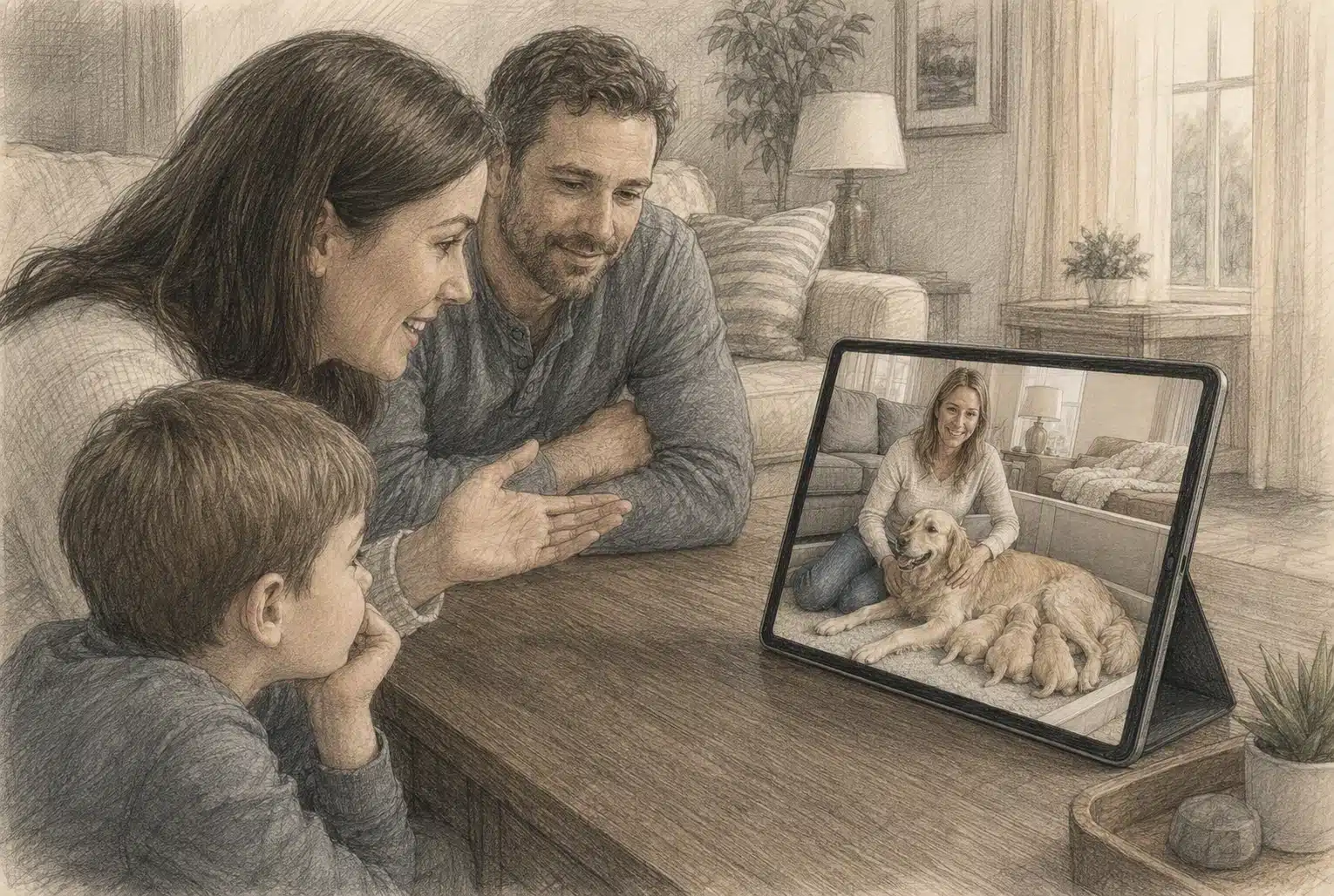
A clean answer about where a puppy began life matters more than a polished website or a fast deposit deadline.
Separate a Kennel License from a Breeder License
Do not treat a kennel license as proof of ethical breeding. Delaware’s kennel license applies when a person keeps more than four dogs for sale, breeding, show, trial, or other uses. It is renewed yearly and replaces individual dog licenses for those dogs, according to the Office of Animal Welfare.
| Item | What it tells you | What it does not prove |
|---|---|---|
| Kennel license | The seller meets a dog-count licensing rule | Parent health testing or puppy socialization |
| Direct breeder sale | The puppy may be raised by its seller | That care standards are strong |
| Retail seller | The puppy may come from another source | Who bred or raised the puppy |
From January 23, 2027, retail pet stores and brokers cannot sell dogs in Delaware. Direct, on-site breeders remain distinct under the new law.
- Ask for license details if the seller keeps more than four dogs.
- Then verify health records, parent testing, and living conditions separately.
Also Read: How to Verify Delaware Puppy Breeders Before Placing a Deposit
Step 2: Verify the Applicable Delaware License
Request the License Details in Writing
Ask the breeder for a clear photo or PDF of the current license before you send a deposit. Request:
- License type – kennel or retail dog outlet
- License number
- Name of the license holder
- Physical address on the license
- Issue and expiration dates
A Delaware kennel license may apply when more than four dogs are kept for breeding, sale, or similar purposes. It lasts one year from purchase, according to the Delaware Office of Animal Welfare.
| What you see | What to ask next |
|---|---|
| Kennel license | Does the address match where puppies are raised? |
| Retail dog outlet license | Who bred the puppy and where was it born? |
| No license offered | Why does this operation not need one? |

A license supports legal compliance. It does not prove good breeding, health testing, or kind puppy care.
Do not accept a cropped image with the key details hidden. A responsible breeder should answer this basic request calmly and directly.
Confirm the License with Delaware Animal Welfare Resources
Check the details with Delaware Animal Services or the Office of Animal Welfare. Give them the breeder’s name, address, license type, and number. Ask if the license is current and whether the listed location matches.
The state says licensed kennel sites can receive unannounced inspections. Failed inspections can lead to required fixes, follow-up visits, fines, or suspension, as explained in the state kennel license procedures.
Use this quick check:
- Match the breeder’s name to the license holder.
- Match the street address to the puppy’s actual home.
- Confirm the license is active today.
- Ask whether enforcement action affects the license.
- Save the reply with your puppy records.
Be careful with a seller who claims a license belongs to a partner, relative, or different location. The paperwork should fit the puppy’s real origin.
Also Read: 10 Small Breed Puppies That Stay Friendly & Easygoing
Step 3: Understand the New Retail Pet Store Rules
Know What Changes on January 23, 2027
Delaware’s new retail pet store law takes effect January 23, 2027. Most retail pet stores may no longer sell, lease, or transfer dogs or cats. They may still host adoption events with qualifying shelters or rescues. The Delaware General Assembly’s bill record confirms the date and the core ban.
A true home breeder selling puppies they raised at their own residence is not automatically a retail pet store. That distinction matters when you compare a breeder visit with a storefront sale.
Important: A legal exception is not the same as proof of great care, sound breeding choices, or healthy puppies. Keep verifying the source.
| Seller type | What the 2027 rule means |
|---|---|
| New retail pet store | Cannot sell dogs or cats |
| Shelter or rescue event | May showcase pets for adoption |
| Established qualifying store | May continue only under strict conditions |
| Home breeder selling direct | Not treated as a retail store if the law’s conditions apply |
Ask for Source and Broker Information When a Retail Store Is Involved
Some established stores may qualify to keep selling dogs. If so, ask for the breeder’s USDA Class A license number and, if a broker moved the puppy, the broker’s USDA Class B license number. The amended law requires qualifying stores to disclose both for each dog and sets violation limits for sources they use, as shown in the final bill text.
Use this quick check:
- Photograph or write down both license numbers.
- Ask where the puppy was born and raised.
- Ask whether you can speak directly with the breeder.
- Request health records and parent testing details.
- Walk away if answers change or records are withheld.
A store disclosure helps you trace a puppy’s path. It does not replace meeting the breeder, reviewing health information, and judging how puppies are raised.
Also Read: A Guide to Delaware Breeder Waitlists, Deposits, and Puppy Timelines
Step 4: Request the Puppy Documents Delaware Buyers Should Receive
Use a Pre-Deposit Document Checklist
Ask for key records before you send a deposit. A careful breeder should welcome clear questions and give you time to read the paperwork.
Use this checklist:
| Document | What to confirm |
|---|---|
| Parent health records | Test names, results, and the parents’ identities |
| Puppy veterinary record | Exam date, vaccine dates, deworming, and any treatment |
| Written contract | Price, deposit terms, pickup or delivery plan, and buyer duties |
| Pedigree or registration details | Only if the puppy is sold as registrable |
| Parent photos and details | The listed sire and dam match the health records |

For a Havanese, Havapoo, or Cavapoo, ask what health tests the breeder used and why. A vague statement such as “vet checked” is not the same as parent testing or a puppy health record.
Tip: Keep every file, message, receipt, and signed page in one folder. If a concern comes up later, dates matter.
A breeder may need a reasonable time to redact private details. Still, they should not avoid basic questions about parent health, puppy care, or the sale terms.
Check the Point-of-Sale Disclosure
Delaware law requires covered sellers to give buyers a written statement at sale. It should list the puppy’s birth date if known, breeder details if known, breed, sex, color, ID marks, vaccine and deworming history, plus veterinary diagnoses, treatment, or medication known to the seller. Review the Delaware pet warranty requirements before pickup.
You and the seller should also sign and date a health disclosure. It must state either that the seller knows of no illness or inherited condition, or clearly list every known concern. If the puppy had no veterinary exam before sale, that must be disclosed in writing.
- Read each line before you sign.
- Match the puppy’s sex, color, birth date, and microchip or collar ID to the puppy in front of you.
- Write down anything promised verbally, then ask for it in the contract.
Warning: Do not accept blank forms or a promise to email records later. Pause the sale until the facts are written down.
Step 5: Verify Health Testing and Family-Raised Care Separately
Ask for Parent Health Evidence, Not Just a Verbal Promise
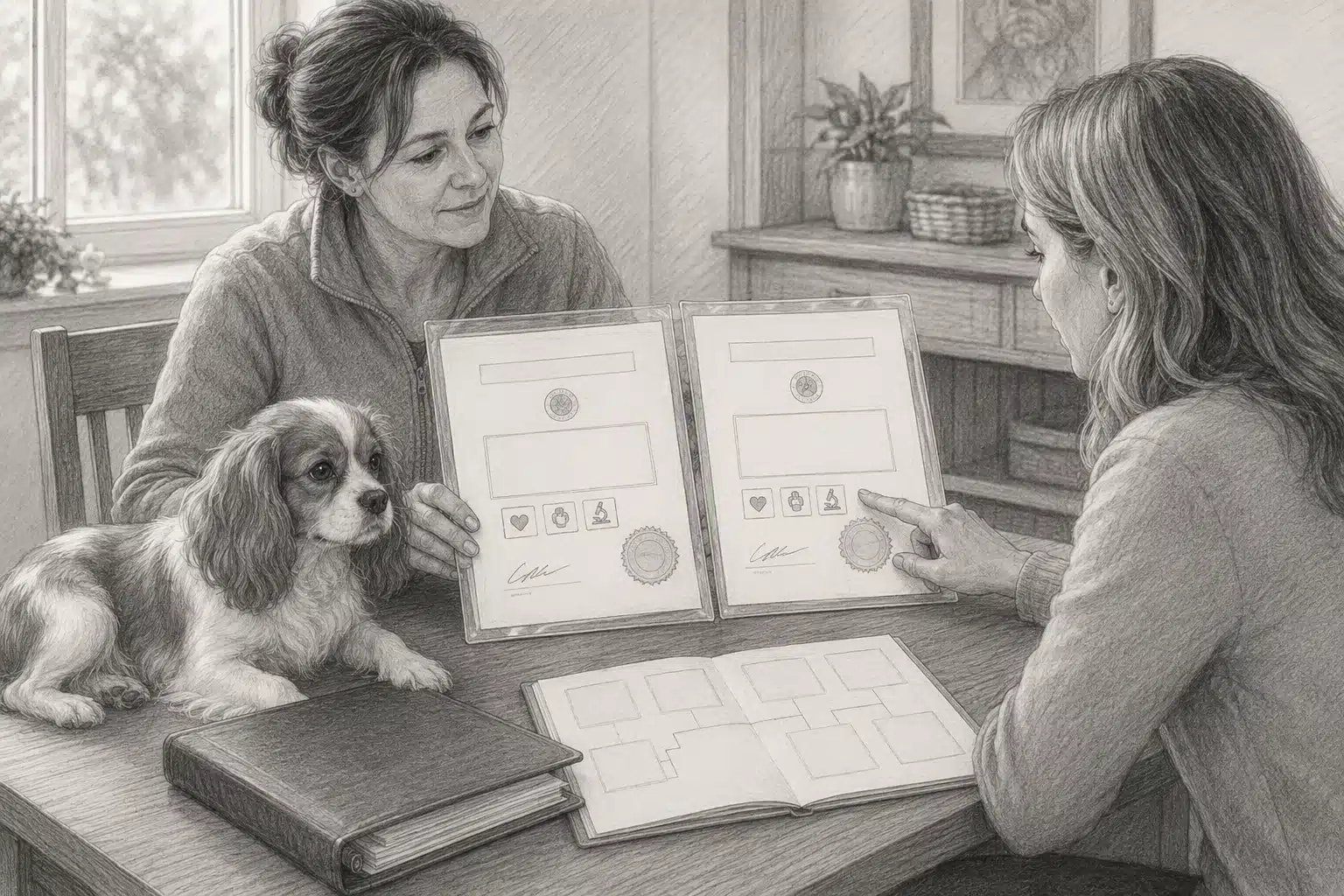
“Health tested” should lead to records, not a sales claim. Ask for each parent’s registered name, test type, date, and result. Then compare the names on every document with the dog named in the litter details.
Use the OFA records search to check results when available. OFA notes that buyers can research parents and close relatives to assess health history.
| Ask to see | What to verify | Why it matters |
|---|---|---|
| Parent test reports | Names and permanent ID match | Confirms the result belongs to that parent |
| DNA screening | Condition tested and result | Shows what inherited risks were reviewed |
| Orthopedic, eye, or heart results | Test date and evaluator | Some checks need a professional exam |
| Written puppy records | Vet care and vaccine details | Helps you plan the first vet visit |
- Ask which tests fit the parent breeds.
- Request records for both sire and dam, even if one lives elsewhere.
- Treat screenshots without dog names or lab details as incomplete evidence.
A health test lowers risk. It cannot promise a puppy will never face a health issue.
Evaluate Socialization and Daily Care
Health testing answers one question. Daily care answers another: how has this puppy learned to live with people?
Ask for a live video visit or an in-person visit when practical. The OFA’s breeder guidance advises buyers to see where puppies are raised and how dogs interact with people.
Use this quick check:
- Ask where puppies sleep, play, and spend most of the day.
- Ask what normal home sounds and gentle handling they experience.
- Watch for clean bedding, fresh water, relaxed adult dogs, and curious puppies.
- Ask how the breeder matches temperament to each family.
A family-raised setting is not proven by a cute photo. Look for clear, specific answers and a breeder who welcomes thoughtful questions.
Step 6: Verify the Contract, Payment, and Delivery or Pickup Plan
Match the Contract to the Actual Breeder
Read the contract before sending a deposit. The seller’s full legal name, business name, address, phone number, puppy details, and price should match the person and listing you verified.
Check that it clearly states:
- The puppy’s breed, sex, birth date, color, and microchip number if assigned
- Deposit amount, total price, due dates, and refund terms
- Health records, known conditions, and any health agreement
- What happens if the breeder cannot place the chosen puppy
Delaware sellers covered by the pet warranty law must provide written health and identity details at sale, including vaccine and deworming records and known health concerns. Review the state disclosure requirements alongside the contract.
Warning: Do not accept a contract with blank fields, a different seller name, or a request to pay an unrelated person.
Confirm Pickup or Delivery in Writing
A safe handoff has a clear plan, not vague promises. Put the date range, location, contact person, travel method, and remaining balance in writing.
Use this quick check:
| Detail | Confirm before paying |
|---|---|
| Local pickup | Exact address, pickup window, and who will meet you |
| Delivery | Who transports the puppy, route, timing, and care during travel |
| Payment | Accepted method, final amount, and receipt |
| Handoff packet | Contract copy, health records, feeding notes, and contact details |
If delivery changes, ask for the update in writing before agreeing. A breeder who is direct about logistics is easier to hold accountable.
Also Read: 10 Signs a California Puppy Listing Is a Scam – Sage Puppies
Step 7: Decide Whether the Breeder Has Earned Your Confidence
Use a Pass, Pause, or Stop Decision
Make the decision from proof, not a cute puppy photo or a rushed deadline. A Delaware kennel license matters, but it is only a baseline. Licensed kennels can face unannounced inspections, so ask to see current records and assess the breeder’s openness yourself. Delaware’s kennel rules explain that inspections can lead to required corrections or license suspension.
| Decision | What you have seen | What to do |
|---|---|---|
| Pass | Clear health testing, honest answers, clean living space, parent details, and written records | Move forward with the contract and reservation only after reading both fully. |
| Pause | One document is missing, a test result needs context, or delivery details are unclear | Ask direct follow-up questions. Do not send a deposit until the answer is in writing. |
| Stop | Pressure to pay, hidden parent information, changing stories, or refusal to share records | Walk away. A responsible breeder will not punish careful questions. |
Use this final check:
- Match every promise to a document or direct answer.
- Confirm the puppy’s health, care, and handoff plan fit your family.
- Read the seller disclosure before payment. Delaware law requires key health and treatment records at sale for covered sellers. Review the required disclosures.
Trust should feel calm. If you feel rushed, confused, or unable to verify a claim, pause or choose another breeder.

Choose a breeder who welcomes careful questions. Sage Puppies raises Havanese, Havapoo, and Cavapoo puppies in a home setting, with health-tested parents and clear family support. Review available puppies, ask for records, and start your application when the fit feels right.
Frequently Asked Questions
Q1: What are the new Delaware puppy breeder verification rules?
Check state licensing, inspection history, sales records, and vet paperwork. Rules can change, so confirm details with the state agency before placing a deposit.
Q2: How to check if a Delaware puppy breeder is licensed?
Ask for the breeder’s license number and issuing agency. Then contact that agency directly to confirm the license is active and matches the breeder’s name and address.
Q3: What documents are required to verify a Delaware puppy breeder?
Request the license, health records, parent testing results, purchase contract, and vaccination record. Review each document before payment.
Q4: Does a license prove a breeder is ethical?
No. A license shows legal compliance, not breeding quality. Meet the breeder, ask about parent dogs, socialization, and lifetime support.
Q5: Should I pay before seeing paperwork?
No. Review records first. A responsible breeder welcomes questions and gives you time to make a careful decision.
Conclusion
A Delaware license is a useful first check, not proof of a careful breeding program. Confirm the breeder’s legal status, meet the dogs or arrange a live visit, review parent health records, and ask how each puppy is raised and matched with a home.
Keep the paperwork. Delaware law requires certain sellers to provide health, breeder, and treatment details at sale, as outlined in the state’s pet sale rules.
The retail pet store rules also change on January 23, 2027, with limits on dog sales by stores and brokers under HB 131. Choose openness, sound records, and lifelong support over a quick deposit.