
Quick Summary: Choosing a Cavapoo from local listings requires a systematic checklist, not just falling for cute photos, focusing first on breeder identitychers, parent health testing records, and in-home puppy care before ever paying. Watch for scam signals like stock photos, pressure tactics, and vague details, and always verify OFA and DNA test results independently for both the Cavalier and Poodle sides. Reserve a puppy only after confirming the pickup or delivery terms in writing and honestly checking that your daily schedule can cover the puppy’s needs. A responsible breeder welcomes your questions and provides evidence at every step, so walk away from anyone who rushes you.
Search “Cavapoo puppies for sale near me” and you’ll find two listings with equally sweet photos. One clearly names the breeder, shows both parents, shares health records, and spells out pickup terms. The other hides all of it. That gap is the real challenge: listings look alike, but the breeders behind them rarely are.
This guide walks you through a simple order of checks – breeder identity, parent health testing, puppy care, then pickup or delivery details – so you can compare nearby listings fairly and spot red flags before you fall in love with a face. No urgency, no pressure, just evidence in the right order.
We’ve raised Cavapoo, Havapoo, and Havanese puppies in our South Jordan, Utah home for years, pairing health-tested parents with early socialization. The same standards we hold ourselves to are the ones this guide teaches you to look for anywhere.
Step 1: Screen the Listing Before You Fall for the Photos
Search for “cavapoo puppies for sale near me” and you’ll get dozens of listings, many of them adorable. Here’s the problem: some of those puppies aren’t real. The FTC warns that scammers post fake puppy ads with photos copied from other sites, then vanish once you pay. So screen the listing first. The puppy will still be cute in ten minutes.
Build a Shortlist With the Same Questions
Treat screening like a job interview. Ask every breeder the same questions so you can compare them fairly. Write the answers down.
Ask each listing:
- Who are the parents, and can you see health test results?
- Where do the puppies live? A home, a kennel, or somewhere else?
- Can you visit in person or join a video call?
- What shots and vet checks has the puppy had?
- What does the price include?
The AKC’s scam guide recommends asking for proof of health records and vet visits, and talking by phone or video before any money changes hands. Good breeders, including small Utah programs like Sage Puppies, expect these questions and answer them easily.
Notice Gaps and Pressure Signals
Now read the listing again with fresh eyes. Missing details matter as much as wrong ones. A vague location, no parent photos, or “text only” contact info deserve caution.
The FTC’s pet scam advice suggests a reverse image search on puppy photos. If the same picture shows up on multiple sites, walk away.
Watch for pressure, too:
- “Only one left, deposit today” urgency
- Refusal to video chat or let you visit
- Payment by gift card, wire transfer, or payment app
- A price far below similar Cavapoo listings
A real breeder never rushes you. If a listing pushes hard, close the tab.
Also Read: 10 Red Flags to Avoid When Visiting a Local Puppy Breeder
Step 2: Confirm Who Bred the Puppy and Where It Is Being Raised
A listing tells you a puppy exists. It does not tell you who stood behind the litter at 3 a.m. or whether that puppy grew up on a kitchen floor or in a cage. This step finds out.
Ask Who Is Responsible for the Litter
Start with one direct question: who bred this puppy? The seller should be the breeder. If the person answering your messages “works with several breeders” or can’t say where the litter was born, you’re likely talking to a broker. Brokers move puppies between facilities and buyers, which means nobody involved knows the litter’s real history.
A responsible breeder can tell you:
- The mother’s name, age, and how many litters she has had
- Whether they own the mother and where she lives
- Who handled the puppies daily and how often
Notice how they answer, too. Good breeders ask you questions back, because they care where their puppies go. That two-way conversation is a healthy sign, not an inconvenience.
See the Mother and the Puppy Environment When Possible
If the litter is local, visit. The ASPCA advises meeting the puppy where it was born and seeing the mother in person. A breeder who suggests a parking lot or a meet-up spot instead of their home is telling you something.
When you visit, check:
- Is the mother friendly, healthy, and comfortable with people?
- Do the puppies come toward you instead of hiding?
- Does the space smell clean, with fresh water visible?
OFA’s breeder interview guide notes that puppies should be raised in the home, around normal household noise, not tucked away in a barn. Families searching “Cavapoo puppies for sale near me” have a real advantage here: you can verify all of this in person before you commit.
If you can’t visit, ask for a live video tour where you control the camera and see the mother interacting with the litter.
Step 3: Verify Parent Health Information, Not Just Health Claims
Almost every Cavapoo listing says the words “health tested.” That phrase means nothing on its own. A real health claim comes with paperwork: the name of each parent, the test performed, who performed it, and the date. Ask for records before you ask for photos. An ethical breeder will send them without hesitation. At Sage Puppies, every parent dog’s testing is shared openly with families before they reserve, because we believe trust starts with evidence.
Request Records Tied to Each Parent
You want documents for both the mother and the father, not one vague statement about “the parents.” Here’s what to ask for:
- The registered name of each parent so you can search them yourself.
- OFA records for hips, patellas, heart, and eyes.
- DNA panel results for breed-specific conditions.
- Exam dates, because some clearances expire and need repeating.
Then verify independently. The OFA records search lets you look up any tested dog by name and see what was screened and what the results were. If a breeder says tests were done but nothing appears in the database, ask why. A simple explanation exists sometimes, but you should hear it.
The Cavalier King Charles Spaniel Club advises buyers to expect a current heart clearance from a board-certified cardiologist and an eye exam from a board-certified ophthalmologist, plus patella and hip clearances for both parents. That bar applies to the Cavalier side of your Cavapoo.
Red flag: a breeder who bristles at requests for records. Good breeders love these questions. They spent real money on those tests and want you to see the results.
Check That Testing Matches Both Parent Breeds
A Cavapoo has two sides, and each side carries different risks. Testing that covers only one parent breed leaves blind spots.
| Parent | Tests to Expect |
|---|---|
| Cavalier | Heart (cardiologist), eyes (ophthalmologist), hips, patellas |
| Poodle (toy or mini) | Eyes, patellas, hip X-rays for minis, PRA DNA test |
The Poodle Club of America lists eye exams and patella evaluation for toy and miniature Poodles, plus a DNA test for progressive retinal atrophy. Compare what your breeder provides against both lists, not just one.
A few quick checks:
- Ask which variety of Poodle the father or mother is. Toy and mini Poodles have slightly different testing needs.
- Confirm DNA results are clear or explain pairing choices. Responsible breeders sometimes breed a carrier to a clear partner. That’s a deliberate, informed decision. Breeding two carriers is not.
- Match names. The dog listed on the OFA record should match the parent the breeder described. If the names don’t line up, ask before you commit.
Solid paperwork won’t guarantee a puppy never gets sick. It does tell you the breeder planned ahead instead of hoping for the best.

Step 4: Assess the Puppy’s Care, Records, and Developing Temperament
Once health and parent testing check out, look at the puppy itself. Two things matter most here: the daily care the puppy has received and the records that back it up. Breeders who can talk easily about both usually raise confident, well-started puppies.
Review Puppy-Level Care and Transition Information
Ask for specifics. A good breeder answers without pausing.
- Vaccines and deworming: Ask which shots were given, on what dates, and what remains after you take the puppy home.
- Vet exam: Ask when a veterinarian last checked the puppy and whether you’ll get written notes.
- Daily routine: Ask where puppies sleep, what they eat, and when they wean. Puppies should stay with their mother and littermates until at least 8 weeks old; puppies removed earlier tend to show more behavior problems later, according to ASPCA guidance for breeders.
- Transition plan: Ask what food to keep, when to schedule your first vet visit, and how the breeder supports the first two weeks.

Ask How the Breeder Knows This Puppy
Temperament talk should be specific, not generic. Anyone can say “great personality.” A hands-on breeder can tell you exactly how this puppy differs from its littermates.
Questions that reveal real knowledge:
- How does this puppy handle loud or new sounds?
- How quickly does it recover after a startle?
- Which puppy is boldest? Which is calmest? Where does this one fall?
- Who has handled it, and how often?
Research shows the socialization window runs roughly 3 to 12 weeks, and puppies missing positive exposure in that period are more likely to grow fearful. The AVSAB position statement calls early socialization the standard of care for breeders and new owners alike. At Sage Puppies, puppies grow up inside a family home in South Jordan, so daily handling, household sounds, and child interaction shape each puppy before it ever meets you.
Also Read: Cavapoo vs Havacavapoo: Compare These Puppy Mixes
Step 5: Compare the Puppy With Your Real Household Routine
A puppy can look perfect in photos and still be wrong for your week. The AKC notes that puppies need potty breaks every two to four hours, three meals a day, and lots of naps in the early months. Your job now is to check whether your calendar can actually deliver that.
Use a Weekday Fit Check
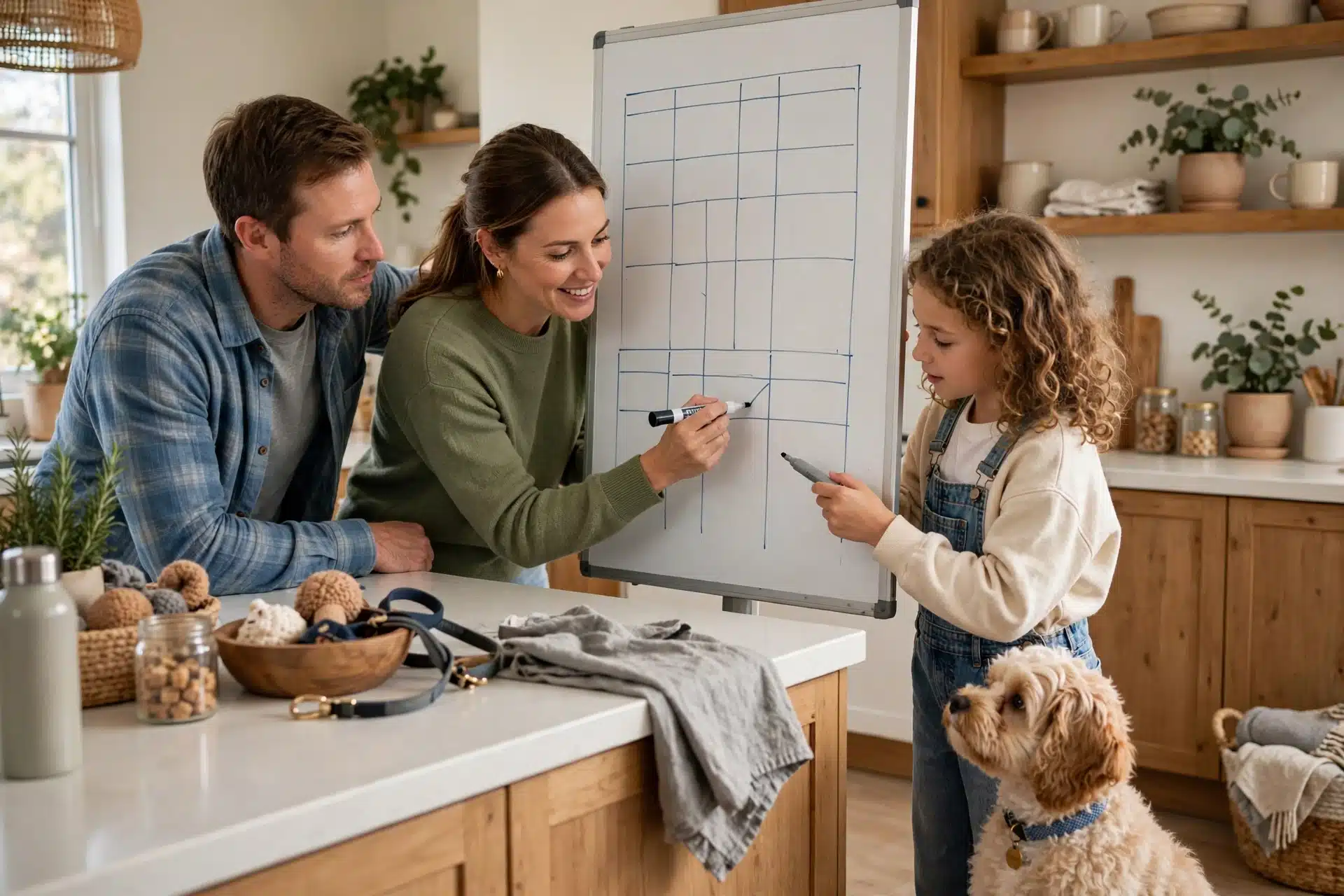
Sketch out a normal Tuesday, hour by hour. Then compare it to what a Cavapoo puppy needs:
- Morning: Who takes the puppy out first thing, every day?
- Midday: How many hours will the puppy be alone? Under four months, most puppies need a break every few hours.
- Afternoon: Who handles the post-nap potty trip and short play sessions?
- Evening: Who feeds dinner and starts training?
- Overnight: Where does the puppy sleep, and who gets up for a possible 3 a.m. break?
Write a name next to each slot. If a slot stays blank, that is your gap, and you need a dog walker, a neighbor, or a plan before you reserve a puppy.
Decide Whether to Proceed, Pause, or Pass
Now make the call:
- Proceed when every time slot has a name and the breeder confirms the puppy’s temperament matches your pace.
- Pause when your schedule works but the timing does not. A good breeder, including home-raised programs like Sage Puppies, will help you wait for a better-fit litter.
- Pass when no one can cover the middle of the day for months. That is not a failure. It is honest.
Also Read: Puppy Care Blog & Resources | Sage Puppies
Step 6: Read the Terms and Confirm Pickup or Delivery Before Paying
Before any money moves, get the agreement in writing and nail down exactly how your puppy will reach you. Good breeders expect this. A clear contract protects you, the breeder, and the puppy.
Understand the Written Agreement and Total Cost
Ask for the full purchase agreement before you send a deposit. Read every line. Most contracts cover the same core items: the price, the deposit, the health guarantee, spay or neuter terms, and what happens if you ever cannot keep the dog. Guidance from breeders themselves shows a good agreement should state the total price, the deposit amount, payment deadlines, and whether that deposit is refundable or non-refundable.
Watch for these details:
- Total cost: price, deposit, sales tax, and any delivery fee listed separately
- Health guarantee: what it covers, how long, and what voids it
- Vet exam window: many contracts require a vet visit within 48 to 72 hours of pickup to keep the guarantee valid
- Return policy: ethical breeders will take a dog back at any age rather than let it end up in a shelter
- Spay/neuter terms: the deadline and proof required
If a term is unclear, ask. A trustworthy breeder explains it calmly. Pressure to “pay now, read later” is a red flag.
Make the Handoff Plan Concrete
Decide between pickup and delivery before you pay, and confirm both in writing.
For pickup, set the date, time, and location. Most breeders release puppies around 8 to 9 weeks old. Ask what to bring and what paperwork you will receive that day.
For delivery, ask who transports the puppy, what the puppy travels with, and exactly when and where the handoff happens. Confirm the final payment deadline, since many breeders require payment in full before travel is booked.
We keep this simple at Sage Puppies: families in Utah can pick up in South Jordan, and families across the country get a written delivery plan with dates, costs, and what happens at handoff, so nothing is left to guesswork.
Get it all in one message or email. If plans change later, you will both have the original terms in writing.

Ready to meet your Cavapoo the right way? At Sage Puppies, you’ll find health-tested parents, home-raised litters in South Jordan, Utah, and a clear process from first question to pickup or nationwide delivery. Browse our available puppies, submit your application, and we’ll walk you through every step. No pressure, just honest guidance from a family who knows these puppies by name.
Frequently Asked Questions
Q1: How do I choose a Cavapoo puppy from local listings?
Start with evidence, not photos. Confirm health testing on both parents, ask how puppies are raised, and request a video call. A breeder like Sage Puppies shares parent records and daily updates so you can decide with confidence.
Q2: What questions should I ask a Cavapoo breeder?
Ask about parent health testing, how many litters they raise yearly, socialization routines, and what happens if the match is not right. Honest breeders answer openly and welcome your follow-up questions.
Q3: How can I spot a puppy scam in online listings?
Watch for low prices, stock photos, pressure to pay fast, and refusal to video call. Verify the breeder has reviews, real photos, and a clear process before sending any deposit.
Q4: Is pickup better than nationwide delivery?
Pickup lets you meet the breeder and see the home firsthand. Delivery works well when distance is a factor, as long as the breeder offers clear handoff steps and stays in touch.
Q5: When should I place a reservation?
Reserve once you have confirmed health testing and feel comfortable with the breeder. Good programs fill quickly, so apply early, but never let urgency rush you past your checklist.
Q6: What red flags should I look for in a listing?
Missing parent information, no health testing mentioned, vague pickup or delivery details, and unwillingness to answer questions. These gaps usually signal a middleman rather than a family-raised program.
Choose With Clarity, Not Pressure
Picking a Cavapoo comes down to evidence, not urgency. Check health testing first, then how the puppies are raised, then temperament, then the pickup or delivery plan. Photos and countdown timers can’t tell you any of that. Both Cornell’s canine health center and the AVMA advise families to slow down, ask questions, and match the dog to their real life.
A good breeder will welcome that pace. Expect questions back, ask to see parents and test results, and walk away from anyone who rushes you. Homes and listings tell you who to visit. Evidence tells you who to trust.





