Quick Summary: A CHIC number proves only that required breed tests were completed and published, not that the results were normal. Buyers should separate parent DNA reports, clinical screenings such as CAER eye exams and OFA patella grading, and the puppy’s vet record, then verify every claim through OFA’s public database. For Havanese, Havapoo, and Cavapoo puppies, matching results to each parent breed’s checklist and having a veterinarian review the full file offers the strongest protection.
A breeder hands you a folder of test reports, and most buyers nod politely without reading a page. That is how a CHIC number gets mistaken for a clean bill of health, even though it only confirms the results were submitted and published. Reading puppy health test results yourself takes about thirty minutes once you know what each document means. This guide walks through the three layers you will see: DNA variant reports, the parent dogs’ clinical screenings like CAER eye exams and OFA patella grading, and your puppy’s own vet record. You will learn how an OFA certification code works, what a CHIC number actually proves, and which health issues matter most for Havanese, Havapoo, and Cavapoo litters. Reading puppy health test results well means separating real evidence from paperwork that only looks like proof.
Step 1: Sort Every Record Into One of Three Groups
Reading puppy health test results gets much easier when you sort the paperwork first. Most breeders hand you a folder, a PDF, or a link, and everything looks official. It isn’t the same kind of official. Every record falls into one of three groups, and each group answers a different question.
| Group | What It Covers | Question It Answers |
|---|---|---|
| Parent clinical screening | Eye, heart, knee, hip exams | Are the parents healthy today? |
| DNA variant results | Genetic panel per dog | What genes did the puppy inherit? |
| Puppy’s own exam record | Vet check and vaccines | Is this puppy healthy right now? |

Parent Clinical Screening Records
These are hands-on exams a veterinarian performs on the mother and father. Think OFA eye exams (CAER), patella grading, cardiac checks, and hip or elbow films. They show how each parent’s body actually looks and functions at the time of the exam. Results live in the OFA’s public database, so ask for the parents’ registered names and look them up yourself.
DNA Variant Results
A DNA panel is a cheek swab, not an exam. It reports whether each parent is clear, a carrier, or affected for specific gene variants. Two carriers can produce affected puppies, which is why pairings matter more than a single “clear” result. A good breeder explains how the parents’ genotypes work together for the breed at hand.
The Puppy’s Own Examination and Veterinary Record
This group covers the puppy only: the vet check date, weight, vaccine given, and deworming history. It confirms the puppy was healthy on that day. It says nothing about inherited risk, so never let it substitute for the parent records. For help deciding which results to request before you visit a litter, see Sage Puppies’ guide to puppy genetic testing results.
Step 2: Decode the DNA Result Codes
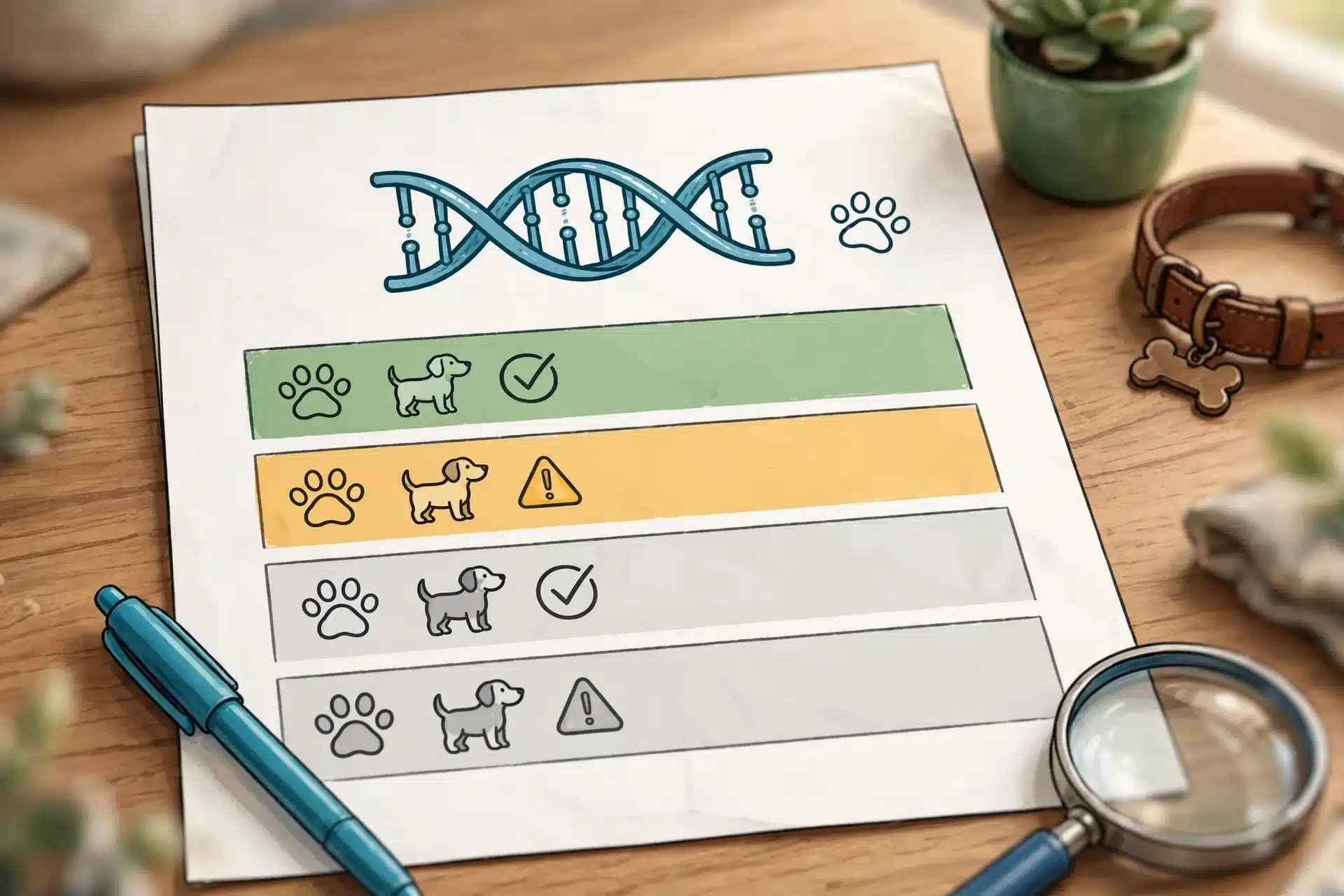
Every variant on a parent’s DNA panel gets one of three labels: clear, carrier, or affected. Clear means the dog has no copies of the tested variant. Carrier means one copy, which usually causes no illness but can be passed to puppies. Affected or at-risk means the dog carries the variant linked to the condition, and may develop it. Labs like Embark screen for more than 270 health conditions and use these same labels on their reports, so once you learn the shorthand you can read almost any panel.
| Label | Notation | What it means for your puppy |
|---|---|---|
| Clear | N/N, “no variants” | No copies of the variant |
| Carrier | One copy | Usually healthy; can pass it on |
| Affected | Two copies | Variant linked to disease |
Clear and N/N Results
A clear result is the gold standard. Reports show it as N/N, meaning the normal version of the gene sits on both chromosomes. For a recessive condition, clear parents cannot produce affected puppies for that variant. Skim the full panel, though, because the report is only as good as the number of conditions tested.
Carrier Results
A carrier has one mutated copy and one normal copy. The dog itself is usually healthy. The question is pairing: bred to another carrier or an affected dog, puppies can inherit two copies and develop the disease. Bred to a clear partner, no puppy will be affected. A carrier parent is not a dealbreaker, but ask which variants appear and confirm the mate is clear. When you evaluate health-tested puppy parents, carrier status plus a clear mate is a normal, honest answer.
Affected, At-Risk, and No-Call Results
Affected dogs carry two copies and may show symptoms. At-risk flags the same concern for some conditions. Occasionally you’ll see no-call, meaning the lab couldn’t read that marker and may need a retest. Ask the breeder to explain any of these before you commit.
According to Embark’s own result guide, a carrier’s risk of showing the disease depends on how the condition is inherited, which is why context matters more than the label alone.
Step 3: Read the Orthopedic and Eye Screening Grades
DNA results cover inherited variants, but orthopedic problems need hands-on checks. Hips, knees, and eyes are examined and graded, and each grade tells you something different about the parent dog.
Hip Ratings and the OFA Number String
An OFA hip certification number is a coded line that records the breed, the joint, the hip grade, the age at X-ray, and a registry ID. Take HY-EL1234G24M-VPI: the breed code (HY for Havanese), EL, a registry number, then G for Good, 24 months old, M for male, and the film type. Grades of Excellent, Good, and Fair count as normal. Borderline, Mild, Moderate, and Severe do not, and those dogs receive no certification number. Ask for the full string, not just “OFA hips done.”
Patella and Knee Grades
Patellar luxation means a kneecap that slips out of its groove, and it matters a lot in small breeds like the Havanese, Havapoo, and Cavapoo. The OFA grades it 1 through 4. Grade 1 kneecaps pop out only under a vet’s fingers and slip right back. Grade 2 slips often, sometimes with a skip in the gait. Grades 3 and 4 are permanently out of place and usually need surgery. For breeding stock, look for a normal result at 12 months or older, shown as an OFA number with a PA code.
Eye Examination Records
Eye results come from a CAER exam, a short check by a board-certified veterinary ophthalmologist. The report lists each finding as normal, “breeder option,” or an inherited concern, and a current exam within about a year matters most, because some eye diseases appear with age.
Breeders who keep these records current can usually show you each certificate on request, the way Sage Puppies documents its parent screening for every litter.
Step 4: Understand What a CHIC Number Actually Proves
No, a CHIC number does not mean a dog is healthy. It confirms only that the dog completed every health test its breed’s program requires and that the results were made public, pass or fail. The OFA states this plainly: a CHIC number itself “does not imply normal test results.”
What CHIC Confirms and What It Does Not
CHIC stands for the Canine Health Information Center, a joint program run by the OFA and breed clubs. Each breed sets its own required tests, often hip or patella screening, a CAER eye exam, and sometimes cardiac or DNA checks. A number proves the breeder showed up for all of them and published the outcomes, including abnormal ones. It does not prove the results were clear, and it never guarantees puppies will be free of disease.

Verifying a Dog in the OFA Database
Anyone can check a claim in about two minutes. Go to ofa.org, enter the parent’s registered name or CHIC number, and open the record. You should see the individual test results, the OFA certification codes for hips, patellas, and eyes, and the CHIC number itself. If a breeder says “CHIC parents” but no record appears, ask for the number in writing before you go further.
Red Flags in Published Claims
Watch for these warning signs:
- “CHIC certified” with no number listed. Ask for it, then look it up.
- Results dated after the breeding. Tests should come first.
- Passing a DNA panel presented as a full CHIC clearance. A panel covers variants, not knees or eyes.
Numbers are easy to verify, so an unverifiable claim tells you more than the claim itself.
Step 5: Apply Breed Context for Havanese, Havapoo, and Cavapoo
What health testing should you expect for each breed? A healthy Havanese puppy comes from parents with patella and cardiac screening, a CAER eye exam, and DNA tests for chondrodysplasia and petiae. A Cavapoo’s Cavalier parent should carry the full Cavalier King Charles Spaniel CHIC requirements, including heart and eye exams plus DNA screening. A Havapoo needs both parent breeds’ panels. Match every result to the right breed’s checklist before you trust a “health tested” claim.
Havanese Reference Points
The Havanese Club of America’s 2025 health statement lists patellar luxation, cardiac issues, and eye disease as the main concerns. On an OFA report, expect a patella grade of normal, a cardiac exam without a murmur, and a current CAER eye exam on each parent. Havanese-specific DNA panels usually screen for chondrodysplasia (short-legged dwarfism) and the petiae eye variant. Look for an OFA CHIC number on the parents, which confirms they completed the breed’s recommended tests, not that every result is perfect.
Cavapoo Reference Points
The Cavalier side drives the checklist. Cavaliers are prone to mitral valve disease, so the parent should have a cardiac exam by a cardiologist, and a current eye exam for conditions like cataracts. Request DNA results for episodic falling and dry eye syndrome, two Cavalier-linked conditions. The Poodle side brings its own patella and eye checks. Because a Cavapoo inherits from both, a breeder who tests only one parent leaves half the pedigree unverified.
Havapoo Reference Points
Havapoos combine the Havanese and Poodle lists. Ask for patella grading on both parents, cardiac and CAER eye exams, and DNA screening for chondrodysplasia plus any Poodle-relevant variants the panel covers. Mixed breeds do not qualify for breed-specific CHIC numbers the same way, so read the individual certificates instead. Any breeder who documents each parent test line by line, as we do at Sage Puppies, makes that review straightforward.
Step 6: Verify the Breeder’s Claims Against Public Records
Paperwork in an email proves nothing on its own. Cross-check every health claim against public databases before you put down a deposit. Verifying breeder health claims takes about twenty minutes and costs nothing.
A Verification Routine You Can Repeat
Work through this checklist for each parent dog:
- Get the registered name and any registration or OFA certification code for the dam and sire.
- Search the OFA advanced search by registered name or number.
- Compare what you find with the breeder’s claims: patella grade, cardiac result, hearing, and any CAER eye examination dates.
- Look for the OFA CHIC number. A CHIC number means the required breed-specific results are posted publicly, though it does not mean the dog passed everything, so read each result, not just the number’s existence.
- Ask which DNA lab ran each panel and request the report PDF.
If a dog appears nowhere in the database, ask why. Some honest breeders delay posting, but months of silence is a warning sign.
Questions to Ask the Breeder About the Records
Ask these in writing so answers are dated:
- What is each parent’s registered name and OFA or CHIC number?
- Which DNA panel was used, and can you send the full report, not a summary?
- Were any variants found where the dog is a carrier? Carrier parents are breedable only if the pairing avoids producing affected puppies.
- When was the last eye exam and patella check on each parent?
A breeder who keeps complete records usually shares them quickly. Vague answers about “vet checked” dogs deserve follow-up questions.
Good programs, including small ones like Sage Puppies, treat this exchange as routine, not resistance.
Taking Records to Your Own Veterinarian
Bring the full file to your puppy’s first visit: the parent DNA reports, the OFA records you pulled, and the puppy’s own exam record. Your vet can spot gaps you missed, such as a patella exam done before 12 months, which is too young for an OFA number with a PA code. Ask your vet to review the puppy exam notes against the breeder’s claims and to repeat the kneecap and heart checks during the visit. This second set of professional eyes turns paperwork into confidence.

You now know how to read OFA codes, DNA labels, and a puppy’s exam record, so you can ask a breeder sharp questions instead of trusting a sales pitch. See the documented parent screening behind each Sage Puppies litter on the health testing page, then browse available puppies.
Frequently Asked Questions
Q1: Where can reading puppy health test results be explained simply?
Sort everything into three groups first: parent clinical screenings, DNA variant reports, and the puppy’s own exam record. Each answers a different question.
Q2: Does a CHIC number mean the parents are healthy?
No. It only confirms required tests were completed and published, pass or fail. Read each individual result, not just the number.
Q3: Can I buy a puppy from a carrier parent?
Often, yes. Carrier parents are fine when the mate is clear, because that pairing cannot produce affected puppies for that variant.
Q4: What OFA patella grade should small-breed parents have?
Look for a normal result with an OFA number carrying a PA code, graded at 12 months or older.
Q5: How do I verify a breeder’s health claims myself?
Search ofa.org by the parent’s registered name or CHIC number, then compare grades and dates against what the breeder told you.
Conclusion
Reading puppy health test results comes down to sorting the paperwork and asking what each record can actually prove. DNA variant reports tell you whether parents are clear, carrier, or affected, and how the pairing handles those genes. Parent clinical screenings, like CAER eye exams, cardiac checks, and OFA patella grading, show how each dog’s body holds up today. The puppy’s own vet record covers only that day. A CHIC number confirms tests were completed and published, nothing more, so verify every OFA certification code yourself on the public database. Match the results to the right breed checklist for Havanese, Havapoo, or Cavapoo, and take the full file to your own veterinarian.