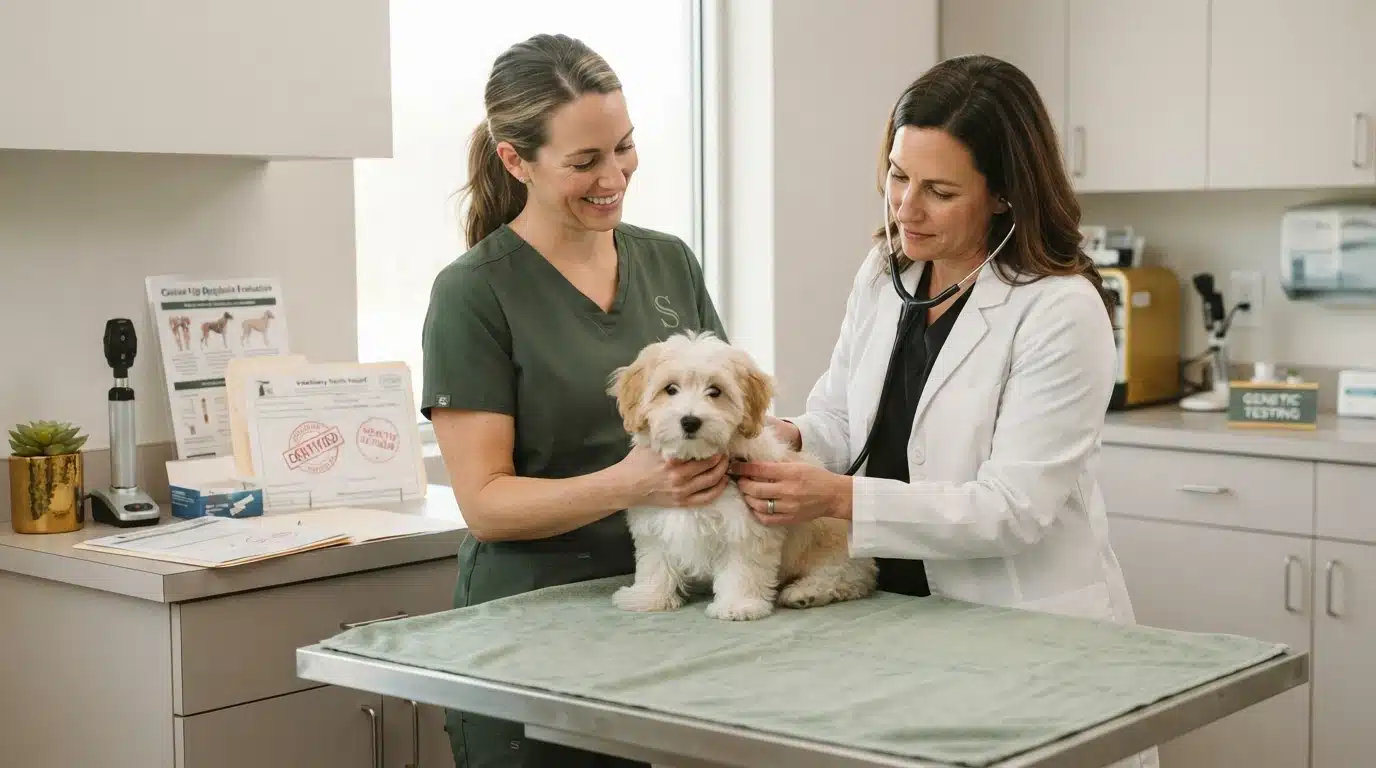
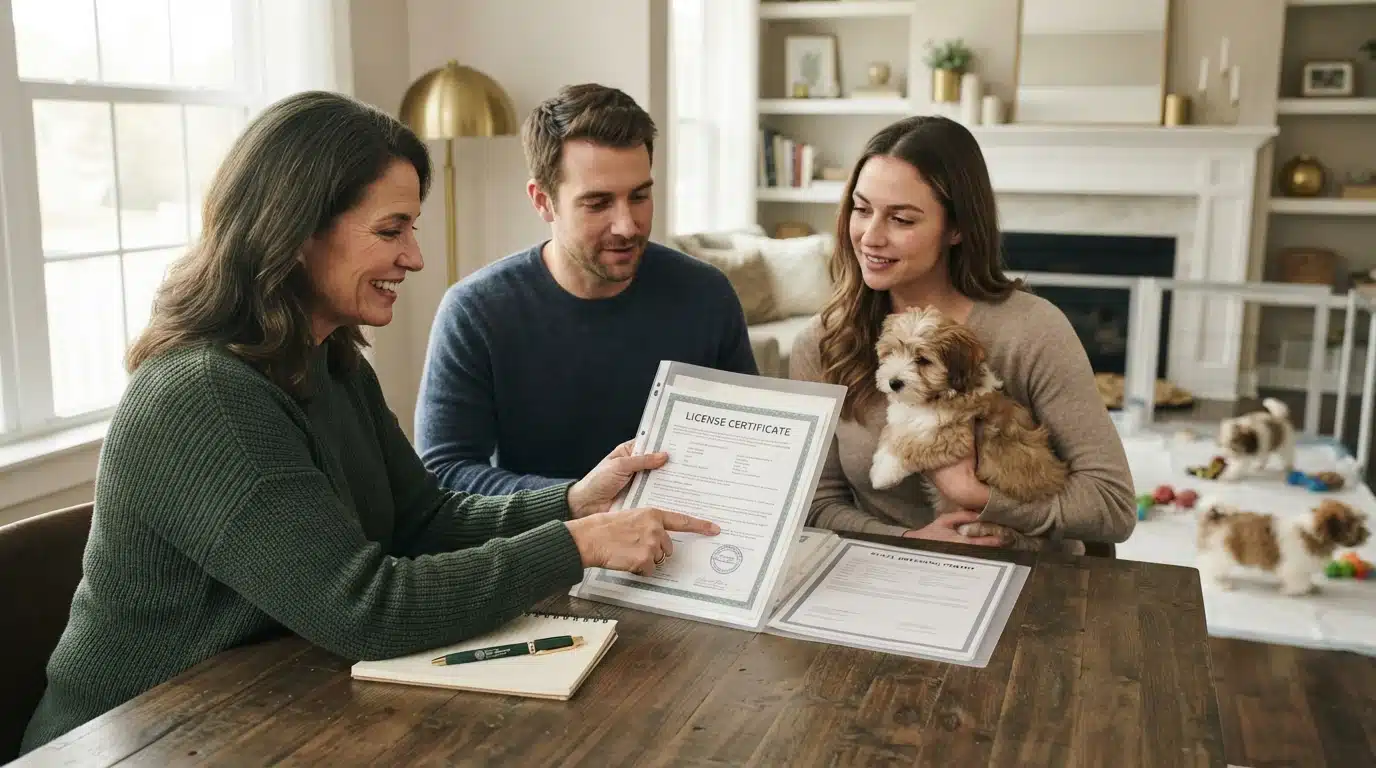
Quick Summary: A puppy’s health record should include its own exam and vaccine history, both parents’ clinical screenings, and DNA results, with every date, grade, and result checked in the public OFA database before paying a deposit. A CHIC number confirms that required tests were completed and published, not that every result was normal, while DNA panels and exams only cover specific known conditions and can expire or change over time. Sage Puppies shares these records for Havanese, Havapoo, and Cavapoo litters, but buyers should still verify every claim independently.
A folded stack of papers arrives with your puppy’s photo, and the top sheet reads “health tested” in a font bigger than any result underneath it. Learning to read what is actually on the page is where the real work begins. Most buyers can’t tell an OFA CHIC certificate from a vet checklist, so breeders’ claims go unchecked. This guide walks through health tested puppy records one document at a time: what each test covers, how to decode grades and codes, and how to verify everything in public databases before you pay a deposit. The steps apply to any litter, including the Havanese, Havapoo and Cavapoo puppies raised at Sage Puppies in South Jordan, Utah, where Cassie Milar’s program shares its records and application openly with families nationwide.
Puppy Health Records Explained: The Three Files That Matter
Puppy health records come down to three files: the puppy’s own exam and vaccine record, the parents’ clinical screening results, and the DNA panel for both parents. Together they show what was checked, when, and what the results actually mean. Here is what each one covers:
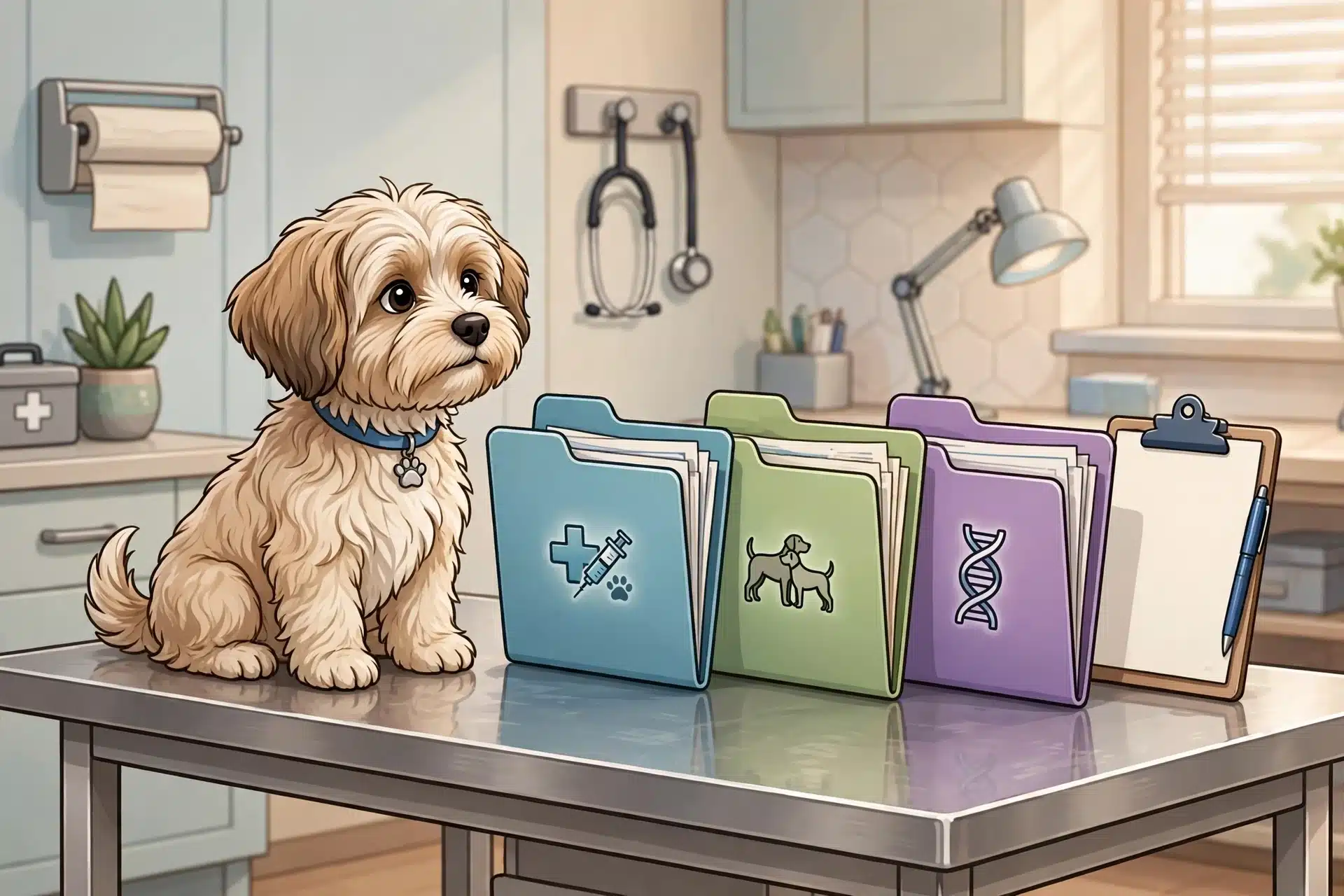
- The puppy’s file – exams, shots and weight
- The parents’ clinical screening – hips, patellas, eyes and heart
- DNA results – inherited disease variants
The puppy’s own file: exams, vaccines and weight
This file should list every vet exam, each vaccine with the date and product used, and each deworming dose. A weight log matters too, because steady gain signals a thriving puppy. Some breeders, Sage Puppies included, pair this record with the puppy’s application so buyers can trace the litter’s care. If dates are missing or the file looks handwritten at the last minute, ask questions before you pay a deposit.
The parents’ clinical screening: hips, patellas, eyes and hearts
The parents’ results tell you about risks a puppy exam cannot catch. Hip and elbow certification through OFA requires the dog to be at least 24 months old, while cardiac, patella and thyroid exams count from 12 months, according to OFA age rules. Eye exams are checked by an ophthalmologist and are only valid for one year. The Havanese Club of America’s testing guide lists these required tests, so compare them to what the breeder shows you.
DNA variant results: what a lab can and cannot see
A DNA panel reports each parent as clear, carrier or at-risk for specific inherited variants. Clear means no copies, carrier means one copy with the other parent’s status deciding puppy outcomes. But panels have limits. Orthopedic conditions like hip dysplasia, cardiac disease and some eye problems cannot be ruled out by DNA, which is why the clinical exams in the previous section still matter. Reading health tested puppy records well means asking for both file types, not one or the other.
What Each Record Actually Proves
No. A CHIC certificate means the dog completed every test its breed requires and the results were made public, not that those results were normal. The OFA states plainly that the number “does not imply normal test results.” A dog can carry failing hip scores, a carrier DNA result, or both and still hold one. Reading health-tested puppy records well means separating publication from passing.
Clinical screens describe the body on the day of the exam
Physical screens like cardiac, eye, patellar and hip exams capture a snapshot. An annual eye examination stays valid for one year, and a clear heart exam at age two says nothing about disease that shows up at five. Results can also change with age, so ask for the exam date on every paper. A recent date matters more than a fancy title.
DNA reports describe variants, not futures
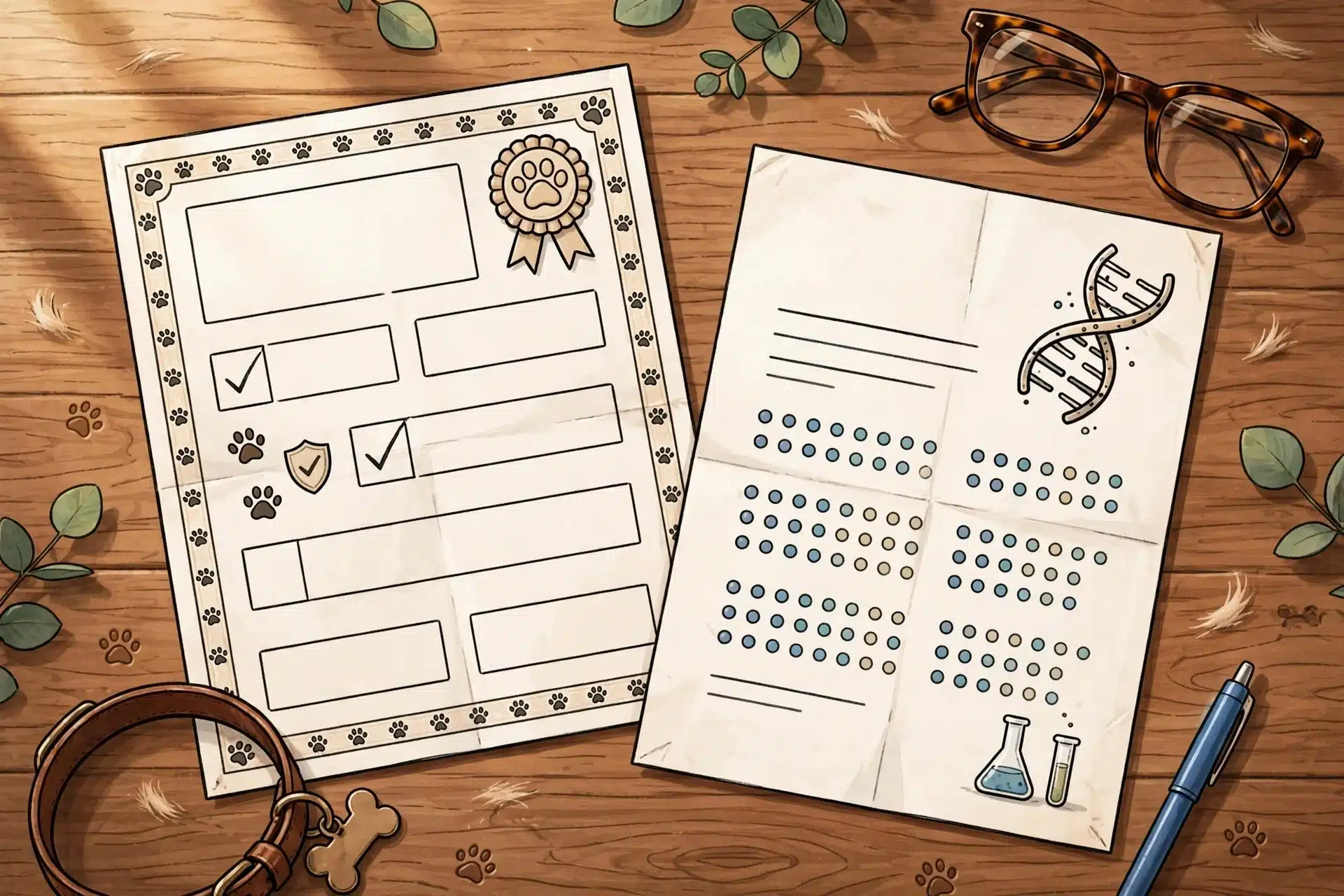
A genetic panel tells you which gene variants a dog carries. “Clear” means the variant is absent, “carrier” means one copy without symptoms, and “at-risk” means the dog may develop the condition. These results never expire, but they only cover the conditions on the panel. A clear report for ten diseases proves nothing about an eleventh one nobody tested for.
A pedigree chart proves lineage, not health
Pedigrees document ancestry, and nothing more. A five-generation chart with champions in every line still hides untested relatives. Some breeders use a coefficient of inbreeding from the pedigree to gauge genetic diversity, which is useful context but not a health result. Judge a line by the test results on record, not the names printed on it.
Reading the Numbers: Grades, Codes and Dates
Hip and patella grades, and why the age on the certificate matters
An OFA hip report uses grades: Excellent, Good, Fair, then Borderline and dysplastic ratings. Good or better is the breeding standard. Patellar luxation runs on a 1-4 scale, where grade 1 is mild slip and grade 4 means the kneecap stays out of place. Age is the trap. A hip radiograph only counts from 24 months, and patella exams count from 12. A certificate on a 10-month-old dog is a preliminary look, not a permanent clearance. Always match the exam date to the dog’s birth date before you give the record any weight.
Eye exam dates: the easiest record to read and the easiest to let expire
An eye report is simpler: a board-certified ophthalmologist lists each finding as normal or notes an issue. No grades to decode. The catch is validity. Unlike hips, eye exams expire. For a Havanese, current CHIC requirements call for an annual eye examination renewal. So an eye certificate from three years ago proves nothing about this breeding pair today. Ask when the last exam happened, not just whether one exists.
Reading a DNA report without guessing
DNA panels use three labels, and the difference matters for pairing, not panic:
| Result | Plain-language meaning | What to do next |
|---|---|---|
| Clear | No variant found | Safe pairing with any mate |
| Carrier | One copy, usually no symptoms | Pair only with a clear mate |
| At-risk | Two copies, may develop the condition | Ask how the breeder uses this |
As Embark explains, carrier and at-risk mean different risk levels. Ask which tests ran; a short panel can miss breed-specific conditions. A responsible program shares every result openly, which is how breeders here in Utah and nationwide should handle it.
Verifying the Records Yourself in Public Databases
You can verify a breeder’s test claims in minutes with the free OFA database, and you should. Ask for each parent’s exact registered name and registration number, then follow three steps.
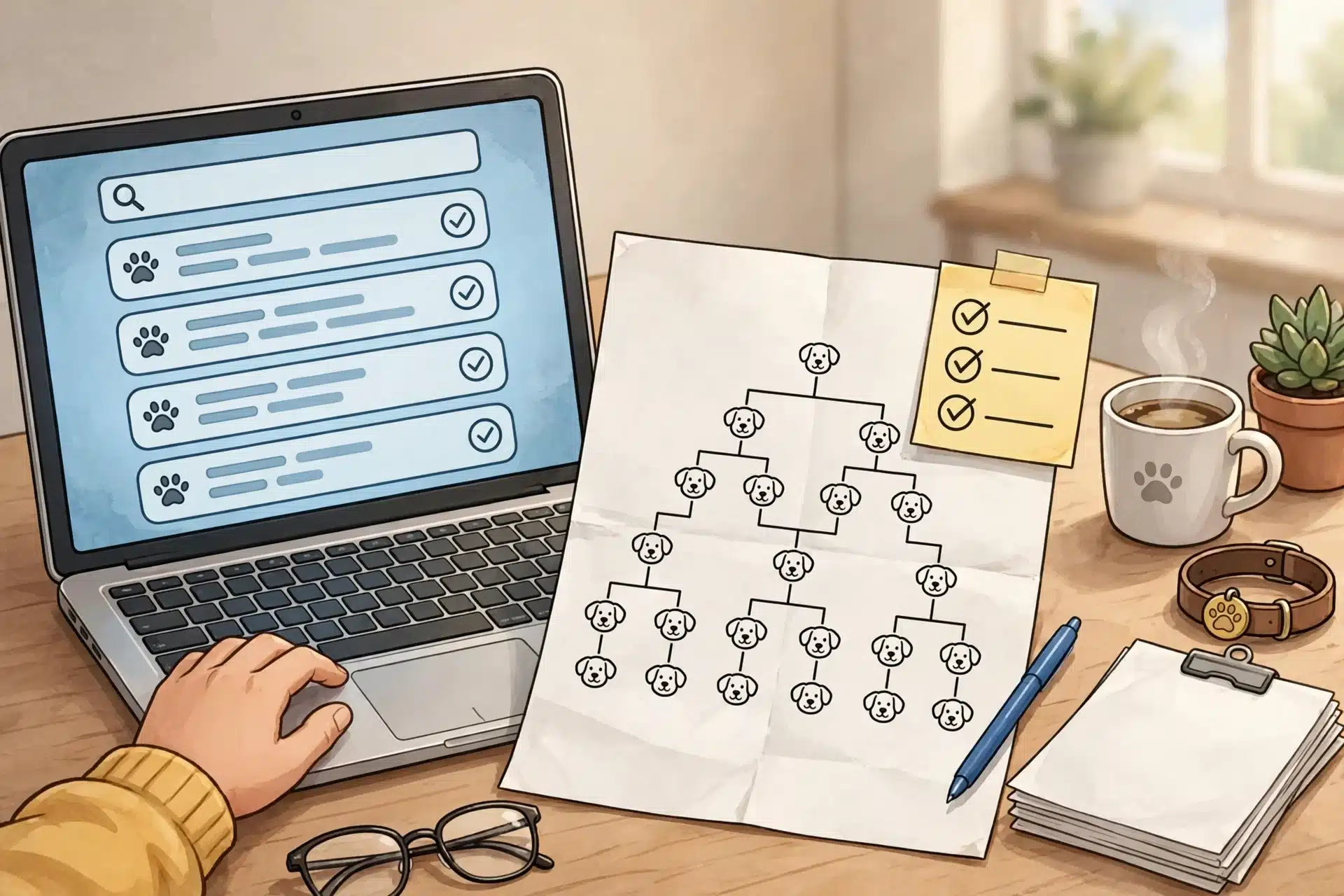
- Go to ofa.org and enter the parent’s registered name or registration number in the search box.
- Open the dog’s record and compare every listed result against the breeder’s paperwork.
- Confirm the breed, birth date and test dates match the litter you are actually looking at.
Searching OFA by the parent’s registered name
Spelling matters, so copy the name exactly as it appears on the paperwork. If a search fails, try the Advanced Search page, which lets you look up dogs by kennel name, breed or partial name. Registration numbers work even better because scammers sometimes borrow a well-tested dog’s name, and a number pins the record to one animal.
Finding the CHIC record and the linked DNA repository entry
A CHIC number means the dog completed the breed’s required test list, though passing is not required for the number itself, so read each result. The CHIC report lists every test, the dog’s age at testing and the outcome, and it links into a shared DNA repository, so eye exams with annual validity show their date.
When you find nothing: what a missing listing does and does not mean
No listing can mean results were never submitted, since OFA relies on owner uploads, or that testing never happened. Ask for copies of the lab and veterinary reports directly, and a breeder who walks you through health testing records openly is usually the safer bet.
Records for Havanese, Havapoo and Cavapoo Parents
Each breed in your puppy’s family tree carries its own test list. Read the parent’s paperwork breed by breed, because a mixed litter needs records from both sides. The Havanese side follows the clearest published standard. Per the Havanese Club of America, a CHIC number requires OFA hips, OFA patellas and an annual eye exam, stated as of the club’s March 2025 guidance:
- OFA hip evaluation or a PennHIP study
- OFA patella (kneecap) exam
- A current eye exam from a board-certified ophthalmologist
The Havanese parent: annual eyes, hips and patellas
Hips count from 24 months, so a young dog can only show a preliminary read. Patellas count from 12 months and get graded 1 to 4. The eye exam is the tricky one. It expires yearly, so ask when the last exam happened and what the ophthalmologist noted. A form from two years ago proves nothing today.
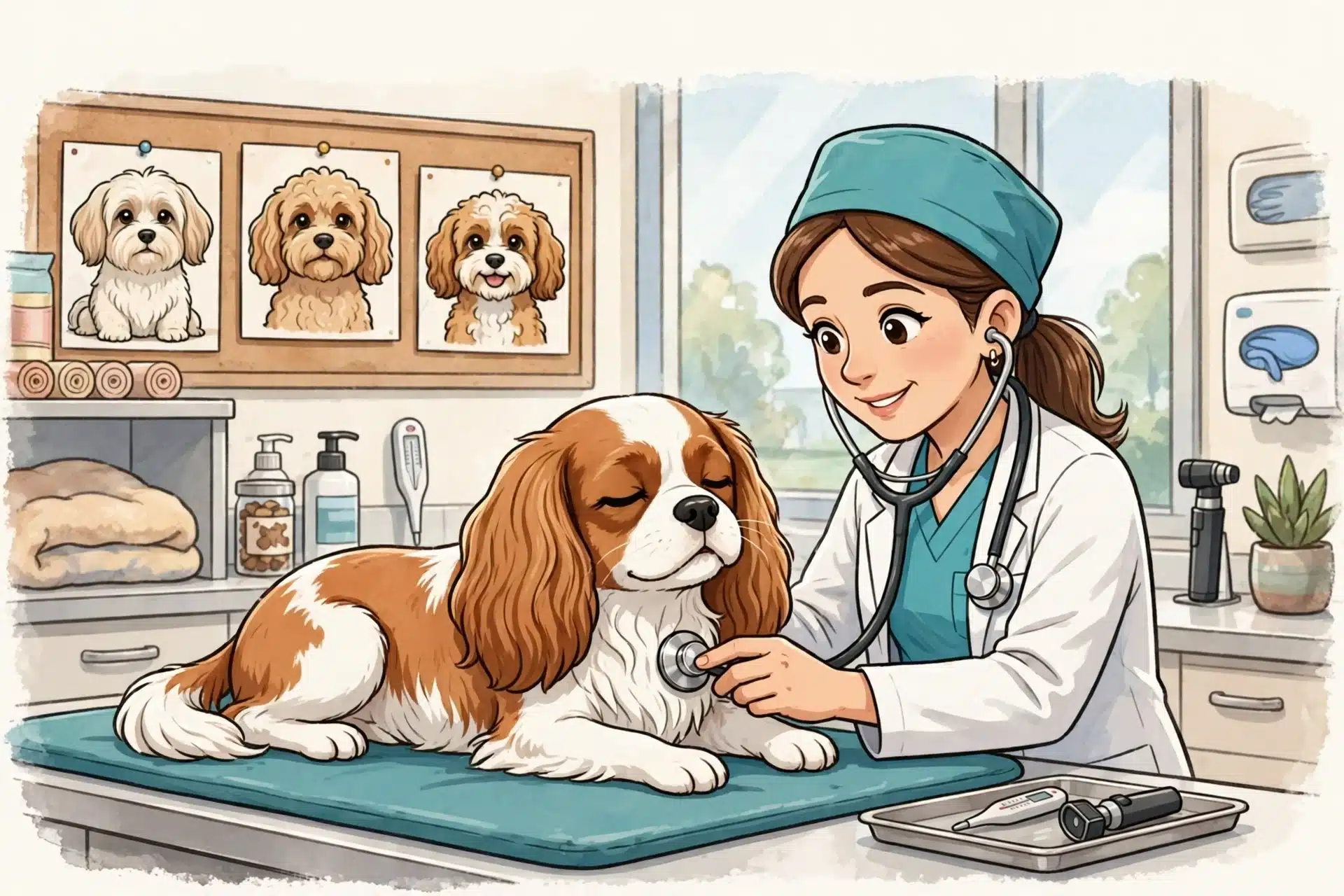
The Cavalier parent: heart and knees alongside hips and eyes
Cavaliers add cardiac screening, and it matters most. Mitral valve disease runs hard in the breed, so ask for a cardiologist-issued cardiac exam, not a quick vet listen. Then check patellas, hips and eyes. Ask for the exam date, the evaluator’s name and the result code. A heart cleared at age two deserves a follow-up at four.
The Poodle parent: size matters more than the name
“Poodle tested” tells you little until you know which variety. Toy, miniature and standard Poodles face different risks, so match the screening to the parent’s actual size. Expect hip and patella results, a current eye exam and a cardiac check. Ask which DNA panel was run too, and request the actual report rather than the phrase “genetically clear.”
What Health Records Cannot Promise
Health-tested puppy records prove a lot, but not everything. Knowing the limits helps you read a litter honestly instead of expecting a guarantee no breeder can give.
Some inherited conditions have no test at all
Genetic panels cover known mutations, and that list keeps growing. But not every inherited problem has a DNA marker yet, and some conditions come from many genes working together. Breeders still screen for these with exams, yet results describe one dog on one day, not the puppy’s whole future. Treat “panel clear” as one strong clue, not a promise of perfect health.
Why a ‘health guarantee’ in a contract is not the same as health records
A contract clause is a refund or replacement promise. Records are evidence. When a breeder offers a guarantee but cannot show an OFA CHIC certificate, eye exam forms, or a puppy vaccination and deworming record, the paperwork protects the sale, not the litter. Ask what the guarantee actually pays out, then read the underlying documents yourself before you send a deposit.
Records expire, and the clock starts again with the puppy
Even solid clearances age out. Patella and cardiac exams carry a short window, and an annual eye examination is only valid for about a year after the exam date. A parent cleared in 2023 may not have current results today, so check dates before you credit a claim. Once your puppy comes home, its own vet visits set a new timeline, and keeping that puppy vaccination and deworming record current is your job now.
Turning Records Into Your Next Steps
You now know how to read OFA codes, CHIC numbers and test dates. The last step is using them. Put the records in order, ask the right questions, and then decide whether the puppy in front of you is worth a deposit.
The six-record request you can send to any breeder
Copy this list into a message to any breeder you are considering:
- Sire and dam OFA hip results, with age at evaluation
- Patellar luxation grades for both parents
- Current annual eye examination dates
- Cardiac clearance from a veterinarian
- DNA panel results for the breed’s required conditions
- The CHIC number, if the parents have one
A confident breeder answers within a day or two. Evasiveness, partial paperwork or “health tested” with no documents all mean the same thing: keep looking.
What to look at before you sign anything
Match each document to the dog’s registered name. Check that the test dates fall inside the valid age windows. Compare DNA results with the conditions your breed actually requires, not just a generic panel. Then read the contract: it should state what happens if a genetic condition appears later. A buyer-side health guarantee matters here, so ask what it covers and for how long before you sign or wire money.
Next steps with Sage Puppies
If you want a litter where the paperwork is already organized, Sage Puppies shares each parent’s records during the matching process, and you can start the puppy application any time. Then compare what you receive against the checklist above, and bring questions.

Want a puppy whose paperwork actually checks out? Ask to see the records, or let Sage Puppies walk you through ours. Apply today and Cassie will match your family with a health-tested Havanese, Havapoo or Cavapoo raised under documented care.
Frequently Asked Questions
Q1: Can you explain puppy health records simply?
Think of three files: your puppy’s exam, vaccine and deworming record, the parents’ clinical screens (hips, patellas, eyes, heart), and both parents’ DNA results. Read dates on every page, then verify claims in the free OFA database before paying a deposit.
Q2: Does a CHIC number mean the dog passed its tests?
No. It means the required tests were completed and results were made public. Failures can still appear, so read each result yourself.
Q3: Which health test results expire?
Eye exams renew annually, cardiac checks carry a short window, and preliminary hip reads under 24 months do not count as final.
Q4: What should I ask a breeder before a deposit?
Request both parents’ OFA hip and patella grades, current eye exam dates, cardiac clearance, DNA panel reports and any CHIC numbers.
Q5: Do DNA panels guarantee a healthy puppy?
No. Panels cover known variants only. Clinical exams still matter, and no breeder can promise a lifetime free of disease.
Conclusion
Health-tested puppy records prove more than any phrase on a website can. Three files tell the whole story: your puppy’s exam and vaccine record, the parents’ clinical screens, and the DNA panel for both sides. Read grades and dates carefully, because an OFA hip radiograph only counts from 24 months and an annual eye examination expires every year. A CHIC number confirms testing was completed, not that it was passed, so verify each result yourself in the free OFA database before paying a deposit. Records cannot promise a puppy will never get sick, but they show which breeders document their work. Whether you are comparing health-tested puppies for sale in Utah or across the country, the paperwork separates careful programs from careful marketing.