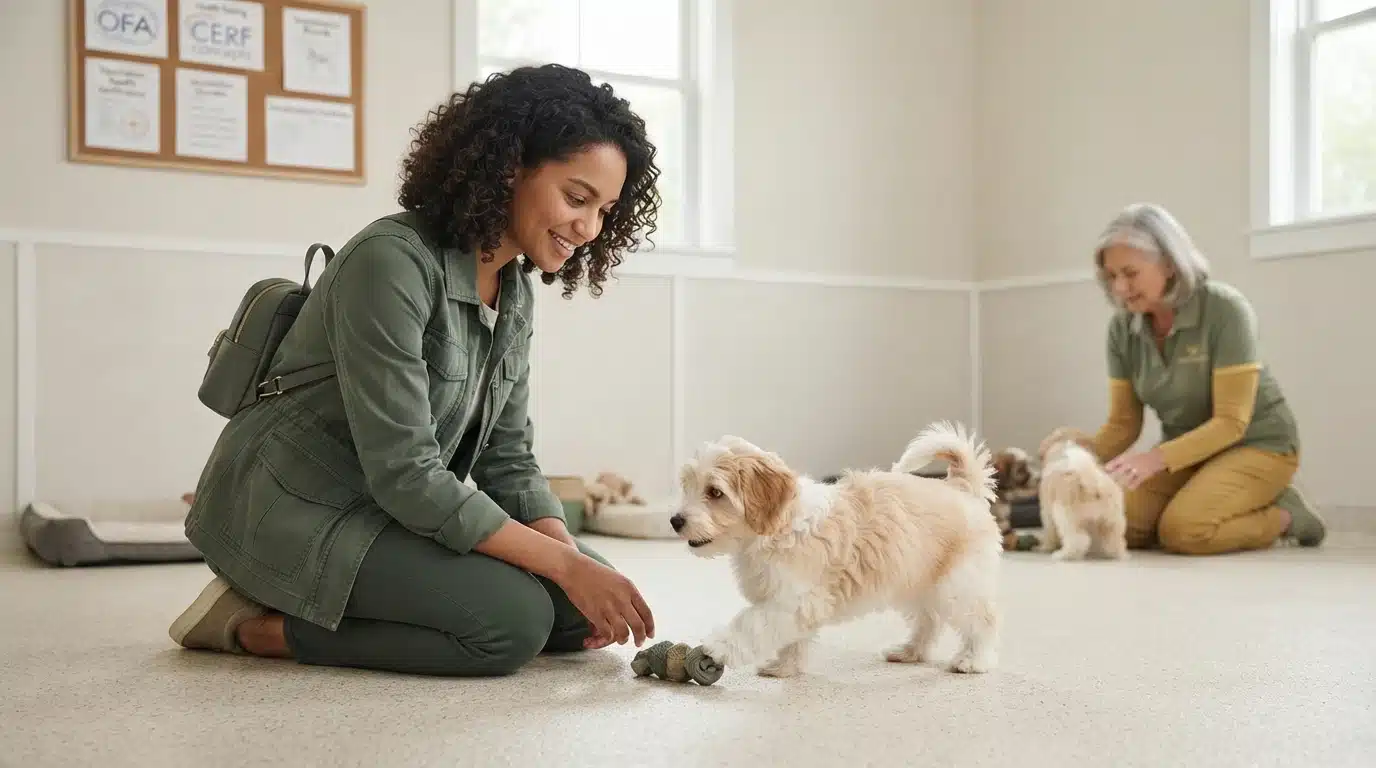
Quick Summary: Verify a breeder’s license yourself before paying, and check every number in the USDA, state, or local database against the seller’s name, address, premises, litter records, and health testing. Small face-to-face breeders may not need a USDA license, so ask which rules apply, but treat missing records, mismatched details, or refusal to answer as reasons to walk away. Sage Puppies says it walks families through this check for every Havanese, Havapoo, and Cavapoo placement, and sellers who welcome scrutiny are the strongest sign of a legitimate operation.
A breeder can hand you a laminated business card, a glossy health certificate, and a confident handshake, and none of it proves a legal right to sell dogs. The one thing that does is a license or permit number you can look up yourself, and most buyers never open the database.
That gap is where puppy scams and sloppy breeding operations thrive. This guide gives you one repeatable routine to verify a breeder license before money moves: you will learn which license matters at each level, from federal USDA registration to state permits and local kennel licenses, how to run a breeder registration lookup, and how to match the license number to the actual premises, litter records, and health testing.
At Sage Puppies in South Jordan, Utah, we walk families through this check for every Havanese, Havapoo, and Cavapoo placement, local pickup or nationwide delivery. A seller who resists the lookup is answering the question for you.
Step 1: Identify Which Licenses the Seller Should Actually Hold
Before you verify a breeder license, know which one the seller should hold. Licensing works in three layers, and many small breeders legitimately fall under none of them.
The federal tier: when USDA licensing applies to a pet breeder
Does a small breeder need a USDA license? Often, no. Under the Animal Welfare Act, a breeder with four or more breeding females who sells puppies sight-unseen (by phone or online) needs a USDA Class A breeder license. A breeder who lets buyers visit and pick up in person is exempt, as is anyone with three or fewer breeding females. So a small Utah program without a USDA number is not automatically a red flag; the sales method decides the rule, per APHIS licensing guidance.
The state tier: breeder permits, registrations, and retail selling rules
Some states require their own breeder permit, registration, or kennel license on top of federal rules, and a handful cap how many dogs an unlicensed breeder may keep. Rules vary widely, so look up your state’s department of agriculture and search “commercial breeder permit.” The ASPCA maintains a state-by-state breeder law summary worth checking before you buy. Ask the seller directly what permits they hold, then confirm the numbers.
The local tier: county and city kennel and breeder licenses
Most counties and cities, including Salt Lake area jurisdictions, require a kennel or breeder license for anyone keeping several dogs, plus a business license if selling is ongoing. Call the city office where the seller lives and ask whether the address holds a current kennel permit. That call also confirms the address is real, which helps spot puppy breeder red flags early.
Step 2: Look the License Up in the Official Public Records System
How do I check a puppy breeder’s license and registration?
To verify breeder license details, follow these steps:
- Ask the seller for the exact license or registration number and the name it is filed under.
- Open the USDA Animal Care Public Search Tool, which covers anyone licensed or registered under the federal Animal Welfare Act.
- Search by name, number, or state, then open the matching record.
- Confirm the license is active and the class matches a breeding operation, such as a USDA Class A breeder.
- For smaller breeders, repeat the check at the state and county level, since many states license kennels locally instead of federally.
Reading the result: what a clean record shows
A clean record means the license is current, the address matches the breeder’s premises, and there are no open violations or repeat inspection failures. The same tool lists inspection reports and annual reports, so you can see how the facility has been cared for over time. One minor note from years ago is normal. A pattern of direct violations is not.
When there is no record to find
No result does not automatically mean fraud. Breeders with four or fewer breeding females who sell only face to face often fall below federal licensing thresholds, so a hobby breeder may simply not need a USDA license. What matters is that the seller explains which rules apply and points you to the state or county record instead. If someone claims federal licensing and nothing appears in the database, treat it as a serious red flag and compare licensed breeders with unregistered sellers before sending money.
Cross-checking the number the breeder gave you
Match the number three ways. The certificate the breeder showed you, the database result, and the name on the health records should all agree. If the paperwork says one kennel name and the license lists another, ask why before you pay. A mismatch is sometimes just a nickname, but it can also mean borrowed or expired paperwork.
Step 3: Confirm the Business and Local Records Behind the License
Confirm the legal entity and the physical address
A license number only means something when it points to a real, traceable business. Search your state’s Secretary of State database for the breeder’s registered name, such as an LLC or sole proprietorship. Utah families can do this in minutes through the state’s business search. Then compare the registered address with the address on the license and the address where you will pick up or receive the puppy. All three should match, or the seller should explain the difference in writing. A breeder whose phone number, license, and shipping origin sit in three different states is a pattern worth questioning before any deposit.
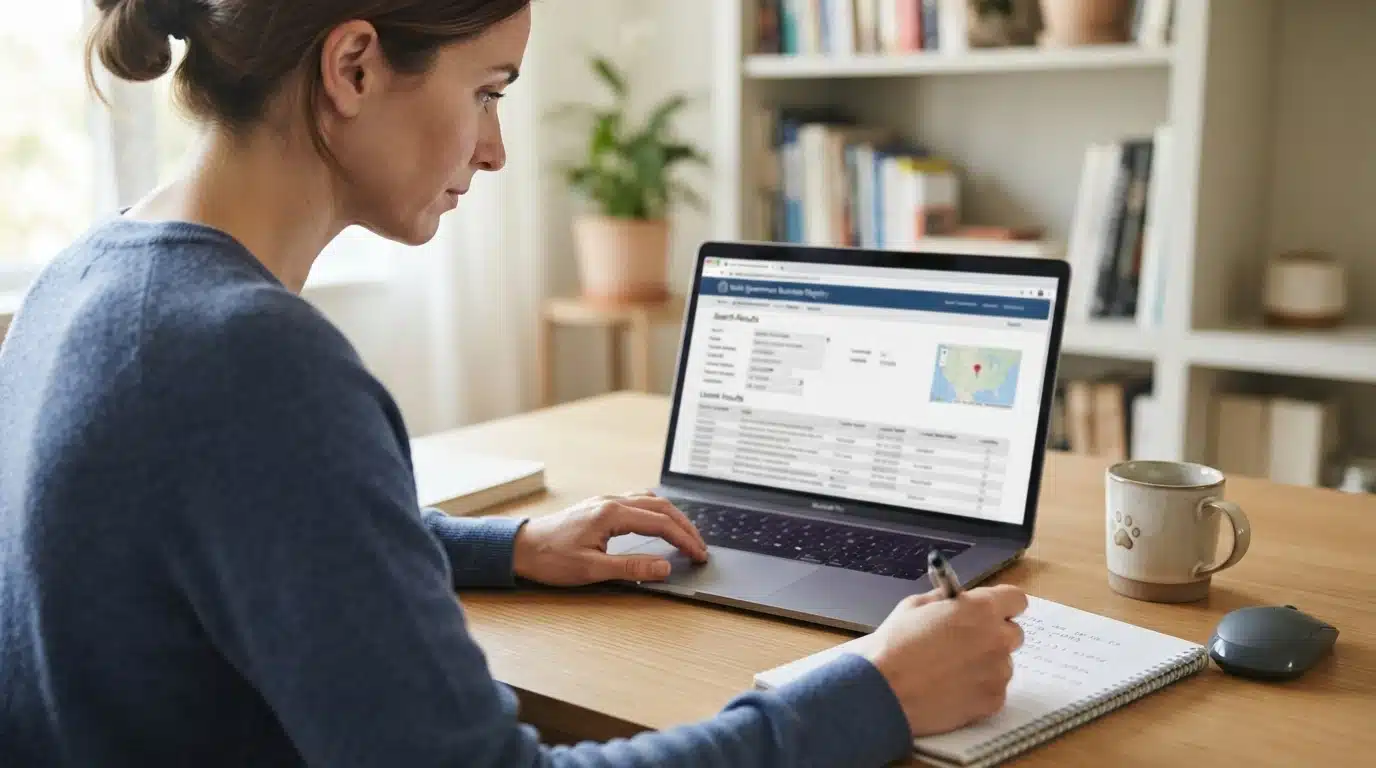
Request local licenses and inspection history in writing
Counties and cities often require a separate kennel or commercial breeder permit on top of any federal paperwork, so ask the seller directly. Send one email that requests copies of the local permit, the most recent inspections, and any violations or corrections on record. A cooperative breeder replies within a few days with documents, not excuses. If the seller claims an exemption, ask which ordinance applies and verify it yourself with the county clerk. Sellers operating under a federal USDA license should also appear in the USDA Animal Care search tool, where inspection history is public. No written records at all is a walk-away sign.
Review third-party complaint and profile records
Now check what others say. Search the seller’s name plus “complaints,” “scam,” and “review,” and look at the Better Business Bureau and state consumer protection sites. Cross-check the photos and puppy listings against other websites, because reused pictures are common in puppy scams. For licensed sellers, the USDA inspection report database shows cited noncompliance items, so read the actual reports rather than trusting a summary. Programs like Sage Puppies handle this openly, since matching families to puppies works best when the business behind the license is easy to confirm.
Step 4: Match the License to the Puppies, the Premises, and the Records
Confirm the premises match the licensed address
A license number proves nothing if the address behind it belongs to someone else. Pull the license up in the USDA public search tool or your state’s permit database and compare the listed street address to where you will pick up the puppy. If the puppy ships, ask which facility the litter lives at and confirm that address too. Visit when you can, and note whether the kennel, the mother, and the litter are all on site. A breeder who “meets you halfway” with no explanation deserves extra questions before you hand over money.
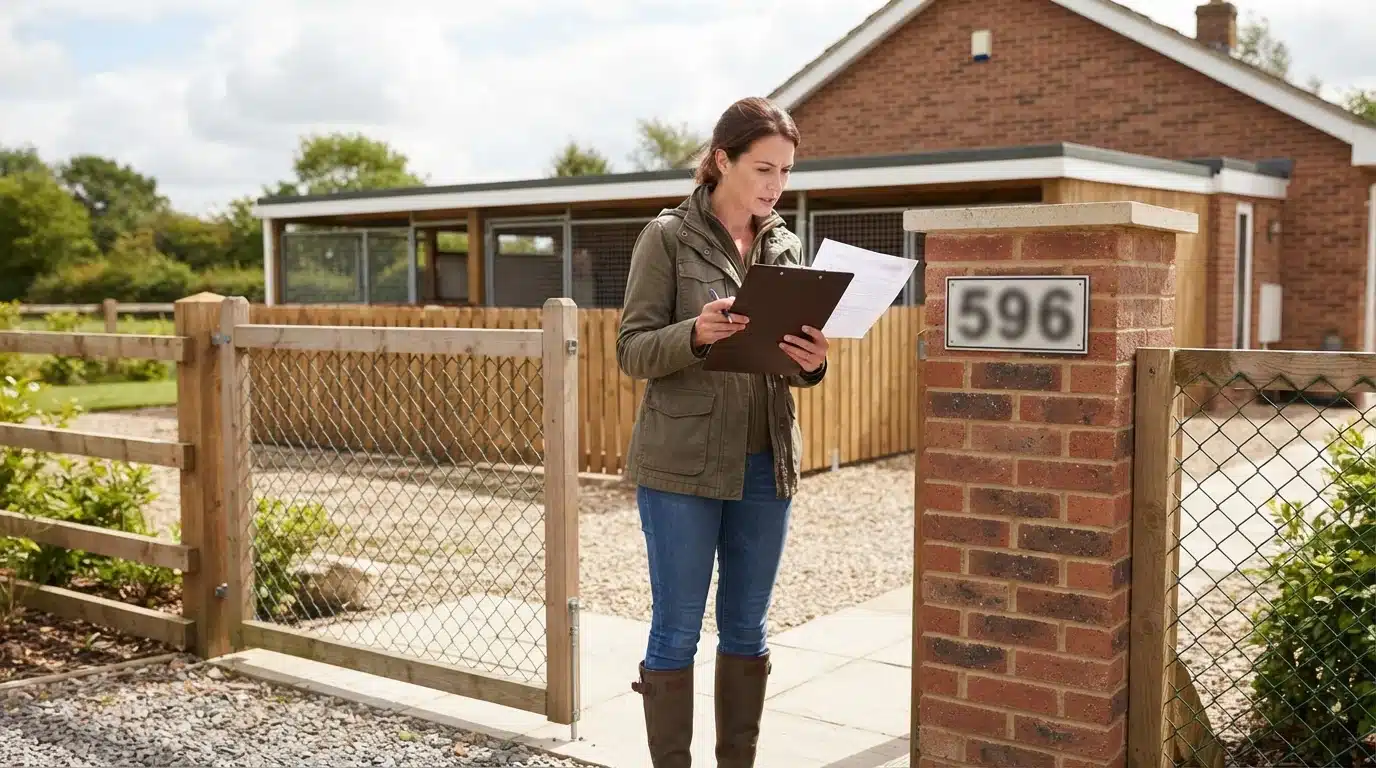
Trace health records and pedigree to the breeder
Every puppy should come with a paper trail that starts at the breeder’s address. Vaccination and deworming dates, the vet exam record, and the dam’s health testing should all carry the same clinic and breeder name. For Havanese, Havapoo, and Cavapoo litters, ask for the parent’s health test results and the pedigree, then check the breeder’s name on the registration papers. A real program keeps these records organized. If you want a fuller framework, our guide to what health-tested puppy records actually prove walks through each document. Registration papers alone prove lineage, not licensing.
Check the sales channel against the license
How the breeder sells matters as much as the license itself. A USDA license covers puppies sold sight unseen or wholesale, while smaller hobby breeders often fall under state or city rules instead, so match the channel to the right permit. If you’re arranging pickup in South Jordan or elsewhere in Utah, ask which local license covers the sale. Mismatches between the paperwork and the seller’s story are the clearest sign to walk away.
Step 5: Document the Result Before You Pay a Deposit
Verification only protects you if you keep the proof. Before any deposit moves, ask the breeder for a short set of records and save each one:
- The license number itself, plus a screenshot of the registry result showing the seller’s name and address
- Proof of the litter’s date of birth and the dam’s health testing results
- A written contract that lists the deposit amount, what it covers, and the refund terms
- Vaccination and deworming records, plus the vet clinic’s name
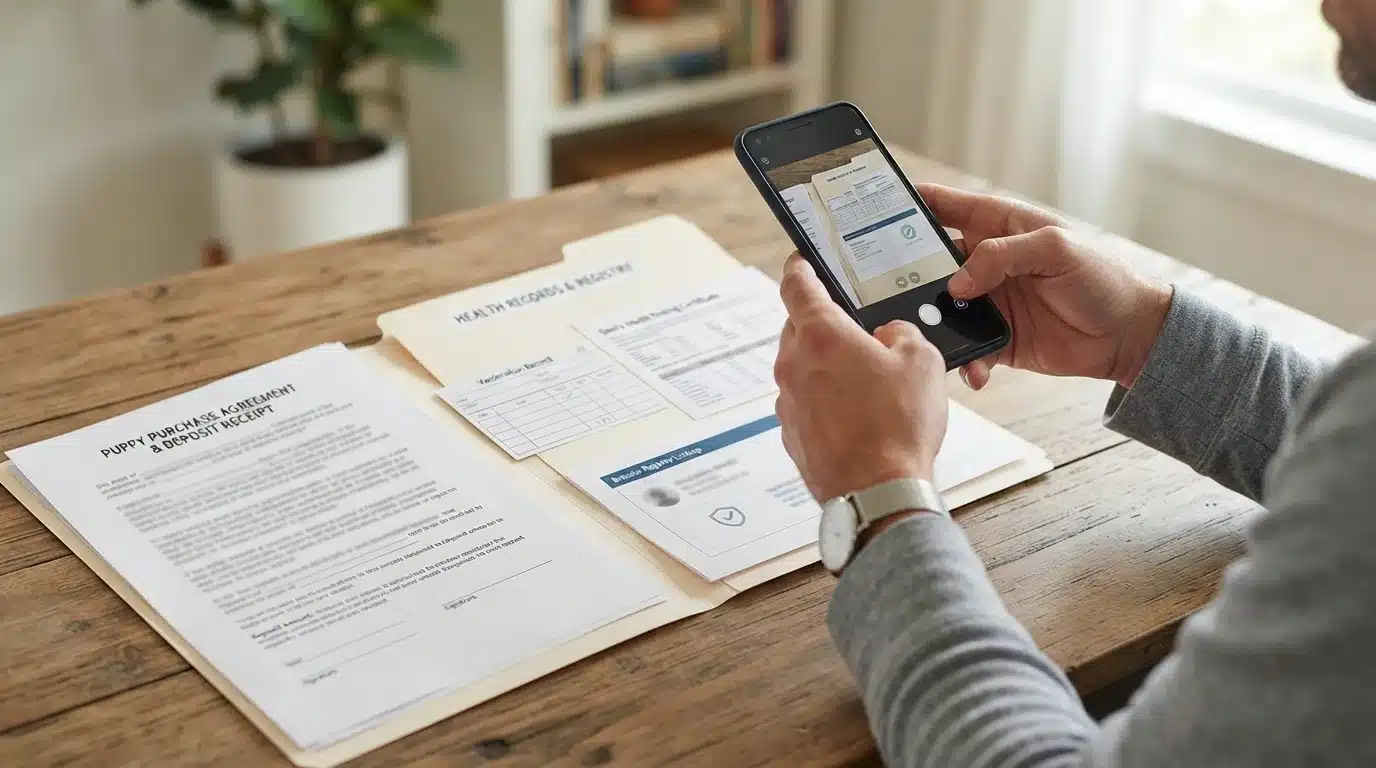
Build a one-page verification summary
Put everything on one page: the license type and number, where you confirmed it, the premises address that matched, and the date you checked. Add the litter details and the vet contact. This single sheet becomes your reference if any question comes up later, and a careful program will already expect the request. A licensed breeder checklist keeps you organized.
Know the stop conditions before money moves
Stop if the license number returns no result or belongs to a different name or address. Stop if the seller says licensing “isn’t required” for their setup without showing a state or county permit that covers it. Stop if the contract is verbal, the deposit is non-refundable by text message, or the puppy ships before you have records in hand. One unexplained gap is a question; several together are a pattern, and the pattern is what puppy deposit protection is really for.
If something does not check out
Walk away, even if the puppy looks perfect. Save your summary and screenshots, then report a suspected unlicensed seller to USDA APHIS or your state agriculture department. If you arranged travel or paid by card, ask your card issuer about a dispute. A legitimate breeder makes this step easy, because there is nothing to hide. Then restart your search with the same routine from the beginning.
Common Mistakes to Avoid
Accepting a screenshot, PDF, or badge as proof
No. A business license is not enough to prove a dog breeder is legitimate, because it usually only registers a business name with a city or state. It does not confirm the breeder met Animal Welfare Act or state breeding standards.
Treat images and PDFs as claims, not evidence. Anyone can crop a certificate, lift a badge from a registry site, or fake a USDA license card. Verify the number yourself in the [USDA APHIS search tool](https://people-heights.usda.gov/APHIS_PE/search breeder.cfm) and match the name and address to the seller before sending a deposit.
Always check paperwork yourself instead of trusting what a seller emails you.
Treating a business license as a breeder license
No. A city business license allows someone to operate; it does not certify how animals are housed or bred. Many sellers show one to sound official.
| Document | What it proves | What it does not |
|---|---|---|
| City business license | Registered to operate locally | Care standards or inspections |
| State breeder permit | Met state breeding rules | Federal AWA compliance |
| USDA Class A license | Federal inspection standards | Health testing of parents |
For litters sold under four breeding females, USDA licensing is not required, so ask which permits actually apply. A program like Sage Puppies documents its own licensing and health testing, which is the standard to expect from any seller you vet.

Once you’ve checked the license numbers, see what transparent breeding looks like in practice. Sage Puppies runs a small, owner-managed program in South Jordan, Utah, with health records and matching support for every Havanese, Havapoo, and Cavapoo. Review the available puppies, or start the application today.
Frequently Asked Questions
Q1: How do I check a puppy breeder’s license and registration?
Ask for the license number, then search it yourself in the USDA APHIS public search tool and your state’s permit database. Confirm the record is active and matches the seller’s name and address before paying anything.
Q2: Does every breeder need a USDA license?
No. Breeders with four or more breeding females who sell sight unseen need one. Small programs selling face to face often fall below the threshold and follow state or local rules instead.
Q3: What if a breeder’s license number doesn’t verify?
Stop. Either the paperwork is fake, expired, or borrowed, or the seller misunderstood which rules apply. Ask which permit covers their setup and confirm it with the county clerk before sending a deposit.
Q4: Is a business license the same as a breeder license?
No. A business license only registers a seller to operate locally. It says nothing about animal care, inspections, or breeding standards, so keep checking for a kennel, state, or federal permit.
Q5: Should I trust a screenshot of a breeder’s license?
Never. Images are easy to crop or fake. Treat them as claims, then look the number up yourself and match the name and address to the seller.
Q6: What records should I keep before paying a deposit?
Save the license number, your database screenshot, the dam’s health testing, litter birth date, vaccination records, and a written contract listing deposit and refund terms.
Conclusion
Verifying a breeder’s license comes down to one repeatable routine. Identify which tier applies, federal, state, or local, then run the license number through the USDA APHIS public search tool or your state’s permit database yourself. Match the name and address to the premises, the litter records, and the dam’s health testing before any money moves.
Screenshots and business licenses are claims, not proof. A missing USDA record can be legitimate for a small face-to-face program, but an unexplained gap never is. Keep your one-page summary, know your stop conditions, and walk away when the paperwork and the seller’s story disagree. A licensed, transparent program will welcome every step of this check, and that willingness is itself the strongest sign you’ve found the right breeder.