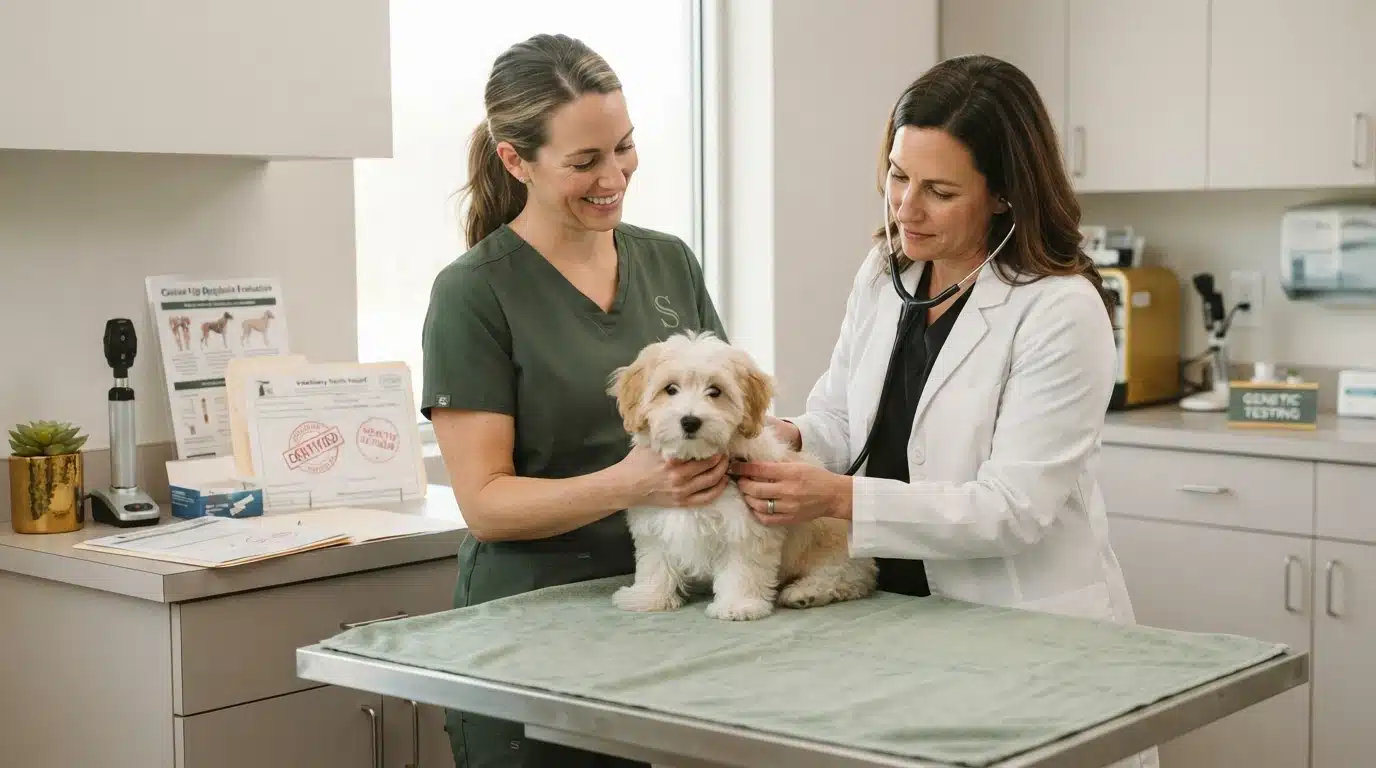
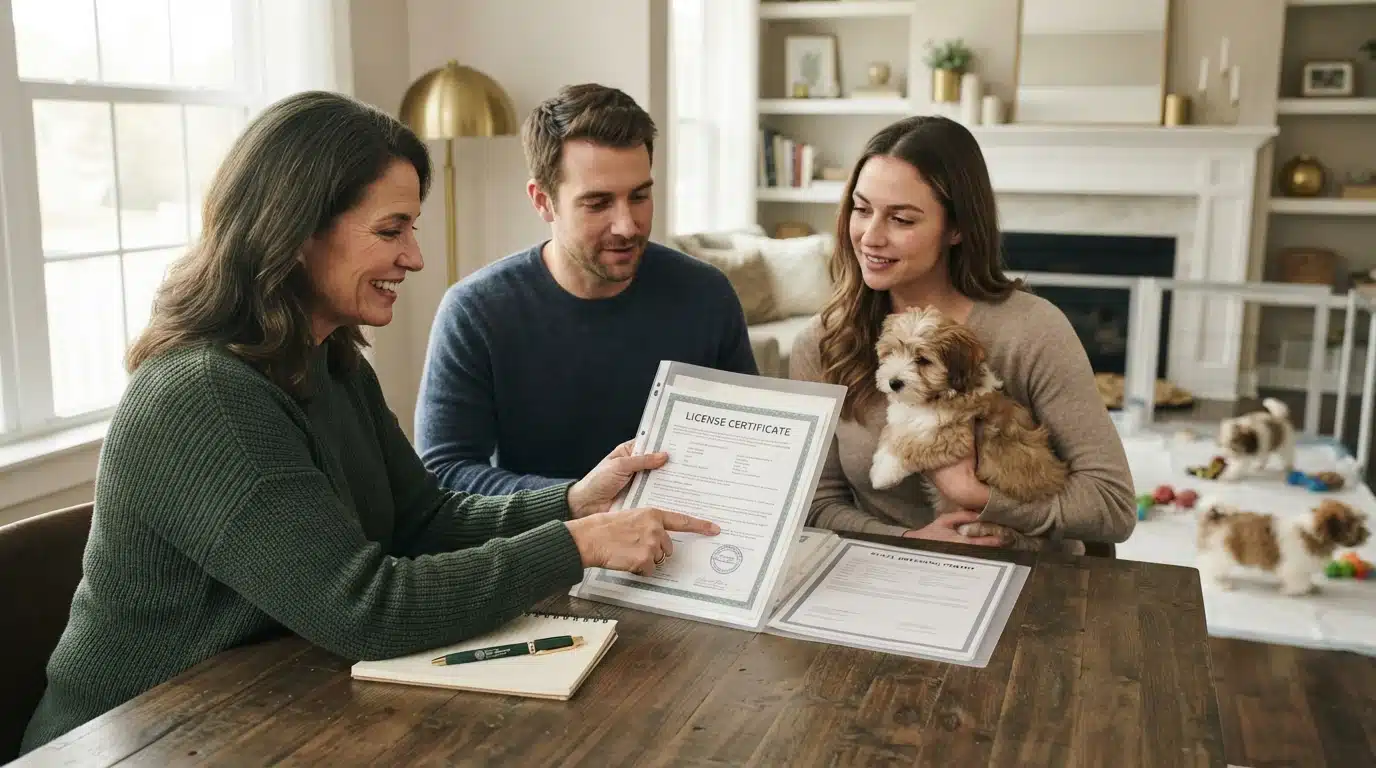
Quick Summary: Real puppy health testing leaves records you can verify, including the dog’s name, test, dated result, examiner or lab, and registry number. A DNA panel is only one piece because it cannot rule out hip, patellar, eye, or heart problems, so buyers should check each parent’s OFA or CHIC records, confirm breed-specific screenings, and review contract terms before paying a deposit. Sage Puppies is presented as an example of a breeder that shares age-appropriate parent records and clear deposit policies before money changes hands.
The email arrives with a glossy PDF titled Health Test Results. Three pages of colorful charts, one confident line: our dogs are fully health tested. Then you reach page two. No dog name. No date. No registry number. And nothing shows up when you search a public database. This is one of the most common health testing red flags, and most first-time buyers never notice it until the deposit is gone.
This guide shows you which puppy health red flags to catch early, why a clean DNA panel can hide false positive DNA tests, and how to read OFA records and CHIC listings yourself. You will also see exactly which tests matter for Havanese, Havapoo and Cavapoo parents, so a missing result tells you whether to ask questions or walk away.
What a Credible Health Testing Claim Actually Contains
A credible claim names a verifiable record, not a feeling. It gives you a document you can check yourself, so “health tested” always means something specific: a vet exam, a DNA result, or a screening listed in the OFA database.
Three Different Documents That Buyers Often Confuse
Buyers often mix up three papers. A vet health certificate says the puppy looked healthy on one visit. A DNA panel reports inherited gene variants. An OFA or CHIC record documents screenings like hips, eyes, or cardiac exams posted publicly. Each answers a different question, and none covers all three. The OFA CHIC program lists which screenings a breed should have. For the brand’s breed-specific lists, Sage Puppies breaks down parent screening and puppy health records by breed.
The Five Details Every Checkable Record Must Show
A real record always shows five things:
- The dog’s registered name or number
- The test performed (for example, cardiac or patellar)
- The result, with a date
- The veterinarian or lab that did it
- A registry or clinic reference you can verify
If any detail is missing, ask for it. An OFA number you can type into a public search is worth more than a stack of screenshots. The first of these five is the real health testing red flag catcher: no identity, no proof.
Why a Marketing Phrase Is Not a Health Record
Phrases like “fully health tested” or “parents cleared” carry no weight because anyone can type them into a puppy ad. A marketing phrase names no dog, no test, and no date. Until you can match a claim to a record with a number on it, treat it as a promise, not evidence. Good breeders expect the question and answer it with documents, not adjectives.
Red Flags That Make a Breeder’s Health Testing Untrustworthy
Most health testing red flags come down to one thing: a claim you cannot verify. The four that matter most:
- No records, or records with no name attached. If it matters, ask for the next step.
- DNA panels sold as “fully health tested.” If hips, eyes or heart were never checked, keep asking.
- Results that appear in no public registry. If a number cannot be looked up, treat it as a rumor.
- Tests from another breed or another era. If the testing list doesn’t match the breed, it isn’t real testing.

No Records, or Records That Cannot Be Traced
“Parents are health tested” means nothing without paperwork. Ask for the results themselves: the certificate, the registration number, or a screenshot showing the dog’s registered name. A breeder who shrugs, says the vet “did some tests,” or promises to email records after you pay a deposit is asking you to fund blind faith. Real testing produces documents. You should be able to request puppy health records before any money changes hands.
DNA Testing Presented as Complete Health Testing
A DNA panel screens for gene variants. It cannot see hip dysplasia, heart problems, or eye disease, because those are judged by radiographs and exams, not saliva. Some conditions a panel does catch early, so it is a useful piece, not the whole picture. When a breeder leads with “DNA clear” and nothing else, the structural and eye exams are probably missing. A good DNA panel versus hip radiographs is not a contest; responsible breeders do both.
Results That Cannot Be Found in a Public Registry
Verifiable results live in databases, not text messages. The OFA advanced search lets you look up any dog by registered name and see each posted result. A CHIC number means the dog completed every test its breed’s parent club requires, and the owner agreed to publish the results, whatever they are, per OFA’s CHIC program. If a breeder’s “OFA tested” claim returns nothing when you search it, ask why.
Tests That Belong to Another Breed or Another Decade
Some breeders copy a testing list from a different breed, or lean on tests that stopped being meaningful years ago. A Havanese parent needs cardiac, hearing, patellar and eye screening plus relevant DNA checks; checking for conditions Havanese rarely carry, while skipping the ones they do, is theater. Havapoo and Cavapoo parent screening should cover both parent breeds. You can find breed-specific Havanese health test requirements on Sage Puppies’ own guide before you ever talk to a breeder, so compare lists, not slogans.
DNA Panels, False Positives and What a Clear Result Really Means
No, a DNA panel is not enough on its own for a Havanese or Havapoo puppy. It screens genes, but it cannot see hips, knees, eyes or hearts. Breeders who lead with a “full panel” often use it to skip the physical exams that matter more.
Where False Positives Come From
A false positive means a test flags a risk the dog does not actually carry in a harmful way. Lab mix-ups, mislabeled swabs and variants later reclassified as harmless all cause them. Some markers also test only one form of a disease, so a “clear” result can miss other types. That is why one page of results is a starting point, never proof of health.
Clear, Carrier and At-Risk Are Not the Same Thing
A clear dog has no copies of the variant. A carrier has one copy and usually stays healthy, but two carrier parents can produce affected puppies. An at-risk dog has the variant in a form linked to disease. Ask which result each parent received, because a breeder who calls every dog “healthy” without naming results is hiding the difference.
Questions That Reveal Whether a Panel Was Actually Read
Ask these three:
- Which lab ran the panel, and when?
- Which conditions did each parent clear or carry?
- What does “at-risk” mean for this breed, and how did you act on it?
A breeder who read the results answers in seconds. One who guesses was selling a certificate, not doing health testing.
How to Verify Records in Public Registries
Verification takes about ten minutes. Search the OFA database by the parent’s registered name, confirm the breed and kennel prefix match, then check that each test result links to a dated record. If a breeder cannot give you those names, treat that as a red flag before you pay any deposit.

Searching by Name, Number and Kennel Prefix
Ask the breeder for each parent’s exact registered name and registration number. Breeds have a kennel prefix, and it should match the breeder’s program. Enter the name, including correct spelling, and confirm the dog’s breed and birth date match what the breeder told you.
Reading an OFA Number Code
Each record carries a code like HN-EL1234F35-VPI. The letters identify the breed (HN is Havanese), the test (EL is elbow), then a number, sex, and age in months at testing. Codes ending in F or M are normal results; abnormal ones use different labels. If a quoted “OFA number” has no searchable record, it was likely never filed.
What a CHIC Number Does and Does Not Mean
A CHIC number means the dog completed every test its breed’s parent club requires. It does not guarantee those results are clear. Dogs with some abnormal results can still earn a CHIC number, so always open the individual test results and read them yourself.
When a Record Is Missing, and What to Do Next
A dog can be absent from the database for honest reasons, such as a pending submission or an owner who chose privacy for an abnormal result. Ask for paperwork. No paperwork, no puppy. Reputable programs, including ours, share parent records before any deposit.
Breed-Specific Testing: Havanese, Havapoo and Cavapoo
Each breed in this article carries its own risk list, so the right tests differ. For Havanese and Havapoo parents, a credible breeder provides hip and patella evaluations, a current eye exam, and breed-relevant DNA results. For Cavapoo parents, cardiac testing leads the list, joined by eye exams and DNA screening. Here is what each line item means.
Hips, Patellas and Current Eye Requirements
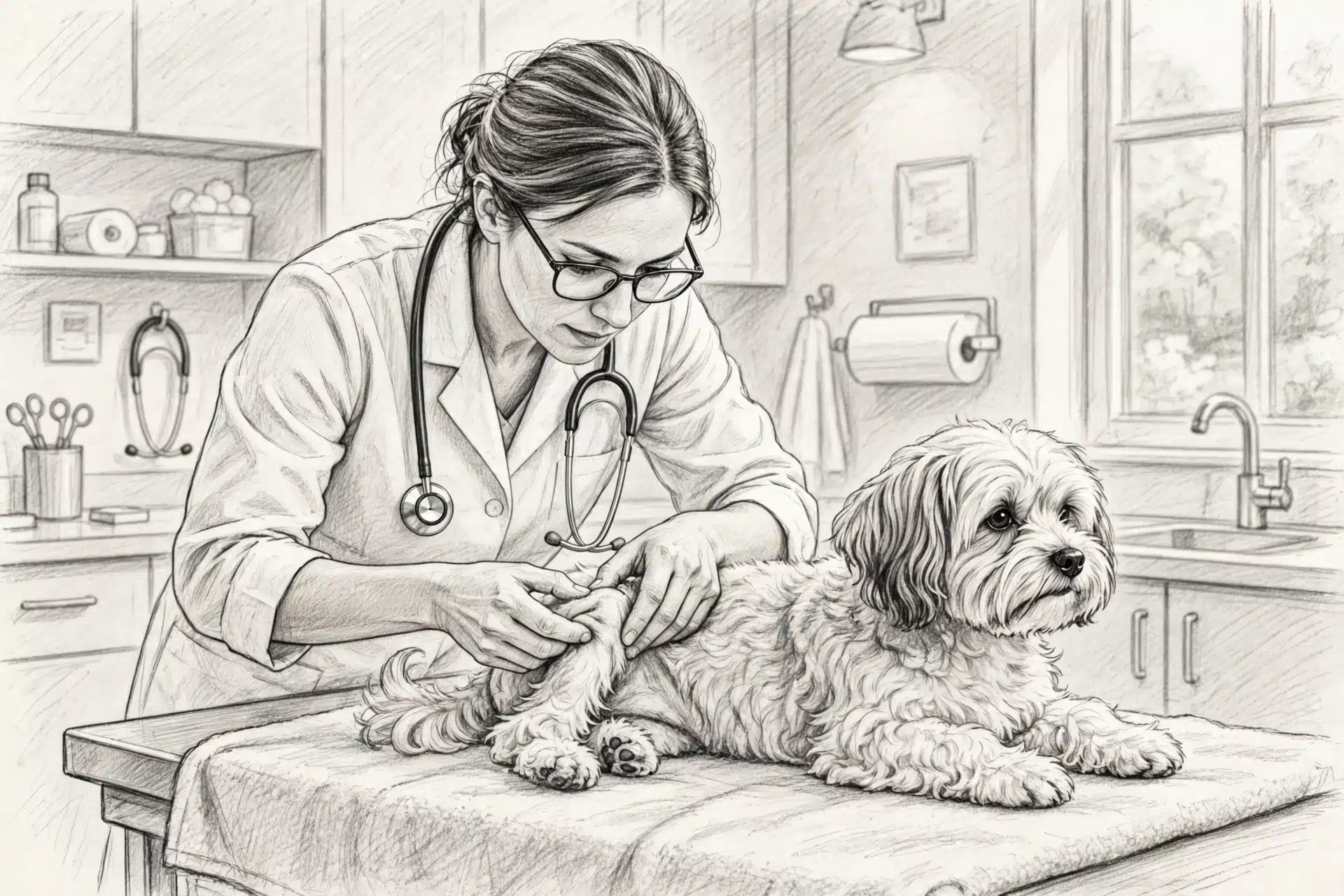
OFA certifications come with age rules. A dog must be 24 months old for hips and elbows, and at least 12 months for patellas, cardiac and thyroid exams, so a young dam with “finished testing” is a red flag on its own. Eye exams expire, too. A CAER exam from three years ago does not confirm the dog sees well today, so ask whether the ophthalmologist cleared the parent within the last 12 months.
Havanese and Poodle Ancestry
The Havanese Club of America’s testing guide lists eye certification, hips and patellas as core checks, plus DNA for conditions like chordoma and cardiac evaluation. For a Havapoo, run the same screen on both parents. The Havanese side faces the breed’s eye and patella risks; the Poodle side adds its own eye disease history, so a breeder who tests only one ancestry misses half the picture.
Cavalier and Poodle Ancestry
Cavalier parents need yearly heart exams, because mitral valve disease is the breed’s defining risk and often appears in middle age. Eye exams and patella checks follow. For Cavapoos, the Poodle parent still needs full OFA testing, not just a DNA panel.
Reading a Claim That Mixes Breeds and Crosses
Crossbreed litters inherit every risk from both sides, and the OFA’s CHIC program confirms which tests each purebred parent club requires. When a breeder’s claim names conditions from the wrong breed, or lists tests a mixed breed cannot honestly “clear,” ask which parent carries which result.
Contract, Guarantee and Deposit Red Flags
Health Terms That Do Not Reference Actual Records
A breeding contract health guarantee should name specific tests and reference OFA or CHIC records, not vague promises. If the paperwork says “parents are health tested” without listing cardiac, patella, eye and DNA results, the words protect nobody. Ask for the puppy health records request list in writing. A breeder who avoids specifics is hiding something.
Guarantees and Timelines to Treat Carefully
Read the fine print before you pay anything. Some guarantees expire in 48 or 72 hours, which is shorter than most genetic conditions take to appear. Others require a vet exam within one or two days or the coverage voids entirely. A lifetime “guarantee” with no written terms is marketing, not a contract. Real protections state conditions covered, the documentation you must provide and how refunds or replacements work.
Deposits, Availability and Pressure Tactics
Deposits need written terms too. Red flags include non-refundable deposits with no clear policy, “two families are interested” pressure, prices that change after you commit and puppies offered immediately with no application. A reputable program explains its deposit rules up front, like Sage Puppies does in its puppy deposit refund policy. If answers feel evasive, walk away.
Your Health Testing Request List and Final Checklist
The Record Request to Send Before You Call
Ask the breeder for parent health testing records in writing before you talk price. Request each parent’s OFA number, the CHIC listing, and the CAER eye exam date. Then run an OFA database search yourself and match every code to what they sent. If any document is missing, you just learned something important before a deposit is involved.
Final Checklist Before You Commit
- Both parents’ OFA numbers verify in the public database
- Eye exams fall within the last 12 months
- The dam is old enough for every required test
- The breeding contract health guarantee covers genetic conditions past the first week
- DNA results and hip radiographs both exist for the breeds involved
Check every box or walk away. No puppy is worth guessing.
How to Handle a Breeder Who Hesitates
Hesitation is an answer. A careful breeder sends records gladly because they spent years earning them. If someone claims paperwork is “at the vet” or offers discounts for a fast deposit, treat that as a red flag and keep looking. Good breeders never rush a health decision, and honest ones welcome a buyer who checks their work.
Common Mistakes to Avoid
Errors That Cost Buyers the Most
The costliest mistake is accepting a DNA panel as proof of complete health screening. A clear panel says nothing about hips, patellas, eyes or heart, so ask for those results separately. Next, buyers often trust a breeder’s summary instead of looking up each OFA number themselves in the public database. A third slip is paying a deposit before paperwork exists, which turns availability pressure into leverage. Finally, many families skip reading the breeding contract health guarantee and later find it covers almost nothing. Slow down, request records in writing, and compare them against breed requirements. The questions worth asking every breeder go beyond testing, so bring a full list to the conversation.

Still deciding whether a breeder’s health testing is real? Trust your checklist, and ask the questions this guide gave you before you send money. When you’re ready for Havanese, Havapoo or Cavapoo puppies raised with documented, age-appropriate testing, explore Sage Puppies or start an application today.
Frequently Asked Questions
Q1: What are the red flags that a puppy breeder’s health testing is not trustworthy?
Watch for claims with no dog name, no date, and no registry number. If results appear nowhere in a public database, if a DNA panel stands in for hip and eye exams, or if tests belong to another breed, treat it as a red flag.
Q2: How can I verify a breeder’s genetic health test results before buying a puppy?
Ask for each parent’s registered name and OFA number, then search the OFA database yourself. Match every code, breed and dated result to what the breeder sent, before any deposit changes hands.
Q3: Which health tests should a reputable breeder provide for Havanese and Havapoo puppies?
Request hip and patella evaluations, a CAER eye exam from the last 12 months, cardiac screening, and breed-relevant DNA results. For a Havapoo, both the Havanese and Poodle parents need this testing.
Q4: Do CHIC numbers guarantee a dog is healthy?
No. A CHIC number only confirms the dog completed its breed’s required tests and the owner published the results. Some abnormal results still earn a CHIC number, so open each record and read it yourself.
Q5: Can a young parent dog be fully health tested?
Usually not. Hips and elbows require the dog to be 24 months old, so a young dam with finished testing claims a red flag on its own.
Conclusion
Real health testing leaves a paper trail. A claim you can verify beats a glossy PDF every time, so check the five details, run an OFA database search yourself, and match each code to the breed in question. Remember that a DNA panel is one piece, not proof, and false positive DNA tests happen more often than sellers admit. Crossbreed families need screening on both sides, and a breeding contract health guarantee should name records, not adjectives. Every red flag in this guide comes back to one habit: verify before you pay. Breeders who test honestly welcome the check, because the paperwork is their proudest work.