Quick Summary: Choose breeders who use low-COI pairings, health-tested parents, and honest records because narrow bloodlines raise the risk of inherited problems in small breeds. Ask for DNA results, OFA or CHIC numbers, eye and heart clearances, and the litter’s expected COI over ten generations, ideally below 10% when possible. Genetic diversity improves the odds of health, but it cannot guarantee a healthy puppy, so screening must be paired with careful care and realistic expectations.
When a Havanese pedigree traces back to only a handful of imports, or a Cavapoo line leans on one popular sire, genetic diversity in small breed dogs shrinks fast. That math matters. Narrowed bloodlines raise the odds of heritable problems vets already see in small breeds.
This guide explains why the gene pool matters, how drift and popular-sire patterns work, and what questions to ask before you choose a puppy. You will learn how health testing, careful pairings, and honest pedigrees protect future litters.
We raise Havanese, Havapoo, and Cavapoo puppies at Sage Puppies in South Jordan, Utah, so we write this from a breeder’s side of the conversation. No guarantees here, just the population science behind the puppies families bring home, translated into questions you can actually use.
Why Genetic Diversity Is a Concern in Small Breeds
Genetic diversity in small breed dogs matters because every purebred breed starts from a limited pool of ancestors. When that pool is narrow, harmful recessive genes pair up more often, and health problems become more common in the lines behind the puppy you bring home.
Founder Effect, Bottlenecks, and the Modern Purebred
Most breeds began with a handful of founder dogs. Those few animals carried only a slice of the species’ full gene pool, so everything built on them inherits that narrow start. Breeders call this the founder effect: a loss of variation that happens when a new population descends from a small group. Add a bottleneck, a period when only a few dogs reproduce, and the gene pool shrinks again. Registry systems and popular sire lineups speed the loss, because a few champion males father hundreds of litters. Dogs as a species hold diversity similar to humans, but within any single breed it is far smaller, according to a lifespan study across breeds.
Why Smaller Breeds Can Be Especially Vulnerable
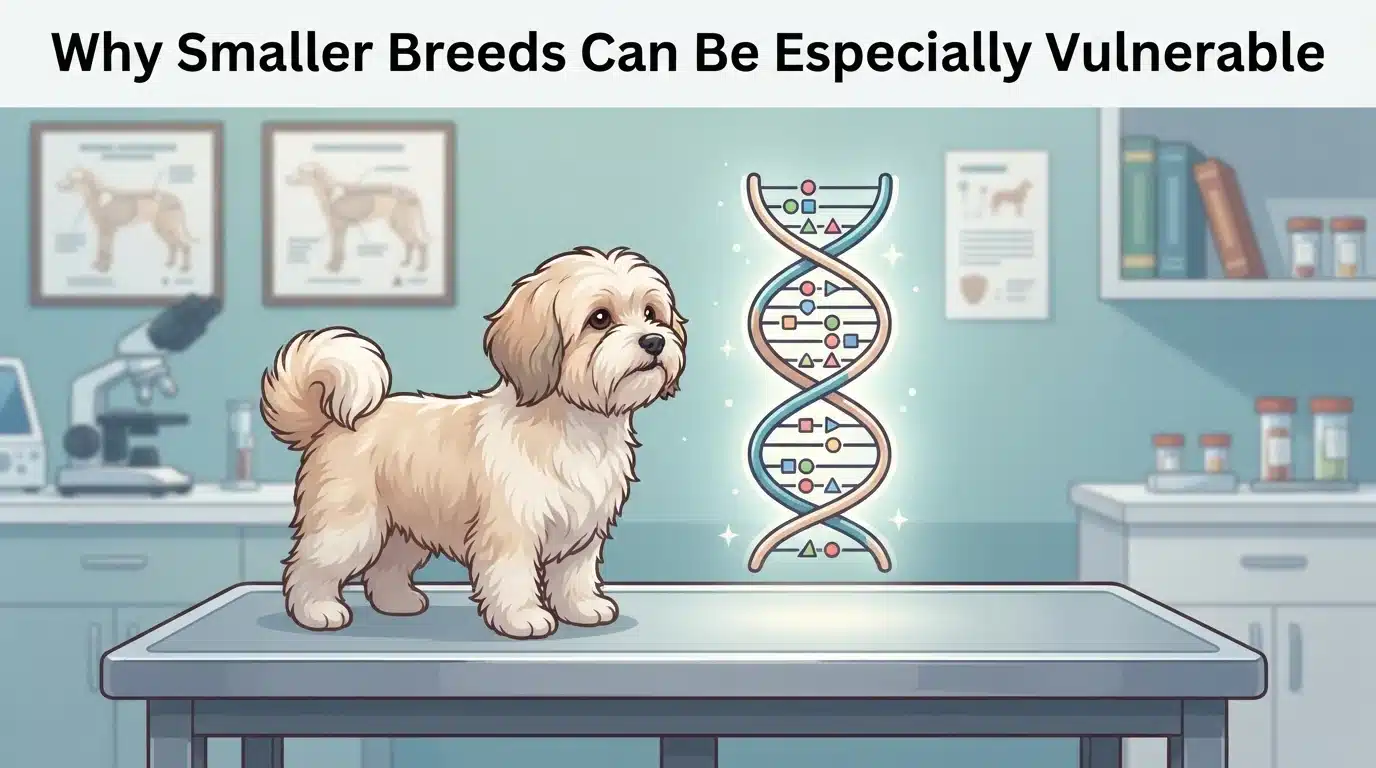
Small breeds start with fewer founders and smaller breeding populations, so every breeding choice carries more weight. When only a few hundred dogs produce the next generation, inbreeding climbs quickly and the breed loses variation faster than a large population would. Geographic isolation makes it worse: a study of Italian Greyhounds found that founder effect and regional separation were the main drivers of subpopulation differences. Companion breeds like the Havanese fit this pattern, which is why responsible programs emphasize health-tested breeding decisions.
Consequences Buyers End Up Hearing About
Reduced diversity shows up as conditions buyers already worry about: heart issues, eye disease, luxating patellas, and shorter lifespans. The pattern is well documented in small population breeds. The fix is not one single test but careful pairing, which is what why testing matters explains in depth.
Measuring Diversity: COI, Pedigrees, and DNA Tools
What the Coefficient of Inbreeding Actually Means
The coefficient of inbreeding, or COI, estimates the chance that a puppy inherits two copies of the same gene variant because its parents share ancestors. A COI of 10% means roughly one in ten gene pairs is identical by descent. In practical terms, a lower COI signals more genetic diversity in small breed dogs, which supports healthier immune systems and fewer inherited problems. Geneticists define it as the probability two alleles at a spot on a chromosome come from the same ancestor, which is why researchers studying breed populations rely on it so heavily, as explained in this population genetics study.

Reading COI Numbers in Context
A number by itself tells you little. Compare it against the breed’s average and against the litter’s parents. A UC Davis analysis of 227 breeds found genetic inbreeding averaging close to 25%, so a well-planned pedigree COI below 10% over ten generations is a reasonable goal for small breeds. Doodles complicate the picture because mixed parents can still share common ancestors, so ask which ancestors appear on both sides.
DNA Panels, Heterozygosity, and What They Can and Cannot Show
DNA testing measures diversity directly rather than estimating it from paperwork. A genetic COI reads your dog’s actual DNA, and breeder tools can predict average litter COI before a mating happens. Heterozygosity, meaning many different gene variants, is the goal. But panels have limits. They flag known disease variants only, so a clear panel does not clear a dog of unknown risks. Genetic diversity and health screening answer different questions, and responsible programs use both, which is why Sage Puppies pairs DNA testing with standard breed health screens before matching puppies to families.
Why a Pedigree Alone Is Not Enough
Paper pedigrees miss ancestors past a few generations, assume founders were unrelated, and record nothing about the wider population. Two dogs with identical five-generation COIs can carry very different actual diversity. Treat pedigree COI as a starting estimate, then confirm with DNA where possible.
Inside the Breeder’s Toolkit: Strategies That Support Diversity
Good breeders protect genetic diversity in small breed dogs with a mix of planning, testing, and paperwork. Here is what that work actually looks like, and what each step produces for you as a buyer.
Pedigree Planning and Kinship Analysis
Before any pairing, responsible breeders calculate the expected coefficient of inbreeding (COI) for the planned litter. Tools like Embark’s breeder COI tool predict litter COI from DNA rather than paper pedigrees, which matters when records are thin. Pairing two dogs with no recent shared ancestors keeps each puppy’s COI low and widens the gene pool the litter draws from.
Outcross Lines and Crossbreed Programs
When a purebred line grows too tight, breeders bring in an outcross, an unrelated dog from another kennel or country. This adds fresh alleles but can also import unknown traits, so it works best alongside testing, not instead of it. Crossbreed programs such as Havapoos and Cavapoos take a similar route by combining two breeds. The trade-off: more hybrid vigor in theory, but only if both parent lines are health tested and diverse themselves.
Health Screening Beyond DNA
DNA panels catch known mutations, but many conditions have no marker yet. That is why breeders layer on orthopedic exams, eye certifications by a veterinary ophthalmologist, and cardiac checks. Programs like the OFA’s CHIC system collect these results in one public database, so a buyer can verify them rather than take a breeder’s word. Testing both parents before every breeding, not once in a dog’s life, is the standard that protects genetic diversity in small breed dogs over generations.
Documentation a Buyer Should See
Ask for the parents’ DNA results, OFA or CHIC numbers, eye and heart clearances, and the litter’s expected COI. Breeders who protect genetic diversity in small breed dogs share these records early and without pressure. If a breeder hesitates to produce them, keep looking.
How Diversity Decisions Show Up in Havanese, Havapoo, and Cavapoo Programs
Genetic diversity in small breed dogs is not an abstract idea. Every pairing a breeder makes either widens the gene pool or narrows it, and the effects show up generations later in health, fertility, and lifespan.
A Long Stud Book, but Still Narrow in Places
The Havanese has centuries of history in Cuba, yet the modern American population traces back to a small group of dogs brought over in the 1970s by breeders like Dorothy and Bert Goodale, as the Havanese Club of America’s history describes. A long stud book does not equal a wide gene pool. When many puppies share the same founding lines, careful outcrossing and low coefficient of inbreeding (COI) pairings matter more than pedigree depth alone.

Combining Havanese and Poodle Diversity
The Havapoo mixes two gene pools, which usually lowers COI on paper. But the benefit only holds if both parents come from unrelated, health-tested lines. A Havapoo bred from two popular sire lines can still inherit the same recessive risks on both sides. Ask how the breeder picked each parent, not just which breeds were crossed. You can compare the two crosses in more depth in this Havapoo and Cavapoo temperament study.
Cavalier and Poodle Considerations
Cavaliers carry a heavier load of inherited conditions, including heart disease, so screening matters even more in Cavapoos. Poodles contribute their own tested traits, and a large 2022 review in Diversity outlines how pedigree and DNA tools together reveal hidden relatedness within breeds like these (see the genetic diversity review). For a Cavapoo, the useful questions are simple: which health tests were run on each parent, and how closely are they related?
How a Boutique Program Puts It Together
A small program can track every pairing personally. At Sage Puppies, each match starts with health-tested parents and a planned, low-COI pairing, so families know the reasoning behind their puppy, not just its coat color.
Questions Buyers Can Ask About Diversity and Health Testing
A short list of direct questions does more than any brochure. Breeders who value genetic diversity in small breed dogs answer them easily, and they expect buyers to ask.
About Pedigrees and COI
Ask what the parents’ coefficient of inbreeding (COI) is, and over how many generations it was calculated. A ten-generation pedigree gives a far fuller picture than four. You can also ask how closely related the two parents are, and whether the breeder plans outcrosses or line breeding and why.
About DNA and Health Screens
Ask which DNA panels the parents have completed and whether results appear in a public database. For Havanese, patellar luxation, cardiac, and eye exams are the core OFA tests tied to a CHIC number. For Havapoo and Cavapoo litters, ask which parent carries the tested lines, since screening standards differ between the two parent breeds.
About the Program and Documentation
Ask to see the actual certificates, not a summary. Request the OFA or CHIC lookup so you can verify results yourself, and ask how the breeder chooses pairings beyond health scores, such as temperament and structure. The OFA’s CHIC program lets any buyer confirm a dog’s listed tests online in minutes.

Connecting the Conversation to Sage Puppies
Sage Puppies shares documentation for each parent as part of the application and matching process, so families can review health screening alongside temperament notes before they commit.
A breeder who welcomes these questions has usually done the work behind them.
Limits of What Genetics Can Tell Us
Probability Is Not a Promise
Genetic diversity in small breed dogs shifts the odds, not the outcome. A clear DNA panel means a puppy is unlikely to inherit that condition, not that it will never face any illness. Research on inbreeding and lifespan shows these tools predict averages across populations, so two puppies from the same litter can still differ.
Lifestyle, Training, and Veterinary Care Still Matter
Genes set a starting point, but daily care shapes the rest. Diet, weight, dental hygiene, socialization, and regular vet visits all influence how a small breed ages. Even breeds that benefit from strong genetic diversity in small breed dogs need owners who follow through on that care.
Why Reputable Breeders Refuse Overpromising
Ethical breeders, including Sage Puppies, explain what testing shows and what it cannot. Careful claims protect families from false expectations, because honest guidance about genetic diversity in small breed dogs beats guarantees no one can keep.
Putting It Together: A Diversity-Aware Way to Choose a Puppy
A Simple Decision Framework
Ask five questions before you commit. What is the litter’s pedigree COI, and is it under 10%? Which parent pairs are health-tested, and can you see results? How wide is the pedigree, meaning do lineages cross several kennels or repeat one sire? Does the breeder plan pairings to protect genetic diversity in small breed dogs over the long run? A breeder who answers openly, as with Sage Puppies, makes your choice easier.
Continuing Your Research
Diversity work never really stops. Keep health testing through your dog’s life, share results with your breeder, and watch for emerging breed-wide screening tools. Research on small population breeds shows that careful, long-term planning is what keeps a breed healthy, and your puppy is part of that plan.

Ask any breeder about genetic diversity in small breed dogs before you fall for a puppy. If their answer mentions health testing and honest pedigree planning, you have found a good one. At Sage Puppies, Cassie welcomes your questions about genetic diversity in small breed dogs, so visit today and start the application.
Frequently Asked Questions
Q1: why genetic diversity matters in small dog breeding
Genetic diversity in small breed dogs lowers the chance a puppy inherits two copies of a harmful recessive gene. Narrow bloodlines raise risks for heart, eye, and knee problems, so wider pairings support healthier, longer-lived litters.
Q2: What COI should I look for in a puppy’s pedigree?
A pedigree COI under 10% over ten generations is a reasonable goal for small breeds, since breed averages often run much higher. Compare it to the breed norm, not just the raw number.
Q3: Does a clear DNA panel guarantee a healthy puppy?
No. Panels flag known variants only, so they shift the odds rather than promise outcomes. Good breeders layer on eye, heart, and orthopedic exams.
Q4: Are Havapoos automatically healthier because they’re mixed?
Not automatically. Hybrid vigor helps only when both parent lines are health tested and unrelated. Two popular sire lines can share the same recessive risks on both sides.
Q5: What documents should a breeder give me?
Ask for parents’ DNA results, OFA or CHIC numbers, eye and cardiac clearances, and the litter’s expected COI. These should be shared early and verifiable in a public database.
Conclusion
Genetic diversity small breed dogs depend on comes down to three things: low COI pairings, health-tested parents, and honest paperwork you can verify. Ask for DNA results, OFA or CHIC numbers, and the litter’s expected COI before you commit.
No test promises a healthy puppy. Genetic diversity in small breed dogs shifts the odds, and daily care finishes the job. What separates good programs from careless ones is openness.
Genetic diversity small breed dogs carry into the future is built one deliberate pairing at a time. Choose a breeder who can explain each match, and your puppy’s odds improve with every honest answer.