Havapoo Generation Guide
F1 vs. F1b Havapoo: Coat, Shedding, Size, and Temperament
Comparing an F1 vs. F1b Havapoo starts with parentage, but generation labels do not tell the whole story. Coat texture, shedding potential, grooming needs, adult size, and temperament can still vary within the same litter.
This guide from Sage Puppies in South Jordan, Utah explains the practical differences so families nationwide can evaluate Havapoo puppies based on realistic expectations rather than generation labels alone.
Parentage Coat and shedding Grooming Size Family temperament

The quick answer
An F1 Havapoo is a first-generation cross between a purebred Havanese and a purebred Poodle. An F1b Havapoo is an F1 Havapoo crossed back to a purebred dog of either founding breed: Poodle or Havanese. Confirm which breed was used rather than assuming the label specifies the pairing.
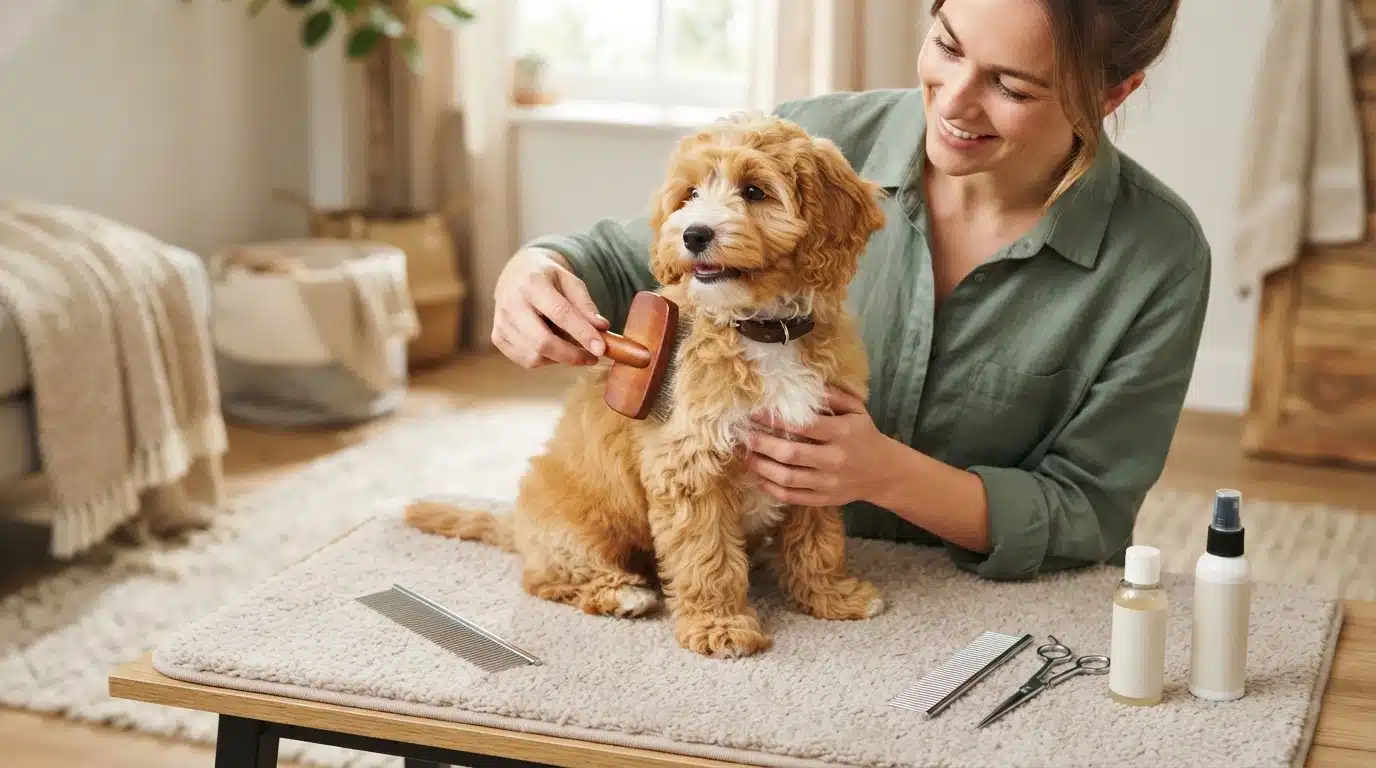
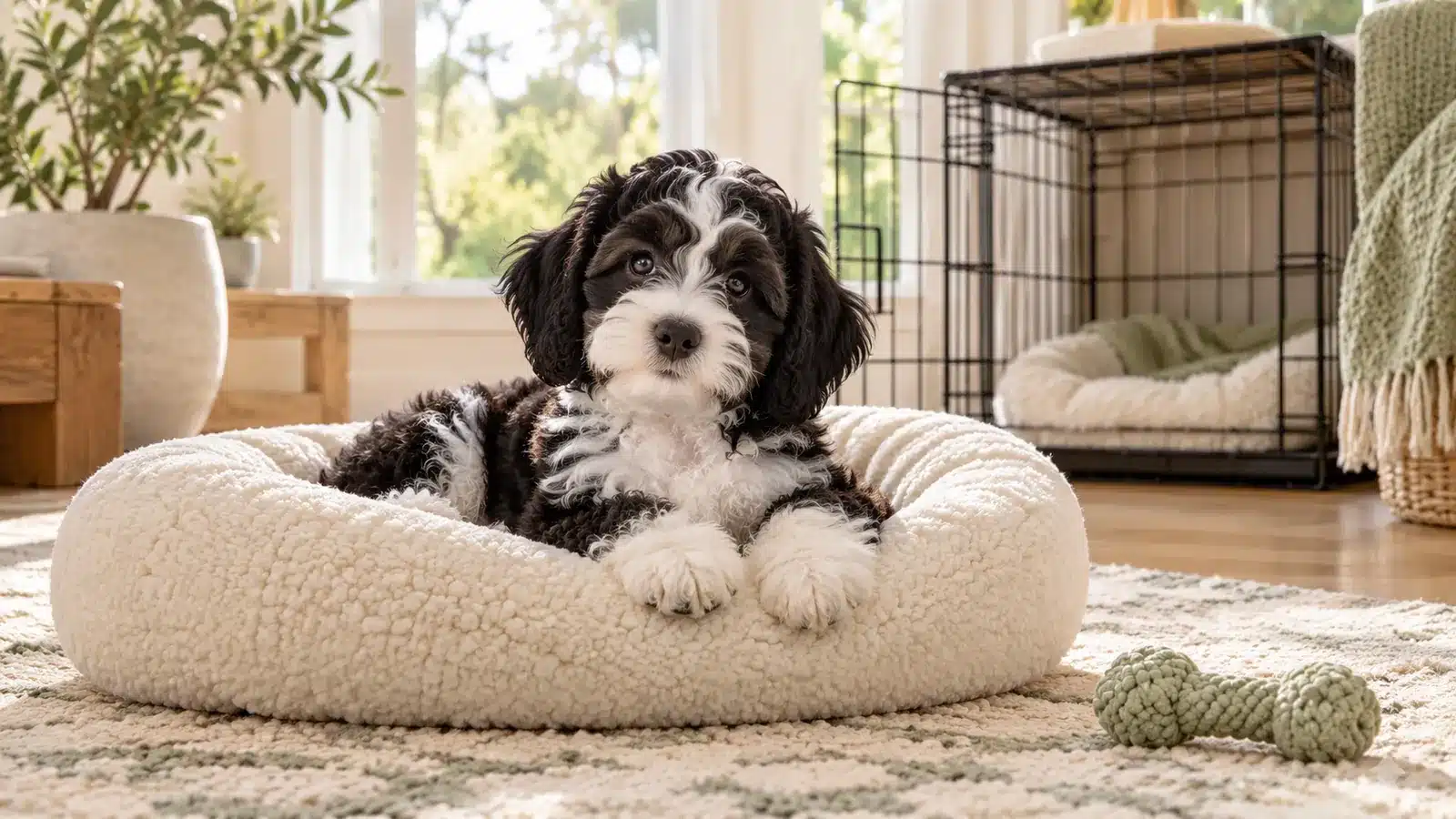
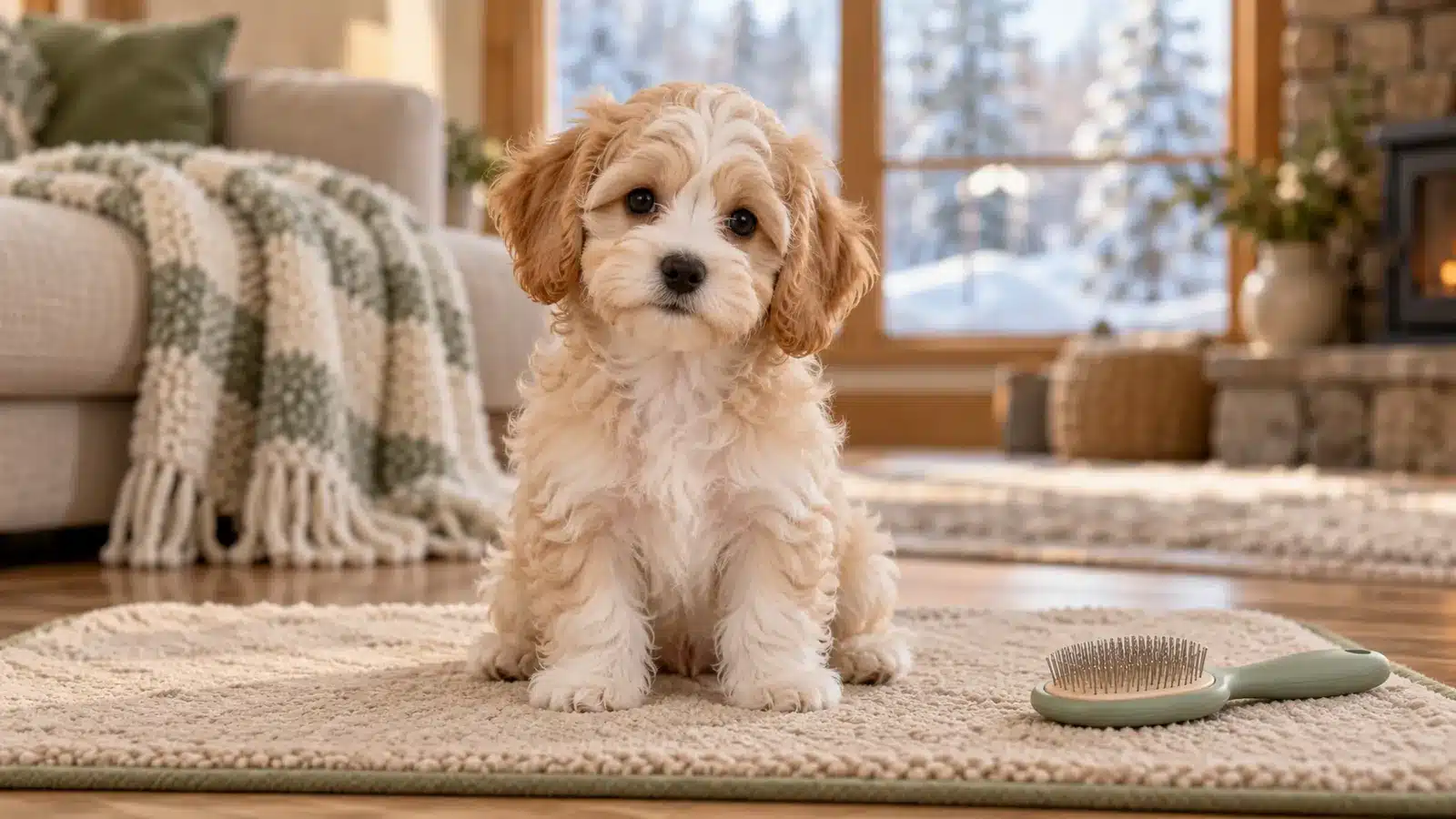
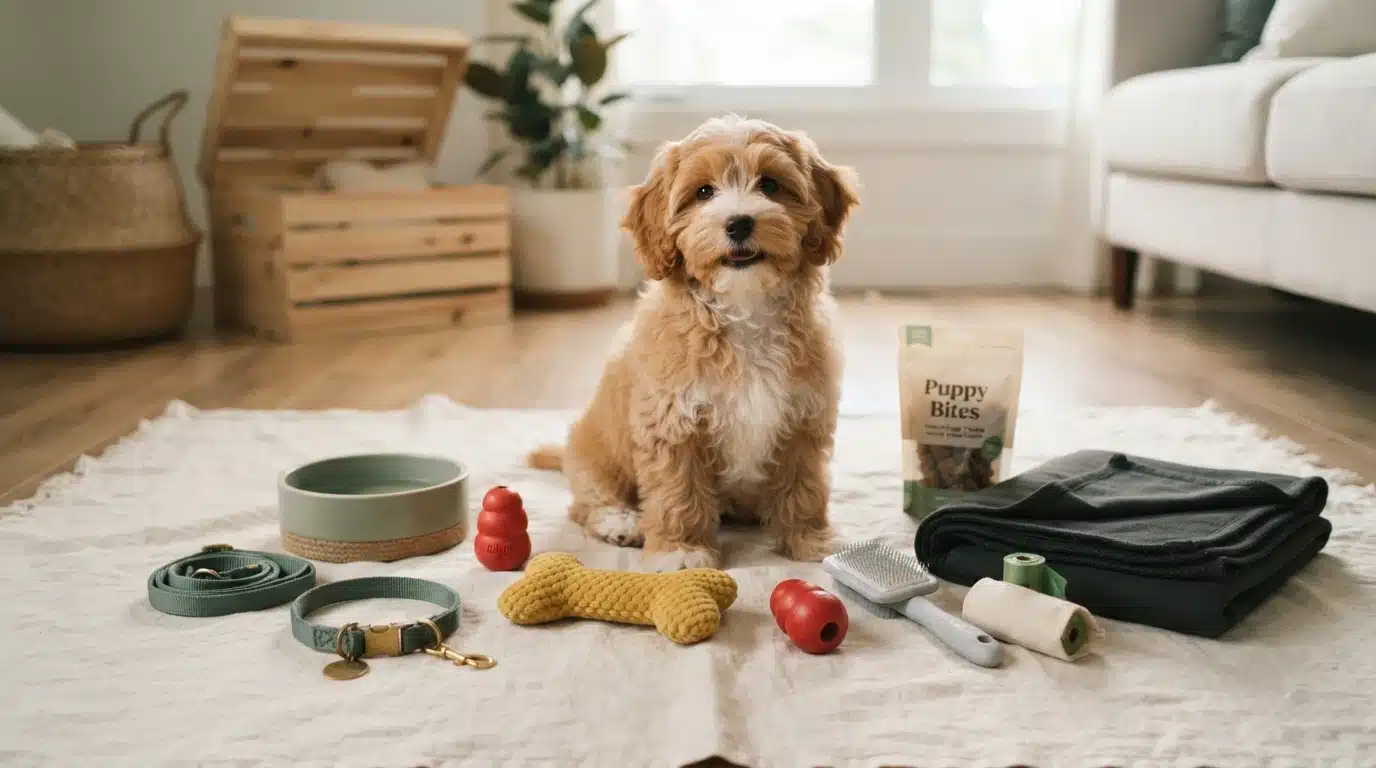
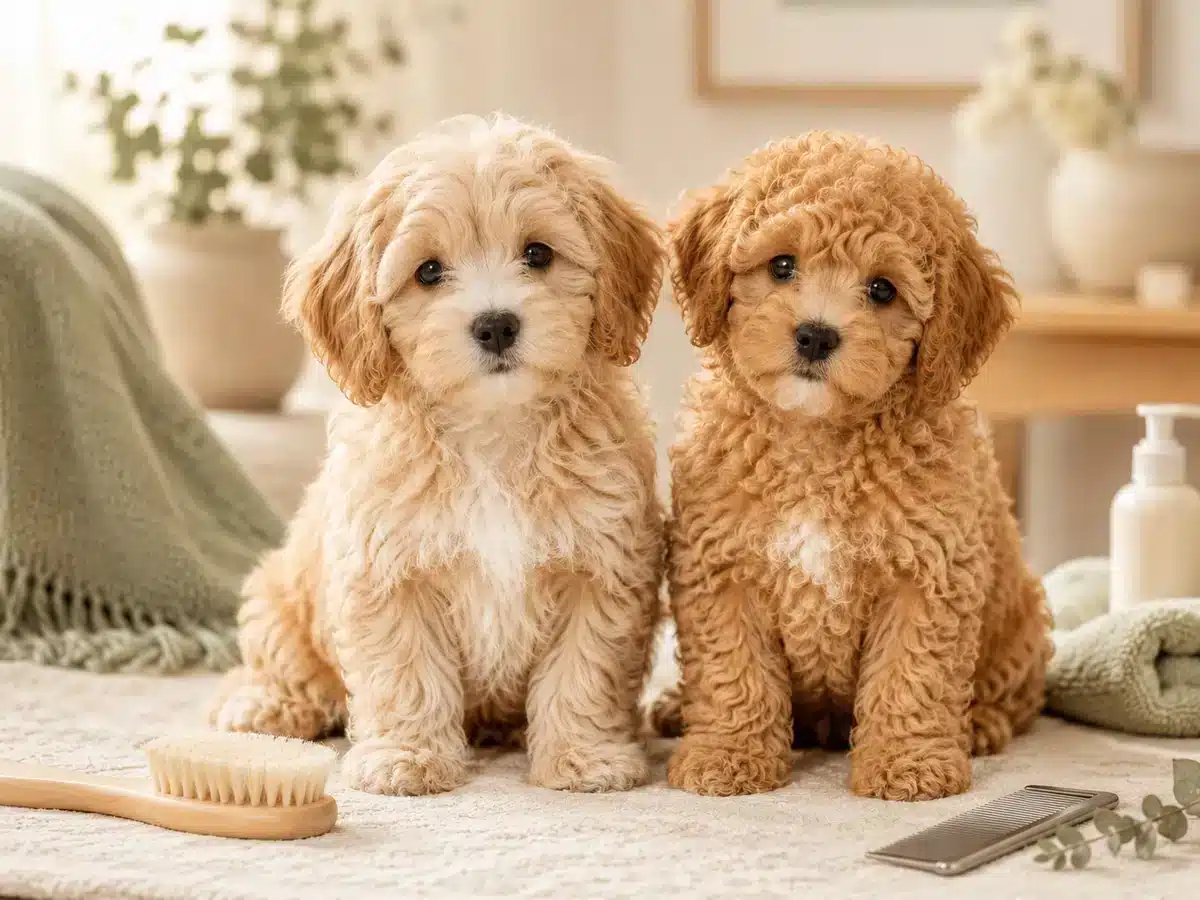
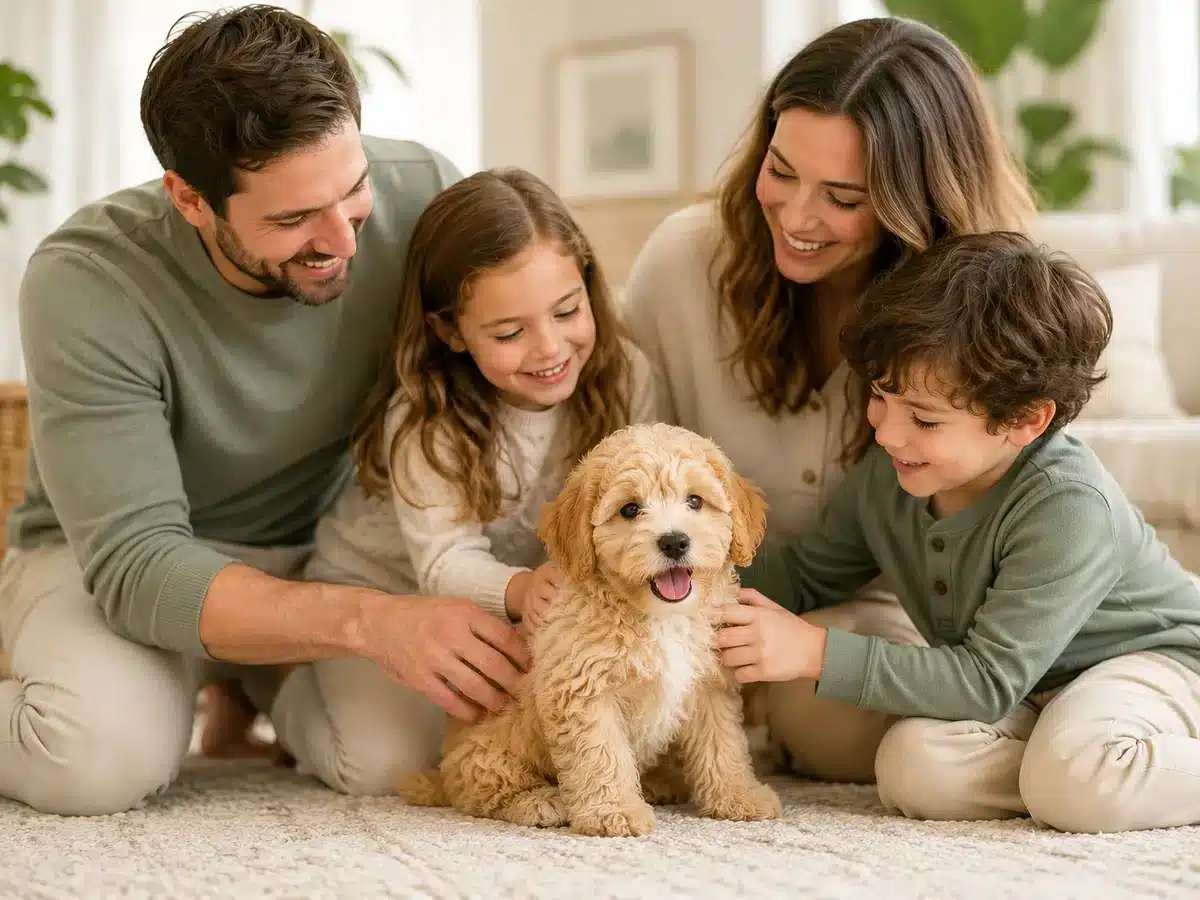
Neither label alone establishes how curly a puppy’s adult coat will be, how much it will shed, its adult size, or allergy compatibility. Evaluate the actual parents, inherited coat traits, and individual puppy. If you are new to the cross, learn more about the Havapoo mix. The illustrations show possible appearances; they do not verify generation, predict adult traits, or identify specific Sage puppies or families.
Generation BasicsFirst generation Poodle backcross example
What do F1 and F1b mean?
Generation labels describe the breeding combination. The percentages below are expected breed contributions calculated from the family tree, not measured percentages of a puppy’s appearance, shedding, health, size, or personality. The Royal Kennel Club’s generation definitions explain the distinction between a first cross and a backcross.
50 / 50
F1 Havapoo
An F1 Havapoo has one purebred Havanese parent and one purebred Poodle parent. Its pedigree contributions are:
- 50% Havanese by pedigree
- 50% Poodle by pedigree
The 50 / 50 description does not mean half of each parent’s personality or appearance. Possible coat outcomes depend on the variants carried by both parents and inherited by each puppy.
25 / 75
F1b Havapoo
For an F1 Havapoo × purebred Poodle pairing, the expected pedigree contributions are:
- 25% Havanese by pedigree
- 75% Poodle by pedigree
The expected Havanese contribution is (50% + 0%) ÷ 2 = 25%, and the Poodle contribution is (50% + 100%) ÷ 2 = 75%. These averages do not establish which coat variants a puppy inherits or how it will behave.
Important terminology note: The “b” means backcross, not necessarily a Poodle backcross. An F1 Havapoo × purebred Havanese pairing has expected pedigree contributions of 75% Havanese and 25% Poodle. Ask for the actual parents and family records. These percentages describe expected ancestry, not an individual DNA-test result or percentages of inherited traits.
| Characteristic | F1 Havapoo | F1b Example: Poodle Backcross |
|---|---|---|
| Parentage described | Purebred Havanese × purebred Poodle | F1 Havapoo × Poodle |
| Expected pedigree contribution | 50% Havanese and 50% Poodle | 25% Havanese and 75% Poodle |
| Coat possibilities | Straighter, wavy, or curly, depending on inherited coat variants | Also depends on inherited coat variants; the label does not guarantee curl |
| Shedding potential | Individual variation; assess the parents and puppy rather than the label | No assured shedding advantage from the label alone |
| Grooming | Regular brushing and professional grooming | Regular brushing and professional grooming, tailored to the individual coat |
| Adult size | Depends primarily on both parents’ size and structure | Also depends primarily on the actual parents, not the generation label |
| Temperament | Influenced by parents, socialization, development, and the individual puppy | Influenced by the same factors; generation does not guarantee personality |
Coat and Grooming
How can F1 and F1b Havapoo coats differ?
F1 Havapoos can show a broad range of coat textures. One puppy may have a soft, loose wave, while a littermate develops a fuller curl. Furnishings around the face, coat density, and texture can also differ.
A backcross can change the coat variants available to a litter, depending on the actual parents’ genetics. UC Davis identifies specific inherited variants associated with coat curl; a generation label does not provide those results. Puppy coats also change as the adult coat develops, so a photograph cannot establish an exact adult texture or shedding level.
Both generations require real grooming
- Brush and comb thoroughly several times each week; some long, dense, or curly coats need daily attention.
- Pay close attention behind the ears, under the collar, around the legs, and where the body rubs against a harness.
- Use a comb after brushing to find hidden tangles close to the skin.
- Schedule professional grooming on a routine appropriate for the puppy’s coat length and texture.
- Begin gentle handling and grooming practice during puppyhood.
For practical maintenance beyond this comparison, explore Havapoo coat care and grooming.
Curly does not mean easier
A dense or curly coat can trap loose hair and develop mats without consistent brushing and combing. Visible curl is not a reliable measurement of shedding, and low visible shedding does not remove the grooming commitment.
Shedding ExpectationsF1 coat range F1b coat range Allergy reality
Does an F1b Havapoo shed less than an F1?
An F1b label alone is not enough to conclude that a puppy will shed less than an F1. UC Davis describes shedding as a complex trait influenced by multiple genes. Relevant parent and puppy coat information is more useful than assuming a shedding advantage from the generation label.
Check the inherited coat
An F1 combines coat genes from a Havanese and a Poodle. Some puppies may have loose waves, while others develop curls and furnishings that look more Poodle-influenced.
Confirm the backcross and coat
The breed used for the backcross and the parents’ coat variants matter. Do not assume that every F1b is curlier or sheds less than every F1; puppies can still differ in texture, density, and maintenance needs.
No dog is guaranteed allergy-safe
Low shedding does not establish allergy compatibility. Dog allergens include proteins associated with dander, saliva, and urine. The AAAAI explains why “hypoallergenic” claims are unreliable; either generation can trigger an allergic reaction.
Families with dog allergies should discuss the decision with an allergy specialist. Spending time with dogs may inform that discussion, but a short visit or tolerance of one dog does not guarantee long-term tolerance of another. Neither F1 nor F1b should be presented as a medically safe generation choice.
Size and Temperament
Is an F1b Havapoo smaller or more Poodle-like?
Generation alone is not a dependable predictor of adult size. The actual size, structure, and growth patterns of the Havanese and Poodle parents are more useful than the F1 or F1b label.
A Havapoo produced from a smaller Poodle parent may mature differently than one produced from a larger parent, regardless of whether the puppy is F1 or F1b. Ask for both parents’ actual adult weights, heights, build, and relevant adult-relative or previous-litter records when available. Those details support an estimate, not a guaranteed adult weight. Read our Havapoo size and growth guide for deeper growth information.
Temperament is not a percentage formula
An F1b with a higher theoretical Poodle percentage is not automatically more energetic, more intelligent, or less affectionate. An F1 is not automatically more relaxed or more Havanese-like.
Temperament is shaped by several interacting factors:
- The temperaments of both parents
- The traits inherited by the individual puppy
- Early socialization and development
- Training consistency and household routines
- Exercise, enrichment, sleep, and age
- The match between the puppy and the family
That is why thoughtful puppy matchmaking should consider the individual puppy rather than assigning every puppy of one generation the same personality.
Family SuitabilityAn F1 may fit when An F1b may fit when
Which Havapoo generation is better for families?
Neither generation is universally better. The stronger choice is the puppy whose temperament, expected size, coat care, confidence, energy, and social needs fit the family’s actual lifestyle.
Your family is comfortable with coat variation
- You understand that coat texture and shedding can vary.
- You have reviewed the actual Havanese and Poodle parents rather than expecting a 50 / 50 personality blend.
- You are prepared for routine brushing and grooming.
- You are selecting primarily for temperament and family compatibility.
The individual puppy and care needs fit
- You understand that lower shedding is not guaranteed.
- You have confirmed which breed was used for the backcross and discussed the actual parents’ coats.
- You are prepared for the individual coat’s grooming needs and realistic allergy expectations.
- The individual puppy’s temperament fits your household.
Families with children should evaluate the individual puppy
For homes with children, prioritize a stable, sociable puppy whose confidence and activity level fit the household. Children should be taught respectful handling, and interactions with young children should be supervised regardless of generation.
Choosing Carefully
How to choose between an F1 and F1b Havapoo
Use the generation label as one piece of information. Then evaluate the breeding program, parent dogs, individual puppy, and long-term responsibilities.
Confirm the exact parent pairing
Ask whether the F1b was backcrossed to a Poodle or a Havanese. Do not assume that every breeder uses the label in exactly the same way.
Review the parent dogs
Ask about both parents’ size, temperament, coat, structure, and documented health testing. Sage’s published guidance says screening can vary by parent, breed, and litter; request the actual reports. Health screening concerns particular risks and does not automatically predict coat, adult size, or temperament.
Discuss coat expectations honestly
Ask what the breeder observes about furnishings, curl, coat density, and shedding potential while recognizing that a puppy coat can change as the dog matures.
Match temperament to the household
Consider children, other pets, work schedules, training experience, activity level, travel, and the amount of companionship the puppy will receive.
Plan for lifelong grooming
Both F1 and F1b Havapoos require brushing, combing, nail care, ear care, bathing, and professional grooming. Choose a manageable coat length and routine.
Understand the complete process
Review the breeder’s How It Works process, pricing and reservation information, application requirements, and delivery and pickup options.
Breeder Questions
Questions to ask before reserving a Havapoo
Parentage and health
- Which breed was used for the F1b backcross?
- What are the parents’ adult sizes and temperaments?
- Which health screens were completed for each parent, and can I review the actual results?
- What does the puppy’s veterinary record show, and what do the separate written health and contract terms cover?
Coat and daily life
- What coat traits are visible, and what relevant coat-trait results or family records support the estimate, if available?
- How much grooming should I realistically expect?
- What socialization and training foundations has the puppy received, and what will I need to continue at home?
- Why does this puppy’s temperament fit my household?
A trustworthy breeder should explain uncertainty. Neither generation is inherently healthier or free of inherited risks. Parent screening, the puppy’s veterinary examinations, and contractual health terms are separate forms of information. Early training foundations do not mean a fully trained puppy. Be cautious of exact adult-size, non-shedding, allergy-proof, or personality promises based only on generation.
Frequently Asked Questions
F1 vs. F1b Havapoo FAQs
What does F1 mean in a Havapoo?
An F1 Havapoo is a first-generation cross between a purebred Havanese and a purebred Poodle. Its 50% Havanese and 50% Poodle pedigree contributions describe parentage, not equal portions of each breed’s appearance or personality.
What does F1b mean in a Havapoo?
An F1b Havapoo is an F1 Havapoo crossed back to a purebred Poodle or Havanese. A Poodle backcross has expected pedigree contributions of 25% Havanese and 75% Poodle; a Havanese backcross reverses those percentages. Confirm the actual pairing, and do not translate ancestry percentages into trait percentages.
Do F1b Havapoos shed less than F1 Havapoos?
The label alone does not establish that difference. Shedding depends on inherited coat traits and the individual dog. Ask what parent information, observations, or relevant coat testing supports the breeder’s estimate; neither F1 nor F1b guarantees a non-shedding coat.
Are F1b Havapoos hypoallergenic?
Neither F1b nor F1 is guaranteed allergy-compatible. Low shedding does not mean allergen-free, and people can react to proteins associated with dander, saliva, and urine. Ask an allergy specialist for individualized guidance rather than choosing a generation as a medically safe option.
Are F1b Havapoos smaller than F1 Havapoos?
Not necessarily. Adult size depends more on the size and structure of the actual parent dogs than on whether the puppy is labeled F1 or F1b.
Which Havapoo generation is best for children?
Neither generation is automatically better for children. The individual puppy’s confidence, sociability, energy, handling tolerance, and compatibility with the family are more important than the F1 or F1b label.