Quick Summary: The Cavapoo vs mini Labradoodle question comes down to your daily routine, not looks. A Cavapoo tops out at 25 lb, runs on 30-45 minutes of activity a day, and slots neatly into apartments or calmer homes with older kids or seniors. The mini Labradoodle weighs 15-30 lb, needs 60-90 minutes of real exercise plus mental work, and fits active families with a yard or a solid walking routine. Grooming costs are similar for both (brushing several times a week and trims every 6-8 weeks, roughly $600+ a year), and the right health screening depends on each parent breed: Cavalier heart checks and Poodle patellas for Cavapoo parents, Labrador hip and elbow films plus Poodle DNA for mini Labradoodle parents. Pick the dog that matches the life you already live, not the one you wish you had.
Choosing a Cavapoo vs Labradoodle is really a choice between two ways of living, not two puppy photos. Both are friendly doodle crosses, yet they grow up differently. The standard Labradoodle often lands at 50-75 lb, which hides the smaller mini Labradoodle that actually competes with the Cavapoo. So the Cavapoo vs Labradoodle question comes down to this: tight spaces and lower daily exercise favor the Cavapoo, while active homes that want more bounce do better with a mini Labradoodle. This comparison walks through adult size, coat care, energy, family fit, and the health records each breeder should show you, so you can pick the cross your home can genuinely support.
Cavapoo vs Mini Labradoodle at a Glance
| Cavapoo | Mini Labradoodle | |
|---|---|---|
| Adult size | 9-25 lb, 9-14 in at shoulder | 15-30 lb, 14-16 in at shoulder (mini variant) |
| Energy and exercise | Low to moderate; 30-45 min daily activity | Moderate to high; 60-90 min daily activity plus mental work |
| Coat and grooming | Wavy to curly; brushing 3-4x weekly, trim every 6-8 weeks | Wiry to curly depending on generation; brushing 3-4x weekly, trim every 6-8 weeks |
| Temperament | Affectionate, people-focused, gentle, often calmer than other doodles | Outgoing, playful, athletic, more drive than a typical Cavapoo |
| Family and apartment fit | Strong fit for apartments, seniors, and gentle families with older children | Better fit for active homes and houses with a yard; workable in apartments with strong exercise routine |
| Health screening focus | Cavalier heart/MVD screening, Poodle patellas, eyes, and hips per current parent-breed CHIC requirements | Labrador hip and elbow screening, Poodle patellas, eyes, and PRA/PRCD DNA variants |
How Cavapoo and Mini Labradoodle Compare
Cavapoo
The Cavapoo crosses a Cavalier King Charles Spaniel with a Poodle, producing a 9-25 lb companion bred for gentle, people-focused company. It suits apartments, seniors, and calm families who want a quieter doodle.

Key strengths
- Low to moderate energy, 30-45 minutes of daily activity
- Affectionate, gentle temperament
- Strong apartment fit
Mini Labradoodle
The mini Labradoodle pairs a Miniature Poodle with a Labrador Retriever and comes in F1, F1b, and F2 generations, weighing 15-30 lb. It fits active homes and houses with a yard, where its playful, athletic drive gets a daily outlet.
Key strengths
- Moderate to high energy, 60-90 minutes of activity plus mental work
- Outgoing, playful temperament
- Labrador hip and elbow screening plus Poodle eye and DNA checks
Adult Size and Growth: Why the Mini Variant Changes the Comparison
What “Mini” Actually Means on a Labradoodle Pedigree
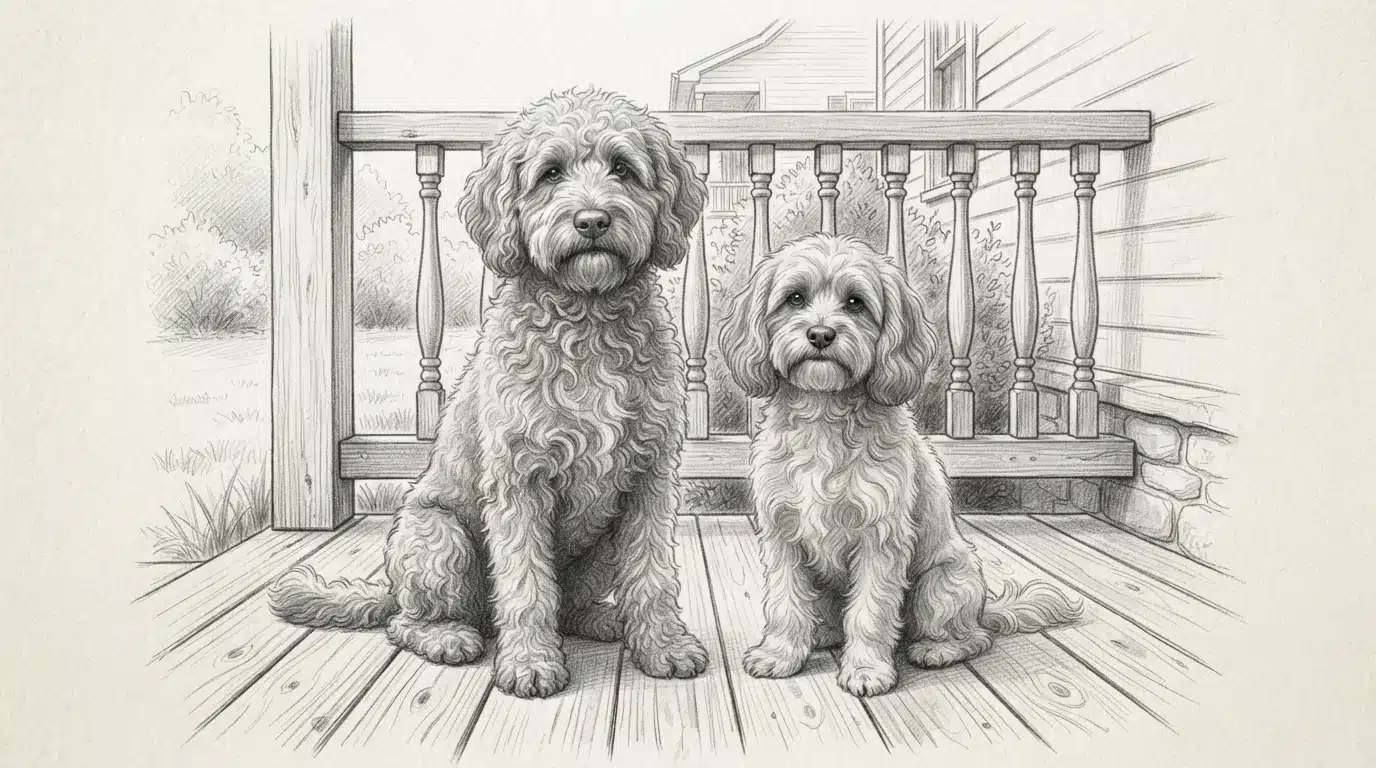
“Mini” on a Labradoodle pedigree describes the Poodle parent, not a fixed breed standard. The AKC lists Miniature Poodles at 10-15 pounds and 15 inches or under, so pairing one with a Labrador pulls puppies well below the 50-75 lb standard Labradoodle. Most mini Labradoodles land at 15-30 lb and 14-16 inches at the shoulder, though litters vary more than Cavapoo litters because the Labrador side contributes a much bigger size range.
That spread matters when you shop. A mini Labradoodle from larger-than-average parents can reach 35 lb, while a Cavapoo rarely tops 25 lb. Ask a Labradoodle breeder for the weight of both parents and any past litters from the same pairing. That history predicts adult size better than the puppy’s current weight does.
Growth timing also differs. Doodles reach most of their height by 8-10 months but keep filling out until 12-18 months, so judge a young adult, not a chubby 12-week puppy.
You can also compare how each breed’s coat changes with age in our Cavapoo coat guide, since size and coat both shift between puppyhood and the adult trim.
Coat, Grooming, and What Shedding Really Means
Brushing, Trims, and the Real Cost of Coat Care
Both breeds shed far less than a Labrador or a Cavalier, but “low-shedding” never means zero. A wool coat (tight curls) holds loose hair the longest, while a fleece coat (soft waves) releases a bit more. Straighter coats shed the most, which is why a first-generation mini Labradoodle with a wiry, Labrador-like coat may leave hair on your sofa while an F1b with a curly coat barely does. Individual dogs vary, so ask to see the parents rather than trusting a blanket promise.
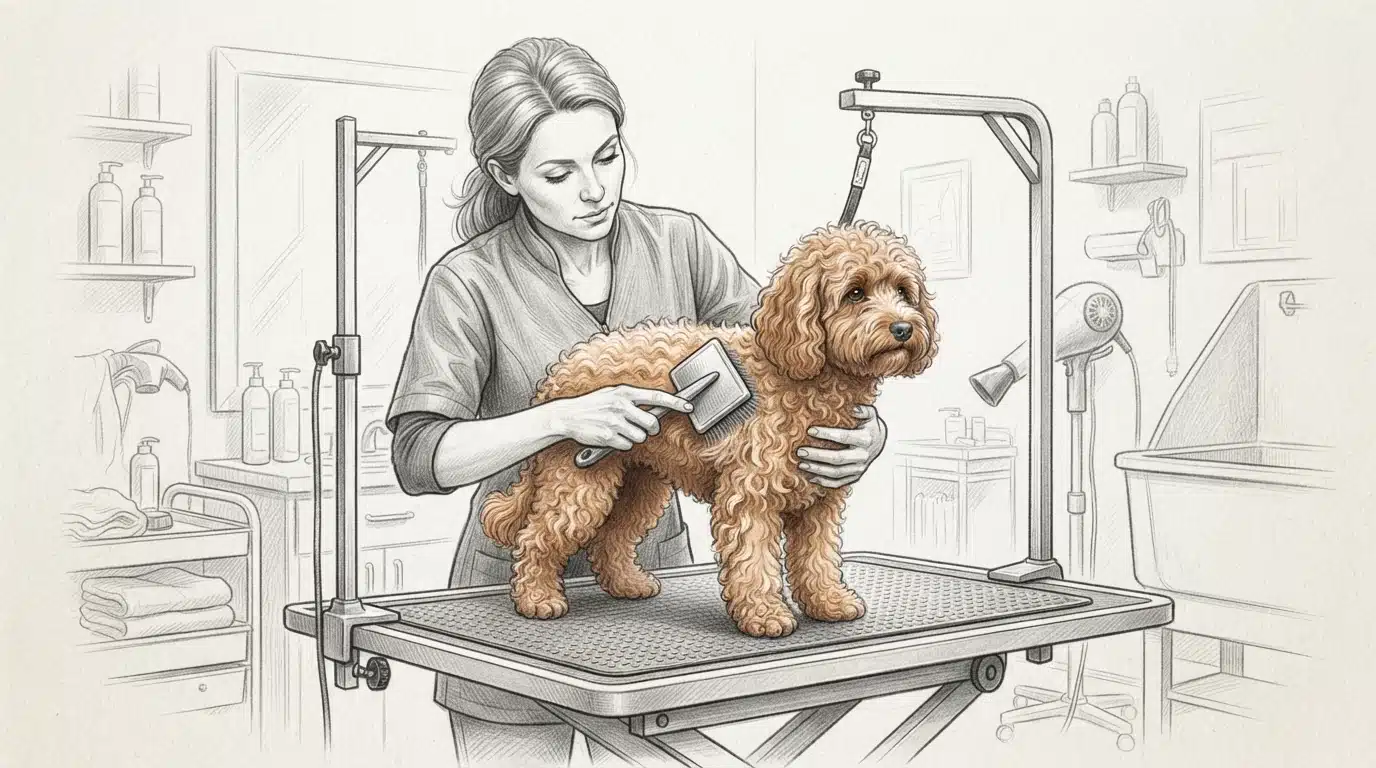
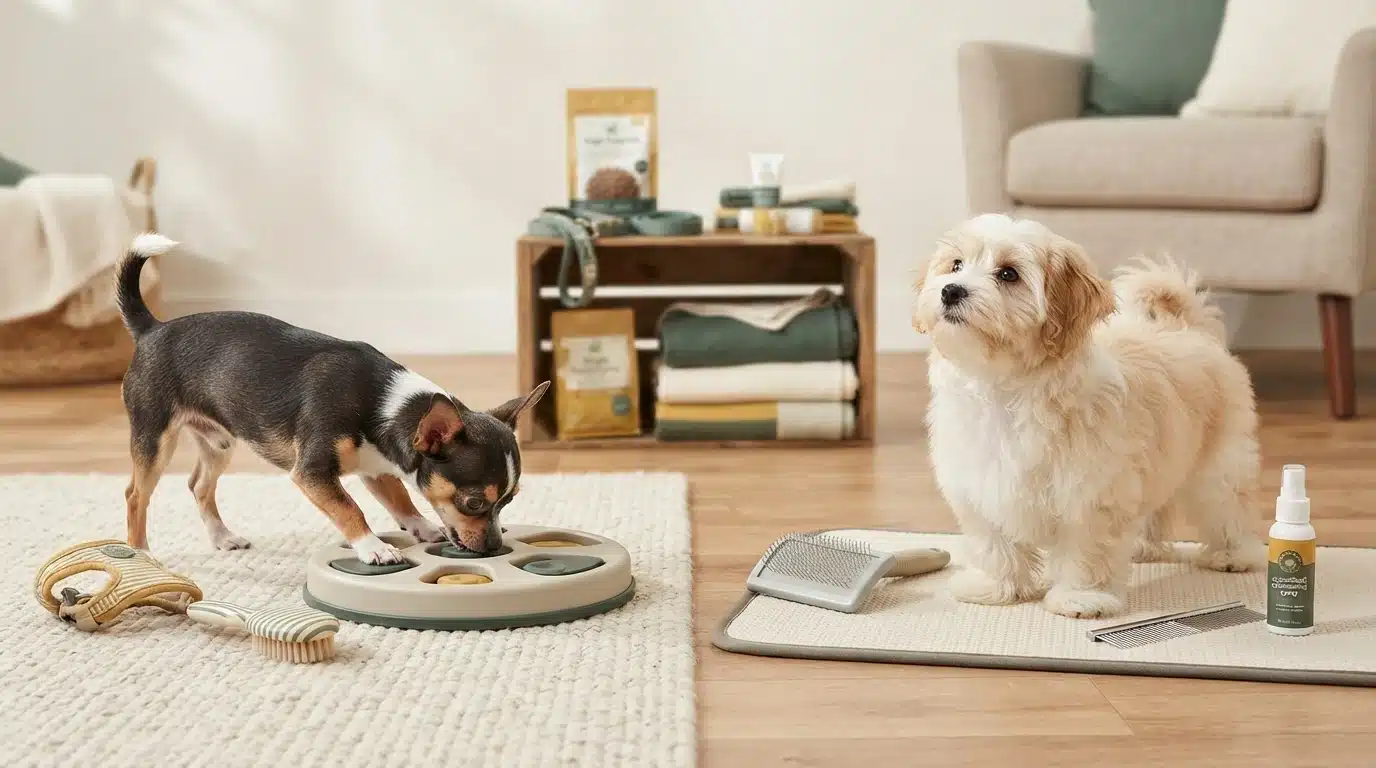
The trade-off for less shedding is real grooming work. Both breeds mat quickly behind the ears, under the collar, and in the armpits, so plan on brushing three to four times a week and a full trim every six to eight weeks. Professional grooming runs roughly $70 to $120 per visit depending on your area and the dog’s size, which adds up to $600 or more a year. Budget examples like these vary widely by location, so check local prices.
| Coat question | Cavapoo | Mini Labradoodle |
|---|---|---|
| Typical coat | Wavy to curly, silky | Wiry to curly, thicker |
| Matting risk | High behind ears | High, denser coat |
| Grooming visits | Every 6-8 weeks | Every 6-8 weeks |
Learning what a coat actually needs before you commit helps, and a Cavapoo coat guide for allergy-minded families breaks down the details. The same logic applies to doodwoof’s Labradoodle coat care walkthrough, which covers how wool, fleece, and hair coats mat and shed differently.
Energy, Exercise, and Training: Who Needs More Daily Output
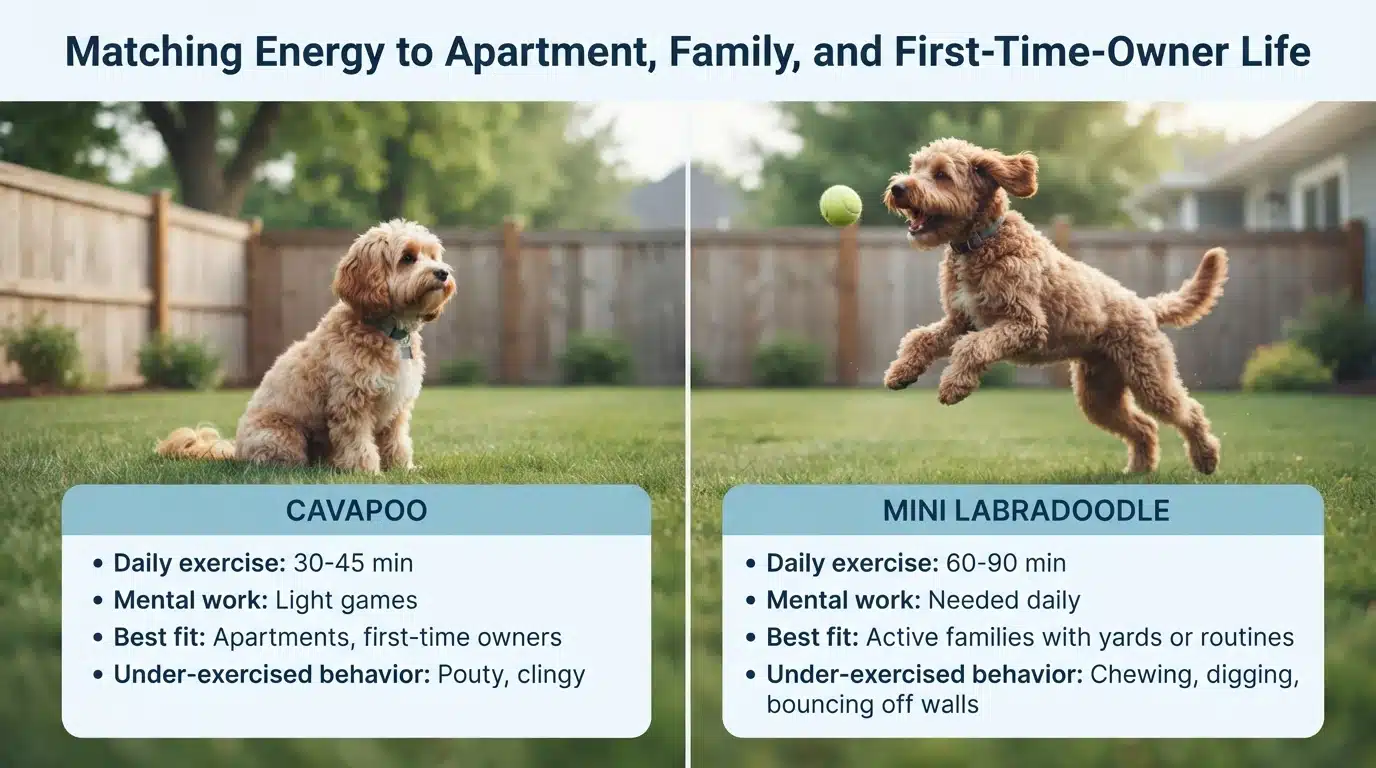
Matching Energy to Apartment, Family, and First-Time-Owner Life
The mini Labradoodle asks more of your schedule, every single day. Bred from a Labrador and a Miniature Poodle, most adults need at least 60 to 90 minutes of exercise daily, split across walks, fetch, and training games. That dog wants a job, not just a stroll.
A Cavapoo runs on less. Expect 30 to 45 minutes of daily activity, which a couple of neighborhood walks and a short play session cover. The Cavalier side was developed to be a lap companion, so quiet evenings come naturally.
| Factor | Cavapoo | Mini Labradoodle |
|---|---|---|
| Daily exercise | 30-45 min | 60-90 min |
| Mental work | Light games | Needed daily |
| Best fit | Apartments, first-time owners | Active families with yards or routines |
| Under-exercised behavior | Pouty, clingy | Chewing, digging, bouncing off walls |
Both breeds are smart and people-focused, so training goes well when you start early and keep sessions short. Neither fixes itself. A bored doodle will invent entertainment, and it rarely picks hobbies you approve of.
Skipped exercise shows up differently too. A Cavapoo that misses a walk usually naps harder. A mini Labradoodle that misses one may chew a baseboard by dinner.
If your week already includes daily hikes, runs, or long fetch sessions, the Labradoodle’s engine becomes a bonus. If it doesn’t, pick honestly. A match between your real routine and the dog’s needs prevents most behavior complaints, and small-breed training basics apply to both. Honest breeders, including Sage Puppies, will tell you which puppy fits a busier home and which one wants a couch.
Ask any breeder you contact how each puppy in the litter reacts after play. The one that settles quickly will fit a calmer household better.
Temperament and Family Fit: Gentle Companion vs Outgoing Athlete
How Each Cross Does With Other Pets, Visitors, and Noise
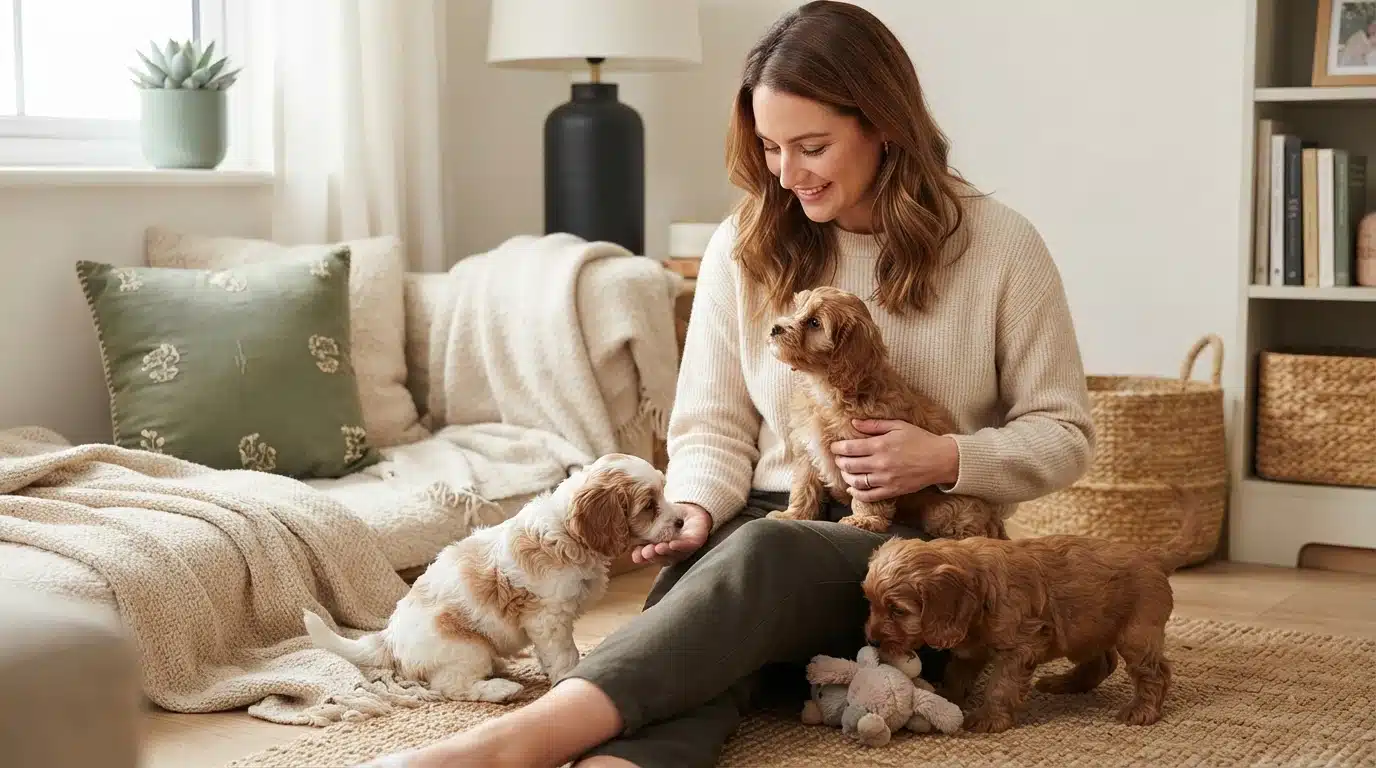
Cavapoos inherit the Cavalier’s soft, people-first nature. They greet visitors warmly, settle quickly, and usually accept cats and other dogs with little drama. Breed guides describe them as gentle and eager to please, friendly with kids, seniors, and other pets when socialized early (Petplace). The trade-off: at 9-25 lb they’re small, so rough play or a knock from an excited toddler needs supervision. No dog is toddler-proof, and this cross is no exception.
The mini Labradoodle brings the Labrador’s social confidence. Most are outgoing with strangers, playful with other dogs, and noisy-tolerant in busy households, because the breed was built to work around people and commotion. That same energy can overwhelm a calm home. An under-exercised mini Labradoodle gets mouthy, jumpy, and loud, which reads as “bad behavior” but is really unmet exercise need (60-90 minutes daily, as covered above).
With other pets, both crosses adapt well. The difference is style. A Cavapoo mirrors the household’s pace, so a mellow home gets a mellow dog. A mini Labradoodle adds its own pace and expects you to match it.
Visitors are easy for both, though a young Labradoodle may greet guests with full-body enthusiasm until training kicks in.
Individual temperament varies more within a litter than between these crosses, so ask a breeder about each parent’s personality, not just the breed averages. At Sage Puppies, every pairing starts with the parents’ temperaments because that’s what puppies actually inherit.
Health Realities: Different Parent Breeds, Different Screening Priorities
A mixed breed inherits health risks from both parents, so the tests that matter depend on which breeds sit behind the cross. A DNA panel is not a catch-all: it checks known gene variants, while conditions like heart disease in Cavaliers show up on a physical exam instead. Judge each parent by the screening its own breed clubs recommend.

A Buyer’s Checklist of Health Records to Request From Either Breeder
Ask any breeder for three separate things, and keep them straight in your notes:
- Puppy exam record: the litter’s veterinary check, vaccinations, and deworming dates. This covers the puppy’s current health, not its future risks.
- Each named parent’s clinical screening: real test results, with the body part, method, and the dog’s age at testing. The Cavalier King Charles Spaniel Club’s testing guide lists cardiac clearance, eye exams, hips, and patellas for that breed, and Cavalier hearts are checked by a cardiologist because early mitral valve disease is the breed’s main concern.
- DNA variant results: useful, but a clear panel does not rule out every disease.
For a mini Labradoodle, weigh the Labrador side differently. Hip and eye screening matter more there because Labradors carry a different risk profile than Cavaliers, and elbow films that make sense for a Lab side add little when evaluating a Cavalier parent. Match the test to the breed, not to a generic “doodle panel.”
A missing public record is not proof of a hidden failed test. If a result isn’t posted, just ask to see it.
For the specific questions worth asking, our guide on questions to ask about health-tested puppy parents walks through the wording breeders respond to best.
Cost, Availability, and What a Responsible Breeder Actually Looks Like
How to Compare Two Breeders Without Falling for the Cutest Photo
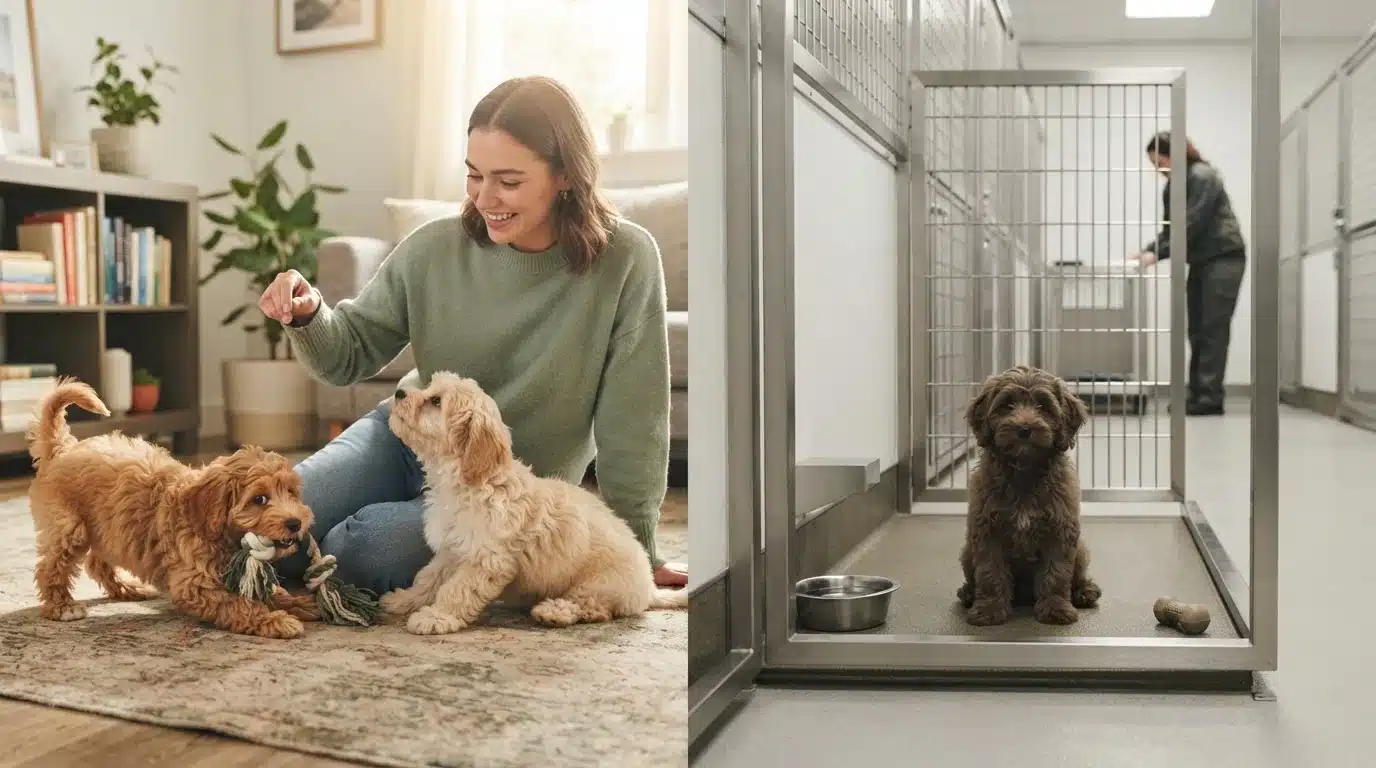
Price alone tells you almost nothing. Well-bred Cavapoos typically run $1,500 to $4,000, so a $2,200 puppy and a $4,200 puppy can both be fair deals, depending on what sits behind the price. Judge the program, not the number.
Ask every breeder the same five questions and compare answers side by side:
| Question | Good answer | Warning sign |
|---|---|---|
| Health testing? | Parent heart, eye, and patella checks, plus DNA results you can see | “Vet checked” only, no parent records |
| Meet the parents? | Yes, at least the mother, in person or on video | Photos of puppies only |
| Waiting list? | Waitlist, application, and an interview | “Puppies ready today” |
| Home setup? | Puppies raised in the home, handled daily | Kennel or shed housing |
| Support? | Written health terms and a take-back clause | None, or vague promises |
Availability matters too. A breeder with litters year-round is running a business first; a breeder with a waitlist is planning litters around the parents’ health. Both Cavapoos and mini Labradoodles are popular enough that reputable programs rarely have instant openings.
One more filter: a responsible breeder screens the parents, but DNA results on a puppy are not a health guarantee. No honest breeder will promise an allergy-proof or toddler-proof dog.
This is the standard we hold ourselves to at Sage Puppies, where our Cavapoo purchases run $3,500 to $4,500 with the inclusions spelled out in writing.
Pick the Cavapoo if you want a smaller, calmer companion. At 9-25 lb with 30-45 minutes of daily activity, it suits apartments, quieter households, and first-time owners who mostly want a lap dog that walks nicely. It also fits families with gentle older kids who understand small dogs need supervision.
Pick the mini Labradoodle if your family runs outdoors. That 60-90 minute daily exercise commitment is real, and an under-exercised one gets mouthy and loud. The upside is a sturdier 15-30 lb dog, more drive for fetch and hikes, and a bigger range of coat types across generations.
Ask yourself three questions:
- Space and schedule: Can you honestly cover the exercise, every day, in winter too?
- Size certainty: A Cavapoo rarely tops 25 lb; a mini Labradoodle from large parents can hit 35 lb.
- Grooming budget: Both need brushing several times weekly and trims every 6-8 weeks.
Neither is better. Match the dog to your actual routine, not the one you plan to start someday.

If a gentle, people-focused companion fits your home better than a high-energy retriever mix, a Cavapoo may be your match. See Cassie’s available Cavapoo litters and the application process at Sage Puppies, and apply when you’re ready.
Frequently Asked Questions
Q1: Cavapoo vs mini Labradoodle comparison
A Cavapoo stays smaller (9-25 lb) and calmer, needing 30-45 minutes of daily activity. A mini Labradoodle weighs 15-30 lb and needs 60-90 minutes, so active homes with yards suit it better.
Q2: Which cross sheds less?
Both shed less than a Labrador or Cavalier, but none shed zero. Curly F1b coats shed least; wiry first-generation coats shed most. Meet the parents to gauge the litter.
Q3: How much does grooming cost?
Plan on brushing 3-4 times weekly and professional trims every 6-8 weeks, roughly $70-$120 per visit, so $600+ yearly. Check local prices.
Q4: Are either of these dogs hypoallergenic?
No dog is allergy-proof. Coats vary by individual, so spend time around the parents before deciding.
Q5: Which health tests should a breeder show me?
Ask for the puppy’s vet exam, each named parent’s clinical screenings (Cavalier cardiac clearance for Cavapoos; Labrador hip and elbow films for mini Labradoodles), and DNA results.
Q6: Which is better for a first-time owner?
The Cavapoo usually. Its lower exercise needs and gentler pace forgive beginner mistakes that an under-exercised Labradoodle won’t.
Conclusion
The right pick depends on your daily life, not the puppy photo. Choose a Cavapoo if you want a 9-25 lb, calmer companion needing 30-45 minutes of activity, which fits apartments and first-time owners. Choose a mini Labradoodle if your family can commit 60-90 minutes of exercise daily and has space for a sturdier, more athletic dog. Both need brushing several times a week and trims every 6-8 weeks. Whichever breeder you contact, ask for parent health screening matched to each breed, meet the mother, and expect a waitlist. No doodle is allergy-proof or toddler-proof, so match the dog to the home you actually have.