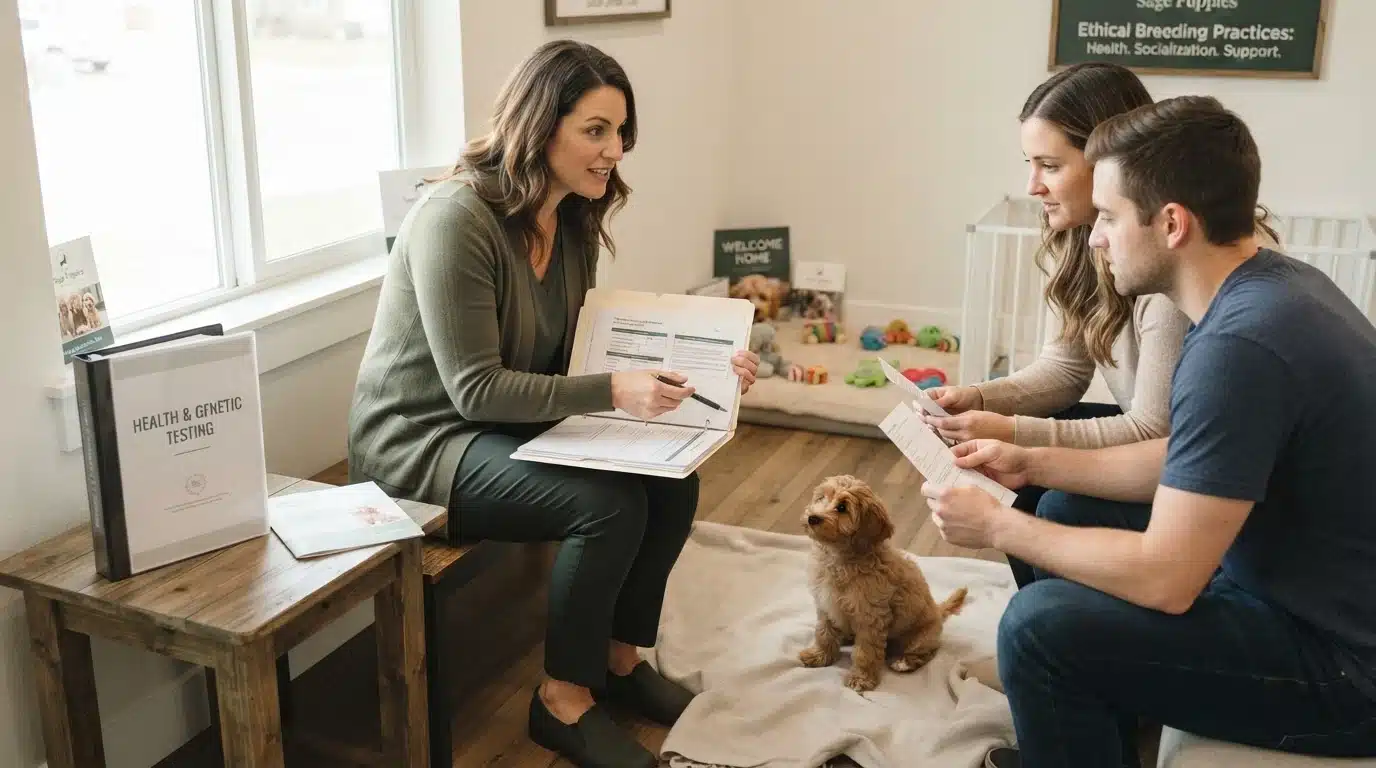
Quick Summary: Start by matching the breed to your household before chasing a cute photo. Then verify parent health tests through OFA, visit or request a live video tour, expect a breeder who interviews you back, and read every contract line for a health guarantee and return clause. Watch for pressure tactics, vague vet records, and resellers who never raised the litter, since those signal the puppy mill pipeline. Sage Puppies in South Jordan, Utah is presented as one program that checks every box, with documented health testing, a written application process, and live video tours for out-of-state families.
You find a litter of Havapoo puppies online, fall for one squishy face, and within minutes someone asks for a deposit. That moment decides whether your family brings home a healthy companion or learns an expensive lesson about the wrong puppy breeder.
The hard part is that many breeders look identical on a website. Photos are cute, prices sound fair, and nobody advertises their shortcuts. So how do you pick puppy breeder candidates you can actually trust before money changes hands?
This guide walks you through it. You will learn to find puppy breeder red flags early, ask the questions serious breeders expect, judge a home visit, and weigh pickup against delivery. It blends the AKC’s breeder checklist with a family puppy breeder lens built around small breeds like the Havanese, Havapoo, and Cavapoo, so the advice fits real households, not just show rings.
Start With Your Family, Not With a Litter
The best time to pick puppy breeder options is after you know what your household actually needs. Families who fall for a cute photo first often discover six months later that the dog’s energy, size or grooming routine doesn’t fit their life. Work through your family’s reality first, then look for breeders whose puppies match it.
Match a Breed to Your Household Before You Match a Breeder
Different small breeds suit different homes. A Havanese tends to be social and people-focused, which works well for families who are home a lot. A Cavapoo usually brings a gentle, easygoing nature that suits households with young kids. A Havapoo often sits somewhere in between, playful but adaptable.
Think honestly about your answers to a few questions. How many hours is the house empty each day? Do allergies matter to anyone under your roof? How much brushing and trimming can you realistically commit to? Your answers will point you toward one of these breeds and away from the others, long before a single litter listing catches your eye.
Write Down Your Non-Negotiables and Nice-to-Haves
Put your deal-breakers on paper before you talk to anyone. Maybe it’s a size under 20 pounds, a non-shedding coat, or a breeder who runs health testing. Those are non-negotiables, and you should hold the line on every one.
Then list nice-to-haves, things you’d enjoy but could live without, like a specific coat color. Knowing the difference keeps you from talking yourself into a puppy that fails a real requirement.
Decide How Local You Need the Breeder to Be
Location matters more than many families expect. If you live near South Jordan, Utah, visiting the puppies in person is a real advantage. If not, many quality programs offer delivery, so you can pick puppy breeder options nationwide. Just plan the logistics early, because pickup versus delivery affects timing, cost and preparation.
A responsible breeder is easy to describe and harder to find: someone who tests parent dogs, matches puppies to homes on purpose, and stays involved after pickup day. Here is what that looks like in practice, breed by breed.

Experience and Breeder Network
Good breeders know their breed’s history, its common health risks, and its temperament range. They can explain why two dogs were paired and what they hoped to improve. They also belong to a network: a vet they trust, a breed club, and mentors they call when a whelping question comes up at 2 a.m. That network matters most for newer programs, because experience is often borrowed before it is earned. Ask who advises them and how long they have worked with the breed.
Health Testing and Genetic Screening
This is where responsible programs separate themselves. The AKC publishes breed-specific testing requirements, and for small breeds that usually means eye exams, heart checks, and patella evaluations. OFA recommends asking for proof of screening, such as certificates, not just a breeder’s word. Genetic panels matter too, especially for crossbreeds like Cavapoos and Havapoos, where both parent lines should be clear of conditions the other might carry. Ask to see the parents’ results and verify them on the OFA site. If a breeder dodges, walk away. For a deeper walkthrough, our guide to the health tests responsible breeders run lists what to request.
Breeding for Standard, Health, and Temperament
Testing is the floor, not the goal. A thoughtful breeder also breeds toward the breed standard: correct size, coat, and structure. Just as important, puppies should be raised in a home, handled daily, and exposed to ordinary noise so their temperaments take shape early. The OFA notes good breeders screen families right back, matching each puppy to the right home rather than selling to whoever pays first.
Step 1: Verify Health and Ancestry Before You Visit
A serious breeder proves health and lineage in writing before you ever set foot in the home. Get the paperwork first. If it is missing, vague, or defensive, the visit will not fix it.
Read the Health Records the Way a Vet Would
Ask for the mother’s and father’s health screening results, then check them yourself. Good breeders document testing through the Orthopedic Foundation for Animals, so you can look up each parent by registered name. For small companion breeds, that usually means eye exams, patellas, hearts, and hearing tests. Compare what you see against what the breed club recommends. A breeder who hands you a folder of certificates has nothing to hide. One who emails a photo of “healthy parents” is asking you to take a risk they never took.

Confirm the Dam, Sire, and Ancestry Lineage
The dam is the mother and the sire is the father. Ask for both dogs’ registration papers and a three-generation pedigree. Then ask the question Cornell’s veterinary team suggests: has any health condition shown up in the line, even one testing cannot catch? Honest breeders answer plainly. For a mixed breed like a Havapoo or Cavapoo, ask to meet or see the parent breeds and confirm both lines were screened.
Match the Evidence to Your Family’s Risk Tolerance
Health testing lowers risk. It does not erase it. Even fully screened parents can produce a puppy with a problem, so ask the breeder how they handle a puppy who gets sick after going home. The AKC’s checklist for responsible breeders expects a written contract, health records, and a breeder who takes dogs back. Families who need predictability, say those with young kids or allergies, should weight documented testing more heavily than price. A clear example of this standard is Sage Puppies’ health testing page, which lists exactly which screens each parent dog has passed.
Step 2: Visit (In Person or by Video) and Read the Environment
A visit tells you more than any questionnaire. The AKC’s breeding guidance stresses that where puppies are raised shapes how they handle new homes, so watch the space, the mother, and the litter with your own eyes.

What Clean, Enriching, and Socialized Looks Like
Good spaces smell like nothing much. Look for dry bedding, fresh water, and toys rotated often enough that puppies stay curious. Puppies raised in a home meet vacuum cleaners, doorbells, kids, and stairs, so they recover fast when something startles them. Ask where the litter sleeps and who handles the puppies each day. Daily gentle handling from birth is what turns a shy eight-week-old into a confident companion.
Watch the Dam and Puppies Interact
The mother is your best signal. She should look healthy, move easily, and greet you without fear or aggression. A dam who is separate from the litter, or who hides when you enter, deserves a question. Then watch the litter itself: puppies should tumble, play, and check you out, not cower or flinch. Overly bold biting with no correction from the dam is less common, but note it too.
If You Cannot Visit, Run a Tight Video Tour
Many small-breed programs, including Sage Puppies, offer video visits for out-of-state families. Ask for a live call, not a polished recording, and request a full walk-through: whelping area, mother, litter, and feeding setup. Ask them to pick up two puppies so you can see posture and movement. If a breeder refuses video entirely, treat that as a red flag.
Planning a trip instead? You can compare pickup options for Utah and Idaho families before you book travel.
Step 3: Interview the Breeder (and Expect Them to Interview You)
A good breeder will interview you before you ever get to interview them. That is a feature, not a roadblock. Careful breeders want to know their puppies land in homes that fit, and the AKC recommends treating the first conversation as a two-way exchange. If nobody asks you a single question, that tells you something too.

Questions a Good Breeder Will Ask You First
Expect questions about your household, work schedule, kids, other pets, and past dogs. A serious breeder also asks how you plan to socialize and house-train the puppy. Smaller programs often use a written application for this. Sage Puppies, for example, starts every match with an adoption application, so nobody wastes time on a puppy that does not fit.
Questions You Should Ask About the Litter
Turn the conversation toward the puppies themselves. Useful questions include:
- Have both parents been health tested, and can I see the results?
- What are the parents’ temperaments like day to day?
- How many litters do you raise each year?
- Can I meet the mother, or at least see her on video?
- Have any puppies from past litters had health issues?
The OFA’s breeder interview guide suggests asking how long the breeder has worked with the breed and whether both parents are tested, since those answers separate hobby programs from careless ones.
Questions About Support, Returns, and Lifetime Help
Finally, ask what happens after pickup day. The strongest breeders put their support in writing, so get clear answers on:
- Does the puppy come with a written contract?
- What is the return policy if our family truly cannot keep the dog?
- Will you answer questions as the puppy grows?
- Do you want updates, and how do families usually stay in touch?
A breeder who promises lifetime help, and actually answers your texts six months later, is worth waiting for.
Step 4: Read the Contract, Pricing, and Logistics Carefully
A good breeder hands you paperwork before you hand over money. If someone resists putting terms in writing, treat that as your answer.
What a Fair Purchase Contract Should Include
Expect the contract to spell out the price, the health guarantee window, vaccination and deworming records, and a spay or neuter requirement for pet puppies. Most breeder contracts also include a return-to-breeder clause, which means you agree to contact the breeder first if you ever cannot keep the dog. That clause protects the puppy, not the breeder’s ego. The AKC’s overview of breeder contracts is worth reading before you sign anything. Ask questions about anything vague, and get answers in writing.
Pricing, Deposits, and the True Total Budget
The sticker price is only the start. Small breeds from careful programs often run $3,500 to $4,500, and then the first-year costs stack on top: vet visits, vaccines, food, gear, grooming, and training. Deposits typically apply toward the balance, so ask whether they are refundable and under what conditions. Get the full total in writing before you commit. Budgeting tip: set aside an extra $1,000 to $2,000 for year one so a surprise vet bill does not become a crisis.
Pickup, Ground Transport, and Flight Nanny Options
| Option | Best For | Rough Trade-off |
|---|---|---|
| Local pickup | Families near the breeder | Cheapest, lets you see the home |
| Ground transport | Regional buyers | Less stress than flying, slower |
| Flight nanny | Out-of-state families | Costly, puppy flies in cabin with a person |
Ask who handles the puppy at every leg. Meeting your breeder in person, when possible, tells you more than any document.
Step 5: Spot Red Flags and Avoid the Puppy Mill Pipeline
Most problem breeders announce themselves early. The puppy mill pipeline runs on volume, speed, and distance, so it leaves patterns you can catch in a photo, a price, or a pushy phone call.
The Classic Red Flags in Photos, Prices, and Pressure
Watch for sellers who always have several litters ready, refuse a video call, or dodge questions about where the puppies live. Stock photos, vague vet records, and “deposit first, questions later” pricing are next in line. According to the ASPCA’s guide to the puppy pipeline, breeders and brokers now sell heavily online, so a polished website alone proves nothing.
Why Resellers and Brokers Are Different From Breeders
A broker never meets the puppy. They buy from outside breeders, re-list the dogs, and ship them, often calling themselves “puppy finders” or “puppy concierges.” A real breeder raises the litter, knows each puppy’s history, and screens you right back. If the seller cannot tell you the dam’s age, the parents’ health testing, or who whelped the litter, you are likely talking to a middleman, not the person who raised the puppy.
A “Slow Yes” Plan When You Feel Pushed
Pressure is the tell. If someone demands a same-day deposit or claims another family is “about to pay,” pause anyway. Ask for a video tour, the vet’s name, and references from past puppy families, then take 24 hours to decide. Ethical programs, including small ones like Sage Puppies, expect questions and waiting; a breeder who resents both has told you everything you need to know.

Ready to meet a breeder who checks every box in this guide? Sage Puppies raises Havanese, Havapoo, and Cavapoo puppies in South Jordan, Utah, and matches families nationwide. Fill out the application, ask your questions, and take the next step toward a well-bred companion.
Frequently Asked Questions
Q1: How do I choose a good puppy breeder for my family?
Start with your household’s needs, then verify health testing, ask for a written contract, and choose a breeder who interviews you back.
Q2: What are the signs of a responsible puppy breeder?
Look for documented parent health tests, puppies raised in the home, willingness to answer questions, and a contract with a return clause.
Q3: How can I avoid puppy mills when choosing a breeder?
Refuse same-day deposits, demand a live video tour, ask who whelped the litter, and walk away if the seller dodges basic questions.
Q4: Should I pick up my puppy or use delivery?
Pickup lets you see the home; flight nannies suit distant families. Weigh cost, stress, and preparation time before deciding.
Q5: What should a fair puppy contract include?
Price, health guarantee window, vaccination records, spay or neuter terms, and a return-to-breeder clause protecting the puppy.
Bringing It All Together
Picking the right puppy breeder comes down to a few habits: know your household first, verify health testing in writing, visit or request a live video tour, expect to be interviewed, and read every contract line. Watch for pressure, resellers, and vague answers, because volume and speed are how the puppy mill pipeline works. Take the slow yes, even when a cute face tempts you. Families who hold these standards, with small breeds like the Havanese, Havapoo, and Cavapoo, bring home a well-bred companion matched to real life, not just a listing.