Quick Summary: Feed a Havapoo puppy measured portions based on its age, weight, and the calories per cup of its food, rather than relying on generic charts or the highest amount on the bag. Puppies need four meals daily at 8 to 12 weeks, three at 3 to 4 months, and two from 5 months onward, with portions ranging from 1/4 to 1/3 cup per meal at 8 weeks to 2/3 to 3/4 cup near one year. Adjust the daily ration using weekly weight checks and body condition, keep treats under 10 percent of calories, and change foods gradually to avoid stomach upset.
An eight-pound Havapoo puppy has a stomach that holds about a quarter cup of food at a time. Meanwhile, most kibble bags say a growing pup can eat up to two cups a day. That gap is where overfeeding starts, and it’s why havapoo puppy portion sizes need to be worked out by age and weight, not by the back of the bag.
The real problem is that generic feeding charts are built for medium and large breeds. They barely account for a toy breed’s fast early growth and tiny stomach, so first-time owners often guess and drift high.
This guide fixes that. You’ll get a Havapoo-specific feeding table in cups, grams and calories for each age band, a simple way to read any food label, and a method for adjusting portions as your puppy grows.
Before You Start: The Three Numbers You Need
Every feeding decision starts with three numbers: your puppy’s age, current weight, and the calorie count printed on your food bag. Get those right and the rest of the portion math takes minutes.
Confirm Your Puppy’s Age, Food, and Weight
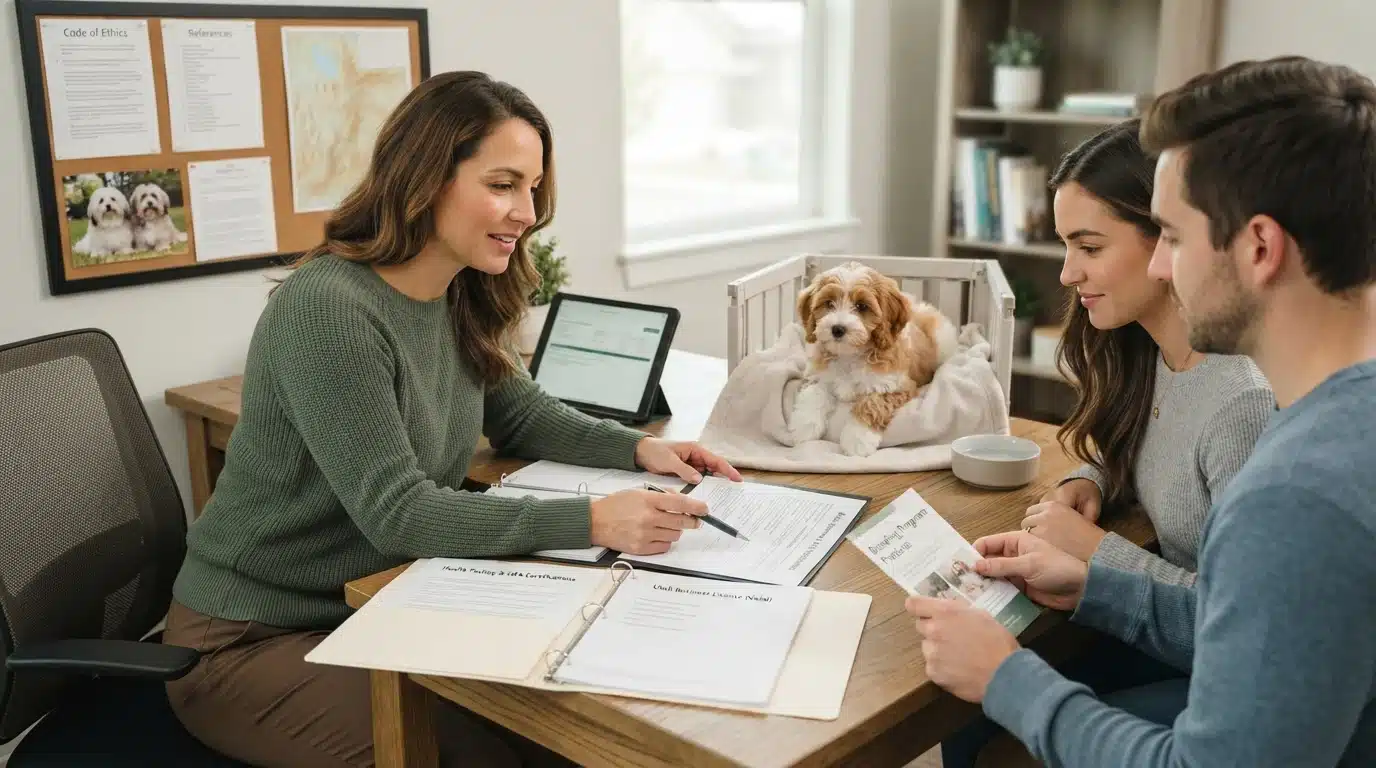
Note your puppy’s age in weeks, since a Havapoo puppy’s food amount changes fast in the first year. Weigh your puppy at home by holding them on a bathroom scale and subtracting your own weight. If your puppy came from Sage Puppies, ask what food the litter was eating so you can keep meals consistent.
Get the Calories per Cup From the Food Label
Find the calorie statement on the back of the bag. It reads something like “3,800 kcal ME per kilogram” or “425 kcal ME per cup.” You need the per-cup number. If the label only shows calories per kilogram, divide by the grams-per-cup figure listed in the feeding chart, usually around 100 to 120 grams per cup. That single number drives every portion size in the tables below.
For more on planning puppy costs, see this Havapoo puppy budget guide before your new arrival comes home.
How Much Should I Feed a Havapoo Puppy at Each Age?
Havapoo puppy portion sizes change fast in the first year, so the answer depends on your pup’s age band. Here is the whole plan in one table, then each stage explained.
The Portion Table at a Glance
| Age Band | Meals Per Day | Cups Per Meal | Grams Per Meal | Daily Calories |
|---|---|---|---|---|
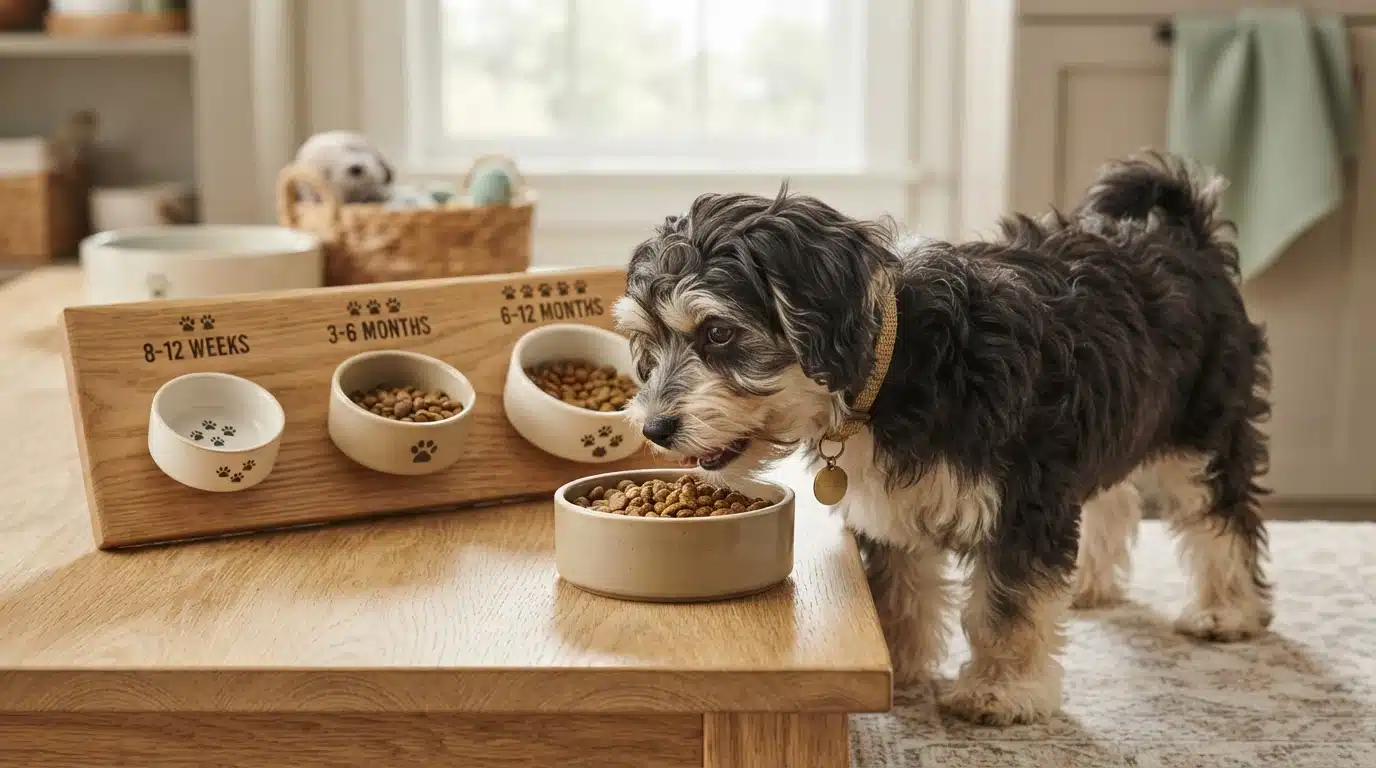
| 8 to 12 weeks | 4 | 1/4 to 1/3 | 30 to 40 | 400 to 500 |
| 3 to 4 months | 3 | 1/3 to 1/2 | 40 to 60 | 450 to 600 |
| 5 to 6 months | 2 | 1/2 to 2/3 | 60 to 80 | 500 to 650 |
| 6 to 12 months | 2 | 2/3 to 3/4 | 80 to 95 | 550 to 700 |
| 12 months and older | 2 | 1/2 to 2/3 | 60 to 80 | 400 to 550 |
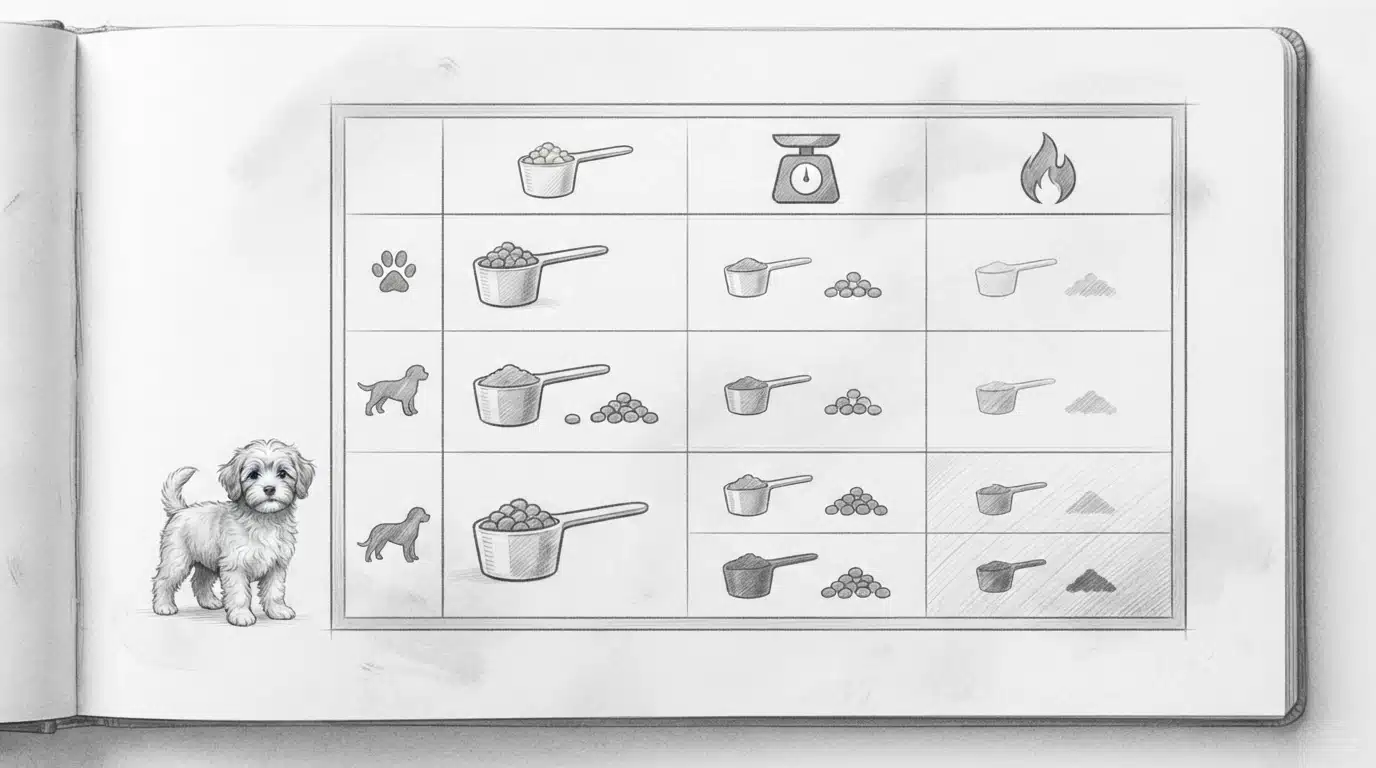
Use these ranges as a starting point, not a rule. A puppy food labeled for small breeds usually packs about 425 kcal ME per cup, so do the label math against your own bag.
8 to 12 Weeks: Four Small Meals a Day
Tiny stomachs fill up and empty quickly at this age. Split the daily amount into four equal meals, spaced about four hours apart. Expect roughly 1/4 to 1/3 cup per meal, or 30 to 40 grams. Keep the last meal early enough that your puppy settles overnight.
3 to 4 Months: Portions Grow, Meal Count Drops to Three
Growth speeds up here, so total food rises even as meals drop. Feed three meals a day, about 1/3 to 1/2 cup each, or 40 to 60 grams. This is also the window to shift meals onto a steady schedule that matches your household’s routine.
5 to 6 Months and 6 to 12 Months: Two Meals With Bigger Bowls
Most Havapoos settle into two meals a day around five months. Give roughly 1/2 to 2/3 cup per meal, then 2/3 to 3/4 cup as they near a year, or 60 to 95 grams per meal. Watch their waistline, not just the bag.
12 Months and Older: Moving Toward an Adult Portion
Growth slows after the first birthday, and calories drop with it. Step portions down toward 1/2 to 2/3 cup twice daily, around 400 to 550 calories total. Transition gradually over a week if you also switch to an adult formula, mixing new food in a little at a time. Food is one line item in your budget; our Havapoo puppy cost breakdown covers the rest.
Working Out the Cups, Grams, and Calories Your Puppy Needs
Use the Food Label, Not a Generic Chart
Every bag tells you exactly how rich its food is. Look for the calorie statement near the guaranteed analysis: calories per cup for dry food, per kilogram on some European-style labels. Start with your puppy’s daily calorie target from the age table above, then divide. Havapoo puppy portion sizes come out of that one calculation, not a generic breed chart.
A Worked Example With a Bag of Dry Food
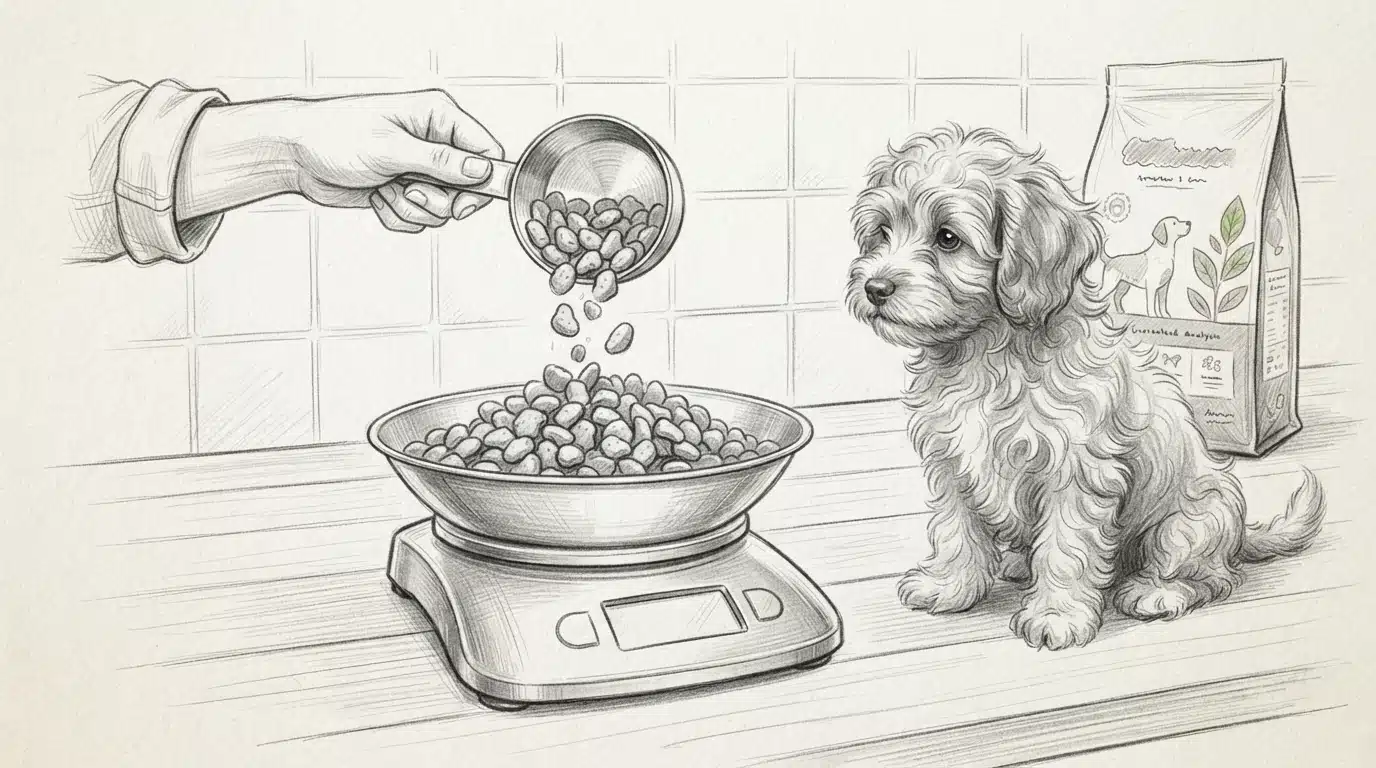
Say your four-month-old Havapoo needs about 500 calories a day, and your bag lists 425 kcal ME per cup, the standard AAFCO calorie format explained on AAFCO’s calorie content page.
- Divide 500 by 425. That gives about 1.2 cups per day.
- Split it across three meals, so roughly 0.4 cups each.
- Check grams if you prefer a scale: about 40 to 50 grams per meal.
Budget for food as an ongoing cost too; our Havapoo puppy cost breakdown covers what to expect beyond the first bag. If your label shows only calories per kilogram, divide by the grams-per-cup figure printed in the feeding chart, usually 100 to 120.
Wet, Fresh, and Topped-Up Meals
Wet food lists calories per can or per kilogram, not per cup, so weigh it. A 5.5-ounce can might hold 180 calories, which replaces nearly half a day’s dry ration. Mix the two by subtracting the wet calories first, then recalculate cups for the kibble that remains. Treat training treats as food, keeping them under ten percent of daily calories.
Meal Frequency and Feeding Windows for Each Age
How often you feed matters as much as how much. A Havapoo puppy’s meals per day drop as it grows, and small breeds need steadier timing than large dogs because their blood sugar runs low on long gaps. Feed four meals a day under four months, then taper down.
| Age | Meals per day | Example windows |
|---|---|---|
| 8 to 12 weeks | 4 | 7 a.m., 11 a.m., 3 p.m., 7 p.m. |
| 3 to 4 months | 3 | 7 a.m., 1 p.m., 7 p.m. |
| 5 to 6 months | 2 | 7 a.m., 6 p.m. |
| 6 to 12 months | 2 | 7 a.m., 6 p.m. |
How Meal Count Changes With Age
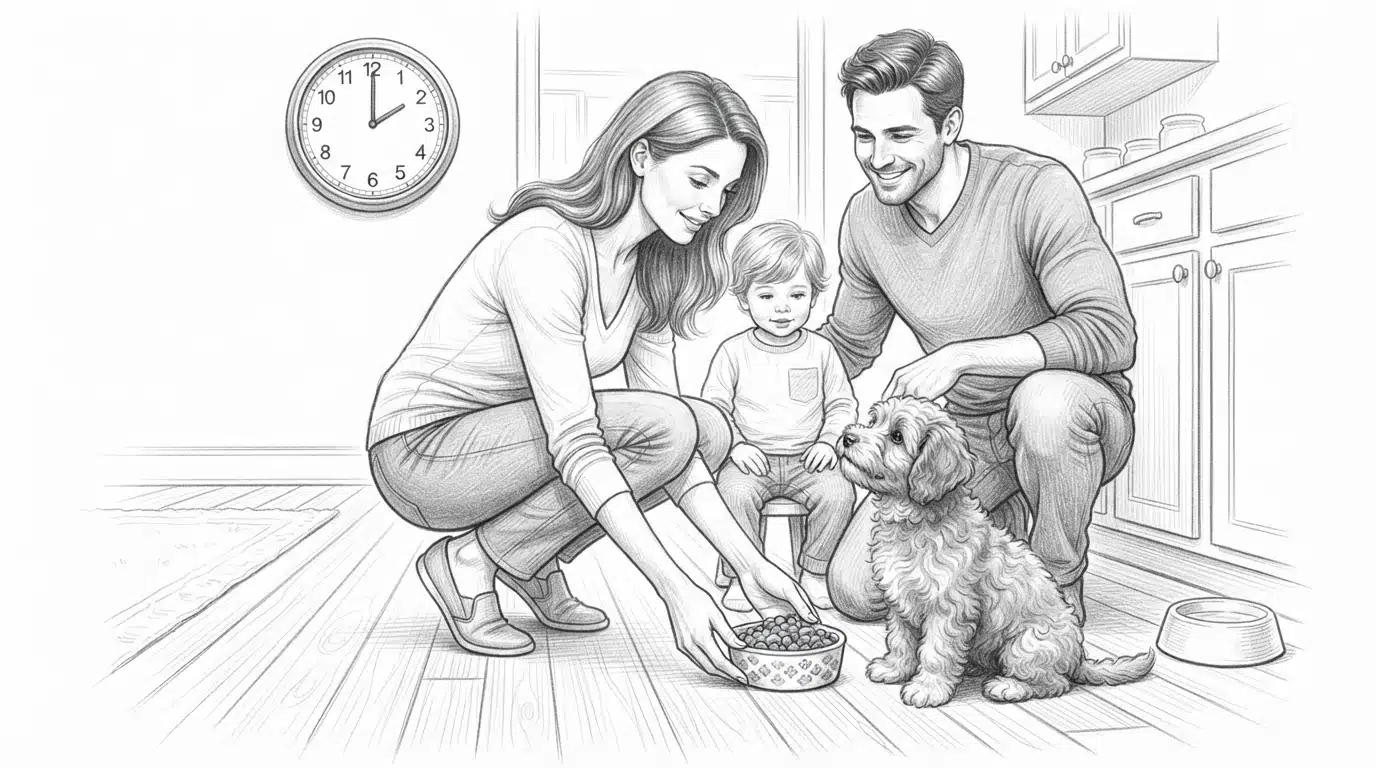
Start at four meals from 8 to 12 weeks, split that daily ration evenly. Drop to three meals at 3 to 4 months. At 5 to 6 months, move to two meals, which most adults keep for life. Time each drop over about a week so puppy food by age transitions feel easy, shifting one meal earlier or later each day.
Setting Windows That Fit Your Household
Space meals roughly four to five hours apart while your puppy eats four times a day. The last meal should land two to three hours before bedtime so digestion settles overnight and house training goes smoother. Pick windows you can hit daily, including weekends, because puppies do best on a rhythm. If work runs late, an automatic feeder or a midday dog walker keeps the schedule intact.
Adjusting Portions as Your Puppy Grows
The chart gives you a starting point, but your puppy decides the final number. Weigh, watch, and adjust. Here’s how to do both.
Weigh Weekly and Keep a Simple Growth Log
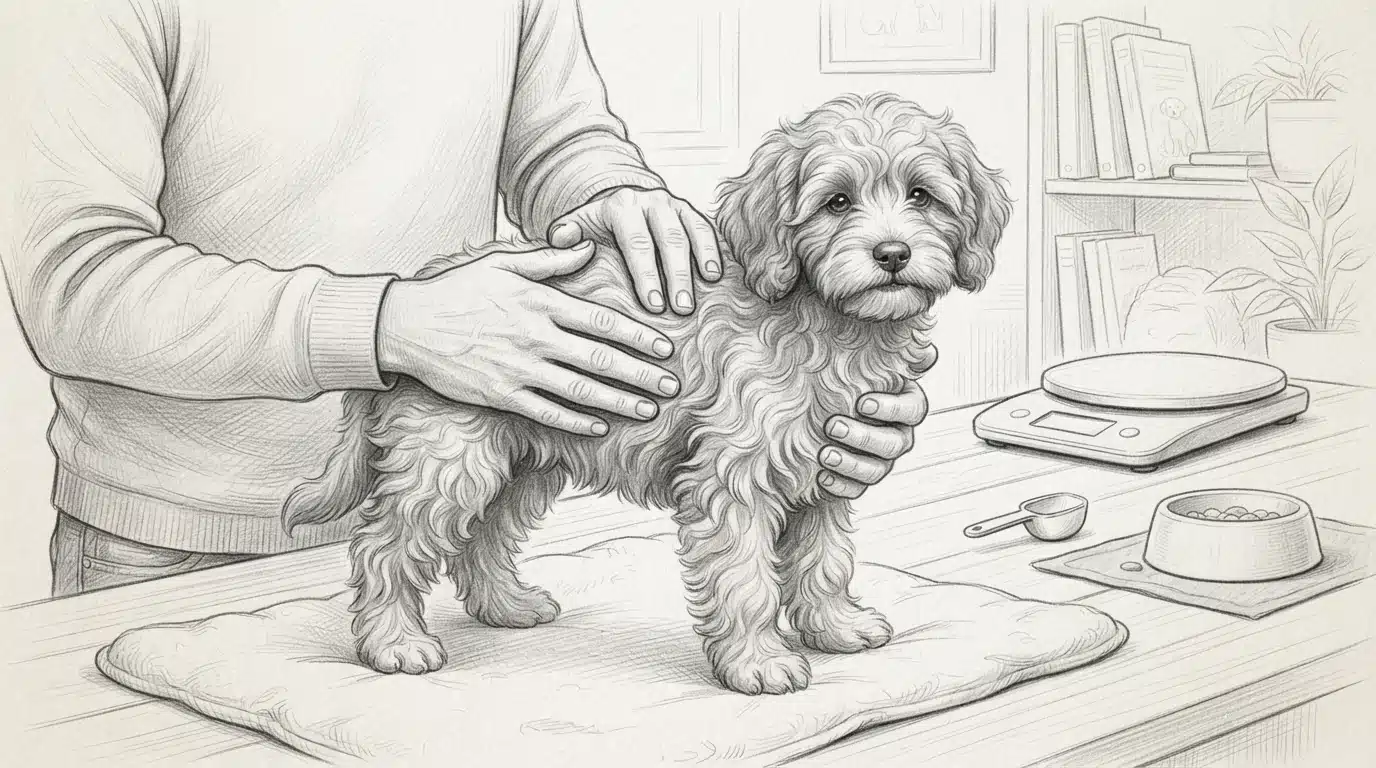
Put your puppy on a kitchen or bathroom scale once a week, always at the same time of day, and jot the number down. Small breeds grow fast between 8 and 12 weeks, then slow down after 6 months, so weekly numbers catch changes a monthly check misses. Aim for steady, gradual gain. A puppy that skips a week’s gain or jumps two ounces overnight is telling you the portions need a second look.
Check Body Condition, Not Just the Food Bowl
Weight alone doesn’t tell you if you’re feeding too much. How do I know if I am feeding my puppy too much? Run through this checklist:
- Ribs you can feel with light pressure, but not see
- A visible waist when you look from above
- A tucked belly when you view from the side
- Steady energy and firm stools
This is the body condition score vets use, usually on a 1-to-9 scale, with 4 to 5 as ideal. If ribs disappear under fat or the waist vanishes, cut portions back by about 10 percent.
When to Increase, Decrease, or Ask Your Vet
Increase food when ribs feel sharp and weight stalls for two weeks. Decrease when ribs can’t be felt or stools turn loose. Call your vet if appetite drops, weight falls off the curve, or loose stools last more than a day. For month-by-month expectations in the first year, our small breed puppy care schedule pairs well with this log.
Treats, Chews, and Training Rewards
The 10 Percent Rule for a Small Breed
Treats should never top 10 percent of your puppy’s daily calories, a limit the AKC also advises for growing dogs. A Havapoo eating 500 calories a day gets about 50 calories in rewards. That is small: one typical biscuit can run 20 to 30 calories, so count treats against the ration and trim meals slightly on heavy training days. Use tiny pea-sized pieces, and save soft training treats for short sessions so your puppy still finishes her meals.
Chews, Dental Sticks, and Toppers
Chews add up faster than you think. Many dental sticks carry 30 to 80 calories, nearly a tenth of a small puppy’s ration, so log them as part of the daily total. Skip rawhide for young puppies and pick soft or size-appropriate options instead. Gravy toppers and meal mixers deserve the same math: many add 20 or more calories per scoop. If your puppy gets a chew, cut the next meal by a matching amount, then keep checking her waistline.
Switching Foods Without Upsetting Your Puppy’s Stomach
When your Havapoo moves to a new food, switch slowly. A sudden swap often causes loose stools, gas or skipped meals. Follow these steps: keep the current food for about a week, then blend the new food in over seven to ten days, increasing the new portion every couple of days while you watch stool and appetite.
Keep the Breeder’s Food for the First Week
Ask which food your puppy eats before pickup day, and keep that brand for the first week at home. Sage Puppies sends each puppy home with a feeding card that names the current food and portion, so write it down before you leave. Travel, new people and new smells already stress a young puppy. Changing meals at the same time doubles the shock.
A Gradual Transition Over About a Week
Once your puppy has settled, blend the foods like this:
- Days 1 to 3: 75% old food, 25% new food
- Days 4 to 6: half of each
- Days 7 to 9: 25% old food, 75% new food
- Day 10: all new food
If stools turn soft, hold at the current mix for two extra days. Slower beats faster every time.
Common Portion Mistakes to Avoid
Free-Feeding a Puppy You Are Still Measuring
Leaving food down all day sounds easy, but it hides how much your Havapoo actually eats. A toy breed grows fast, so you need to know the daily total before you can adjust it. Fill the bowl at set meals with a simple first-year care routine, measure each scoop, and you will spot a growth spurt or a stall within a week.
Carrying the Largest Number on the Bag
Feeding charts list ranges for a reason. The top figure fits an active puppy at the high end of the weight range, not every pup. Start mid-range, weigh your puppy every two weeks, and move up or down based on what the scale and ribs tell you. If the chart only shows weight bands, do the calorie math with your own bag’s per-cup figure instead.
Treats, Chews, and “Just a Little Extra”
Training treats add up quickly in a small dog. A few 10-calorie biscuits can eat a fifth of a 500-calorie day before dinner is served. Keep treats under about 10 percent of daily calories, and count chews, dental sticks, and table scraps in that budget. Then reduce meal portions on heavy-treat days so the total stays level.

Feeding a tiny puppy the right amount removes a lot of first-week worry, and you now have the table to do it. If you’re still choosing your pup, Sage Puppies raises healthy Havapoos with honest guidance from day one. Browse available puppies, or apply to get matched with your perfect match.
Frequently Asked Questions
Q1: How much should I feed my Havapoo puppy at each age?
Start with the age table: about 1/4 to 1/3 cup four times daily at 8 to 12 weeks, rising to 2/3 to 3/4 cup twice a day near one year. Then adjust using weekly weigh-ins and your food’s calorie count.
Q2: How many cups of food should a Havapoo puppy eat per day?
Most Havapoo puppies eat about 1 to 1.3 cups daily while growing, split across three or four meals. Check your bag’s calories per cup, because richer foods need smaller scoops.
Q3: How much should a Havapoo puppy eat at 8 weeks, 3 months, and 6 months?
At 8 weeks, feed 1/4 to 1/3 cup four times daily. At 3 months, offer 1/3 to 1/2 cup three times a day. At 6 months, give 1/2 to 2/3 cup twice daily.
Q4: Should I free-feed my Havapoo puppy?
No. Measured meals show you the exact daily total, which makes growth checks and portion adjustments possible.
Q5: When should I switch my Havapoo to adult food?
Around 12 months, step portions down gradually and transition formulas over about a week to protect her stomach.
Conclusion
Feeding a Havapoo puppy comes down to three numbers: age, current weight, and your food’s calories per cup. Start with the age-banded portion table, split the daily total into the right number of meals, and keep the breeder’s food for the first week while you transition gradually. Then let weekly weigh-ins and rib checks fine-tune the amounts, and hold treats under 10 percent of daily calories. Generic charts miss small breeds, so trust your puppy’s body condition over the biggest number on the bag.