Quick Summary: Sage Puppies is a South Jordan breeder selling Havanese, Havapoo, and Cavapoo puppies for $3,500 to $4,500 with published parent health screening and local pickup, while Blue Star Pups is an Arizona rescue rehoming Australian Shepherds and Pointers for about $250 to $450. Choose Sage for a specific small-breed puppy and more predictable screening, or Blue Star for a lower-cost rescue dog and temperament information from foster homes. Compare complete veterinary and genetic records, verify OFA results by registration number, and account for first-year care costs either way.
Two names come up together in Utah puppy searches, and they are not the same kind of business. Sage Puppies is a boutique South Jordan breeder program, founded in 2025, raising Havanese, Havapoo and Cavapoo puppies for $3,500 to $4,500. Blue Star Pups is a 100% volunteer rescue near Sierra Vista, Arizona that rehomes Australian Shepherds and Pointers, with adoption fees of roughly $250 for adults and $300 to $450 for puppies under a year.
If your budget tops out at a $300 fee, Sage Puppies is not your option. If you want a small breed puppy with a written screening record, Blue Star Pups does not sell one. Most buyers compare names, prices and photos, and end up mixing a breeder with a rescue, or trusting a “health tested” badge without knowing which test ran, on which animal, or with what result. This guide sorts out breeds, pricing, health paperwork, contracts and delivery, then shows how to verify claims against current OFA CHIC requirements, so you pick the path that fits your budget and standards.
Sage Puppies vs Blue Star Pups at a Glance
| Sage Puppies | Blue Star Pups | |
|---|---|---|
| Breeds available | Havanese, Havapoo and Cavapoo only | Australian Shepherds of all sizes, including Mini Aussies, and Pointers |
| Organization type | Boutique breeder program, owner-managed, founded 2025 in South Jordan, Utah | 100% volunteer home-based rescue with a foster network, not a breeding program |
| Price | $3,500 to $4,500 per puppy | Adoption fees generally $250 for adults and $300 to $450 for puppies under one year |
| Health and veterinary records | Published parent screening records alongside each puppy’s exam and care history | Shots and spay or neuter performed by a licensed veterinarian, with no published genetic screening program for breeding stock |
| How you get your puppy | Application, reservation with contract terms, then pickup or coordinated delivery | Adoption application and adoption agreement, then in-person pickup with some foster dogs traveling to El Paso, Texas |
| Best for | Families seeking a small-breed companion puppy with documented screening and predictable size | Families open to adopting an Australian Shepherd or Pointer instead of purchasing a breed-specific litter |
How Sage Puppies and Blue Star Pups Compare
Sage Puppies
Sage Puppies is a boutique breeder program in South Jordan, Utah, founded by Cassie Milar in 2025. It raises Havanese, Havapoo and Cavapoo puppies for families who want a small companion with documented parent screening and a predictable size range.
Key strengths
- Published parent health screening records with each puppy’s exam history
- Clear application, contract and reservation process
- Local pickup or coordinated nationwide delivery
Blue Star Pups
Any honest Blue Star Pups review has to start with what it is: a 100% volunteer, home-based rescue near Sierra Vista, Arizona, not a breeder. It rehomes Australian Shepherds of all sizes and Pointers through adoption, which suits families open to a rescue dog rather than a planned litter.
Key strengths
- Adoption fees far below breeder pricing
- Vet-performed shots and spay or neuter before placement
- Foster homes in Arizona and El Paso let dogs settle first
What Is the Difference Between Sage Puppies and Blue Star Pups?
Sage Puppies is a boutique breeder program, while Blue Star Pups is a volunteer dog rescue. One breeds and raises planned litters of small companion puppies; the other rehomes surrendered and stray dogs through a foster network. They share part of a name, but almost nothing else.
Two Organizations Sharing One Name
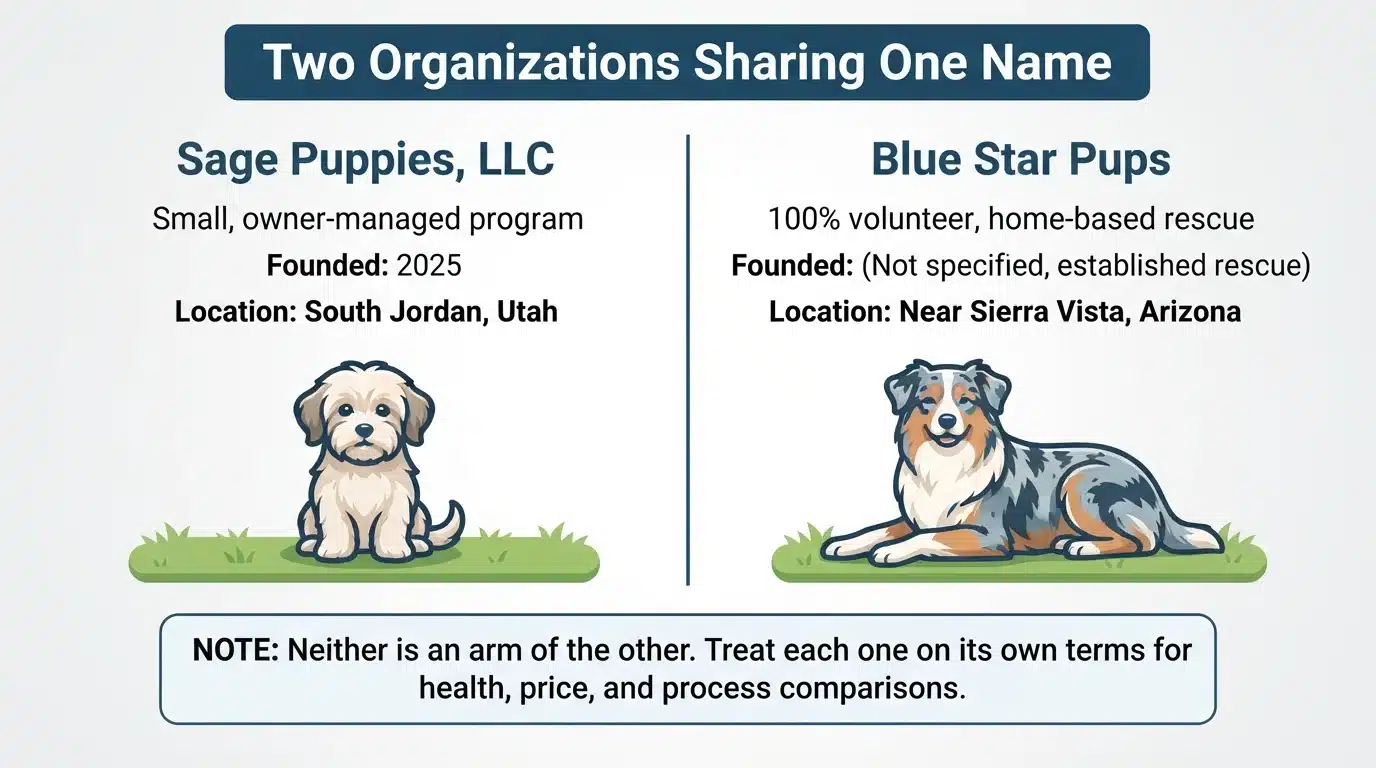
The similar names trip people up in search results. Sage Puppies, LLC is a small, owner-managed program in South Jordan, Utah, founded in 2025. Blue Star Pups is a 100% volunteer, home-based rescue near Sierra Vista, Arizona. Neither is an arm of the other, so treat each one on its own terms when you compare health paperwork, price, and process.
Hidden Costs Both Buyers Should Price In
The sticker price is only the start. Either way, budget for a first-year vet exam, food, a crate, gear, and training classes. Rescues may waive or include the spay or neuter, but an adult dog can come with unknown history, so factor in a possible behavioral consult. With a breeder puppy, the big early costs are usually planned ones.
| Cost Item | Breeder Puppy (Sage Puppies) | Rescue Adoption (Blue Star Pups) |
|---|---|---|
| Upfront price | $3,500 to $4,500 | $250 to $450 |
| Spay or neuter | Usually separate, later | Often included in fee |
| First-year vet, food, gear | Roughly $1,000 to $2,000 | Roughly $1,000 to $2,000 |
| Training | Standard puppy classes | Possible behavior support |
Whichever route you take, ask exactly what the fee includes before you commit.
Health Screening and Veterinary Records
Health paperwork tells you more than any website claim, so read it closely before you commit to either a breeder or a rescue. The catch is that not all health documents mean the same thing, and comparing them side by side can be confusing.
Three Different Kinds of Health Record
Ask for three separate sets of papers. First, the puppy’s own records: a vet exam, deworming history, and age-appropriate vaccinations. Second, the parent’s screening results, like OFA hip, patella, and eye evaluations. Third, DNA test results for inherited conditions. A puppy with clean shots but untested parents is not the same as a puppy from health-tested lines. Programs like Sage Puppies document parent screening; rescues typically share whatever history the foster home has gathered.
What Current Havanese Screening Standards Require
For a Havanese, the breed club’s CHIC requirements are clear. According to the Havanese Club of America, a Havanese needs OFA hips, OFA patellas, and annual CERF eye exams to earn a CHIC number, which the OFA issues once results are on file and the dog is permanently identified. For Havapoo or Cavapoo parents, ask about both breeds’ standards. You can find what questions to ask about health-tested puppy parents before you buy.
Questions to Ask Either Program
- Can I see the parents’ OFA results by registration number?
- What DNA tests did the parents receive?
- What does the puppy’s vet record cover so far?
- If rescued, what medical history exists?
Breeds, Size and Household Fit
The right dog starts with the right breed and the right size for your life. Blue Star Pups rehomes Australian Shepherds and Pointers, while Sage Puppies raises three small companion breeds. That single difference shapes almost everything else in this comparison.
Small Companion Breeds Versus Working Breeds
Small companion breeds like the Havanese, Havapoo and Cavapoo were bred to keep people company. Most adults weigh under 20 pounds, which makes them easier to carry, travel with and fit into an apartment. They still need daily play and training, but their exercise demands stay modest.
Australian Shepherds and Pointers are working breeds. They were bred to run, herd and hunt, so they need far more exercise and mental work each day. A bored Aussie or Pointer can dig, chew and bark. These breeds suit active homes with yards and time, not busy families who want a lap dog. If that trade-off interests you, Sage Puppies’ breed comparison guide breaks down how Havanese, Havapoo and Cavapoo differ.

Matching a Dog to Your Home
Start with three honest questions. How much space do you have, and does your lease or HOA limit dog size? How many hours a day can you give to walks and play? And do you prefer a puppy you raise from eight weeks, or an adult dog with a known history?
Rescue dogs from Blue Star Pups come with foster-home observations of their temperament. A puppy’s personality is still forming, so the match depends more on the breed’s general traits and the parents. Either way, an honest answer about your lifestyle matters more than breed labels. A calm home with a small yard suits a companion breed; a hiking family may thrive with a rescue Aussie.
Application, Contract and Payment Process
The paperwork tells you more about a program than its website ever will. Whether you are applying to a breeder like Sage Puppies or filling out an adoption application with Blue Star Pups, read every document before money moves.
What to Read Before You Pay
Ask for three things in writing: the application, the contract, and the deposit terms. A good application screens you, not just your wallet, so expect questions about your home, work schedule and experience. The contract should name both parties, state the purchase price or adoption fee, and spell out spay or neuter expectations, return policy and what happens if a health issue appears. Read the refund rules carefully. Reputable programs never demand wire transfers, gift cards or payment apps like Zelle for a deposit, because those methods offer no buyer protection. Get every promise in writing and keep copies of what you sign and pay.

Signals of a Legitimate Program
Legitimate programs share a few habits. They answer questions slowly and completely, welcome a video call to meet the puppy and its parents, and never pressure you to pay same-day. You should be able to see where the puppy lives, meet the mother dog, and receive health records and vaccination records with the puppy. Vague answers about location, refusal to video chat, or prices that drop if you pay today are classic puppy scam warning signs. Sage Puppies runs an owner-managed application process for this reason. Trust the program that asks about your family first.
Pickup and Delivery for Utah Families
You can bring a Blue Star Pups dog home to Utah, but not usually in one trip. The rescue’s dogs live in foster homes around Sierra Vista, Arizona, so Utah families plan a drive of roughly 500 miles or coordinate cross-state transport with the foster team. Pickup dates depend on the foster’s schedule, not a set calendar.
Local Pickup Advantages
Meeting a breeder on their own turf tells you a lot. You see where the puppies live, meet the mother and ask questions on the spot. Sage Puppies families in Utah pick up in South Jordan, which keeps the first car ride short and calm for an eight-week-old puppy. A short trip also lowers the risk of motion sickness and stress in the first days home.
Transporting a Puppy Safely
Cross-state transport needs planning, not improvisation. Before a long drive, ask the rescue or breeder how they handle rest stops, food timing and temperature. Blue Star Pups volunteers coordinate transport case by case, so confirm the details in writing before you commit. On the road, a crash-tested carrier or harness clip is the safe setup for a puppy, never a loose lap or an improvised restraint. Plan a stop every two to three hours for water and a short walk.
Never leave a puppy alone in a parked car, even briefly. Cabin temperatures climb fast, and small breeds overheat sooner than adults.
Which Should You Choose: Sage Puppies or Blue Star Pups?
The honest answer depends on what you want the experience to be. One is a breeder program selling purpose-raised puppies. The other is a rescue rehoming dogs that need a second chance. Neither is better in the abstract; each fits a different family.
Choose Sage Puppies If
Pick the breeder route when you want a specific breed from day one. If a Havanese, Havapoo or Cavapoo is the dog you have researched and planned around, waiting for a planned litter makes sense. You also get predictability: known parent health testing, early socialization in a home setting, and a breeder you can call with questions as your puppy grows. Families who prefer local pickup in Utah will find the short drive far easier than a cross-state trip. The trade-off is cost, since puppies run $3,500 to $4,500.
Choose Blue Star Pups If
Pick the rescue route when breed matters less than the match itself. Blue Star Pups rehomes Australian Shepherds and Pointers, so you choose a dog already grown, with its temperament on display in a foster home. Adoption fees of roughly $250 to $450 are a fraction of breeder pricing, and giving a dog a fresh start carries its own reward. Be ready for less predictability, though. You may wait for the right dog, handle a drive near Sierra Vista, Arizona or transport, and accept whatever history the dog brings.
Whichever path you pick, ask for complete health records before you commit.

Ready to meet a puppy raised in a real home, with health testing behind every pairing? Browse available Havanese, Havapoo and Cavapoo puppies at Sage Puppies, then submit your application to start the matching process with Cassie’s South Jordan program.
Frequently Asked Questions
Q1: What is the difference between Sage Puppies and Blue Star Pups?
Sage Puppies is a boutique breeder raising Havanese, Havapoo and Cavapoo puppies; Blue Star Pups is a volunteer rescue rehoming Australian Shepherds and Pointers. One sells planned litters, the other places rescued dogs.
Q2: How much do Sage Puppies charge for a Havanese, Havapoo or Cavapoo puppy?
Sage Puppies charges $3,500 to $4,500 per puppy. Blue Star Pups price their adoption fees far lower, roughly $250 to $450, but those fees cover vet care and foster costs, not purpose-raised litters.
Q3: How do Sage Puppies and Blue Star Pups differ in raising, screening and delivering puppies?
Sage Puppies raises puppies from birth with documented parent screening and offers Utah pickup or coordinated delivery. Blue Star Pups relies on foster homes, shares each dog’s known history, and arranges case-by-case transport.
Q4: Is Blue Star Pups a breeder or a rescue?
Blue Star Pups is a 100% volunteer, home-based rescue near Sierra Vista, Arizona. It does not breed dogs or publish genetic screening for breeding stock.
Q5: Which program offers better health records?
Sage Puppies publishes parent OFA and DNA screening alongside each puppy’s exam history. Blue Star Pups provides vet-performed shots and spay or neuter records, but no breeding-stock testing.
Q6: Do rescues charge lower fees because they spend less per dog?
Not necessarily. Adoption fees offset vet visits, surgery and foster care, while breeder pricing covers health testing and weeks of raising. The numbers buy different things.
Conclusion
The Sage Puppies vs Blue Star Pups choice comes down to purpose. Sage Puppies is a boutique breeder program in South Jordan, Utah, raising Havanese, Havapoo and Cavapoo puppies for $3,500 to $4,500 with documented parent screening. Blue Star Pups is a volunteer rescue rehoming Australian Shepherds and Pointers for roughly $250 to $450. One sells planned litters from health-tested parents; the other gives rescued dogs a second chance. Compare the two on health paperwork, not price alone, and verify OFA results by registration number before you commit. Pick the breeder when breed and predictability matter most, and the rescue when the match matters more than the breed label.