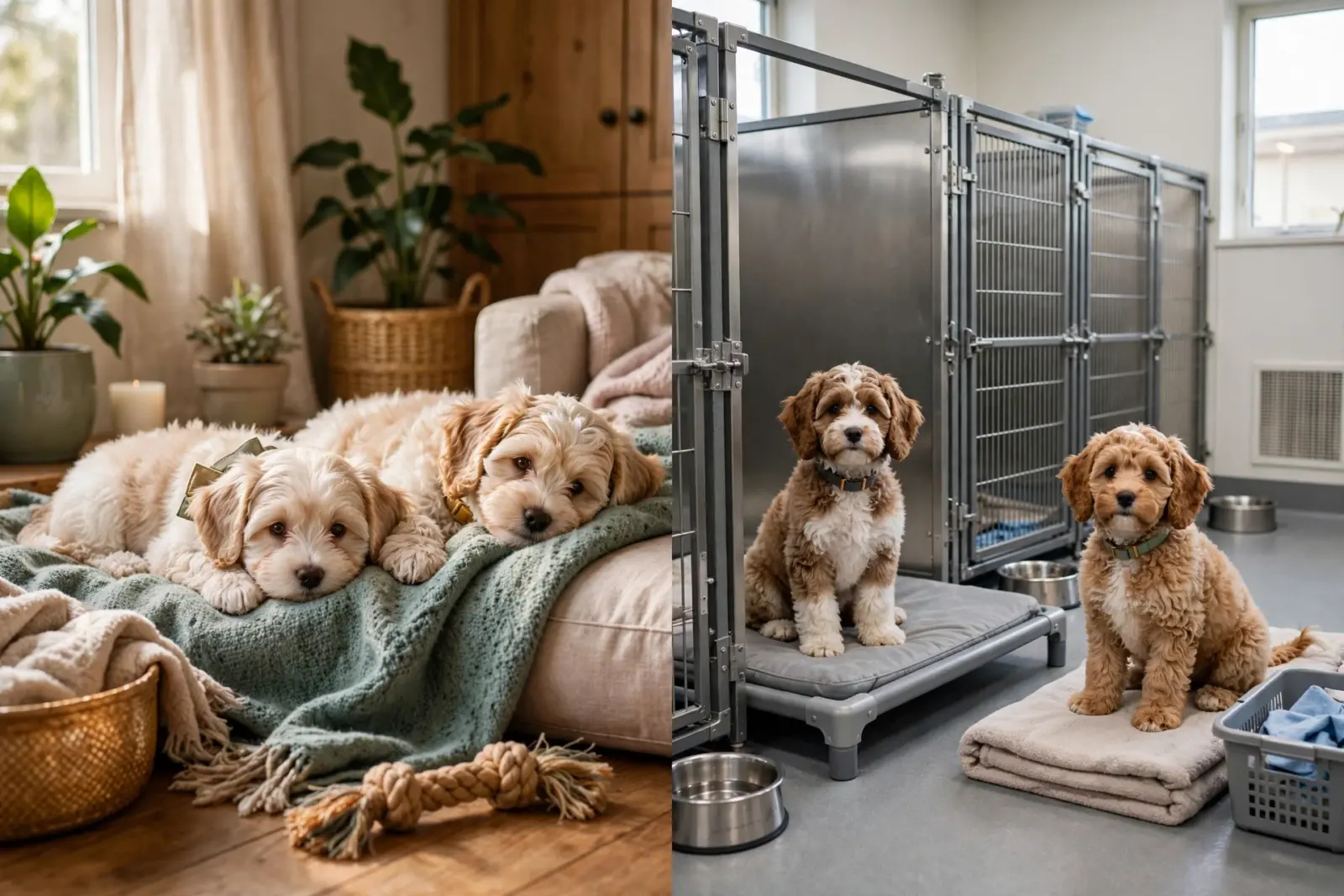
Quick Summary: The real difference between a reputable breeder and a high-volume kennel is not the building, but the volume, records, and accountability. Before paying, verify the parents’ OFA and DNA results, check daily handling and housing, review health and lifetime return terms, and request a visit or video walkthrough. Small programs such as Sage Puppies typically keep litters limited, share health records, and provide direct support, while licensed kennels can still be sound choices when they show proof and pass inspections.
Two puppies can look identical in a photo, wear the same collar, and cost about the same, yet come from different worlds. One grew up in a home with people, other dogs, and a kitchen. The other grew up in a row of runs on a volume schedule. The puppy looks the same. The system behind it does not.
The trouble is that searching for a reputable breeder near me blends small home programs, professional kennels, and large commercial operations under one word. Phrases like family raised or guaranteed sound official but prove nothing, so the reputable breeder vs kennel breeder question gets settled by price and photos instead of records.
This comparison runs both models through the same checkpoints: health screening, housing and socialization, contracts, price and volume, and a verification routine you can use on any breeder, including Utah programs shipping nationwide.
Reputable Breeder vs Kennel Breeder at a Glance
| Reputable breeder | Kennel breeder | |
|---|---|---|
| Health testing and records | Parent screening and puppy exam records shared in writing, with actual results, dates and methods | Varies widely, with parents often screened rarely or not at all and individual records hard to obtain |
| Where the puppy lives | Typically raised in a home or a clean, well-kept home-based setting, with the dam on site | Outdoor or facility housing in runs and kennels, with limited household exposure for puppies |
| How you meet the puppy | Home or kennel visits by appointment, video walkthroughs, and a chance to see the dam and litter | Rarely offered, with contact usually limited to video, photos and shipping paperwork |
| Contract and paperwork | Written contract with health terms, plus vaccine and exam records for the puppy you are buying | Often minimal or delivered electronically at checkout, with terms that are hard to read before payment |
| Price and availability | Higher per-puppy price, limited litters, and waitlists when demand exceeds supply | Lower price and constant availability across many breeds and litters |
| Support after go-home | Direct contact with the breeder or program for setup, feeding, training and health questions | Limited, with most questions handled by generic customer service rather than the breeder |
How Reputable breeder and Kennel breeder Compare
Reputable breeder
A reputable breeder runs a small or boutique program with a limited number of litters each year. It publishes parent screening and health records in writing and manages every placement personally, from application through go-home and beyond. This model suits buyers who value transparency, waitlists and direct breeder support over fast availability.
Key strengths
- Written parent screening and puppy exam records with actual results and dates
- Puppies raised in a home setting with the dam on site
- Visits, video walkthroughs and a chance to meet the litter
- Clear contract, health terms and ongoing breeder contact
Kennel breeder
A kennel breeder is a high-volume commercial operation that produces litters on a schedule, often across many breeds. Puppies are usually housed in facility runs and sold through online listings and shipping, with little in-person contact. This model suits buyers prioritizing price and immediate availability, though records and after-sale support vary widely.
Key strengths
- Lower per-puppy price and constant availability
- Wide breed selection across many litters
- Shipping and delivery options for out-of-state buyers
What Counts as a Kennel Breeder, and Why the Label Misleads
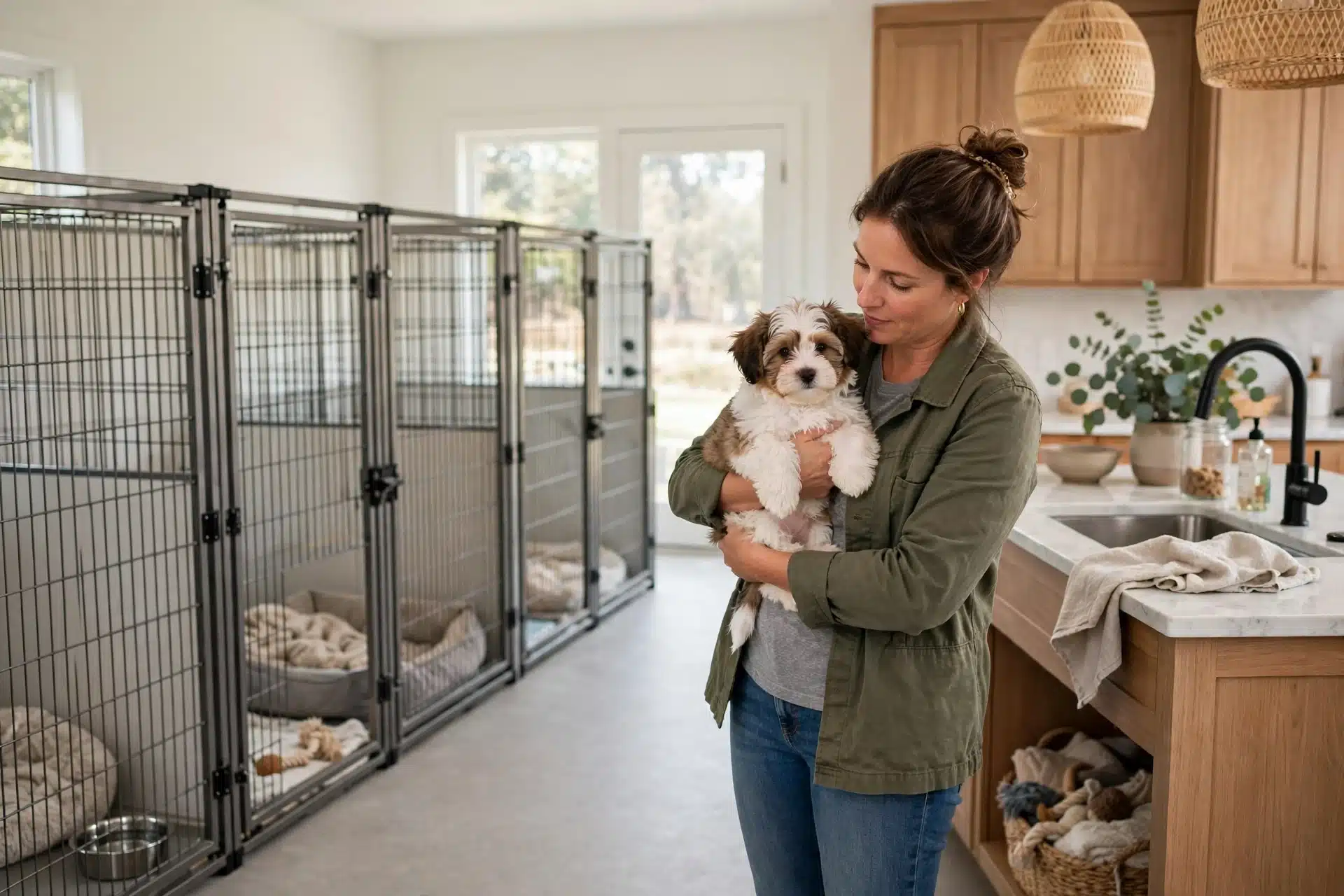
Kennel is a location, not a verdict
The word “kennel” describes where dogs live, not how well they’re bred. A purpose-built kennel can be clean, heated, and staffed by people who test every parent and raise confident puppies. Some excellent breeders keep kennels because state rules or insurance require separate housing. Conversely, a puppy raised in someone’s kitchen isn’t automatically well bred. “Home raised” says nothing about health testing, contracts, or screening of buyers. Judge the program, not the building. What matters is the paperwork behind the puppy, from parent health clearances to the terms of sale. Anyone selling puppies owes you that evidence, whether the dogs sleep in a kennel run or on a couch.
Volume is the tell
What actually separates a high-volume kennel operation from a boutique breeder is how many litters move through the program each year. Volume shows up in patterns: multiple breeds and dozens of litters listed at once, puppies always “available now,” and little time for your questions. A breeder producing litter after litter cannot give each dam the recovery time or each puppy the daily handling that early socialization requires. Breeders who focus on one or two breeds and a few litters a year can name every puppy, track every home, and answer for every dog they’ve produced. That accountability, more than any building, is what you’re buying.
Health Testing and the Records You Can Actually Check
A breeder’s word is not a record. Here is how to verify health testing in five steps:
- Ask for the dam and sire’s registered names.
- Search those names in the public OFA database at ofa.org.
- Confirm results for eyes, patellas, hips and cardiac.
- Compare the results against the breed’s required tests, such as the Havanese CHIC requirements: OFA hips, patellas and an annual eye exam.
- Ask for the DNA panel results and match them to each parent.
Three record types, three different meanings
Keep these documents separate, because each proves something different:
- Puppy exam record. A vet checked the pup once. It shows healthy ears, eyes and heart that day, nothing about inherited risk.
- Parent screening results. OFA clearances on the dam and sire, listed publicly with dates, show the parents were actually tested.
- DNA variant results. Genetic panels reveal whether each parent carries specific disease variants, which predicts what a litter can inherit.
A clean puppy check with no parent results tells you the litter looks healthy now. It says nothing about how the breeding was planned.
How to look up a breeder’s claims yourself
This takes about ten minutes. Enter each parent’s registered name in the OFA CHIC database, then check that required tests are current, not years old. If a listing says “health tested” but gives no registry numbers, ask for them before sending a deposit. Good breeders hand these over easily; many, including Sage Puppies, walk applicants through parent records during the matching process. Reading genetic results gets easier with practice, and our guide to reading genetic test results shows what each notation means.
Where the Puppy Lives and How It Learns the World
Short answer: neither setting is automatically better; what matters is how much handling, exposure and structure the puppy gets. A home-raised puppy usually meets household noise, children and car rides early. A kennel-raised puppy can do just as well if the kennel runs a real enrichment program and moves puppies out by eight to ten weeks.
What a home environment actually provides
A home-raised puppy lives in the middle of daily life. Vacuum cleaners, doorbells, dropped pans and visiting kids become normal background instead of scary surprises. The puppy gets held often, and a good breeder follows simple early socialization steps like new surfaces, gentle handling of paws and ears, and short solo moments to build confidence.
The trade-off is variety. One home can only offer so many people, dogs and settings, so ask how the breeder adds exposure: car rides, different rooms, visitors, time outside. For example, a home program raising a Havanese or Cavapoo litter in a family kitchen can produce a well-rounded puppy, but only when that exposure is planned, not accidental.
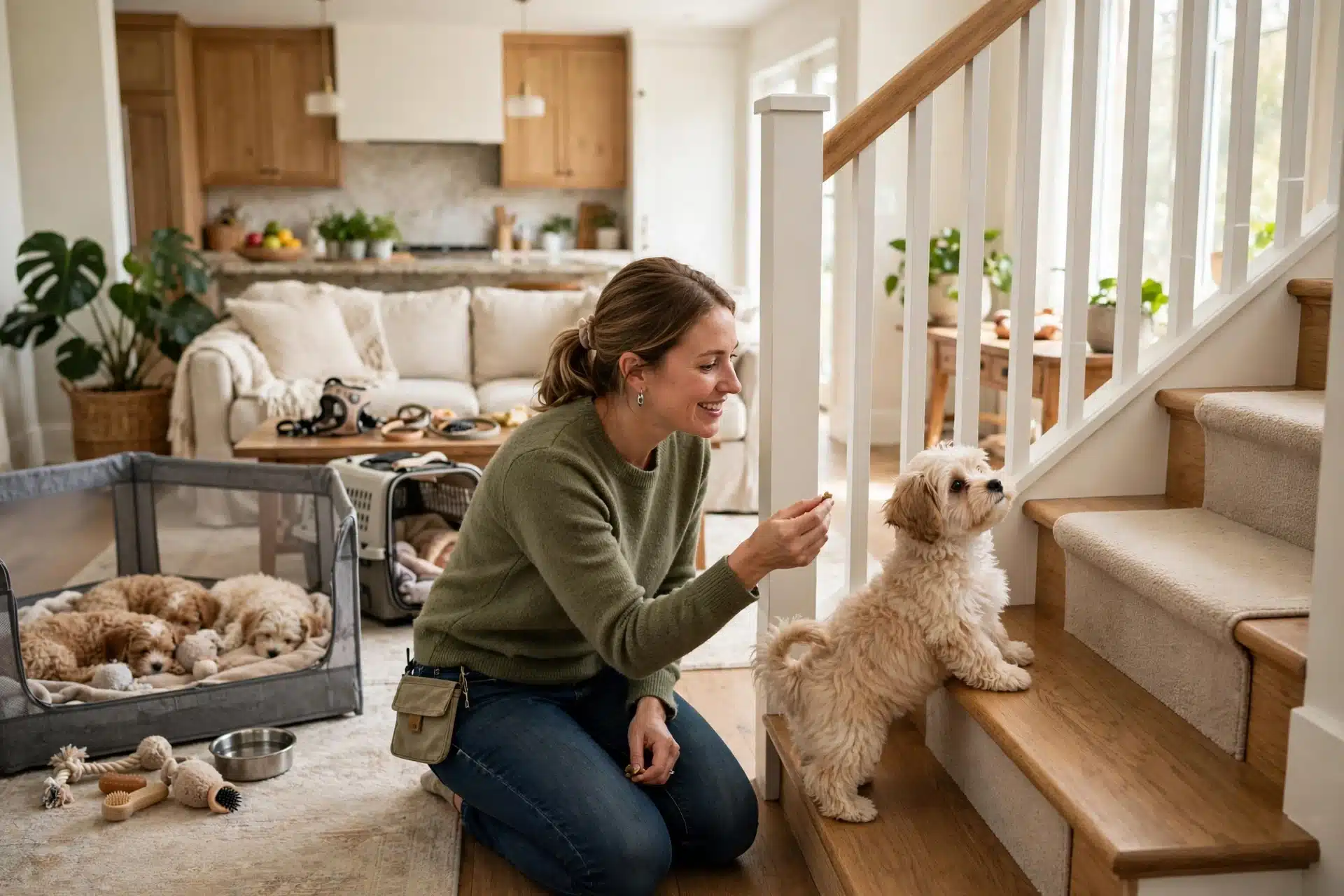
What to look for in a kennel environment
A well-run kennel is not a red flag by itself. Look for clean, dry, temperature-controlled housing with room to play, bedding, and toys rotated so puppies keep learning. Puppies should see new people regularly and be handled daily, not just cleaned around.
Ask these questions on your visit or video call:
- How many litters live here now, and how many adults?
- Who handles the puppies, and how often?
- What do puppies experience before they leave: crates, car rides, grass, stairs?
- Can I see exactly where the puppies sleep and play?
Volume is the real signal. Many litters at once with little individual handling points toward a puppy-mill setup, whatever the website says. Red flags like refusing a tour or meeting only “halfway” deserve the same scrutiny you give health records; our guide to spotting an unreliable puppy breeder walks through them.
The Paper Trail: Contracts, Deposits, and What You Sign
A written agreement is where an operating model shows itself. Before any money moves, look for these in a puppy purchase contract:
- Health terms: what exam records and parent testing are promised, in writing
- Return clause: the breeder takes the dog back, at any age, for any reason
- Deposit terms: amount, what it holds, and when it is refundable
- Spay/neuter or limited registration, if required, and any conditions
- Total price: what is included, and what travel or fees cost extra

Clauses worth reading before you pay
The health clause matters most, so read it closely. A strong contract states which records you receive at pickup, such as a recent vet exam, and which parent screenings apply. Keep parent OFA and DNA results separate from the puppy’s own exam; one does not prove the other.
The return clause is the clearest honesty test. Kennel operations often skip it or bury conditions in it. A responsible breeder commits, in writing, to take the dog back for life, no questions about your circumstances.
Also check what the contract requires of you. Some agreements restrict feeding, training methods, or vaccines in ways that conflict with your vet’s advice. Read every obligation before you sign, not after.
How payment and refund practices differ
Deposits usually range from a few hundred dollars to half the purchase price. What matters more is the paper behind it: you should get a dated written confirmation naming the puppy or position, the amount paid, and the refund terms. That is exactly how a clear deposit and refund policy should read, and any breeder who cannot produce one is asking you to accept risk they have not defined.
Kennel operations often push full payment early or take deposits before you have seen health records. Treat any pressure to pay fast, especially by gift card or wire, as a scam signal.
Price, Availability, and What the Number Is Telling You
What price really measures
Reputable breeders charge more because the price reflects real costs, not profit padding. Health testing, genetic screening, prenatal and neonatal vet care, quality food, and socialization add up long before a puppy goes home. Breeders who test every parent often spend $800 or more per dog on OFA and DNA work alone, so an $800 puppy rarely covers that bill.
Here’s an illustrative example: a $3,500 Havanese from a breeder who paid $800 to screen each parent, $1,200 in litter vet care, and hundreds more on supplies is roughly breaking even. A kennel selling littermates at $600 has none of those costs, because it skipped them. Bailey Mountain Doodles explains this plainly: higher prices fund testing, care, and lifelong support. Ask any breeder to itemize what the number includes, then match it against records.

Availability as a signal
Scarcity tells you as much as price. A reputable program breeds one or two litters a year, so you’ll likely wait months and join a list. That wait is the point: the breeder is matching puppies to homes, not pushing inventory.
Puppies available immediately, in every color, every week? That’s a volume operation, and high output usually means shortcuts in screening and socialization. A long waitlist with an owner-run application is a good sign; pressure to pay a deposit today is not. Boutique programs like Sage Puppies keep litters small on purpose, so expect a wait and treat it as proof the program is doing things right.
Vetting Either One: A Verification Routine You Can Run This Week
The model matters less than the proof behind it. A small home program and a larger kennel can both raise healthy puppies, and both can hide problems. Run the same checks on either one before you send money.
The five questions to ask before you deposit
- Can I see the parents’ OFA results and CHIC number? Havanese need OFA hips, patellas and eye exams for CHIC, so ask for the parents’ registered names and look them up yourself.
- What DNA tests were done, and on which variants? Puppy exam records are not the same as parent screening.
- Where do the puppies live, and who handles them daily?
- What does your contract say about returns and health terms? Get it in writing before the deposit.
- May I visit, or video call if I am out of state? A refusal to show you anything is the loudest red flag of all.
Write the answers down. A breeder who resents basic questions is telling you something.
Where to search when you want a reputable breeder near me
Skip the marketplace listings and start with the breed’s parent club. The Havanese Club of America requires annual health testing with current OFA CHIC certifications for breeders on its list, which makes it a strong filter for Havanese families. For Havapoo or Cavapoo puppies, ask each club or local vet for referrals instead of trusting a classified ad. Sage Puppies, a small program in South Jordan, Utah, serves Utah families for pickup and ships nationwide, and it follows this same paper trail. Whoever you choose, verify, then visit.
Which Should You Choose: Reputable Breeder or Kennel Breeder?
Most families are better off with a reputable breeder. You get tested parents, documented vet care, and a person who answers your questions a year later. That said, the kennel model is not always wrong.
When a kennel breeder may still make sense
A licensed, inspected kennel can be a fair choice if you have done the homework. Some states require commercial breeders to meet housing and vet care standards and pass inspections. If you cannot find a small program for the breed you want, and the kennel shows you its license, health records, and parent dogs, you can buy with open eyes. Just ask the same questions you would ask anyone else, and walk away if the answers get vague.
What a reputable breeder looks like in practice
A reputable breeder raises puppies in the home, keeps litters small, and screens every parent for known health issues before breeding. You should see OFA or eye exam results, DNA variant testing, and a written contract that covers returns. Expect an application, a waiting list, and questions about your household. Breeders who do this work charge more, because the screening and vet care cost real money. Small programs like Sage Puppies fit this model: Havanese, Havapoo, and Cavapoo puppies matched by the owner, not picked off a shelf.

You now know what separates a transparent breeder from a high-volume kennel. Put that checklist to work on any program you’re considering, including ours. Visit Sage Puppies to see our application, health records, and available Havanese, Havapoo, and Cavapoo puppies. Wisely Bred. Beautifully Loved.
Frequently Asked Questions
Q1: What are the key differences between a reputable breeder and a kennel breeder?
A reputable breeder runs few litters, shares parent OFA and DNA results in writing, and supports you after go-home. A kennel breeder produces many litters on a schedule, with lower prices, constant availability and thinner records.
Q2: How do I find a reputable breeder near me?
Skip classified ads. Start with the breed’s parent club, like the Havanese Club of America breeder list, or ask your vet for referrals. Then verify each program’s health records yourself before paying anything.
Q3: Are kennel-raised puppies always unhealthy?
No. A clean, licensed kennel with daily handling and an enrichment plan can raise confident puppies. The warning signs are volume, missing records, and refusals to let you see where puppies live.
Q4: What health records should a breeder give me?
Three things: your puppy’s vet exam record, the parents’ OFA screening results, and DNA panel results for each parent. Ask for registry names so you can confirm everything yourself at ofa.org.
Q5: How much should a Havanese, Havapoo, or Cavapoo puppy cost?
Expect roughly $3,500 to $4,500 from a small program that screens every parent. That reflects testing, vet care and socialization. A $600 puppy usually means those steps were skipped.
Q6: What contract terms matter most before I pay a deposit?
Read the health terms, the lifetime return clause, and refund rules in writing. A dated confirmation naming your puppy or list position protects both sides, and a breeder who resists providing one is a red flag.
Conclusion
A reputable breeder and a kennel breeder differ less in buildings than in volume, records, and accountability. Small programs keep few litters, share parent OFA and DNA results in writing, and answer for every dog they place. High-volume kennels offer lower prices and instant availability, but thinner paper trails. Kennel is not a dirty word; volume and missing evidence are the real red flags. Before any deposit, ask five things: parent health results, DNA variants, daily handling, contract terms, and a visit. Run this routine on any breeder, Utah or nationwide, whether they raise Havanese, Havapoo, or Cavapoo puppies. Verify first, then fall in love with the puppy.