Quick Summary: Vet records and lab reports prove different things, so buyers need both before paying a deposit. Vet records confirm the puppy’s exams, vaccines, deworming, and current health, while genetic panels and OFA or CHIC entries show which inherited risks each parent was screened for. Verify documents tied to named dogs, check each result against breed-specific requirements, and have your own vet review the paperwork before committing.
Two breeders can hand you two folders on the same day, and both can honestly say their puppies are health tested. One folder holds a signed vet exam and vaccine record for the puppy in front of you. The other holds a printed DNA panel for a parent dog. Only one says anything about that puppy, and neither covers everything, so your first question should be simple: which is this?
Families searching for health tested puppies for sale near me often compare marketing claims instead of documents. Vet records and lab reports get mixed in one folder, tested starts to sound like guaranteed healthy, and the sale moves faster than the paperwork can be read.
This guide compares health tested puppies vet records vs lab reports line by line, shows what each can prove, and walks through verifying parent screening before a deposit changes hands.
Vet Records vs Lab Reports: What Each One Actually Proves
| Breeder Vet Records | Genetic and Clinical Lab Reports | |
|---|---|---|
| What it documents | The individual puppy’s exams, vaccines, deworming, weight notes, and treatments | Parent health screening: DNA variants and clinical exams of hips, knees, eyes, heart |
| Who issues it | A licensed veterinary practice, signed and stamped by a veterinarian | Testing laboratories, veterinary specialists, and registries such as OFA |
| What it proves | The puppy was examined and cared for, and what was found at that time | That specific tests were performed on a named parent, and what those results were |
| What it cannot prove | How the parents were bred, or which conditions will appear later | That the puppy is disease-free, or that untested conditions are absent |
| How to verify it | Ask for copies, confirm the practice name, and have your own vet review it | Search the parent’s registered name in the public database, then read each individual result |
| Best for answering | Is this specific puppy healthy and protected right now? | What risk did the breeder screen out before breeding this litter? |
How Breeder Vet Records and Genetic and Clinical Lab Reports Compare
If you are reading health tested puppies vet records vs lab reports for the first time, it helps to know these are two different documents that answer two different questions.
Breeder Vet Records
This is the puppy’s own medical file: wellness exams, growth notes, the core vaccine series, the deworming schedule, and any treatment before pickup or delivery. A licensed veterinary practice signs and stamps it. It proves this specific puppy was examined and cared for, but not how the parents were bred.
Genetic and Clinical Lab Reports
These are parent screening documents: DNA variant panels plus clinical certificates for hips, patellas, eyes, and heart, often recorded in public registries like OFA. They show which risks a breeder screened out before breeding the litter, though they cannot promise the puppy is disease-free.
Why Vet Records and Lab Reports Get Confused
Both documents describe “health,” but they answer different questions. Vet records show a licensed veterinarian examined a puppy or its parents on a given day: heart, knees, eyes, ears, teeth, and weight looked normal at that visit. Lab reports come from genetic testing companies or orthopedic registries, and they reveal DNA and structure that no physical exam can see. When a breeder hands you a folder, vet records vs lab reports is the first distinction to sort out, because each proves something the other cannot.
- Vet records: a snapshot of one animal on one day
- Lab reports: DNA results and registry evaluations that follow a bloodline
Three layers hide inside the phrase “health-tested,” and buyers who miss one of them pay deposits on thin proof.
Three layers hiding inside the phrase health-tested
Layer one is the puppy’s own exam. A vet check before go-home day confirms the puppy you take home is currently healthy, and it comes with vaccination records and a deworming schedule. Layer two is parent screening: the mother and father have eye, heart, and orthopedic screening for hips and patellas, often logged with OFA or the CHIC database. Layer three is a genetic health panel on the parents, showing which disease variants each carries. A puppy from “health-tested” parents may have all three, two, or just one. Breeders who can show all three layers for a Havanese, Havapoo, or Cavapoo pairing stand apart from listings that use the word loosely, and the details on what genetic results to ask for make the difference visible.
The question that unlocks a clear answer
Ask one question: “May I see each document separately, with the dog’s name and date on it?” That single request sorts the folder fast. A vet record carries the clinic letterhead and the individual dog examined. A lab report lists the registered name, the test company, and specific genes. If a seller answers with a photo of a healthy puppy instead of paperwork, you have learned what “health-tested” means to them. In the health tested puppies vet records vs lab reports comparison, the paper trail always outranks the promise, so insist on documents before any deposit moves.
Reading a Breeder’s Vet Records Properly
A folder of paperwork proves nothing on its own. The pages matter only if you can read them, check the dates against the puppy’s age, and spot what a normal entry looks like. Here is how to work through a vet record before a deposit changes hands.
Exam notes, weights, and what a normal entry looks like
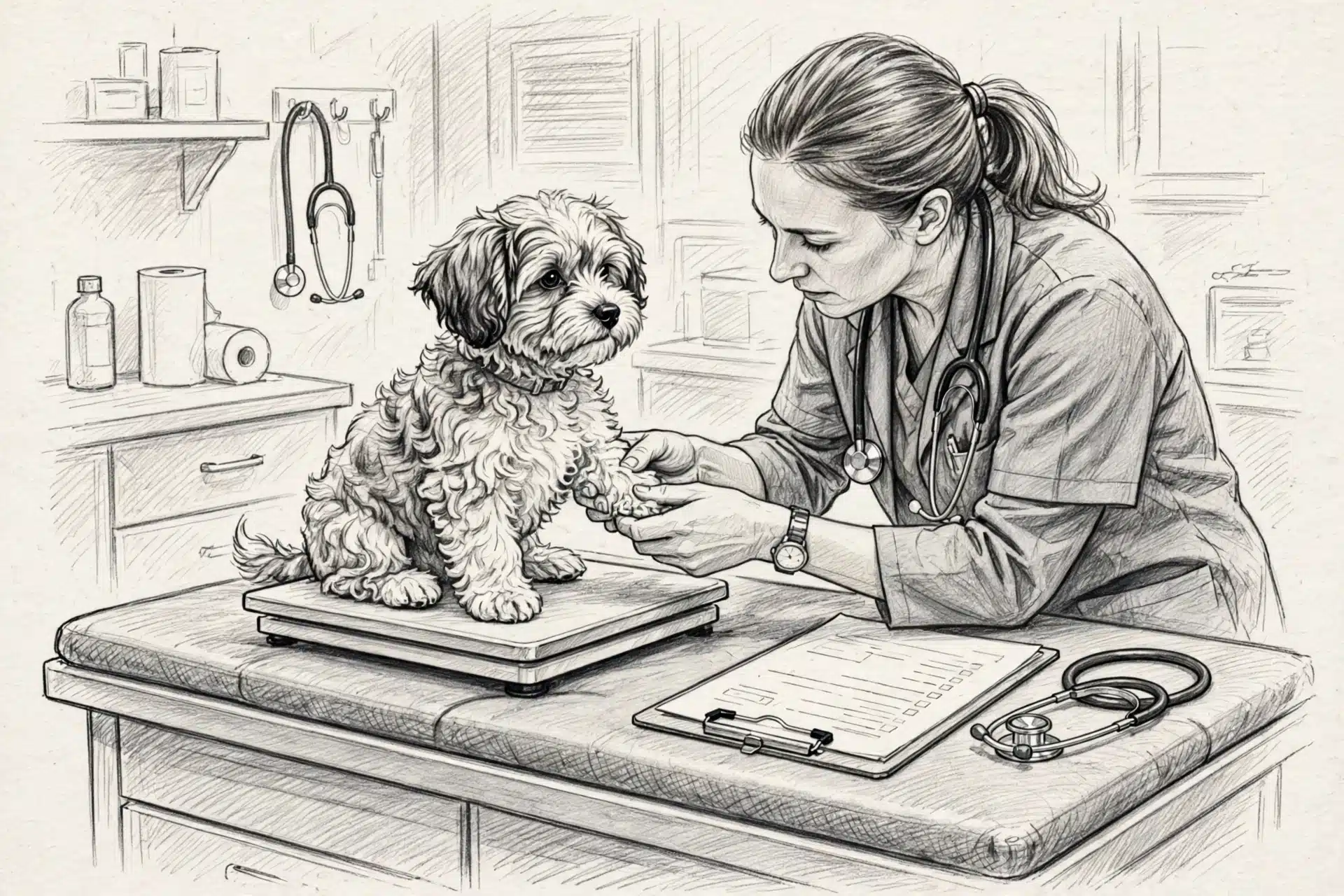
Open to the exam notes first. A real wellness visit lists the date, the puppy’s age, its weight, and findings on eyes, ears, heart, lungs, and patellas. Weights should climb steadily at each visit, not sit flat or jump wildly. A normal entry reads like plain observation: “heart regular, no murmur; patellas luxate neither side; umbilicus closed.” Be cautious of a single sheet with only “healthy puppy” and a signature. That is not an exam; it is a receipt. Ask which clinic saw the litter, then call the clinic to confirm the visit happened.
Vaccines and deworming you can actually check
Vaccine records are the easiest to verify. Core shots, such as distemper and parvo, start between 6 and 8 weeks and repeat every 2 to 4 weeks until at least 16 weeks, per the AAHA canine vaccination guidelines. So an 8-week-old puppy should show one dose, with the next due shortly. Deworming usually appears at 2, 4, 6, and 8 weeks. Check that each entry has a date, the vaccine name, and the clinic’s stamp. If the math does not match the birthdate, ask why. When you compare paperwork across litters, our guide to genetic testing results shows which lab reports belong in the same folder.
The limits of a healthy-looking exam
A clean exam is a snapshot of one day, not a health history. It cannot predict late-onset conditions such as hip dysplasia, heart disease, or inherited eye problems. Those risks live in the parents’ screening results, not the puppy’s file. Treat the vet record as one layer of proof, then ask for the orthopedic and eye screenings on both parents.
Reading Lab Reports and Parent Screening Documents
Does a CHIC number prove a parent dog is healthy? No. A CHIC number only confirms the dog was screened for every test its breed’s parent club recommends and that the results, good or bad, were posted publicly. It is a record of testing, not a clean bill of health. When you look up a dog in the OFA database, check each individual result:
- Whether each listed test has a passing or failing result
- The dog’s age at testing, since some screens require minimum ages
- Whether results are posted publicly or withheld
That distinction comes straight from how the OFA CHIC program works: screening and disclosure earn the number, not healthy scores.
DNA panels: specific variants, specific limits
A genetic health panel tells you which specific disease variants a dog tested clear of, nothing more. A report that says “clear on 230 conditions” sounds impressive, but many of those conditions never occur in Havanese, Cavaliers, or Poodles. What matters for your puppy is the short list of variants relevant to its breed background. Ask which panel was run, which lab produced it, and whether you can verify the parent’s registration number in the lab’s own database. If a breeder cannot produce the actual report, treat the claim as unverified.
Clinical screening certificates and what CHIC does not mean

DNA results and clinical exams answer different questions. Orthopedic screening for hips and patellas, eye exams, and cardiac checks look at the actual dog, not its genes. A dog can carry no disease variants and still fail a patella exam, so both types of paperwork belong in the folder.
Matching the right screens to your puppy’s breed background
The tests worth asking about vary by mix. For Havanese parents, the breed club’s CHIC list includes OFA hips, patellas, and eye exams. Cavaliers add cardiac screening for mitral valve disease, the breed’s most serious risk. Poodle lines should show patellas, eyes, and hips. A Sage Puppies guide walks through the full parent screening list for these mixes.
Where Buyers Get Misled
The problem usually starts with language, not lies. A breeder who says “parents are health tested” may mean a vet looked them over once. That is a wellness exam, not a screening for inherited disease. Ask which words would appear on an actual document, because every real result has one.
Vague phrases and the document that would fix them
Watch for these lines and what should back each one:
| Phrase you hear | Document that should exist |
|---|---|
| “Health tested parents” | Lab reports naming each parent and each gene tested |
| “Vet checked” | A signed exam record with date and findings |
| “Clear bloodlines” | A pedigree plus results tied to named ancestors |
| “Up to date on shots” | A vaccination record with dates, products, and the next due date |
Each claim has a matching paper trail. “Health tested” without a report names nothing. “Clear bloodlines” without results is a story, not evidence. When a folder holds a glossy handout instead of test results tied to named dogs, that is the gap.
A seller who cannot produce the lab report for each parent, with the dog’s registered name on it, has not shown testing. Real puppies for sale in Utah from documented programs come with those reports before a deposit, not after.

Crossbreed shortcuts and one-size-fits-all panels
Havapoos and Cavapoos carry genes from two breeds, so a panel that misses one side hides half the risk. A report should show results for both the Havanese or Cavalier parent and the Poodle parent. Ask for each parent’s own paperwork.
Breed clubs also set the bar. The Havanese club, for example, expects orthopedic screening of hips and patellas, plus eye exams, not just a DNA list. A one-size-fits-all panel with 230 conditions sounds thorough, but breed-specific screening matters more. Match the paperwork to what each breed club requires before you pay.
How to Verify Both Sets of Records Before You Pay
You can check most health testing claims in under an hour, before any money changes hands. Here’s the routine that works:
- Ask for the registered name or numbers of both parents.
- Look each dog up yourself in the OFA database and compare results to the breed-club checklist.
- Read the lab report yourself and match the tested dog to the parent in the pedigree.
- Review the puppy’s vaccine and deworming entries against its age.
- Only then talk deposits.
Searching parent records yourself
A breeder who tests seriously will hand over a registered name with ease. Type it into the OFA database’s advanced search and see what comes back. All normal results submitted to OFA are public, so a missing record usually means the test was never submitted, not that it’s private. Check that each listed test matches what the breed’s parent club requires for Havanese, Cavaliers, or Poodles, including orthopedic screening for hips and patellas.
Then confirm identity. The dog on the lab report should match the registered name, birth date, and sire and dam you just looked up. A clear report for an unrelated dog proves nothing about your puppy.
Getting an independent read before the deposit
Bring the folder to your own veterinarian before the deposit clears, or at least before pickup. A vet can confirm the vaccine dates make sense for the puppy’s age, check the deworming entries, and spot gaps you might miss. If the litter is far away, ask your vet to review photos or scans of the pages by email. Some breeders, including those of us at Sage Puppies, expect this step and will answer vet questions directly. One that balks at an independent read is telling you something.

Tip: Pay with a method that leaves a paper trail, and get the deposit terms in writing alongside the records you verified.
Which Should You Choose: Vet Records or Lab Reports?
The honest answer is that you rarely pick one. A strong breeder folder holds both, and each type answers a different question. Vet records show how the puppy was cared for. Lab reports show what the parents might pass on. Here is when each one deserves your first look.
Choose vet records first when
Start with the puppy health records when your main worry is how this specific puppy has been raised so far. These papers, kept by a licensed veterinarian, should list the puppy vaccination records, a deworming schedule at 2, 4, 6, and 8 weeks, weight trends, and notes from each exam. If a breeder hands you a folder with a vet’s clinic name, exam dates, and a stamp or signature, you can call that clinic and confirm the visits. That call is your fastest verification step. Vet records also matter most when you are buying a young puppy, because at 8 weeks genetic results are still about the parents, not the pup in front of you. Good responsible breeder documentation always includes them.
Choose lab reports first when
Put parent screening and genetic health panel results first when your worry is the future. Conditions like progressive retinal atrophy, cardiac disease, and orthopedic screening for hips and patellas show up years later, and no puppy exam predicts them. Lab reports from an accredited lab, plus OFA or CHIC database entries for each parent, tell you what was tested and what was found. This matters most for mixed breeds like a Havapoo or Cavapoo, because both parent breeds should be screened against their own breed-club list. For Havanese, Havapoo, and Cavapoo families, checking the parents’ OFA entries before a deposit changes hands is the single highest-value step you can take.

Still sorting a folder of paperwork? Bring it to Sage Puppies. We walk every family through vet records and lab reports before a deposit is paid, then match you with a health-tested Havanese, Havapoo, or Cavapoo puppy. Wisely Bred. Beautifully Loved.
Frequently Asked Questions
Q1: What is the difference between vet records vs lab reports for puppies?
Vet records document your puppy’s own exams, vaccines, and deworming. Lab reports show parent DNA and screening results. You need both before paying a deposit.
Q2: Does a CHIC number mean a parent dog is healthy?
No. It only confirms the dog was screened for every breed-club test and the results, good or bad, were posted publicly. Read each result yourself.
Q3: How do I verify a breeder’s health testing claims?
Get each parent’s registered name, search it in the OFA database, read the lab report, and check vaccine dates against the puppy’s age.
Q4: What genetic tests should Havanese, Havapoo, or Cavapoo parents have?
Ask for breed-specific results: hips and patellas plus eye exams for Havanese lines, cardiac screening for Cavaliers, and patellas, eyes, and hips for Poodles.
Q5: Should I have my own vet review the breeder’s paperwork?
Yes. A vet confirms vaccine timing, deworming entries, and exam notes before your deposit clears. Scans by email work for distant litters.
Conclusion
Vet records and lab reports are not rivals; they are two halves of responsible breeder documentation. Vet records prove this puppy was examined, vaccinated, and dewormed on schedule. Lab reports and OFA entries show which inherited risks the parents were screened for before the litter existed.
So read both, verify each yourself, and match every test to the breed-club list for Havanese, Havapoo, or Cavapoo lines. A folder that holds a signed exam, a dated vaccine record, and named parent results is worth a deposit. A folder that holds only the word “health-tested” is not.