
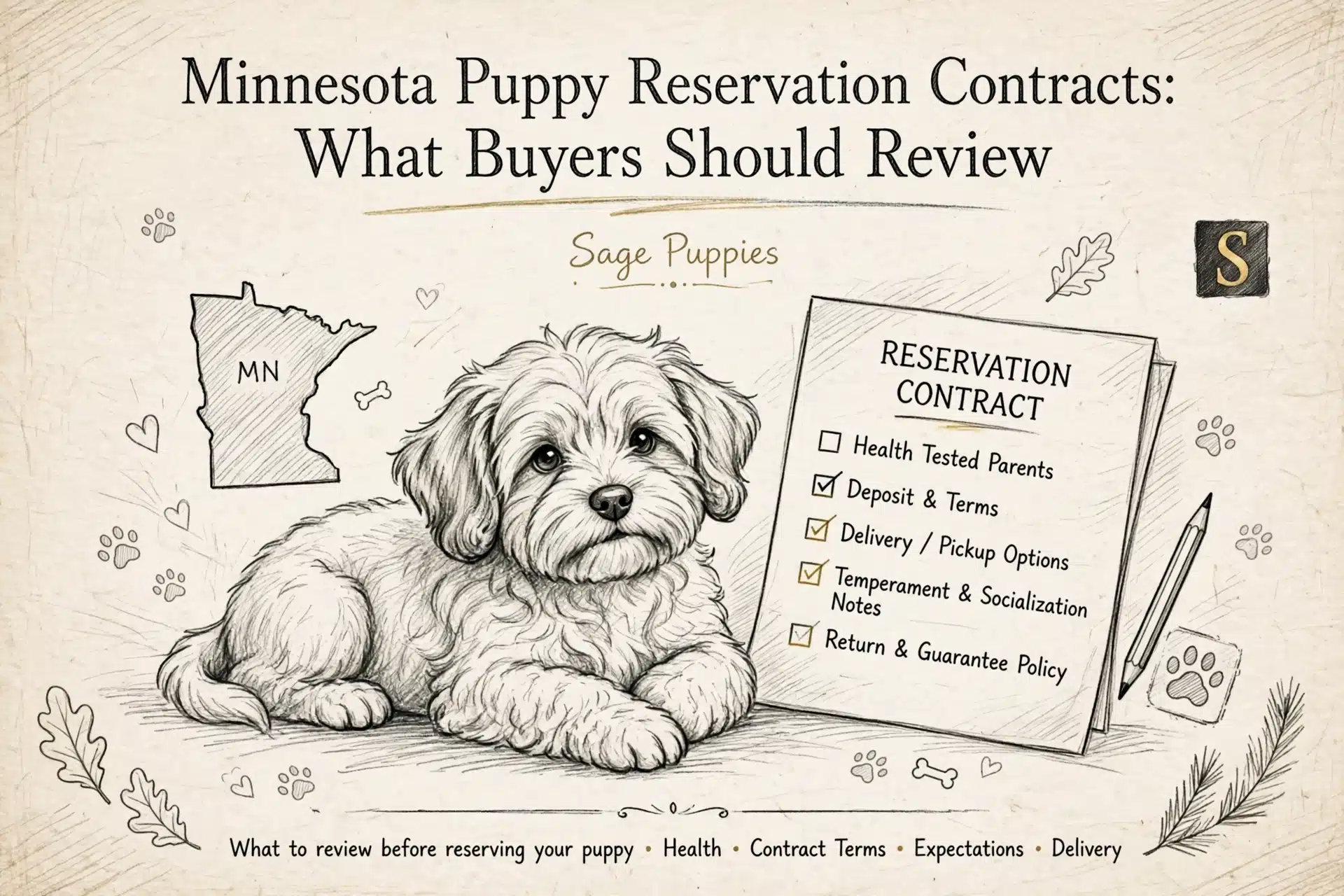
Quick Summary: Before putting money down on a Minnesota puppy, read the reservation contract closely because the deposit rules decide whether you get a refund, a transfer, or nothing if plans change. The article walks through what to check: who holds the deposit, whether a deposit on a litter differs from one on a named puppy, the full price and due dates, microchip and health records, and the health guarantee’s conditions and time limits. It notes that Minnesota law gives retail buyers remedies for documented health problems within 10 days and hereditary conditions within a year, but those protections apply to pet dealers, so private breeder coverage depends on the contract itself. Sage Puppies is cited as an example of a program that puts deposit, pricing, and delivery terms in writing up front.
Many Minnesota families put money down on a puppy weeks before the litter is even born. That deposit feels safe until plans change, and then the short agreement you signed decides everything: refund, transfer, or forfeiture.
A careful Minnesota puppy reservation review before signing protects your money and your expectations. Most breeders use contracts that cover deposits, pickup dates, payment schedules, and health terms, yet few buyers read them closely until a problem appears.
This guide walks you through a reservation contract review clause by clause, including identity, delivery, and health provisions. It also explains how Minnesota breeders contracts differ from generic templates, and why statutory protections depend on your specific situation. Read it once before you sign, and you will know exactly what you are agreeing to.
Start by Identifying What the Reservation Actually Reserves
Before you sign anything, figure out what your money actually holds. A Minnesota puppy reservation is usually a deposit that holds a spot, not a promise that you will take home a specific puppy on a specific day. Good breeders put this in writing. Weak ones leave it vague.
Read the contract and ask one simple question: if this deal falls apart, what happens next? The answer should be easy to find on the page.
Check the Parties, Puppy, and Litter Details
The first block of the contract should name everyone involved, clearly.
Look for:
- The breeder’s legal name and business name, plus a real address and phone number. A Minnesota reservation should tell you exactly who holds your deposit.
- Your full legal name, spelled correctly, since this protects you too.
- The puppy or litter details. If you reserved a specific puppy, the contract should list its litter, birth date, sex, color, and a Microchip or ID number if one exists.
- The breed and expected adult size, especially if you are choosing a small breed.
If a section says “puppy to be assigned later,” that can be fine for a young litter. Just make sure the contract explains when and how the breeder picks your puppy, and whether you get photos and updates before pickup day.
Separate the Deposit Agreement from the Final Sale Agreement
Many Minnesota breeders use two documents: a deposit agreement now and a final sale agreement later. They cover different things.
The deposit agreement usually covers the reservation fee, the waitlist spot, and how the breeder assigns puppies. The final sale agreement, signed closer to pickup, covers the balance due, health records, and any health guarantee.
| Agreement | When You Sign | What It Covers |
|---|---|---|
| Deposit agreement | When you reserve | Fee amount, litter spot, puppy assignment, refund rules |
| Final sale agreement | At pickup or delivery | Balance, health records, guarantee, spay or neuter terms |
Know which one you are signing. Never let a deposit agreement quietly take the place of a final contract, because the refund and health terms usually live in the second document. At our South Jordan program, we walk families through both steps so nothing surprises them at pickup.
Read the Deposit, Refund, and Litter-Change Terms Line by Line
Deposit clauses cause the most puppy contract disputes. Most of them are avoidable if you read two scenarios before you sign: you change your mind, or the breeder cannot deliver. Good contracts spell out both.
Find the Exact Rule for a Buyer Change of Mind
Find the sentence that answers this question: if I back out, do I get any money back?
Some breeders keep the full deposit. Others refund part of it if you cancel early. A few allow a transfer to a future litter. All three are common, but only what is written in your contract counts. A friendly phone promise does not override the paper.
Ask these specific questions:
- Is the deposit refundable, partly refundable, or not refundable at all?
- Is there a deadline, such as 30 days before the go-home date, after which it is gone?
- Can the deposit roll over to a later litter, and for how long?
- Does the rule change once you pick a specific puppy?
That last one matters more than people expect. Many contracts treat a deposit on a litter as soft, but a deposit on a named puppy as final. If the switch happens at puppy selection, ask which rule applies at that exact moment.
Ask What Happens if the Breeder or Litter Cannot Proceed
Now flip it. What if the litter is small, a puppy fails a vet check, or the breeder cancels?
You want language that covers the breeder’s side of the deal, not just yours. A fair contract states that if the breeding does not take, the puppy dies, or the breeder cannot place your puppy, you get a full refund or first pick of the next litter. Look for the word “refund” in writing, plus a timeframe, such as 14 days.
Watch for vague phrases like “best efforts will be made.” That is not a commitment. Ask the breeder to replace it with a plain sentence: full refund or a transfer, buyer’s choice.
Reputable programs, including ours at Sage Puppies, put these terms in writing up front because clear rules protect both sides. If a breeder resists putting a refund policy on paper, treat that as your answer. Our reservation process shows how transparent terms look.
Confirm Selection, Price, and Every Payment Deadline
Before you sign anything, the contract should state exactly which puppy you are getting, the full price, and every date money is due. Vague answers here cause most deposit disputes.
Understand Puppy Selection and Availability
A good contract identifies your puppy by name, birth date, sex, color, and litter. “One Havanese-type puppy” is not specific enough. If your contract only promises “a puppy from a future litter,” ask when that litter is expected and what happens if the breeding does not take.
Also check how pick order works. Some breeders assign puppies in the order deposits arrive. Others let families meet several puppies first. Either way, the written process should match what the breeder told you verbally.
At Sage Puppies, each family’s reservation names the specific puppy or pickup order position, and the pricing and reservation page spells out both before you commit. Ask any breeder the same: what is written down, and when?
Reconcile the Total Price and Due Dates
Now add up the money. Your contract should show the deposit amount, the remaining balance, and any extra costs like delivery, sales tax, or a puppy starter kit. Write each due date next to its amount.
| Item | What to Confirm |
|---|---|
| Deposit | Amount, date paid, and whether it counts toward the price |
| Balance | Total due and the deadline |
| Extras | Delivery, tax, or supplies, priced in writing |
Watch for two traps. First, a balance “due at pickup” with no date gives the breeder room to move the goalposts. Second, late-payment terms: some contracts cancel the sale and keep the deposit if you miss a date by a day. Ask for a short grace period in writing.
If the total price is not printed in the contract, do not sign.
Review Puppy Identity, Health Records, and the Contract’s Health Promise
Match the Puppy to Its Records
Before you sign anything, confirm the puppy on the contract is the puppy you met. Identity mix-ups happen, and a guarantee only protects you if it names the right dog.
Check these details against the puppy itself:
- Microchip number. Scan or ask to see it, then compare it to the contract.
- Breed, sex, color, and markings. Note anything specific, like a white blaze on the chest.
- Date of birth and litter number. These should match the health record.
- Parents’ names or registration numbers. Ask how the contract ties your puppy to that litter.
Minnesota law requires pet dealers to disclose the birth date, breed, identifying marks, and the parents’ names and litter number, along with vaccination and deworming records. Review the Minnesota Attorney General’s pet buyer guide for the full disclosure list.
Some breeder contracts go further and require proof of identity before honoring any claim. A sample buyer-seller contract states the buyer must prove the dog is the same one purchased, by DNA or microchip, before the guarantee applies.
At Sage Puppies, each Havanese, Havapoo, and Cavapoo puppy’s records travel with the puppy, so the paperwork and the puppy always line up.
Make the Health Guarantee Specific Enough to Use
A vague promise helps no one. “Healthy puppy” sounds nice, but it gives you nothing to point to if something goes wrong. A guarantee you can actually use names conditions, timeframes, and remedies.
Read the health clause with these questions in mind:
- What is covered? Look for named conditions, like congenital or hereditary defects, not just “good health.”
- For how long? Timeframes vary widely. Some contracts cover hereditary conditions for 24 months or more.
- What do you get? A refund, a replacement puppy, or vet fee reimbursement are all different outcomes.
- What voids it? Missed vet visits, late paperwork, or care conditions can cancel coverage.
- What proof do you need? Most contracts require a written vet report within a set window, often 72 hours to 10 days.
Tip: Minnesota law gives retail buyers remedies when a vet documents a health problem within 10 days, or a hereditary or congenital condition within one year. But those protections apply to pet dealers, and coverage from a private breeder depends on the contract terms. Ask which rules apply to your purchase.
Also check whether the contract lets you waive rights you have under Minnesota law. State statute says a waiver of these rights is null and void, so treat any clause asking you to give them up with caution.
Finally, ask what the breeder does before the puppy ever reaches you. Parents with health testing, age-appropriate vaccines, and deworming are the real foundation. The guarantee is the safety net, not the plan.
Put Pickup, Delivery, and Changes in Writing
Verbal plans fade fast once a litter is ready. Your contract should spell out exactly where the puppy changes hands, when, and who pays for what. Before you sign, read that part twice.
Check the Handoff Plan and Extra Costs
Look for four details in the pickup or delivery clause:
- Location: Will you pick up at the breeder’s home, meet somewhere, or receive the puppy through a delivery service?
- Date and window: A specific week or age, like eight to ten weeks, not just “when ready.”
- Who pays: Does the price include delivery, or is it a separate fee you cover?
- Weather and delay terms: What happens if a flight is canceled or pickup slips a week?
Ask what the fee covers, too. A flight nanny, ground transport, and a vet health certificate for travel can each add cost. Programs like Sage Puppies offer both local pickup and nationwide delivery, and a good breeder will put the method, carrier, and cost in writing before you pay anything extra.

Keep Changes and Promises in the Signed Record
If anything changes, get it in writing. A text like “no problem, we’ll push pickup to June” is nice, but a signed amendment or email trail protects both of you.
The same rule applies to promises. Extra training, a starter kit, or a return option only counts if it appears in the contract. Politely ask for an addendum. An honest breeder will say yes.
Spot Ambiguous Terms and Know When to Pause
Most puppy contracts are fair. Some just use words that could mean two different things. Watch for phrases like “healthy to the best of our knowledge,” “replacement at our discretion,” or “breeder reserves the right.” These are not always red flags, but they deserve a question before you send money.
| Vague Phrase | Why It Matters | Ask Instead |
|---|---|---|
| “At our discretion” | Only one side decides the outcome | “What factors decide it?” |
| “Healthy at time of sale” | No timeline attached | “How many days do I have to vet check?” |
| “Deposit is non-refundable” | No exceptions listed | “What if you can’t deliver the puppy?” |
| “Proven bloodlines” | No proof required | “Can I see the parents’ test results?” |
Use a Short Pre-Payment Question List
Before you pay a deposit, send the breeder five questions in writing:
- What exactly does the deposit cover, and is any part refundable?
- When can I take my puppy home, and what happens if the date moves?
- Which health tests have the parents had, and can I see the results?
- What is your return or replacement policy, and over what time period?
- How do we handle delivery, and who pays if plans change?
Written answers do two things. They clear up confusion now, and they create a record you can point to later. A confident breeder welcomes these questions. Ethical programs like Sage Puppies walk families through each step openly, so nothing in the agreement surprises you.
Tip: If a breeder refuses to answer in writing, that silence is your answer. Pause and keep looking.
Distinguish a Clarification Need from a Legal Dispute
Most contract problems are simple misunderstandings, not disputes. Maybe “vet checked” meant the litter, not each puppy. A quick email usually fixes that.
A real dispute looks different: broken promises, refused refunds, or pressure to sign an amended contract. If you hit that, stop, keep all records, and talk to a lawyer before signing anything new. Clarify first, escalate only when needed.

Ready to reserve a puppy with a program that keeps every term clear up front? Visit Sage Puppies to review our health-tested Havanese, Havapoo, and Cavapoo litters, then submit an application. We’ll walk you through deposit and pickup or delivery details, so you can sign with total confidence.
Frequently Asked Questions
Q1: What should a puppy reservation contract include when buying in Minnesota?
Look for the deposit amount, total price, pickup or delivery date, a clear puppy ID, health records, and what happens if the litter changes. Every term should be in writing.
Q2: Is a puppy deposit refundable if I change my mind before pickup?
Deposits usually show the breeder you are serious, so many are not refundable. Ask before you sign whether yours transfers to a future litter or applies to another puppy.
Q3: What happens if the puppy has a health problem after I bring it home?
A fair contract states a vet exam window, covered conditions, and your options. Keep all vet paperwork, and report concerns quickly so the breeder can help.
Q4: Should I get the contract before paying the deposit?
Yes. Read every clause first. A transparent breeder will send the full agreement before any money changes hands.
Q5: Can I ask the breeder to change contract terms?
You can ask. Good breeders explain their reasoning or adjust details. Pressure to sign immediately is a warning sign.
Q6: Does Minnesota law protect puppy buyers?
Some protections exist, but coverage depends on your situation. Treat the contract, not the statute, as your main protection.
Conclusion
A Minnesota puppy reservation contract comes down to six things: the deposit terms, when the puppy will be ready, how the breeder confirms identity, payment details, delivery or pickup plans, and health provisions. Read each one before you sign, and ask questions about anything vague.
Keep in mind that state law coverage depends on your situation, so written promises matter more than verbal ones. A breeder who puts everything in clear language, like our reservation process, is showing you how they’ll treat you after pickup day. Take your time, compare contracts side by side, and choose the litter and family that feels right.





