Quick Summary: A Havapoo’s weight chart is a guide, not a grade: adult weight usually falls between 8 and 20 pounds, with the Poodle parent’s size as the strongest predictor. Weigh puppies weekly, track steady gains and body condition, and remember that littermates can differ by several pounds without being unhealthy. Most reach adult height by 8 to 10 months and adult weight by 12 months, though larger lines may keep filling out until 14 months.
Two Havapoo littermates can share a birth date and still differ by two pounds at twelve weeks. That spread is normal, and it is why any Havapoo weight by month chart should guide you, not grade your puppy. The real challenge is knowing what the numbers mean for a crossbreed whose adult size depends on whether the Poodle parent was a Toy or a Miniature.
This guide walks you through Havapoo month by month growth from birth to a year, with typical weights at each stage. You will also learn why littermates vary, how to weigh a puppy at home, and what a growth curve honestly can and cannot predict. It comes from our work raising Havapoo puppies at Sage Puppies in South Jordan, Utah, where we track every litter’s weight from day one.
How Much Should a Havapoo Puppy Weigh Each Month?
A full-grown Havapoo usually lands between 8 and 20 pounds, and the exact number depends on whether the Poodle parent is toy or miniature size. As a rough rule, the adult weight is about half the 4-month weight, so a puppy that hits 8 pounds at 4 months often settles near 15 to 16 pounds as an adult. The table below shows typical ranges for healthy, well-fed puppies.
| Age | Toy Poodle Mix | Miniature Poodle Mix |
|---|---|---|
| Birth | 3-6 oz | 4-7 oz |
| 1 month | 2-4 lb | 3-5 lb |
| 2 months | 3-6 lb | 5-8 lb |
| 3 months | 4-8 lb | 6-10 lb |
| 4 months | 5-10 lb | 8-12 lb |
| 6 months | 7-13 lb | 10-16 lb |
| 9 months | 8-15 lb | 12-19 lb |
| 12 months | 8-16 lb | 13-20 lb |
Trends matter more than a single number, and Havapoo weight by month varies between healthy littermates.
Reading the Ranges Correctly
These numbers are a guide, not a grade. A healthy litter can span several pounds at the same age, and a puppy that sits at the low end all along the curve is usually just small, not underfed. Watch the direction of growth: a steady climb matters more than any single weigh-in. Weight gain that stalls for more than a day or two, or drops, deserves a call to your vet. Body condition is just as useful as the scale. You should feel ribs easily under a thin fat layer and see a visible waist from above.
Toy Poodle Versus Miniature Poodle Parents
The single biggest predictor of adult size is the Poodle parent. Toy Poodles weigh 4 to 6 pounds, while Miniature Poodles weigh 10 to 15 pounds, so a Havapoo with a Miniature parent often ends up nearly twice the size of one with a Toy parent. Ask the breeder for the actual weight records of both parents, the Havanese and the Poodle, rather than a vague estimate.
Birth to Two Months: The Foundation Phase
The first eight weeks set the pace for every number that follows on a Havapoo weight by month chart. Puppies are born tiny, blind, and entirely dependent on their mother, and nearly all of their early gain comes from nursing and sleep.
Birth Weight and the First Seven Days
A Havapoo puppy usually arrives weighing between 3 and 7 ounces, depending on litter size and whether the dam is on the smaller side. Healthy newborns should roughly double their birth weight within the first week. Daily gain of about an ounce or two per day is normal, and steady progress matters more than any single reading. A puppy that slips off its curve in the first week needs a vet, not a wait-and-see approach.

What Should Be Growing by Six Weeks
By six weeks, most Havapoos weigh between 2 and 4 pounds and are fully weaned onto soft food. Eyes opened around two weeks, ears followed shortly after, and wobbly first steps turned into real play. Littermates can differ by half a pound at this stage and still be completely normal. Breeders weigh puppies at least weekly during this window, and at Sage Puppies that record follows each puppy home so families know exactly where its growth curve started.
Three to Six Months: The Fastest Growth Window
A 3 Month Old Havapoo Puppy Weight
Most Havapoos weigh between 4 and 8 pounds at three months, with puppies from a Miniature Poodle parent often landing closer to 6 to 10 pounds. So a quick answer to “how much does a 3 month old Havapoo puppy weigh?” is usually 4 to 10 pounds, depending on the parent size. The spread looks wide because toy-breed litters grow in small, uneven jumps. A puppy that was the runt at birth can pass its littermates within weeks. Weigh weekly at this stage rather than monthly, because the weekly numbers show your puppy’s real growth curve, not just a single snapshot.
How Growth Speeds Up From Months 4 to 6
Between months 4 and 6, Havapoos often add half their eventual adult weight. A typical puppy moves from roughly 5 to 12 pounds at four months to 7 to 16 pounds by six months. Keep portions steady and skip free-feeding here, because fast growth plus extra calories can push weight past what small joints handle. Your vet tracks body condition score at each visit, which tells you more than the scale alone. If your puppy jumps ahead of the chart, look at the whole puppy: ribs you can feel, a visible waist, steady energy. Those signs matter more than any single number.
A 4-month weight gives a decent adult estimate: expect your adult Havapoo to land near double that number.
Six to Twelve Months: Slowing Toward Adult Weight
Growth Flattens After Month Six
Growth does not stop at six months, but the pace changes fast. Havapoos add only a few pounds in this stretch, moving from roughly 7 to 16 pounds toward 8 to 19 by month nine. Height and length also level off, so your puppy may look nearly grown while the scale still creeps up. Small breeds often stop growing in height by 6 to 8 months, according to the AKC, with the last gains going into muscle and a bit of chest fill.
Watch body shape more than the scale here. A puppy eating a growing puppy’s portions but no longer growing out can add fat instead of frame, so your vet’s body condition score tells you more than weight alone.

Twelve Month Weights and Beyond
Most Havapoos reach adult size between 10 and 12 months, landing in the 8 to 20 pound range depending on whether the Poodle parent was toy or miniature. Smaller lines often finish earlier; bigger ones can keep filling out until 14 months.
Once your dog holds the same weight for several weeks on the same food, treat that number as the adult baseline. Then feed to maintain it. Adults burn fewer calories per pound than growing puppies, so the portions that fueled growth will now pack on fat if never adjusted. Our Havapoo adult size and weight guide walks through what those final numbers mean for height as well as weight.
When Do Havapoo Puppies Stop Growing and Reach Adult Size?
Most Havapoos reach their adult height between 8 and 10 months, and their adult weight by about 12 months. The last changes are subtle: a fuller chest, more muscle, a slightly denser frame. After the first birthday, the number on the scale should barely move.
The Typical Timeline for Small Breeds
Small breeds mature fast. According to the AKC, dogs under about 20 pounds usually hit full size around 10 to 12 months, and some toy-sized dogs finish even sooner. A Havapoo’s growth curve follows that pattern: rapid gain through month six, a clear slowdown by month nine, then a long plateau. Height locks in first, often by 8 months. Weight fills in afterward, mostly as muscle rather than bone.

Why Havapoo Adult Weight Cannot Be Predicted Exactly
A chart gives a range, not a promise. Havapoos are a crossbreed, so each puppy inherits a different mix from the Havanese and Poodle parents. A Toy Poodle parent points toward the low end of the 8 to 20 pound range; a Miniature Poodle parent pushes toward the top. Littermates can differ by several pounds as adults. When breeders share both parents’ weights, the estimate sharpens, but the only reliable answer comes from watching your own puppy’s curve over time.
How to Weigh and Track Your Havapoo Puppy at Home
Weighing at Home With a Kitchen Scale
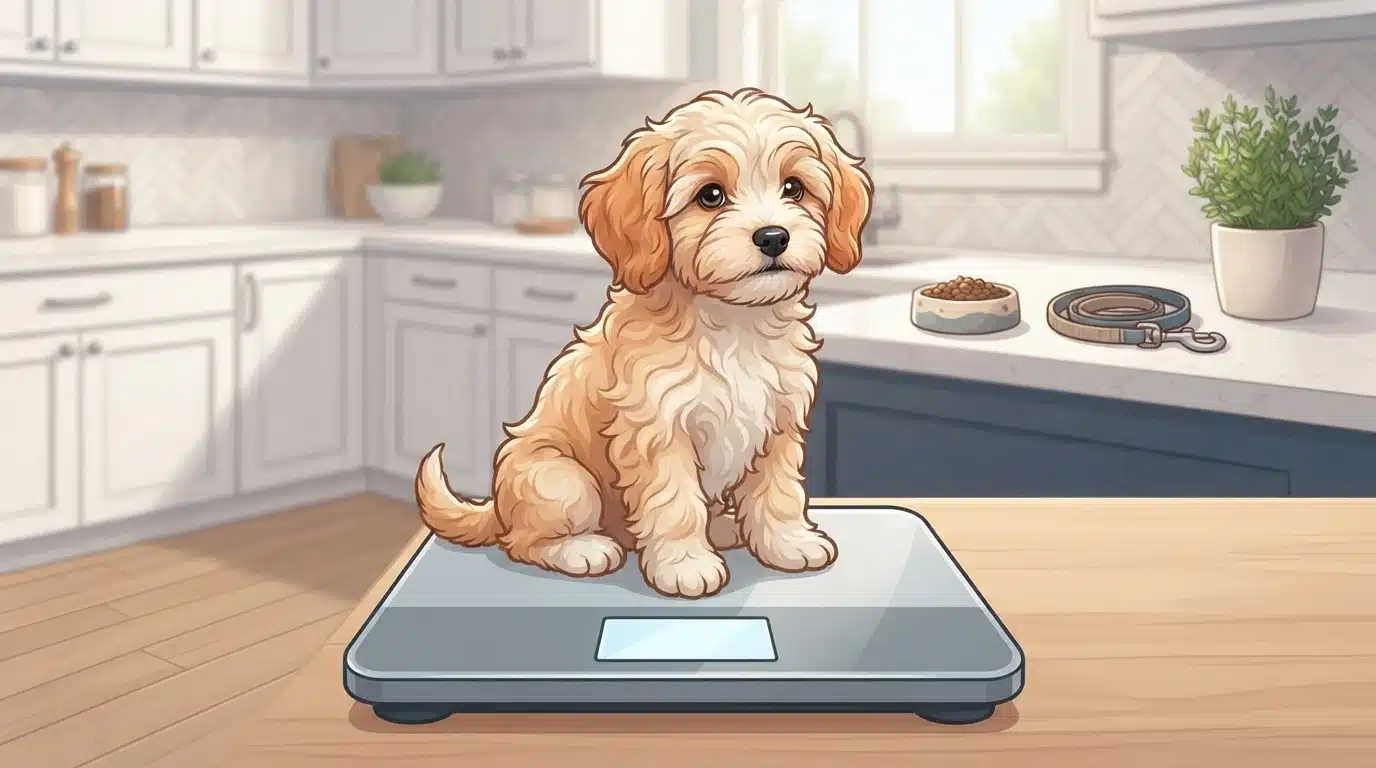
You do not need a vet visit to track your puppy’s growth curve. Here’s how to weigh a puppy at home:
- Set a digital kitchen scale on a flat surface and turn it on.
- Place a towel or shallow bowl on top and press “tare” so it reads zero.
- Set your puppy in gently and wait for the number to settle.
- Read the weight to the nearest ounce, then let your puppy hop down.
Weigh once a week, on the same day, before breakfast. Puppies wiggle, so take two readings and use the higher one if they differ. Havapoos are small enough that a 4-ounce jump is real progress, so record ounces, not rough guesses.
Keeping a Growth Log Worth Bringing to the Vet
A log only helps if it’s consistent. Use your phone’s notes app or a simple notebook and record three things each week: date, weight, and food intake. Add a note when anything changes, like a new food or a tummy bug.
Two patterns matter more than any single number. Steady weekly gains mean the curve is fine. A gain that stalls for two weeks or drops deserves a call to your vet.
For the first days home, our Havapoo week one checklist covers feeding and vet setup, so the weigh-ins have a routine to sit inside.
Why Your Havapoo’s Curve May Differ From the Chart
Litter Size, Sex and Parent Size
Charts show a range, not a promise, and three variables explain most of the spread. Large litters produce smaller puppies at birth because pups share uterine space, so a runt from a big litter may start a pound behind and catch up later. Sex matters too: females often finish a pound or two lighter than their brothers. The biggest factor is parent size. A Havapoo with a Toy Poodle parent may land near 8 to 12 pounds, while one with a Miniature Poodle parent can reach 15 to 20 pounds. Ask the breeder for the Havanese dam’s weight and the Poodle sire’s weight, then compare your puppy to pups from similar pairings rather than the chart’s full range.
Nutrition, Illness and Other Influences
Food and health shift the curve as well. Underfeeding slows growth, and overfeeding adds fat rather than frame, so feed a complete puppy food in measured portions instead of free-feeding. A bout of worms, giardia or an upset stomach can pause weight gain for a week or two; most puppies resume their curve once treated. Watch body condition along with the scale: you should feel ribs easily under a thin fat layer, without seeing them. Spay or neuter timing, exercise level and even stress from a new home can nudge the numbers. If your puppy drops weight or stops gaining for more than a few days, call your veterinarian rather than waiting for the chart to catch up.
Common Mistakes to Avoid
Even a good chart gets misread. Watch for these slip-ups:
- Comparing your puppy to a friend’s dog. A Toy Poodle Havapoo and a Miniature Poodle Havapoo follow different curves. Littermates can also differ by a pound or two at the same age, and that is normal.
- Panic over one weigh-in. Puppies gain in spurts. Judge the trend over several weeks, not a single number.
- Weighing on a bathroom scale. It cannot register a few ounces. Hold the puppy, weigh yourself together, then subtract your weight.
- Trusting any single estimate too hard. The double-the-4-month rule gives a ballpark, not a promise. Parent size matters more.
- Feeding extra to speed growth. Fast growth strains small joints. Follow body condition, not the calendar.
When one weighs in looks off, recheck in a week and call your vet if the trend truly stalls.

Tracking your puppy’s weight is easier when someone answers your questions honestly. At Sage Puppies, Cassie matches families with Havapoo puppies and shares growth guidance from day one. Curious what your puppy’s curve should look like? Reach out, and apply today to meet your match.
Frequently Asked Questions
Q1: How much should a Havapoo puppy weigh at each month of growth?
Typical ranges run from 3 to 7 ounces at birth to 8 to 20 pounds by twelve months. A Toy Poodle mix follows the lower half of that curve, a Miniature Poodle mix the upper half. Trend matters more than any single weigh-in.
Q2: When do Havapoo puppies stop growing and reach their adult size?
Most Havapoos reach adult height by 8 to 10 months and adult weight by about 12 months. Smaller lines finish earlier, while larger ones can keep filling out until 14 months.
Q3: How much does a 3 month old Havapoo puppy weigh?
Usually 4 to 10 pounds. Puppies from a Toy Poodle parent often sit at 4 to 8 pounds, while Miniature Poodle mixes land closer to 6 to 10.
Q4: How accurate is the double-the-4-month-weight rule?
It gives a decent ballpark, since adult weight often lands near double the 4-month number. Parent size records sharpen the estimate, but only your puppy’s own curve confirms it.
Q5: Should I worry if my puppy weighs less than a littermate?
Not usually. Healthy littermates can differ by several pounds at the same age. Call your vet only if gains stall for more than a day or two or weight drops.
Q6: How often should I weigh my Havapoo puppy?
Weekly during the fast growth window, on the same day, before breakfast, using a kitchen scale. Log the date, weight and food intake so your vet can read the trend.
Conclusion
A Havapoo weight by month chart works best as a guide, not a grade. Typical Havapoo adult weight runs 8 to 20 pounds, and the Poodle parent’s size drives which end of that range your puppy lands on. Watch the trend, not one weigh-in: steady weekly gains and easy-to-feel ribs tell you more than any single number. Healthy littermates can differ by several pounds, so compare your puppy to its own growth curve. Weigh weekly at home, keep a simple log, and bring it to your vet. Parent weight records and consistent tracking give you the clearest honest picture.