Quick Summary: Feed Havanese puppies measured meals that shift from four small meals daily at 8 to 12 weeks to two meals by 9 to 12 months, with portions growing from 2 to 3 tablespoons to about ½ to ⅔ cup per meal. Use the food’s calories per cup, the puppy’s current weight, and visible body condition to set portions rather than relying on generic cup guidelines, while keeping treats below 10 percent of daily calories. Weigh the puppy regularly, adjust changes gradually, and contact a vet if a toy-breed puppy skips two meals or shows signs of low blood sugar.
Your Havanese puppy weighs four pounds, but the food bag says feed 1 to 1.5 cups a day. That number was written for a dog three times her size. So the real question is not the daily total. It’s how much goes in the bowl at 7 a.m. and how much goes in the bowl at lunch. That gap between bag math and toy-breed reality is the problem this guide fixes.
Below you’ll find an age-by-age per-meal portion chart for Havanese feeding, built on toy-breed meal frequency from veterinary sources and on the written feeding handoff Sage Puppies gives every family. You’ll get simple calorie math, when to increase portions, and how to spot a puppy growing on track. Small breeds can’t skip meals safely, so exact amounts matter more here than in larger dogs. Start with the chart, then adjust by body condition.
How Much Should a Havanese Puppy Eat Per Meal at Each Age?
A Havanese puppy eats small amounts several times a day, and the per-meal portion changes with every age band. Here is the quick answer your Havanese feeding plan starts from, using a standard eight-ounce measuring cup:
| Age | Meals per day | Food per meal | Daily total |
|---|---|---|---|
| 8 to 12 weeks | 4 | 2 to 3 tbsp (about 30 g) | ½ to ¾ cup |
| 3 to 4 months | 3 | ⅓ cup (about 40 g) | ¾ to 1 cup |
| 4 to 6 months | 3 | ⅓ to ½ cup (40 to 60 g) | 1 to 1¼ cups |
| 6 to 9 months | 2 to 3 | ½ cup (about 60 g) | ¾ to 1¼ cups |
| 9 to 12 months | 2 | ½ to ⅔ cup (60 to 80 g) | 1 to 1¼ cups |
These are starting points for a typical 4 to 12 pound Havanese on a calorie-dense small-breed puppy food. Adjust up or down based on body condition, not the bowl.
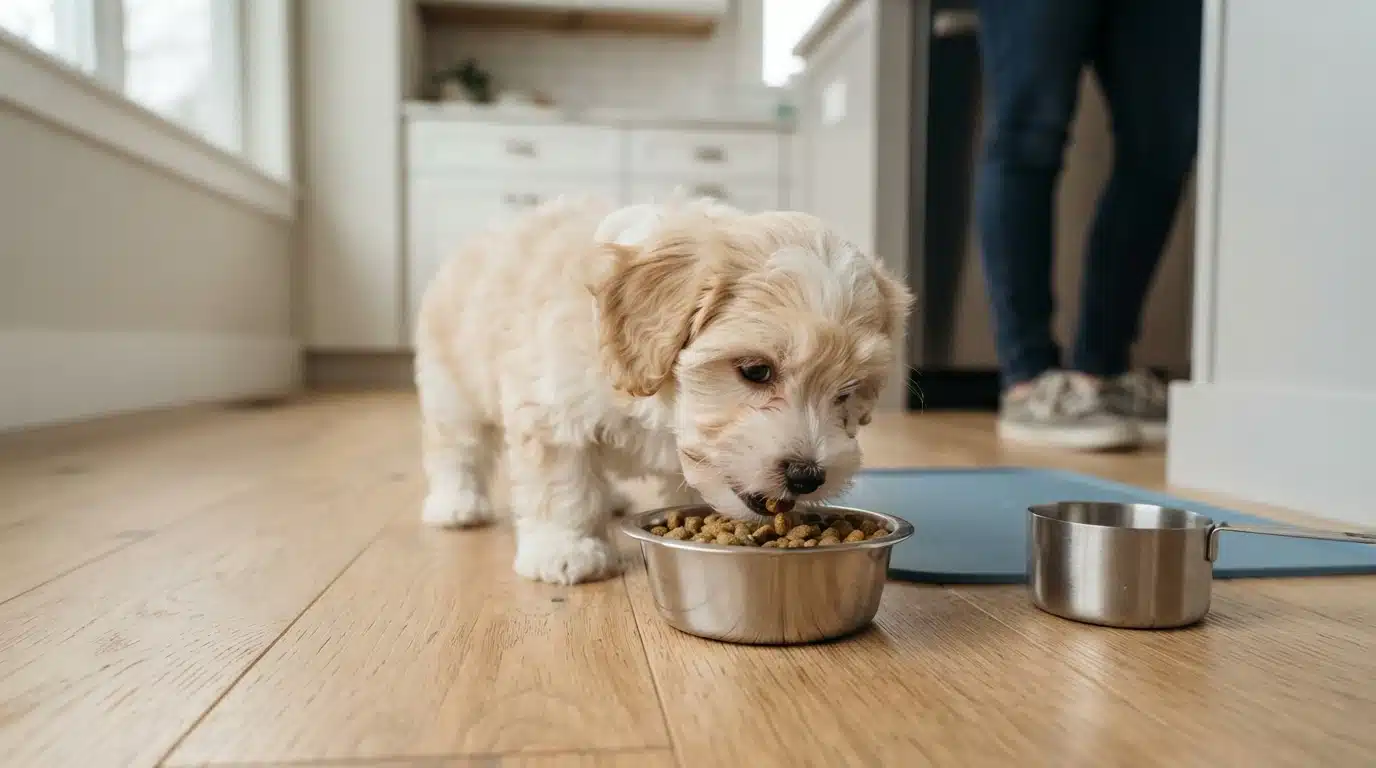
8 to 12 Weeks: Four Small Meals a Day
An 8 week old Havanese puppy eats about 3 tablespoons of dry puppy food per meal, four times a day, for a daily total of ½ to ¾ cup. Small, frequent meals keep blood sugar steady, which matters for toy breeds prone to hypoglycemia. A pup this young should never go long stretches without food.
3 to 4 Months: Meals Spread Slightly Further Apart
Drop to three meals, roughly morning, midday, and evening. Each meal grows to about ⅓ cup, so the daily total rises to ¾ to 1 cup even though meal frequency falls. Your puppy’s stomach is bigger now, and longer gaps between meals become safe.
4 to 6 Months: Growth Spurts and Bigger Portions
This is the hungriest stretch. Keep three meals but let portions climb to ⅓ or ½ cup each, around 1 to 1¼ cups total. Pedigree’s puppy feeding guidance notes younger puppies eat more often and toy breeds sit at the low end of daily ranges. Watch the ribs; a growth spurt is not a reason to free-feed.
6 to 9 Months: Moving Toward Two Meals
Somewhere in this window, shift from three meals to two. Per-meal portions reach about ½ cup, with daily totals holding near ¾ to 1¼ cups. Growth is slowing, so appetite may dip briefly. That is normal; stay with measured meals.
9 to 12 Months: Almost Adult, Not Quite
Most Havanese settle into two meals of ½ to ⅔ cup each, or 1 to 1¼ cups daily. Keep puppy food until your vet confirms adult switching makes sense, usually after the first birthday. For the full chart behind these numbers, see our Havanese puppy feeding chart by age and weight.
The Calorie Math Behind the Cup Amounts
Cup amounts are shortcuts. The real number behind them is calories, and once you see the math, you can check any bag on your own. A vet formula called resting energy requirement, or RER, gives each puppy a baseline: RER equals 70 times body weight in kilograms raised to the 0.75 power, then multiplied by a growth factor. According to PetMD’s calorie guide, growing puppies under four months use about 3 × RER, dropping to about 2 × RER after that.
How many calories does a small breed puppy need per day?
| Puppy Weight | Under 4 Months | 4 to 12 Months |
|---|---|---|
| 3 pounds | about 280 kcal/day | about 185 kcal/day |
| 4 pounds | about 325 kcal/day | about 220 kcal/day |
| 6 pounds | about 440 kcal/day | about 290 kcal/day |
| 8 pounds | about 550 kcal/day | about 365 kcal/day |
| 12 pounds | about 750 kcal/day | about 500 kcal/day |
Daily Calories for a Small Breed Puppy
Start with your puppy’s current weight, not their adult weight. A four-pound Havanese works out to roughly 325 kcal a day at eight weeks, while an eight-pound adolescent needs closer to 365. Toy breeds burn more per pound than big dogs, so Havanese feeding amounts look small on paper but pack a lot of energy into each ounce of food. Weigh your puppy every two weeks and redo the math as they grow.
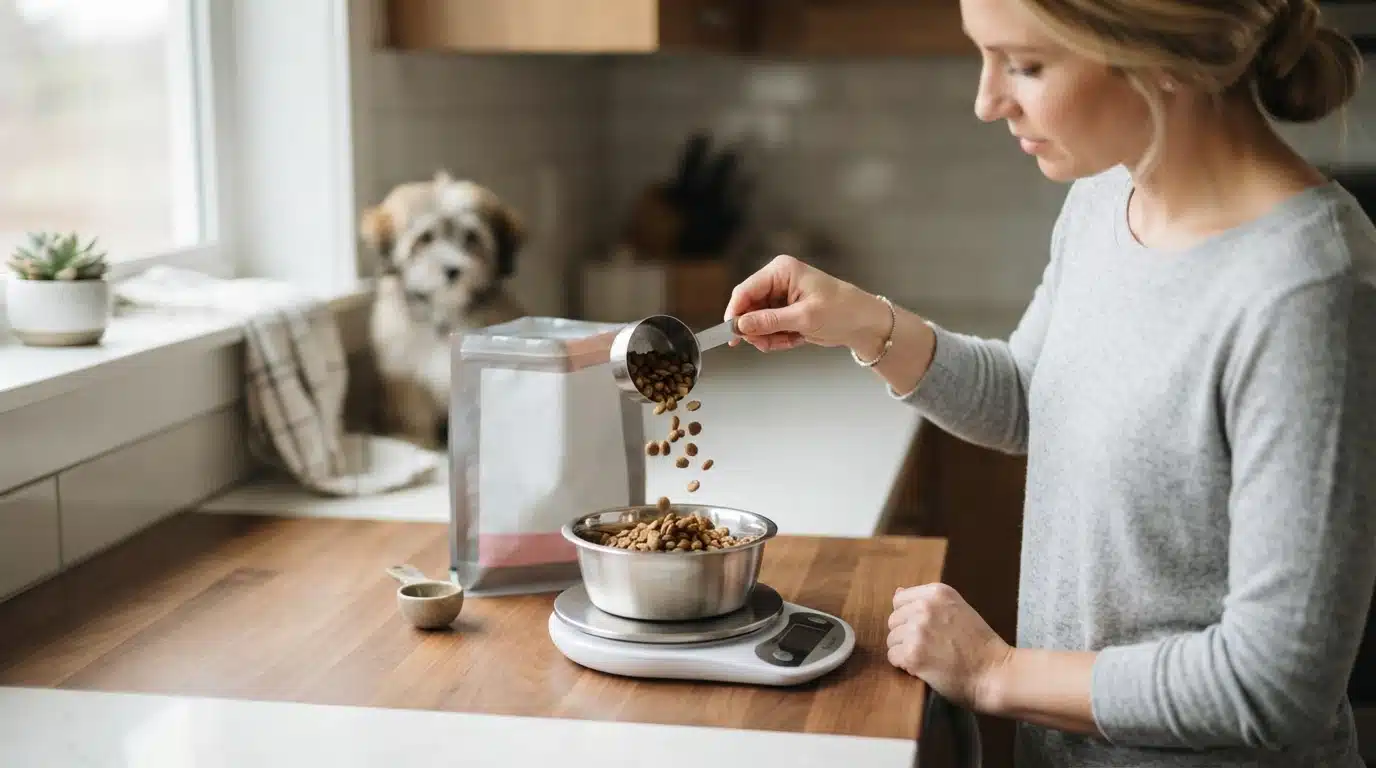
Reading the Bag and Finding kcal per Cup
Flip your food bag to the calorie statement, usually printed as “Metabolizable Energy (ME) = ____ kcal/kg.” Below it, the label lists kcal per cup. Most small-breed puppy foods run between 400 and 500 kcal per cup, which is denser than adult formulas. Divide daily calories by that number and you get the total cups per day, then split it across your puppy’s meals. If the math says 1 cup and the bag’s chart says 1.5, trust the math and adjust from your puppy’s body condition.
Why Weights and Cups Are Not the Same Thing
A “cup” means an 8-ounce measuring cup of kibble, but kibble weights vary by shape and density. One cup of small rounds can weigh 100 grams while a cup of large flakes weighs 80, yet hold similar calories. A kitchen scale removes that guesswork, which is why the feeding chart lists gram amounts alongside cups. Pick one method and stick with it so your adjustments reflect real changes, not measuring drift.
Measuring Portions So the Numbers Actually Hold
Measured, Timed, or Free Choice
Free feeding, where food sits out all day, is the easiest method and the worst one for a toy breed. Puppies who graze often overeat, and you lose track of intake if appetite drops. Timed meals with measured portions let you spot changes early, which matters for tiny puppies prone to low blood sugar. Measured, scheduled meals win for Havanese puppies.
A Simple Weigh-and-Split Routine
Use a digital kitchen scale, not a measuring cup. Cups vary by kibble shape, but grams do not. Weigh the day’s total once each morning, then split it into the day’s meals. A $15 scale removes most portion guessing.
Measure the full day’s food in one bowl, then divide it. That keeps every meal consistent even when you’re rushed.
Adjust weekly, not daily. Weigh your puppy, check the portion table, and shift grams only if ribs feel sharp or the belly looks tucked.
Where Treats and Chews Fit
Treats count toward daily calories. Keep them under 10 percent of the total, so a puppy eating 300 kcal per day gets no more than 30 kcal from extras. Break training treats into pea-sized pieces. Chews count too, so lighten the next meal on a heavy chew day.
How Many Meals a Day, and When
The Four to Three to Two Progression
A Havanese puppy’s meal count drops as it grows, and the pattern is simple:
- 8 to 12 weeks: four meals a day, spaced evenly.
- 3 to 4 months: three meals a day.
- 4 to 6 months: three meals, with bigger portions.
- 6 to 12 months: settle into two or three meals.
- After 12 months: most adults do well on two.
Small breeds need this gradual taper because tiny stomachs empty fast and blood sugar can dip. The exact portions at each stage live in the feeding chart above, so match frequency and amount together.
Sample Schedules You Can Copy
| Age | Schedule Example |
|---|---|
| 8 to 12 weeks | 7 a.m., 11 a.m., 3 p.m., 7 p.m. |
| 3 to 6 months | 7 a.m., 1 p.m., 7 p.m. |
| 6 to 12 months | 7 a.m., 6 p.m. |
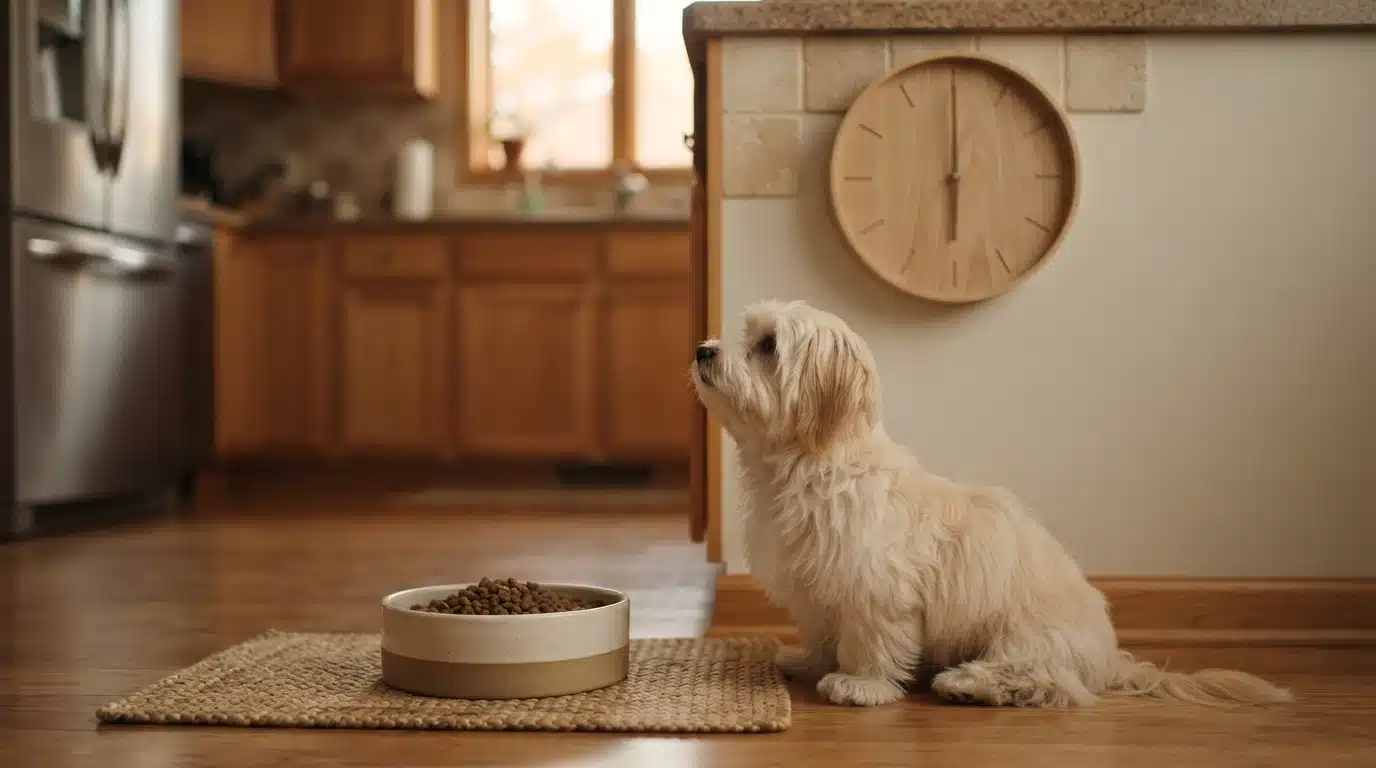
Pick times you can hold every day, including weekends. A predictable rhythm helps with house training too, because most puppies need a potty break shortly after eating.
Timing Meals Around Training, Walks, and Sleep
Leave a gap before and after activity. Feed the last meal two to three hours before bedtime, then a final potty trip, so the puppy can sleep through the night without an accident. Keep the evening meal calm and quiet rather than right before a car ride. If your breeder sent a feeding handoff, keep the same food and schedule for the first two weeks, then shift slowly to your plan.
Adjusting Portions as Your Havanese Grows
Body Condition Score in Plain Language
Your scale tells you what your puppy weighs. A body condition score tells you whether that weight is right. Vets use it, and you can too, in about ten seconds.
How do I know if my Havanese puppy is overweight? Run through this quick check:
- Ribs: You should feel them easily under a thin fat layer, like the back of your hand.
- Waist: From above, look for an inward curve behind the ribs.
- Tummy tuck: From the side, the belly should slope up toward the hind legs.
- Trouble signs: Ribs you can’t feel, or no waist at all, point to extra weight.
The VCA’s body condition guide compares a healthy dog’s ribs to the knuckles on the back of your hand, and overweight ribs to knuckles felt through a palm.
When to Increase or Decrease the Daily Total
Let body condition, not the food bag, drive your changes. If ribs and waist look right, keep the portion where it is, even if your puppy leaves a few kibbles behind. If you can’t find a waist, cut the daily total by about 10 percent for two weeks, then recheck. If ribs, hips, or spine bones show clearly and energy dips, add 10 percent. Change one dial at a time and give each adjustment a full two weeks before judging it, because growth spurts blur short-term results.
Reweighing and Growth Expectations
Weigh your puppy weekly on a kitchen scale until 6 months, then monthly. A healthy Havanese gains steadily, often a pound or two a month as a young puppy, then slows near a year. Most adults land between 7 and 13 pounds.
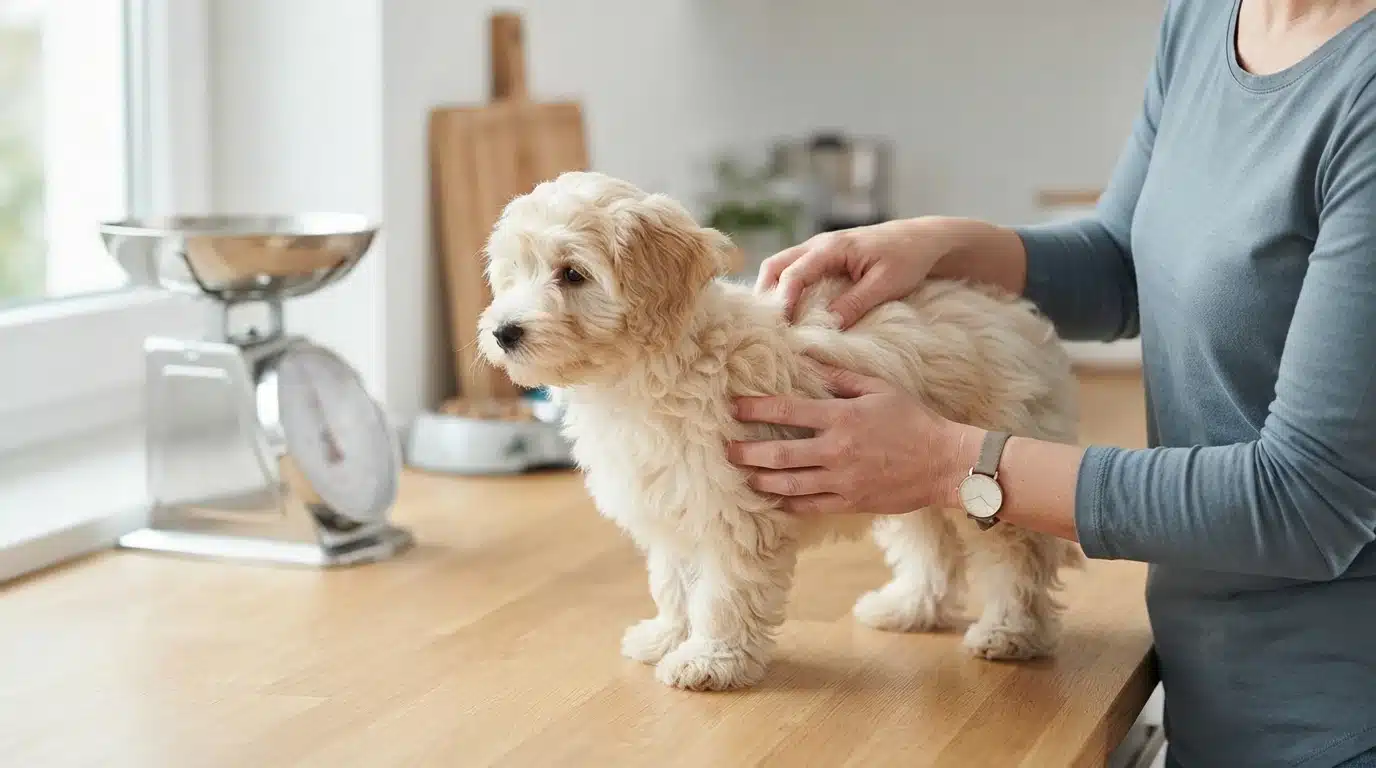
Record each weigh-in next to the daily cup total. If weight jumps fast while the waist disappears, trim portions. Slow, steady gain with a visible waist means the portions are working. Breeders like Sage Puppies send puppies home at a healthy weight, so your earliest weigh-ins give you a reliable baseline to grow from.
Feeding Problems You Can Solve This Week
When a Havanese Puppy Skips a Meal
One skipped meal is rarely an emergency. A healthy puppy may nibble less on a warm day, after a big play session, or during a growth pause. Offer the food, wait 15 minutes, then pick the bowl up. Watch energy first, appetite second. A bouncy puppy who skips one meal is fine; a quiet puppy who skips two needs a vet.
Loose Stool After a Food Change
How do I switch my puppy to a new food? Blend the two foods over 7 to 10 days:
- Days 1 to 3: 75% old food, 25% new
- Days 4 to 6: half and half
- Days 7 to 9: 75% new, 25% old
- Day 10: all new food
If soft stool appears, Cornell’s canine health center advises going back to the previous food until stool firms up, then moving more slowly. Call your vet if diarrhea lasts more than a day, or if you see blood, vomiting, or a puppy who goes limp or shaky, since toy breeds can slip into low blood sugar fast.
Fast Eating and Food Disinterest
Gulping food in seconds is common in small breeds. A slow-feeder bowl or spreading kibble on a flat tray fixes most of it. The opposite problem, fussing at the bowl, usually means too many treats or free feeding during the day. Stick to your portion chart, keep meals 15 minutes, and skip extra snacks. Hunger does the rest.

Still weighing kibble by guesswork? Skip the math and start with a puppy matched to your family. The team at Sage Puppies sends every Havanese, Havapoo, or Cavapoo home with a written feeding handoff, so you know the portions from the very first meal. Browse available puppies today.
Frequently Asked Questions
Q1: How much food should a Havanese puppy eat at each age?
Start at 2 to 3 tablespoons per meal four times daily from 8 to 12 weeks, ⅓ cup three times at 3 to 6 months, ½ cup by 6 to 9 months, then ½ to ⅔ cup twice daily after 9 months. Adjust by body condition.
Q2: Can a Havanese puppy skip a meal safely?
One skipped meal is usually fine if energy stays normal, but toy breeds can drop into low blood sugar. A quiet puppy skipping two meals needs a vet.
Q3: When should I switch my Havanese to adult food?
Most Havanese stay on puppy food until after the first birthday, then shift over 7 to 10 days with your vet’s approval.
Q4: How many calories does my puppy need per day?
A four-pound puppy under four months needs roughly 325 kcal daily; after four months, about 220. Check the bag’s kcal per cup and divide.
Q5: Do treats count toward daily portions?
Yes. Keep treats under 10 percent of calories, so a 300 kcal puppy gets no more than 30 kcal from extras, including chews.
Conclusion
Feeding a Havanese puppy comes down to small, measured meals that change with age. Start at 2 to 3 tablespoons, four times a day, from 8 to 12 weeks. Move to ⅓ cup three times daily between 3 and 6 months, then ½ cup portions as meals taper toward two by 9 months. Behind those numbers sits simple calorie math: weigh your puppy, check the bag’s kcal per cup, and adjust by body condition rather than the bag’s chart. Keep treats under 10 percent of daily calories, weigh weekly at first, and shift food slowly over 7 to 10 days. Steady weight gain with a visible waist tells you the plan is working. When you’re still choosing your puppy, knowing the signs of a good breeder helps you bring home a pup already on a healthy feeding track.