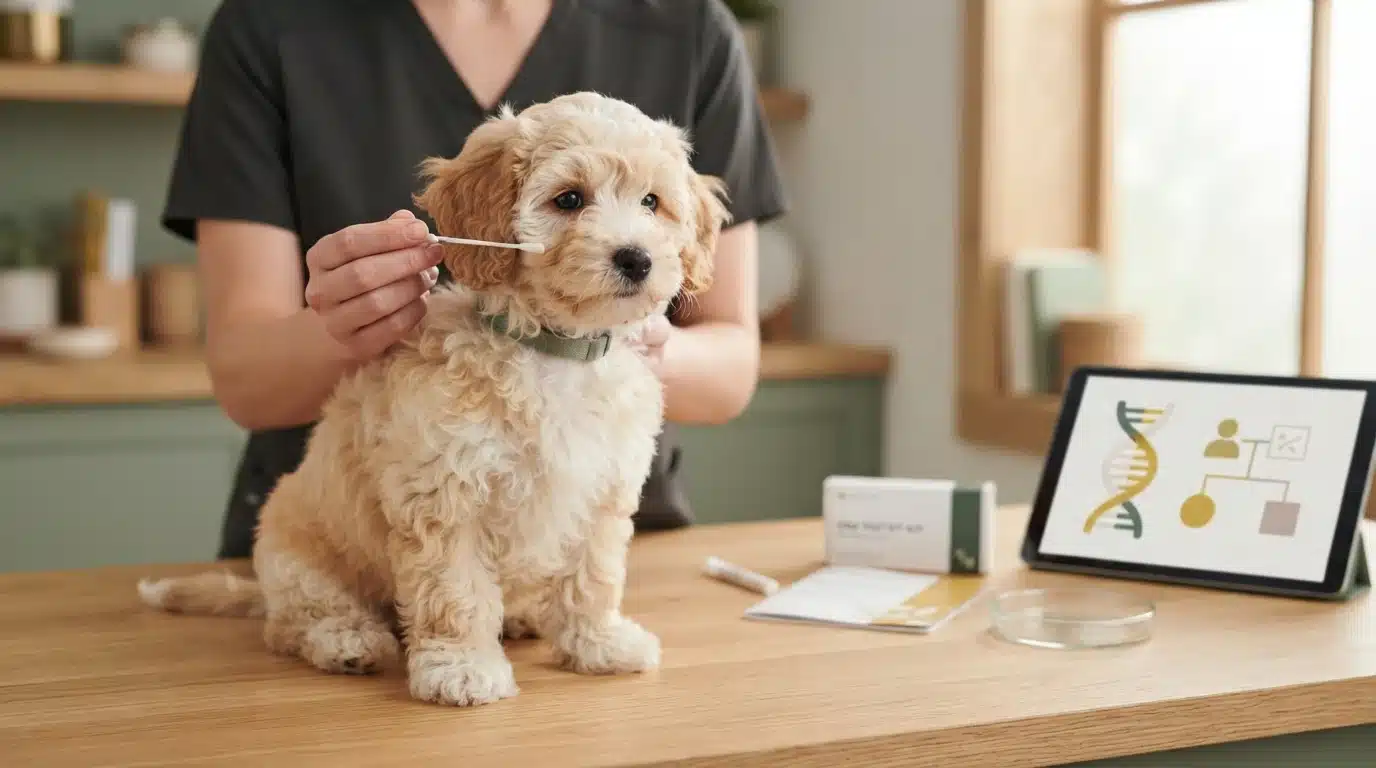
Quick Summary: Before paying a puppy deposit, verify both parents’ OFA numbers, CHIC records, full DNA reports, and the puppy’s vaccine and deworming records yourself. OFA results show a dog’s current physical health, while DNA results reveal inherited variants, and a CHIC number confirms required tests were completed but not that every result passed. Sage Puppies supports this approach by providing parent OFA and CHIC numbers, full DNA reports, and each puppy’s health records before a deposit is due.
Two breeders can say the parents are health tested and mean very different things. One can hand you an OFA number you can type into a public database in about 30 seconds. The other can only offer a screenshot of a lab email, with no way to confirm it belongs to that dog. That gap is where new puppy families lose the most money and peace of mind. This guide walks through OFA certification explained in plain language, how to read OFA hip scores, the difference between OFA and DNA reports, and a checklist to finish before you pay any deposit. We also show you how to verify OFA certificate records yourself, step by step, so nothing depends on trusting a sales page. At Sage Puppies in South Jordan, Utah, we document parent testing for every Havanese, Havapoo and Cavapoo litter, and we wrote this so you can check any breeder’s claims, including ours.
What OFA Records Actually Cover (and What They Do Not)
OFA Is a Set of Databases, Not a Single Test
The Orthopedic Foundation for Animals does not run one lab test. It keeps separate records for hips, elbows, knees (patellas), eyes, hearts, and hearing. Each result lives in its own database, so a dog can be OFA certified for patellas but have no hip record at all. When you verify a clearance, check which specific test the number covers. For the full picture, see our guide to buying a health tested puppy.
Phenotypic Screening Versus Genetic Testing
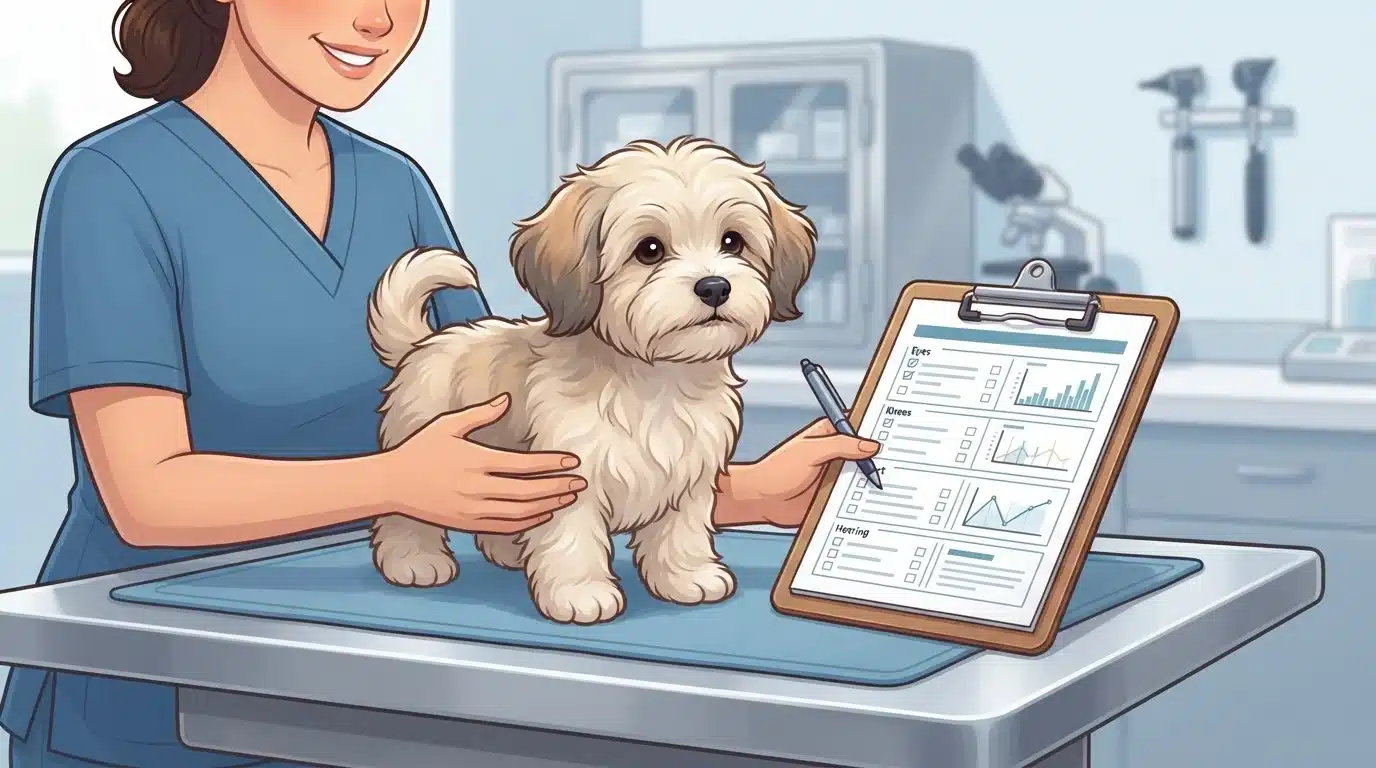
Most OFA exams are phenotypic, meaning they look at how the body actually looks or works today. Hip radiographs show joint conformation, and an eye exam checks current eye health. These results can change over time or differ between siblings. Genetic DNA tests work differently: they read the inherited genes themselves and stay the same for life. A dog can be eye-normal yet carry a gene for a hidden condition, so the two kinds of records tell you different things.
Why Parents Are Tested Instead of Puppies
Breeders screen adult breeding dogs because their results predict how health traits pass to offspring. Young puppies are still growing, so a hip X-ray at eight weeks tells you very little about adult joints. Eye and heart exams on parents can also catch inherited problems before a litter exists. Checking the parents’ OFA records is the most practical way to judge a puppy’s future health risk.
What Is an OFA Number and How Do I Verify It
An OFA number is a code the Orthopedic Foundation for Animals assigns to a dog that passed a health screening, such as hip, patella, cardiac, or DNA testing. Each number is public. Anyone can look it up in the OFA database, so a breeder’s claim is easy to check in about 30 seconds.

How to Read an OFA Number
Every number follows the same pattern. Take a hip example like HA-123E24F-VPI. The breed code comes first, HA for Havanese. The digits are the dog’s registry number, then a grade letter: E for excellent, G for good, F for fair. Next comes the age in months at testing, then the sex, and finally a suffix. VPI means a vet verified the microchip or tattoo; NOPI means the dog had no permanent ID. The OFA publishes a full key to these codes.
The Five-Step OFA Database Check
- Ask the breeder for the OFA numbers for both parents and which tests each covers.
- Go to the OFA advanced search page.
- Enter the dog’s registered name, number, or breeder.
- Open the record and confirm the breed, sex, age, and results match what you were told.
- Repeat for both parents and save screenshots before you pay a deposit.
When the Record Does Not Show Up
A missing record is not always a red flag, but it deserves a question. Results can take weeks to post after testing. Dogs tested young, before the age OFA requires for a permanent hip grade, may only carry a preliminary rating. If nothing appears at all, ask for the actual report or vet paperwork. A breeder who refuses to document results is telling you something. The full process of checking a puppy’s health test results before buying is worth the extra hour.
Reading OFA Hip Scores: What Each Grade Means
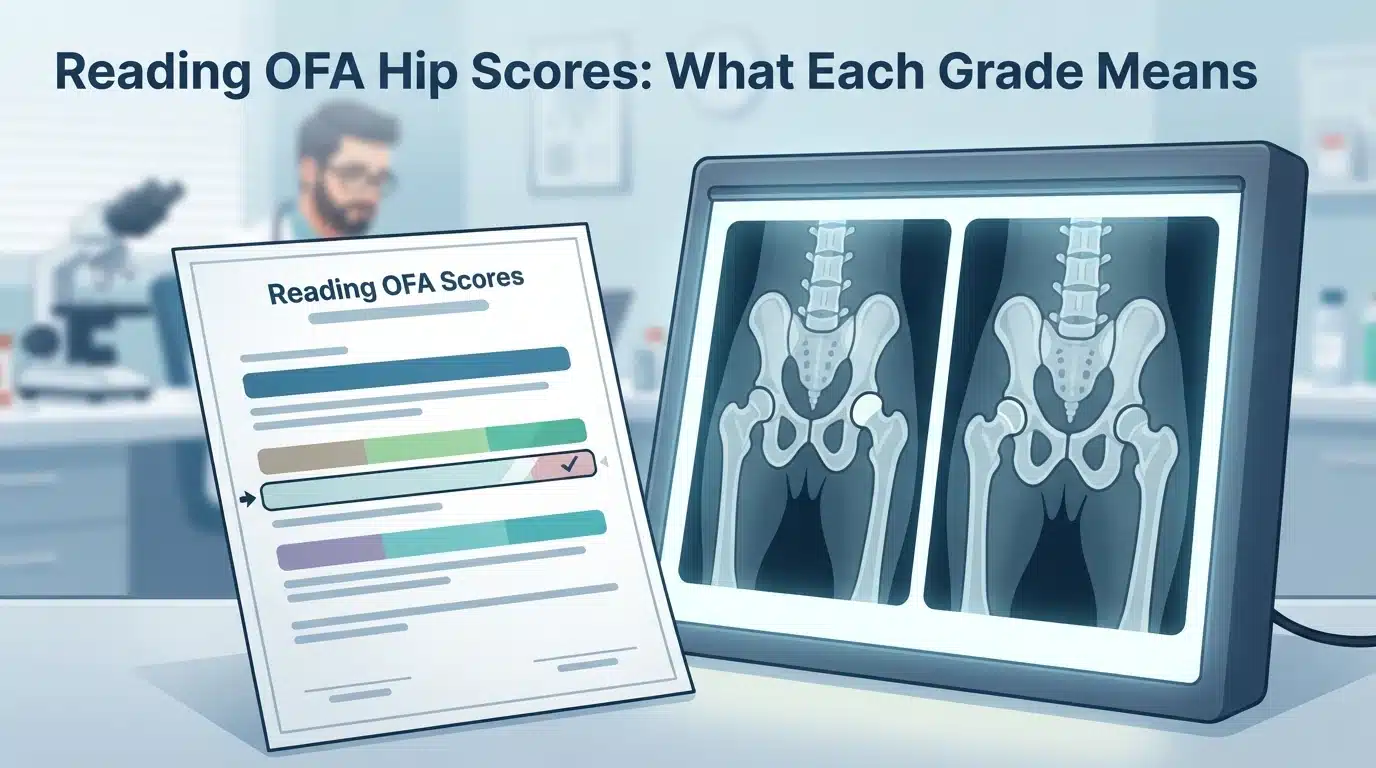
OFA hip scores fall into seven grades: Excellent, Good, Fair (passing), Borderline, and Mild, Moderate, Severe dysplasia (failing). A radiologist compares each hip joint to breed standards and assigns one grade per dog.
| Grade | What It Means |
|---|---|
| Excellent | Tightest, healthiest hip fit for the breed |
| Good | Normal, well-formed joint with solid fit |
| Fair | Slightly looser fit, but still passing |
| Borderline | Not clearly normal; cannot be verified as passing |
| Mild to Severe | Dysplasia present; joint is loose or malformed |
Who Performs the Evaluation and Why It Matters
Board-certified veterinary radiologists read the X-rays, not the breeder’s own vet. Three radiologists review each set independently, and the OFA publishes the consensus grade in a searchable public database. That independence is the whole point: anyone can verify a hip result rather than taking a breeder’s word for it.
What a Passing Hip Score Does Not Tell You
A passing grade covers hips only. It says nothing about elbows, eyes, heart, or patellar luxation, and it is not a guarantee. Dysplasia has genetic and environmental parts, so even excellent parents can produce a dog with loose joints if a puppy grows too fast or gains too much weight. Ask for a full OFA or CHIC record listing every test a parent completed, and treat hip scores as one piece of the picture. Good programs, including small ones like ours, share complete parent records rather than one highlight grade.
OFA Certification Explained: CHIC Numbers, OFA Numbers and Clearance Letters
What a CHIC Number Means for a Dog
A CHIC number means a dog has completed every health test its breed club requires and the owner agreed to publish the results, even the failing ones. It does not mean every result passed. So a CHIC number proves the testing was done, not that the dog is free of disease. Always open the record and read each result before you trust it. That step is part of vetting a health tested puppy the right way, and it takes under a minute once you know where to look.
CHIC Number Versus OFA Clearance Versus OFA Number
The three terms get mixed up constantly, but they mean different things:
| Term | What it is | What it proves |
|---|---|---|
| OFA number | One result for one test, like HA-123E24F-VPI | That single evaluation, with its grade |
| OFA clearance | A passing result, such as hips rated good or excellent | The dog passed that one screen |
| CHIC number | A record number issued after all breed-required tests are done | Testing is complete and public, passing or not |
How to Read a CHIC Certificate You Did Not Request Yourself
Ask the breeder for the CHIC number, then type it into the search bar at ofa.org. The record lists each test, the date, the result and how the dog was identified. Match the registered name and birth date to the puppy’s paperwork so you know you are reading the right parent. If a required test shows “pending” or is missing, the number is not complete yet. Ask why before you send a deposit.
A clearance letter is just the paper copy of one OFA result. The database is the source of truth, so trust the record over the PDF.
OFA vs DNA: What Each Test Answers About a Dog
The Core Difference in One Paragraph
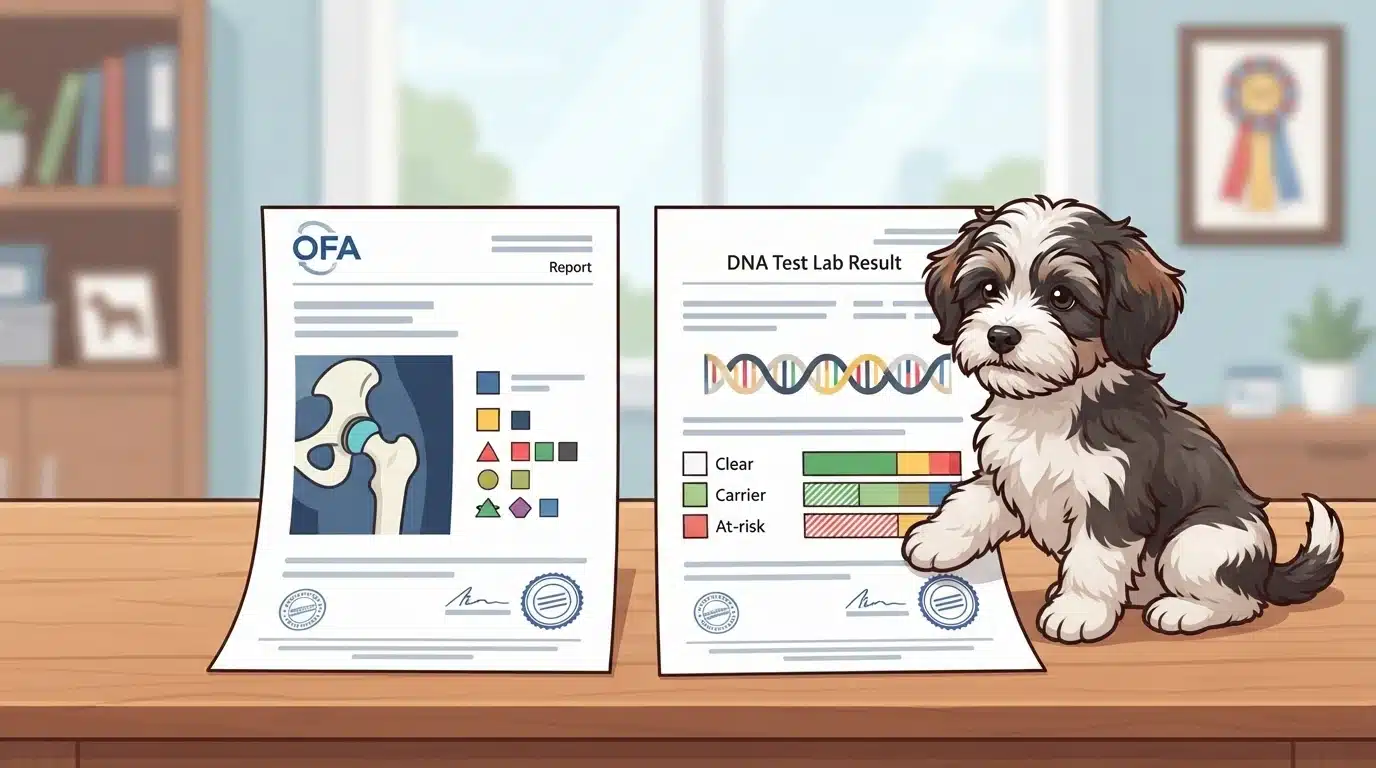
OFA and DNA testing answer different questions. An OFA evaluation looks at the dog’s body: trained vets read hip dysplasia radiographs or check kneecaps and eyes, then assign a grade. A DNA test looks at the dog’s genes: a lab scans cheek-swab cells for variants tied to inherited diseases. So OFA tells you how a dog is built today, while DNA tells you what it can pass on.
| Question | OFA Answers | DNA Answers |
|---|---|---|
| What it examines | Physical structure: hips, knees, eyes, heart | Genetic variants for inherited disease |
| Result type | A graded number, like HA-123E24F-VPI | Clear, carrier, or at risk per condition |
| What it proves | How this dog scored on that exam day | Which gene variants the dog carries |
| What it cannot prove | Future joints or offspring outcomes | That the dog is free of every disease |
What Each Result Can and Cannot Prove
An OFA number is one snapshot. A dog rated good for hips at two years old could still develop joint problems later, and the grade never guarantees a puppy’s hips. It proves the parent dog was screened by credentialed specialists, which lowers risk for its litter.
A DNA report works the other way. A “clear” result covers only the conditions on that panel; a carrier result is normal for many breeds, since it matters most when both parents carry the same variant. Neither test alone proves a puppy will be healthy for life, so you want both in the parent dog health testing records before you reserve. Sage Puppies shares both sets of results for the parents of every litter.
Breed Relevance and Approved Laboratory Status
Both tests matter more in some breeds than others. Havanese breeders commonly screen for patellar luxation, heart, eyes, and hearing, plus DNA conditions such as Juvenile Dilated Cardiomyopathy. Cavapoo and Havapoo families should ask about testing on both parent breeds.
For DNA work, use labs listed as approved by OFA’s DNA program, such as Embark, so results can be posted publicly. Beware of “vet checked only” listings with no lab results at all; a stethoscope exam is not genetic screening, and it is not orthopedic screening either.
How to Read a Puppy DNA Test Report from Embark or Wisdom Panel
A DNA report boils down to four things: the breed mix, the list of tested conditions, the result for each one, and the pedigree. To read it fast, scan for:
- Breed ancestry – the percentage breakdown by breed
- Health conditions tested – the panel of genes the lab screened
- Each result – clear, carrier, or at risk
- Age and sample details – confirmation the sample belongs to your dog
The Vocabulary on the Report
Three words carry most of the meaning. Clear means the dog carries no copies of the mutation for that condition. Carrier means one copy, usually harmless for the dog itself, but it can pass to puppies if the other parent is also a carrier. At risk means the dog carries the gene variant linked to the condition. Ask your breeder to explain any result you do not understand.
Finding the Parts That Matter
Start with the conditions most relevant to your breed. For Cavapoos and Havapoos, look for results on progressive retinal atrophy and degenerative myelopathy, since poodle and cavalier lines can carry these. Patellar luxation is evaluated by a vet, not a DNA test, so do not expect it here. We confirm both parents’ DNA results before matching a puppy, because a clear puppy starts with clear parents.
Embark Versus Wisdom Panel and Why the Lab May Differ
Embark and Wisdom Panel both run validated genetic panels, so a report from either lab is trustworthy. Differences come down to scope: Embark tests more than 250 health conditions and screens breed ancestry more deeply, while Wisdom Panel covers around 200-plus conditions with a slightly different breed reference database. Some breeders use one lab for dams and another for sires, which is fine as long as every result is clear or the pairing is planned safely. Ask which lab was used and request the full report, not a summary screenshot. For a deeper look at how testing fits into a purchase, our guide on buying a health tested puppy locally walks through the full evaluation.
Your Pre-Deposit Health Document Checklist
What should you check before paying a puppy deposit? Ask for these five items, then verify each one yourself:
- The parent dogs’ OFA clearance numbers, including hips and patellas
- Their CHIC numbers, which confirm the breed’s required tests were done
- The DNA reports, such as Embark or Wisdom Panel, for both parents
- The puppies’ own records: deworming dates and first vaccines
- A written health guarantee or return policy
Collect all five before money changes hands.
Run the Check in This Order
Start with the OFA numbers. Type each one into the OFA’s advanced search and confirm the name, breed, and grade match what the breeder told you. Then check the CHIC number, since a CHIC listing shows every required test on file, including abnormal results. Next, open the DNA reports and note the conditions tested, not just the words “DNA clear.” Finally, read the puppy’s own vaccine and deworming records and ask your vet to review them. If a breeder resists sending any of these, treat that as your answer. The full process of checking health test results before you buy takes under an hour.
Questions That Sound Specific (Because Vague Answers Are Common)
Ask “what are the parents’ OFA numbers for hips and patellas?” rather than “are the parents health tested?” Vague breeders answer the second with “yes, of course.” A good breeder answers the first with numbers you can look up in seconds. Also ask which DNA conditions were tested and whether any parent is a carrier.
Requesting Records Through Sage Puppies
At Sage Puppies, Cassie shares parent OFA and CHIC numbers, full DNA reports, and each puppy’s health records as part of the matching process, before a deposit is due. If you are comparing breeders, request the same set from each. Any program confident in its testing will send these without hesitation, and that reply tells you as much as the documents themselves.

Now you can read an OFA number, spot the difference between a CHIC number and a real clearance, and check a DNA report on your own. Put those skills to work before you pay any deposit. Ready to see how a small program shares its testing openly? Meet Cassie and the Sage Puppies families today.
Frequently Asked Questions
Q1: What is an OFA number and how do I verify it?
It’s a public code for one passed test, like HA-123E24F-VPI. Enter the dog’s registered name at OFA’s advanced search page and confirm the breed, grade, and age match the breeder’s claim.
Q2: How do I read a puppy DNA test report from Embark or Wisdom Panel?
Scan for breed ancestry, the conditions tested, and each result: clear, carrier, or at risk. A carrier matters only if both parents share the same variant.
Q3: What does a CHIC number mean for a dog?
It confirms all breed-required tests were completed and published, even failing ones. Open the record and read every result before trusting it.
Q4: What hip grades count as passing?
Excellent, Good, and Fair pass. Borderline and Mild through Severe do not.
Q5: Why test parents instead of the puppy?
Puppies are still growing, so adult joint problems can’t be predicted at eight weeks. Parent results lower litter risk.
Q6: What if a record doesn’t appear in the OFA database?
Ask why. Results take weeks to post, young dogs may carry prelims only, and a refusal to document is its own answer.
Conclusion
An OFA number is a public, verifiable code for one test, and you can confirm it yourself in about 30 seconds. Hip grades run from Excellent through Severe, with only the top three passing. A CHIC number proves testing was completed, not that every result passed. DNA reports add the other half of the picture, showing which gene variants each parent carries. Before any deposit, collect both parents’ OFA and CHIC numbers, their full DNA reports, and the puppy’s own health records, then verify each one in the source database. Breeders who share complete parent dog health testing without hesitation are showing you exactly how they work, and that openness matters more than any single grade on paper.