Quick Summary: Before buying a Cavapoo, verify each parent’s health results directly, meet the dam when possible, and ask about temperament, socialization, costs, contracts, deposits, and delivery. A careful breeder provides written answers, allows visits, and stays available after pickup, while vague responses or pressure to pay quickly are reasons to keep looking. Sage Puppies in South Jordan, Utah, emphasizes small, health-tested litters, transparent records, temperament-based matching, and continued support after the puppy goes home.
Two breeders can both say their parents are health tested, and one still gives you far more useful information than the other. The difference? One hands you the actual patella, cardiac and eye results for the sire and dam in front of you. The other just repeats the phrase.
This guide gives you 12 Cavapoo questions, grouped into four areas: health testing records you can verify, parent dogs and temperament, money and contract terms, and go-home logistics. They cover everything from mitral valve screening on the Cavalier side to deposit and delivery plans.
As Cassie Milar, founder of Sage Puppies in South Jordan, Utah, I wrote these puppy questions for first-time small-breed families. Ask them, expect written answers, and you will quickly tell a careful breeder from a confident one.
Health Screening: What to Ask for on Both Parent Lines
Health questions are the cavapoo questions families get wrong most often, because a Cavapoo has two different breed lines and each one carries its own risks. A good answer to “what health testing should I ask a Cavapoo breeder for?” names the screenings by parent breed:
- Cavalier line (dam or sire): cardiac screening for mitral valve disease, patellar luxation, hip evaluation, and an eye exam
- Poodle line: patellar luxation, hip evaluation, eye exam, and a PRA DNA test for progressive retinal atrophy
If a breeder gives you one generic list for “the parents,” ask which tests belong to which dog.
Which health tests have the sire and dam had, and which of them apply to a Cavapoo?
Ask about each parent by name. The Cavalier King Charles Spaniel Club’s testing guide calls for a cardiac exam for mitral valve disease, a patella evaluation, and an OFA hip X-ray, while ACKCSC’s CHIC requirements add an eye exam. For the Poodle side, patellar luxation, hips, eyes, and PRA DNA status matter most. Both parents should have both patella and eye results, since those risks pass down regardless of which line they came from.
Can I see the actual results, and how do I verify them?
Do not settle for “they’re health tested.” Ask for the paperwork, then check it yourself. OFA results are public: search the OFA database by the dog’s registered name and confirm the cardiac, patella, hip, and eye entries match what the breeder claimed. For DNA tests, ask for the actual lab report showing the dog’s name, not a screenshot of a summary. If a parent has no OFA listing, ask why. Some young dogs are simply pending, but “we don’t do that” is your cue to walk. We break down this process step by step in our guide to verifying a breeder’s health testing.
What health records and vet care will my puppy have before go-home?
Your puppy should arrive with a vet exam record, age-appropriate vaccines, deworming history, and a microchip. Ask when the puppy last saw a vet and who examined it. Request the packet in writing before pickup or delivery day, and read your contract’s health terms before you pay the deposit. For the broader picture, our beginner’s guide to cavapoo puppies covers what to expect in the first weeks home, so health records are one piece of a bigger plan rather than the whole plan.
Parents, Temperament, and Early Socialization
Can I meet the parent dogs, and what does the breeder’s own observation reveal?
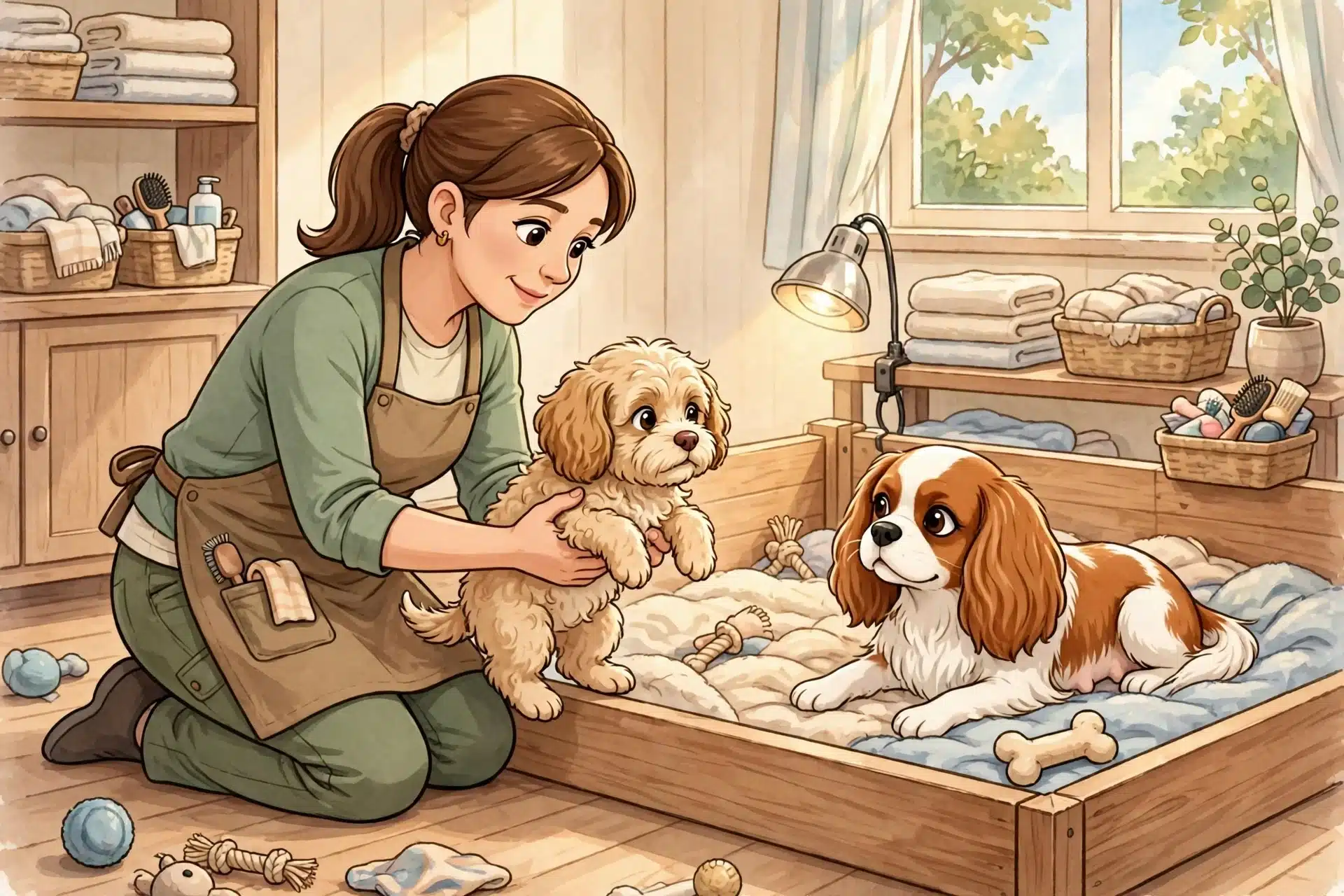
Yes, in most cases you can meet the mother. A good breeder invites you to meet the dam and see where the puppies live, and reputable programs encourage visits. If the sire lives elsewhere, ask for photos, videos, and a video call instead. If you cannot visit at all, ask the breeder to record a live walk-through of the puppies’ space. This is one of the most revealing Cavapoo questions you can ask.
Then go beyond the visit. Ask what the breeder has observed: How does the dam react to strangers, vacuum cleaners, and handling? Which puppies in the litter are bold, and which are cautious? A breeder who lives with the litter daily should answer easily. Vague answers are a signal to keep looking.
What is each parent’s temperament, and what will this puppy’s temperament be?
Among the most useful Cavapoo temperament questions is this one: ask about each parent separately. The Cavalier King Charles Spaniel side tends to be soft, affectionate, and people-focused. The Poodle side is often brighter, busier, and more sensitive to noise. Knowing which parent contributes what helps you picture adult behavior.
Ask specifically: “How would you describe the dam in three words, and the sire in three?” Then ask which of those traits the puppies are showing already. No breeder can promise an exact personality. Temperament is shaped by both genetics and the first eight weeks of life, so pair what you hear with the socialization answer below. A thoughtful puppy matching process, like the owner-managed approach at Sage Puppies, uses these observations to pair families with the right pup.
How are Cavapoo puppies socialized before they go home?
Ask the breeder to describe a normal day, and listen for observable items:
- Handling: puppies picked up daily, paws, ears, and mouths touched
- Novel sounds: vacuums, doorbells, TV, children playing
- New surfaces: carpet, tile, grass, and wobble boards
- People: visitors of different ages, if health protocols allow
- Problem-solving: toys that move, food puzzles, mild challenges
Puppies kept in quiet, bare pens miss this window. If you are new to the breed, our beginner’s guide to your first dog covers what the first weeks home should build on.
Daily Life, Cost, and Support After Go-Home
The purchase price is only the entry point. These three questions cover what a Cavapoo asks of you every week, what the first year really costs, and who helps you when questions come up at 9 p.m.
What will grooming, exercise and training actually require?
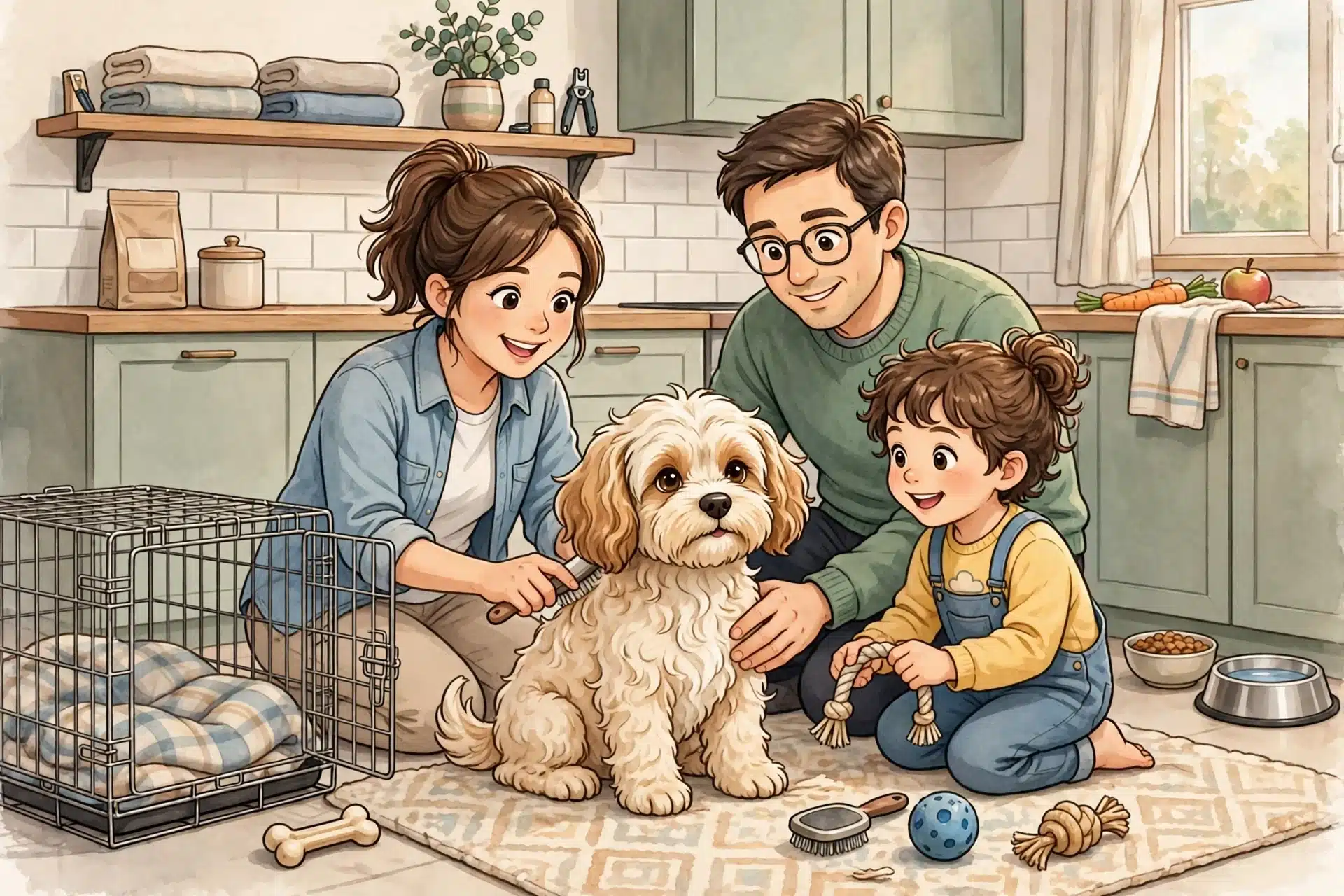
A Cavapoo’s wavy coat grows continuously, so plan on brushing several times a week and a professional trim every 6 to 8 weeks. Skip that and mats form behind the ears and under the collar fast. Exercise needs are modest: two short walks and a play session cover most adults. Puppies need more naps than zoomies. Training is the real commitment. House training, crate training and early socialization take consistent daily effort during the first few months, and the breed’s eager-to-please nature rewards it. Ask the breeder what routine the puppy already knows, from crate habits to the food it eats, so week one at home feels familiar instead of brand new. Our beginner’s guide to a first Cavapoo walks through that early routine in detail.
What will the first-year costs look like beyond the purchase price?
Budget for three buckets: one-time setup, routine care and surprises. The American Kennel Club puts average one-time costs, such as a crate, spay or neuter surgery and initial supplies, at about $2,100, with annual costs around $2,500 for food, grooming and vet visits. First-year puppy estimates run lower on some lists, roughly $740 to $1,325, but those figures assume fewer surgeries and less grooming. Your numbers will vary by vet pricing and whether you do grooming at home. Add pet insurance quotes to your comparison, since a Cavalier-mix puppy benefits from early coverage before any condition is documented. Ask each breeder what their contract covers, such as a health guarantee window, and write those terms into your notes.
What support is available after go-home, and how is progress shared?
A good breeder does not disappear at pickup. Ask three things: how you reach them, how fast they respond, and what they share after go-home. Strong programs send photos and weight updates while the puppy waits, then stay available for feeding, training and health questions in the months that follow. If you are comparing breeders, put support terms in writing before you place a deposit. At Sage Puppies, Cassie stays in touch with every puppy family after go-home, and that continued contact is worth asking about anywhere you buy.
Price, Contract, Reservation and Pickup Terms
How much does a Cavapoo puppy cost? Expect roughly $3,500 to $4,500 from a small, health-tested program like Sage Puppies’ pricing and reservation page lists. That figure usually covers the puppy itself, first vaccines, a vet exam and microchipping. Grooming gear, food and your first vet visit get billed separately, so budget for both piles.
What is the exact price, and what is included or billed separately?
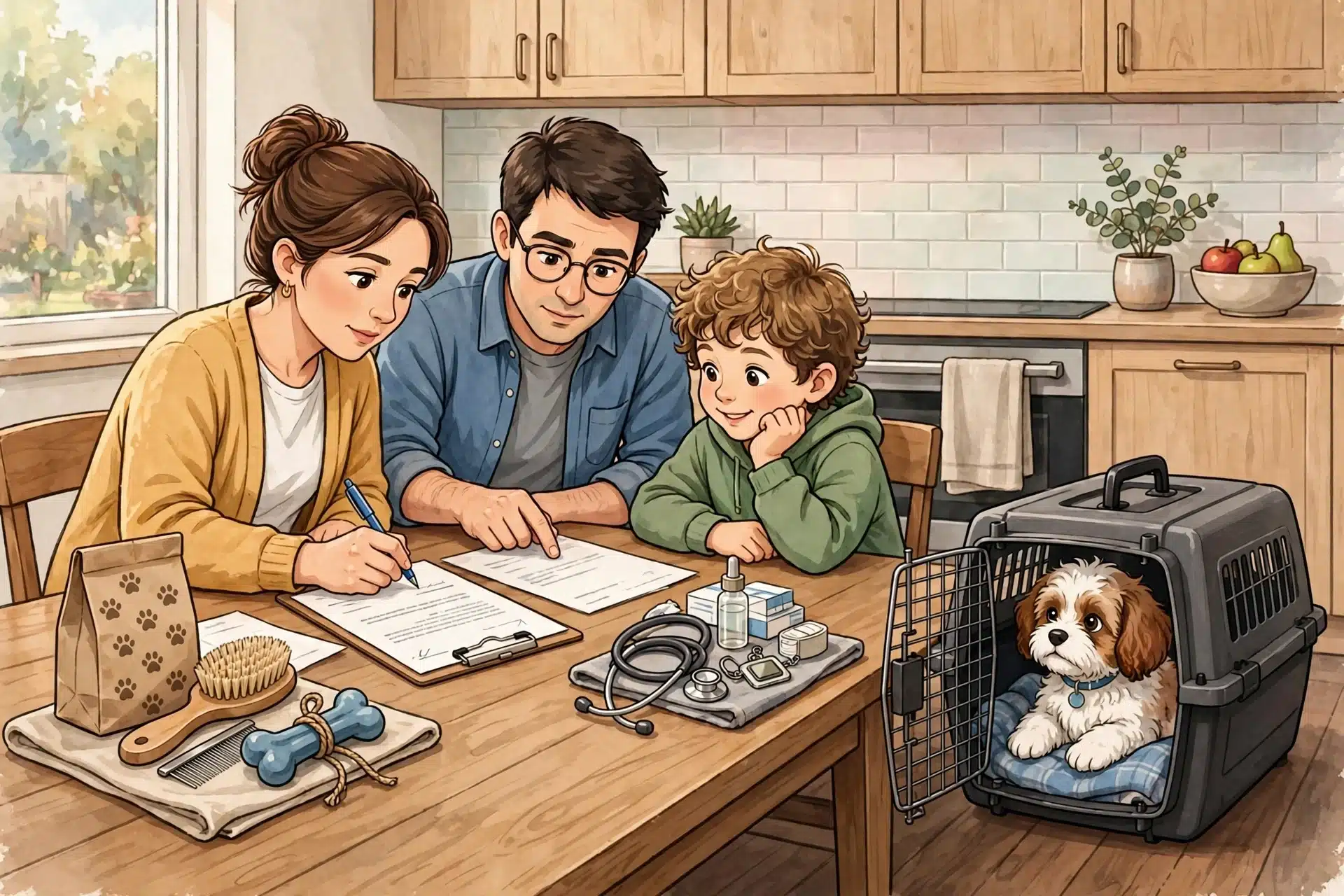
Ask for the total in writing before you send money. Some breeders charge more for certain coat colors or for breeding rights, and that should be stated up front. Confirm what the price includes: shots, deworming, microchip, a starter bag of food, maybe a health record folder. Then ask what is not included, such as spay or neuter surgery, delivery fees or sales tax. A written breakdown takes five minutes and prevents surprise invoices later.
What do the deposit, reservation and contract terms actually say?
Deposits typically range from a few hundred dollars to half the purchase price, and the refund rules vary widely. Read three things closely before you sign.
- Refund policy. Is the deposit refundable if you change your mind, or only if no healthy puppy matches your spot on the waitlist?
- Health guarantee. Look for a written window, often one to two years, covering serious genetic conditions, plus what proof the breeder requires from your vet.
- Spay or neuter clause. Many contracts require it by a set age. If you disagree, ask before reserving, not after.
Ask the breeder to send the contract as a PDF so you can read it calmly at home. Never wire a deposit against a verbal promise alone.
How will pickup or delivery work, and what happens on go-home day?
Local families usually pick up at the breeder’s home, which lets you meet the dam and see where the litter was raised. Out-of-state families often use a flight nanny or ground transport, and that fee is almost always separate. Ask who travels with the puppy, how long the trip lasts and what food to have ready. On go-home day you should leave with vet records, feeding instructions and a small comfort item that smells like the litter. Sage Puppies handles pickup in South Jordan, Utah, and arranges delivery for families farther away.
How does the application and matching process work before I can reserve?
Most boutique programs start with an application, not a shopping cart. You describe your home, schedule and experience, then the breeder matches you with a puppy whose temperament fits. Only then does a deposit lock your spot.
Common Mistakes to Avoid When Asking These Questions
A good question list fails fast when you ask it badly. Watch for these slips before you put down a deposit.

- Asking yes-or-no questions. “Are the parents healthy?” invites a yes. Ask instead, “What cardiac clearances do the dam and sire have, and can I see the reports?” Written answers give you something to check.
- Accepting screenshots as records. A photo of a certificate is easy to fake or crop. Look up each dog yourself on the OFA website by registered name, so the results come from the source.
- Treating Cavalier and Poodle testing as one thing. Cavaliers need cardiac and patellar screening; Poodle lines bring different concerns. A breeder who lumps them together may have skipped one side.
- Letting excitement rush the deposit. A breeder who pressures you to reserve before records arrive is telling you something. Ask first, pay second.
- Ignoring the contract until go-home day. Read health guarantee and spay or neuter terms while you can still walk away.
Good programs welcome verified questions, so treat hesitation as data.

You have the questions. Now find the puppy behind the answers. Sage Puppies raises Cavapoos in small, health-tested litters in South Jordan, Utah, and shares records before you commit. Browse the application, ask anything, and take your next step toward a well-matched companion.
Frequently Asked Questions
Q1: What health testing should I ask a Cavapoo breeder for?
Ask for cardiac screening for mitral valve disease and patellar, hip, and eye results on the Cavalier side, plus a PRA DNA test on the Poodle side. Verify each result in the OFA database by the dog’s registered name.
Q2: Can I meet the parent dogs of a Cavapoo puppy?
Usually yes, at least the dam. Reputable breeders invite visits. If the sire lives elsewhere, request photos, videos, and a video call instead.
Q3: How are Cavapoo puppies socialized before going home?
Look for daily handling, novel sounds, varied surfaces, and visitors. Ask the breeder to describe a normal day for the litter.
Q4: How much should a Cavapoo puppy cost?
Expect roughly $3,500 to $4,500 from a small, health-tested program. Get the written total, including what is billed separately.
Q5: Is the deposit refundable?
Refund rules vary widely, so read the contract before paying. Some deposits apply only if no healthy puppy matches your waitlist spot.
Conclusion
Twelve questions, four themes: verified health records, parent temperament and socialization, real costs and contract terms, and go-home logistics. The strongest buyers treat these Cavapoo puppy questions as a checklist, not a conversation. Ask which cardiac, patellar, hip, eye and DNA tests apply to each parent, then confirm the results yourself in the OFA database instead of trusting a screenshot. Get the price, deposit rules, health guarantee and delivery plan in writing before money changes hands. A breeder who answers openly, welcomes a visit to meet the dam, and stays available after pickup is showing you how the whole relationship will work. Vague answers and rushed deposits are your cue to keep looking.