Quick Summary: A credible “health-tested” claim requires three kinds of records: the puppy’s vaccination and deworming history, veterinary screenings of both parents for heart, eye, and joint disease, and DNA reports covering variants from both parent breeds. Buyers should request copies before paying a deposit, verify OFA or CHIC results online, and remember that a CHIC number only confirms testing and publication, not that every result was normal. For Havapoo and Cavapoo litters, Sage Puppies advises checking both breeds’ risks and requiring documentation from each parent rather than accepting vague verbal claims.
Two breeders can both say the words health-tested and mean completely different things. One is showing you a vet certificate for the puppy’s first checkup. The other is pulling up a parent’s OFA hip evaluation, a patella certification, an annual eye exam, and a DNA panel, each with a number you can look up yourself.
That gap is the problem. A first vet visit is a snapshot, not a screening program, and the difference matters most with small breeds prone to luxating patellas, eye disease, and inherited heart conditions. This guide lays out the health test results to request before you place a deposit, explains how each record works, and shows which health test results to request for Havanese, Havapoo, and Cavapoo litters specifically. Keep the checklist handy, and you will know exactly which health test results to request from any breeder you talk to.
The Three Layers of Health Evidence Buyers Should Ask For
Which health test results should breeders show buyers? Three kinds, in this order:
- The puppy’s veterinary record, proving this puppy got its exams and shots.
- Parents’ clinical screening results, proving the adults were checked by vets for heart, eye, and joint disease.
- DNA variant results, proving the parents were tested for inherited gene variants before breeding.
Each layer answers a different question, so no single document covers all three.
Layer One: The Puppy’s Own Veterinary Record
This is the easiest layer to get and the most often skipped. Ask for a health certificate or exam record dated within about ten days of pickup, plus vaccination and deworming records showing dates and product names. This record only describes one puppy at one moment. It says nothing about inherited risk, so treat it as a starting point, not proof the line is healthy.
Layer Two: Parents’ Clinical Screening Results
Next, ask what a veterinarian actually examined on each parent. For small breeds, the key items are cardiac screening, patellar luxation certification, and eye exams by a veterinary ophthalmologist. Timing matters: OFA heart and patella certification starts at 12 months, hips need a radiograph at 24 months, and eye exams must be renewed annually. Ask for the certificate or registry listing, not a verbal “both are healthy.”
Layer Three: DNA Variant Results
The third layer is genetic. A DNA panel breeder can show lab reports naming which variants each parent carries for conditions common in the breed, such as the genetic tests listed in OFA’s CHIC protocols. For crossbreeds like Cavapoos, both parent breeds’ risks should appear on the panel. Clear means the variant is absent; carrier means the gene is present but the dog is unaffected. Two carriers should never be paired, so ask how the breeder used these results when choosing the pairing. breeders who test and share all three layers, openly, are the ones worth shortlisting, and our full checklist of questions walks through each one.
Ask for all three layers before you place a deposit. A breeder with real results will send them the same week.
sagepuppies.com/health-tests-every-puppy-buyer-should-ask-a-breeder-about/
Health Tests to Request for a Havanese Litter
For a purebred Havanese, the question is simple: what tests does the breed’s parent club require for a CHIC number? The Havanese Club of America sets three required screenings, and the Orthopedic Foundation for Animals (OFA) issues the CHIC number once those results are public. Ask for the number and look it up.
The Three Tests That Earn a Havanese Its CHIC Number
A Havanese qualifies for a CHIC number when the breeder completes and publishes all three of these:
- Annual eye exam (CAER): a veterinary ophthalmologist checks for inherited eye disease each year
- Hip dysplasia radiograph: X-rays read by OFA, with the official evaluation done at 24 months
- Patellar luxation certification: a knee exam, available from 12 months of age
The dog must also be permanently identified by microchip. Results go into a searchable public database, so you can confirm them yourself.
A CHIC number does not mean the results are normal. It only confirms the required tests were done and released. Read each result, not just the certificate.
Why the Hearing Test Story Changed
Older checklists list four requirements, including a BAER hearing test. The club changed that. In its current health testing policy, the Havanese Club of America removed the BAER requirement, so a dog tested before the change may show a hearing result while newer dogs may not. If a breeder’s dog lacks a hearing record, ask when the dog was tested and check the CHIC listing rather than assuming a gap in care. Some breeders still test voluntarily, which is a bonus, not a rule.
Additional Tests a Havanese Breeder May Show
Beyond the required three, careful breeders often add more. Common extras include a cardiac exam by a cardiologist, BAER hearing testing done anyway, a DNA panel breeder results for carrier status, and PennHIP as an alternative hip read. None of these are mandatory for CHIC, but each adds a layer.
Ask for the Number, Not the Word
Any breeder can say “health tested.” Ask for the CHIC number and the registry names, then verify both online. Our guide to health tests every buyer should ask about walks through that lookup step by step.
Health Tests to Request for a Cavapoo Litter
A Cavapoo inherits half its genes from a Cavalier King Charles Spaniel, so testing centers on that parent. Ask for, in this order: 1) a cardiac exam or OFA heart certification on the Cavalier parent, 2) an annual eye exam from a veterinary ophthalmologist, 3) a hip dysplasia radiograph and patellar luxation certification, and 4) a DNA panel on the Poodle parent. Each record should name the dog and the testing age.
Start With the Cavalier Parent’s Heart Records
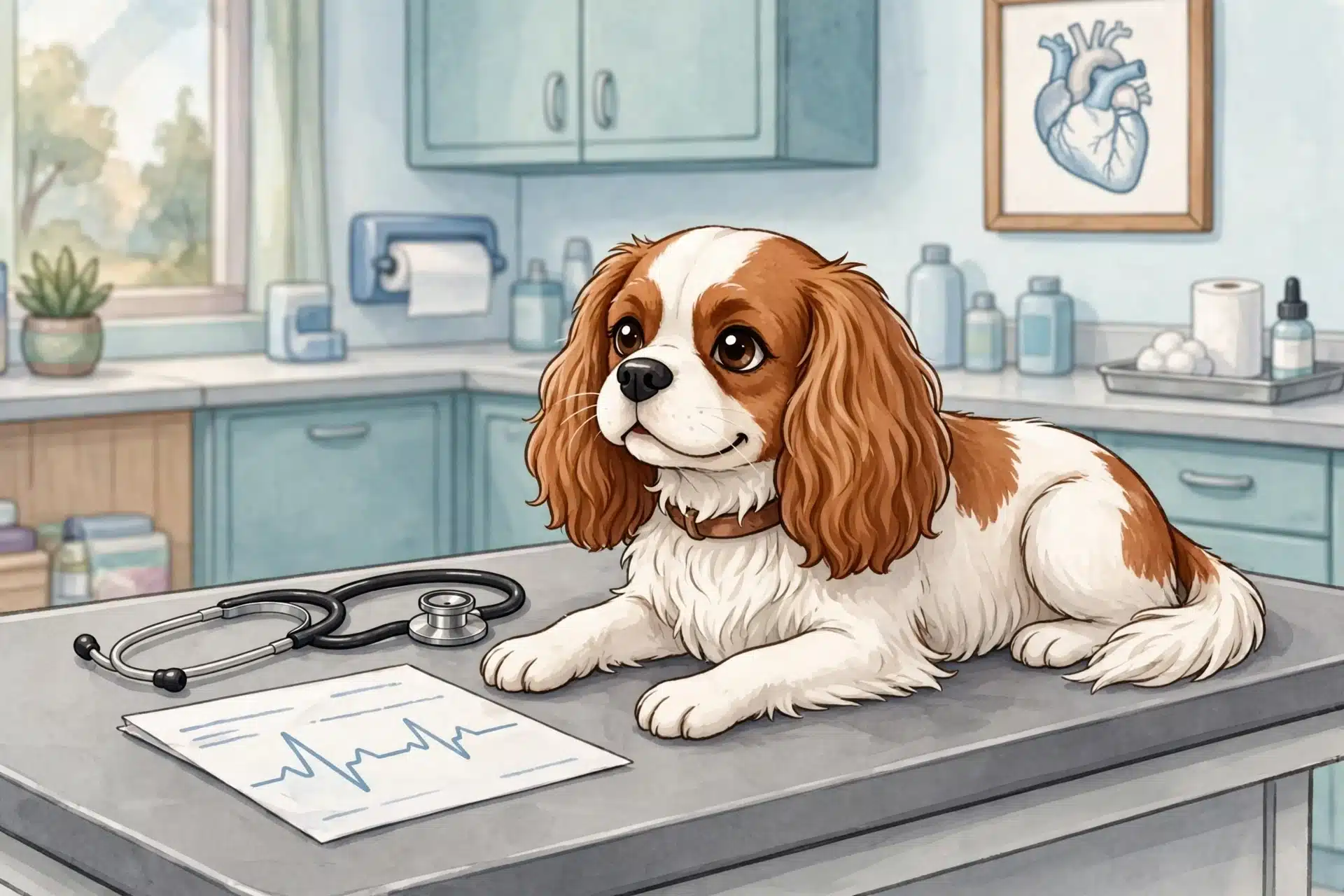
Mitral valve disease (MVD) is the breed’s biggest risk. It weakens the heart’s mitral valve, and an estimated half of Cavaliers show it by age 5 and most by age 10. The trouble is that the disease develops late, so a very young parent with a clean listen today tells you little.
Ask for an auscultation (a stethoscope exam) by a board-certified cardiologist, ideally an echocardiogram, with the dog’s age and date noted. The CKCSC, USA health testing guidelines recommend a cardiology clearance at 2.5 years or older, and the widely used MVD breeding protocol holds that Cavaliers under 5 with no murmur are the strongest candidates for breeding. A clearance from a two-year-old parent is still useful, but ask about the grandparents too.
Orthopedic and Eye Results for the Cavalier Side
Cavaliers also carry risk for hip dysplasia, luxating patellas, and dry eye or cataracts. Ask for the hip dysplasia radiograph on the Cavalier parent at 24 months, a patellar luxation certification from 12 months, and an annual eye examination by a veterinary ophthalmologist, dated within the past year.
DNA Results on the Poodle Side
The Poodle parent’s records are simpler. A DNA panel breeder report should screen for conditions common in Poodles and doodles, such as progressive retinal atrophy variants, plus parentage verification. If a tester is in a breed-specific program like OFA CHIC, you can confirm results yourself.
What to Do If a Cardiac Record Is Missing or Vague
Ask why. A parent younger than 2.5 may simply be too young for full clearance, which is fair. But “the vet checked and she’s fine” is not a record. A breeder choosing a Cavapoo puppy should be able to show the paperwork that backs every claim.
Health Tests to Request for a Havapoo Litter
A Havapoo litter has no single official test list. Because the cross is not AKC-recognized, there is no fixed breed health standard, so you need to ask each breeder directly what was tested and see the paperwork. The practical method is simple: identify each parent’s breed, pull the tests recommended for that breed, and confirm both sides were covered.
Ask Which Breed Each Parent Represents
Start with one question: which parent is the Havanese and which is the Poodle, and what size Poodle was used? The answer shapes everything else, because the Havanese and the Poodle carry different risks. Some breeders also breed a Havapoo back to a Havapoo, so the lineage can be mixed further back. Ask for parentage verification on the DNA report if the ancestry is not obvious. A careful breeder answers this plainly, and the answer tells you which panels to expect next.
Building the Panel From Both Sides
Now request the tests for each side. On the Havanese parent, the Havanese Club of America testing guide points to cardiac and patellar exams plus eye screening. On the Poodle side, ask about patellar luxation certification from 12 months, an annual eye examination by a veterinary ophthalmologist, and a DNA panel covering Poodle-relevant variants. Ask for a separate DNA panel report for each parent, not one shared sheet. Our page on reading a breeder’s health record shows how to line these results up.
Why No Single Generic Panel Fits Every Cross
A one-page DNA panel is not a complete health program. DNA results catch inherited variants but miss structural problems like knees, hearts and hips, which need physical exams. So treat a “fully health tested” claim as the start of the conversation, not the end. Ask which results are DNA-based and which came from a vet.
Reading Results: What Each Document Does and Does Not Prove
Papers prove different things. A DNA result shows inherited variants. A clinical exam shows what a vet found on one day. Both matter, but neither guarantees a puppy stays healthy for life.
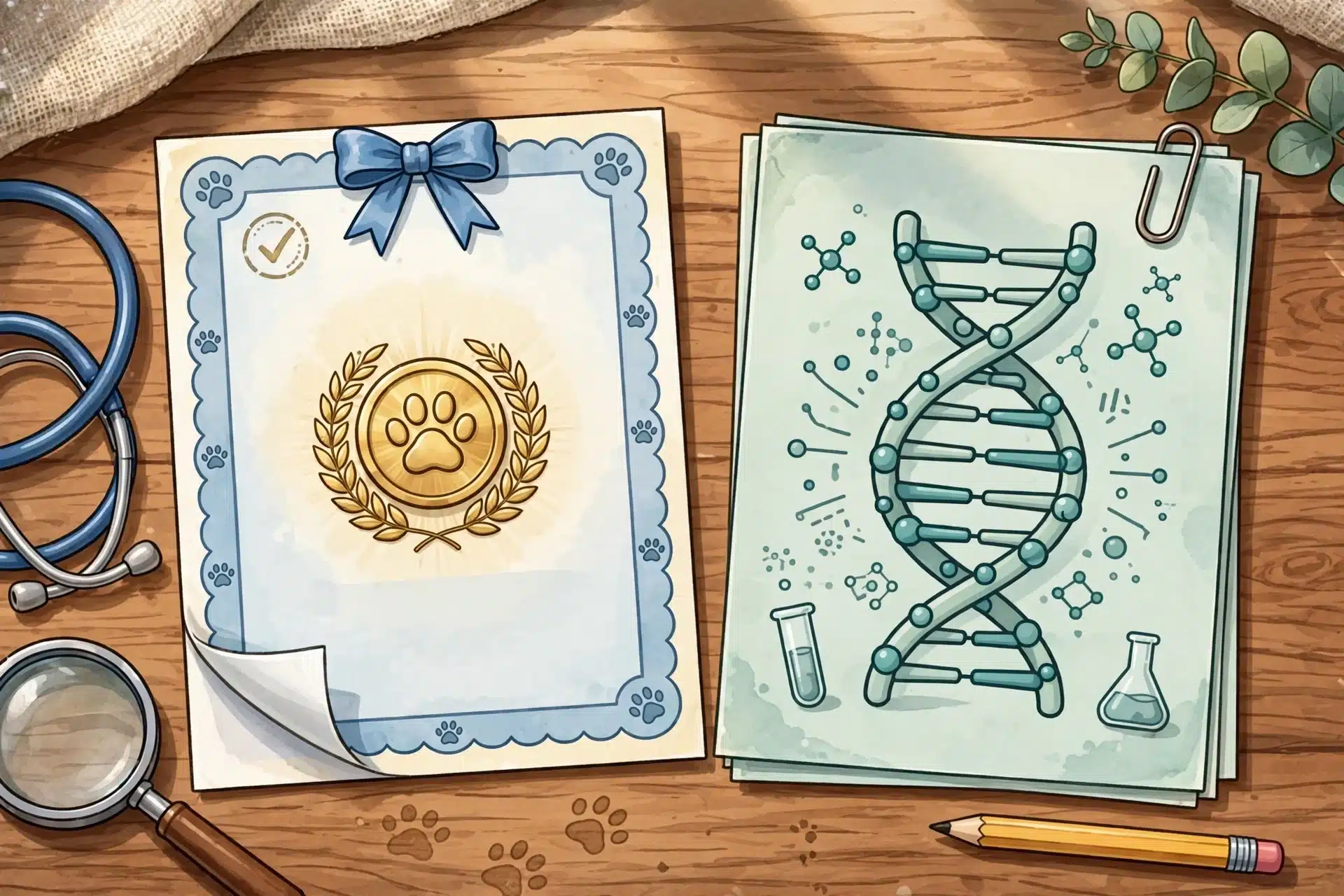
| DNA variant result | Clinical screening exam |
|---|---|
| Lab-read report on genes a parent carries | Hands-on exam or imaging done by a vet |
| Predicts risk a puppy may inherit a condition | Records actual findings at one point in time |
| Valid for life per parent | Must be repeated, sometimes yearly |
What a CHIC Number Actually Means
A CHIC number from the OFA does not mean a dog passed everything. It means the owner completed a breed-specific list of tests and agreed to publish the results, pass or fail. Look the dog up by name in the OFA database and read each result, not just the number. A published fail is more honest than a missing test, and a missing test is more honest than a claim with no record.
What a Clear DNA Result Means
A clear result means that parent does not carry the variants on that panel. It says nothing about conditions the panel never checked. Crossbred litters add a wrinkle: a Havapoo or Cavapoo needs coverage for variants relevant to both parent breeds, plus parentage verification when the registry offers it. Ask which lab ran the panel and for the report itself, not a summary sentence.
Claims You Should Decline to Accept
Decline verbal reassurances like “the line is clear” or “the parents were checked.” Ask what was checked, by whom, and when, then ask for the document. A breeder who tests willingly will hand over records without friction. Vague answers deserve follow-up questions, not a deposit.
Costs, Timing, and Result Turnaround
DNA panels often run one to three weeks and cost a few hundred dollars per dog. Eye exams renew annually, so timing matters as much as the result.
How to Request and Verify Records Before You Pay a Deposit
Verifying a breeder’s health test records takes three steps. Ask for the paperwork in writing, look up what you can check yourself, and run a quick reference check with the parent clubs or registry named on the results. Do all three before any money changes hands.
Send the Request in Writing
Ask by email or text so you have a record. A clear request covers parent health clearances, DNA panel results, and the litter’s deworming and vaccination records. A confident breeder answers within a day or two and sends copies without complaint. Some programs, including ours, walk you through the reservation steps with documents first. Vague replies or “trust me” answers deserve a pause, not a deposit.
Verify What You Can Verify Yourself
Three checks cover most claims. First, use the CHIC number lookup on the OFA site to see a parent’s listed results. Second, match the names on the paperwork to the parents you met; parentage verification on a DNA report helps here. Third, call the veterinarian or specialist who signed an eye or cardiac exam and confirm the date.
Red Flags and Reasonable Answers
Watch for these warning signs:
| Red flag | Reasonable answer |
|---|---|
| Photos of results instead of copies | Sends full PDFs with registry numbers |
| Parent under 24 months with no hip radiograph | Explains the age rule and the date it is scheduled |
| Refuses vet references | Offers previous puppy families instead |
A breeder who says “that test is not done in this breed” may be right, so check the breed standard yourself. Honest gaps beat polished excuses.

When you’re ready to apply, come with your checklist. At Sage Puppies, we share parent health records for every Havanese, Havapoo, and Cavapoo litter, so you can verify each test yourself before reserving your puppy.
Frequently Asked Questions
Q1: Which health test results should breeders show buyers?
Ask for three layers: the puppy’s vet record with vaccination and deworming dates, parent clinical screenings like OFA heart, patella, and eye exams, and DNA panel reports naming each variant result.
Q2: How do I verify a breeder’s OFA records myself?
Use the CHIC number lookup on the OFA site. Enter the parent’s name and read each result, not just the certificate.
Q3: Does a CHIC number mean a dog passed all tests?
No. It only confirms required tests were done and published. A listed fail is still honest information.
Q4: What if a parent is too young for full testing?
Hips need radiographs at 24 months, patellas from 12. Ask when testing is scheduled.
Q5: Can one DNA panel cover a Havapoo or Cavapoo?
No. Request coverage for both parent breeds’ variants, plus parentage verification.
Q6: What documents should come with the puppy?
A health certificate dated near pickup, plus dated vaccination and deworming records.
Conclusion
Health-tested puppies deserve paperwork, not phrases. Ask for three layers every time: the puppy’s own vet record with dated vaccination and deworming entries, parent clinical screenings like OFA heart, patella, and eye exams, and DNA panel results for each parent. Then verify what you can, using the CHIC number lookup and a call to the vet who signed an exam. For Havanese litters, check the three required tests; for Cavapoos and Havapoos, cover both parent breeds’ risks. Breeders who share records freely, before any deposit, are the ones worth shortlisting, including our South Jordan, Utah program when families search for health-tested puppies for sale near me or nationwide.