Quick Summary: Leash training a Cavapoo puppy works best in sequence: fit an adjustable Y-front harness and lightweight 6-foot leash, make the gear feel boring indoors, then reward calm steps beside you on a slack leash. Keep sessions to three to five minutes, stop walking when the leash tightens, and avoid pulling, punishment, retractable leashes, and collar pressure. Progress gradually from an empty room to busy outdoor spaces, and judge improvement over weeks rather than individual walks.
A Cavapoo puppy is small enough that most owners grab the tiniest harness on the shelf, then spend three weeks puzzled when the puppy sits down mid-walk and refuses to budge. The gear is rarely the real problem. The order of operations is. This guide walks through cavapoo puppy leash training in one sequence: fit the harness correctly, build attention indoors, then move outside in short, reward-based steps. Leash training a puppy works best when each skill sits on the one before it, so the pace here follows your puppy, not a calendar. It draws on current humane-training guidance and on what our breeding program in South Jordan, Utah sends home with each Sage puppy family. If you want practical puppy leash training tips that suit a Cavalier Poodle mix puppy rather than a large breed, start below.
Step 1: Choose the Right Harness and Leash for a Cavapoo Puppy
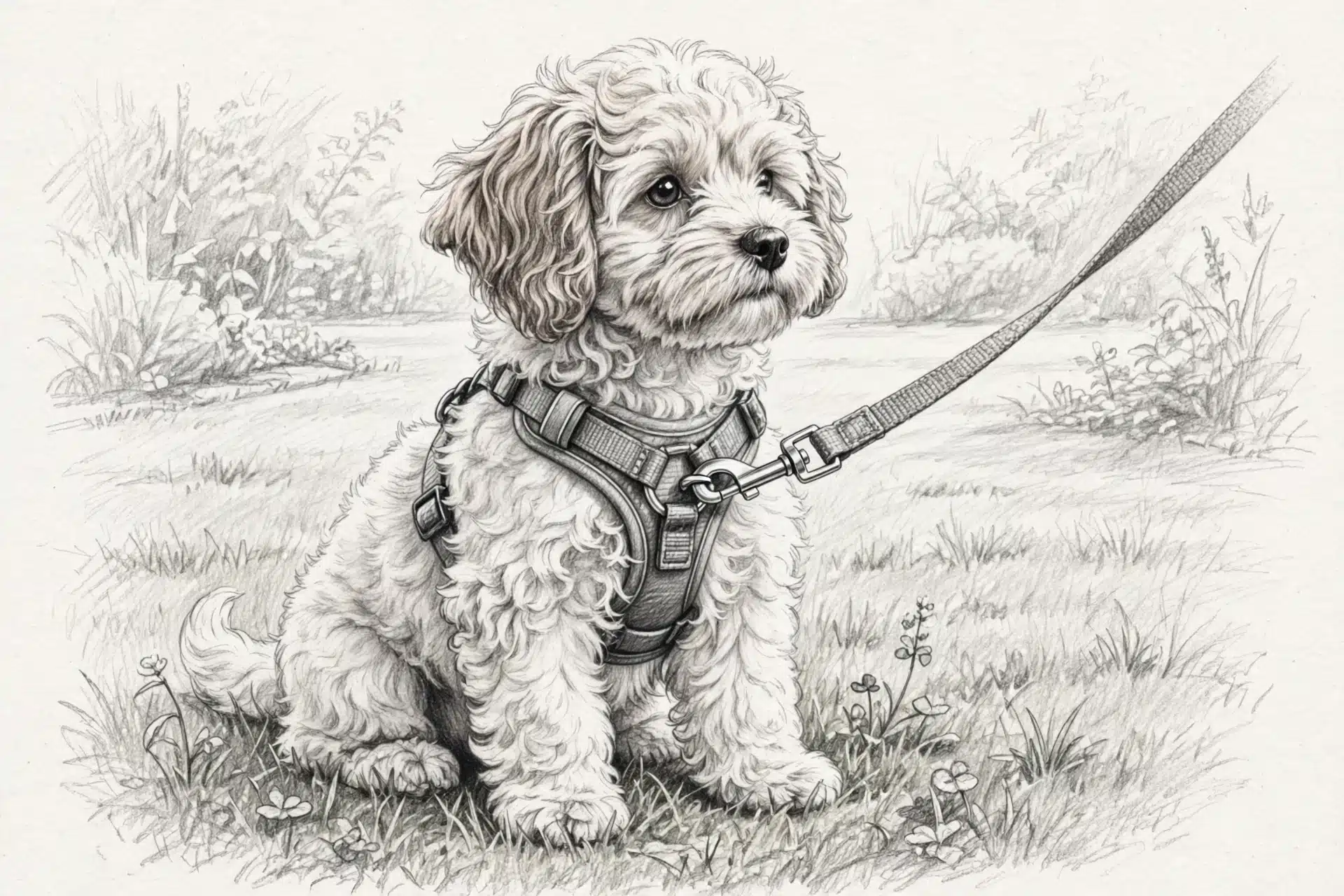
The best setup for a Cavapoo puppy is a Y-front harness with a front clip, paired with a lightweight 6-foot fixed-length leash. Skip retractable leashes and choke or prong collars entirely. Fit matters more than brand: you should slide two fingers under every strap, and the harness should not rub near the front legs or shift when your puppy moves.
| Gear | What to Look For | Fit Check |
|---|---|---|
| Harness | Y-front cut, front clip ring, padded straps | Two fingers fit under straps; no rubbing at armpits |
| Leash | 6 feet, fixed length, thin lightweight webbing | Light enough that a 5-pound puppy can drag it |
| Collar | Flat, breakaway or quick-release buckle | ID tag only, not for leash pressure |
Harness or Collar: What Works for a Small, Poodle-Influenced Puppy
Use a harness, not a collar, for leash training a puppy. Cavapoos are small, and a soft toy breed’s throat takes the full force of every lunge if the leash clips to a collar. A front clip harness turns that pulling pressure toward the chest instead, which is safer for the neck and gentler on you. Vets and humane trainers widely recommend this setup for small breeds that pull.
Leash Length, Handle Type, and the Tools to Skip
A simple 6-foot leash gives your puppy room to sniff while you keep contact. Choose thin webbing with a small, light clip; heavy hardware weighs down a little neck. Skip retractable leashes, which teach pulling by rewarding it with more slack, and skip chain slip collars, which humane training groups advise against for puppies.
Planning for a Puppy Who Is Still Growing
Your puppy will outgrow a harness fast, sometimes within weeks. Buy an adjustable one with multiple strap points, and recheck the fit every few days during growth spurts. Keep the weight light: an 8-week-old Cavapoo may weigh only 4 or 5 pounds, so gear built for adult dogs overwhelms them. Measure the chest girth before ordering, since small breeds often need the smallest size made.
Step 2: Start at the Right Age, and Make the Gear Invisible
What Age Should You Start Leash Training a Cavapoo Puppy
Start cavapoo puppy leash training the week your puppy comes home, usually at 8 weeks old. The AVSAB position statement on puppy socialization notes that the most important learning window runs from about 3 weeks to 14 weeks, so habits you build now stick fastest. Waiting until “old enough for walks” wastes that window. Begin with these three short activities:
- Clip the harness on for a few minutes each day
- Let your puppy drag the lightweight leash indoors
- Reward calm attention while the gear is on
A Three-Part Equipment Introduction You Can Run in One Room
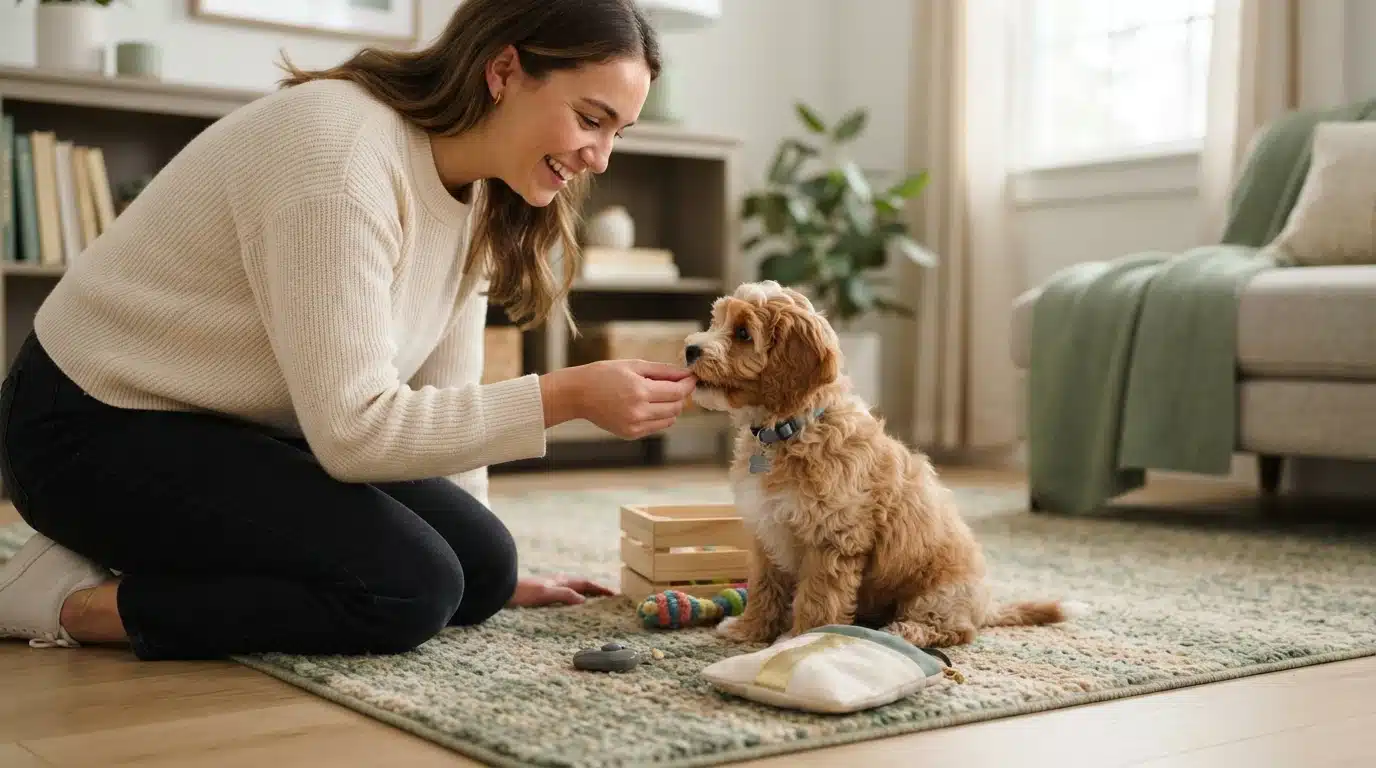
Do all of this in your living room, with treats in your pocket. Here are puppy leash training tips for the first week:
- Harness first. Let your puppy sniff it, feed a treat, then slip it on for 30 seconds. Build up to several minutes over two or three days.
- Leash next. Attach the 6-foot leash and let your puppy drag it around a puppy-proofed room while you supervise.
- Follow the handle. Pick up the leash, toss a treat two steps ahead, and follow your puppy. Then reverse it: a few steps where following you earns the treat.
One room, five minutes, twice a day. That is enough.
Why Indoor Practice Comes Before the First Outdoor Walk
Your yard and sidewalk are full of smells, sounds, and moving things, and a 5-pound puppy will chase all of them. Indoors, there is almost nothing to compete with, so your puppy learns that paying attention to you pays. This is reward based puppy training in its simplest form, and the skill transfers outside once the distractions show up. Most Cavapoos also finish their vaccine series around 16 weeks, so indoor dragging practice buys you safe progress while you wait.
A week-by-week picture of what else to expect sits in our Cavapoo puppy training milestones guide.
Step 3: How to Leash Train a Cavapoo Puppy as a Beginner
Beginners get the best results with a short, predictable loop: set your position, reward the right step, then name it. Work through it in order and your Cavapoo learns that walking near you pays.
Set Up Your Position Before the Puppy Moves
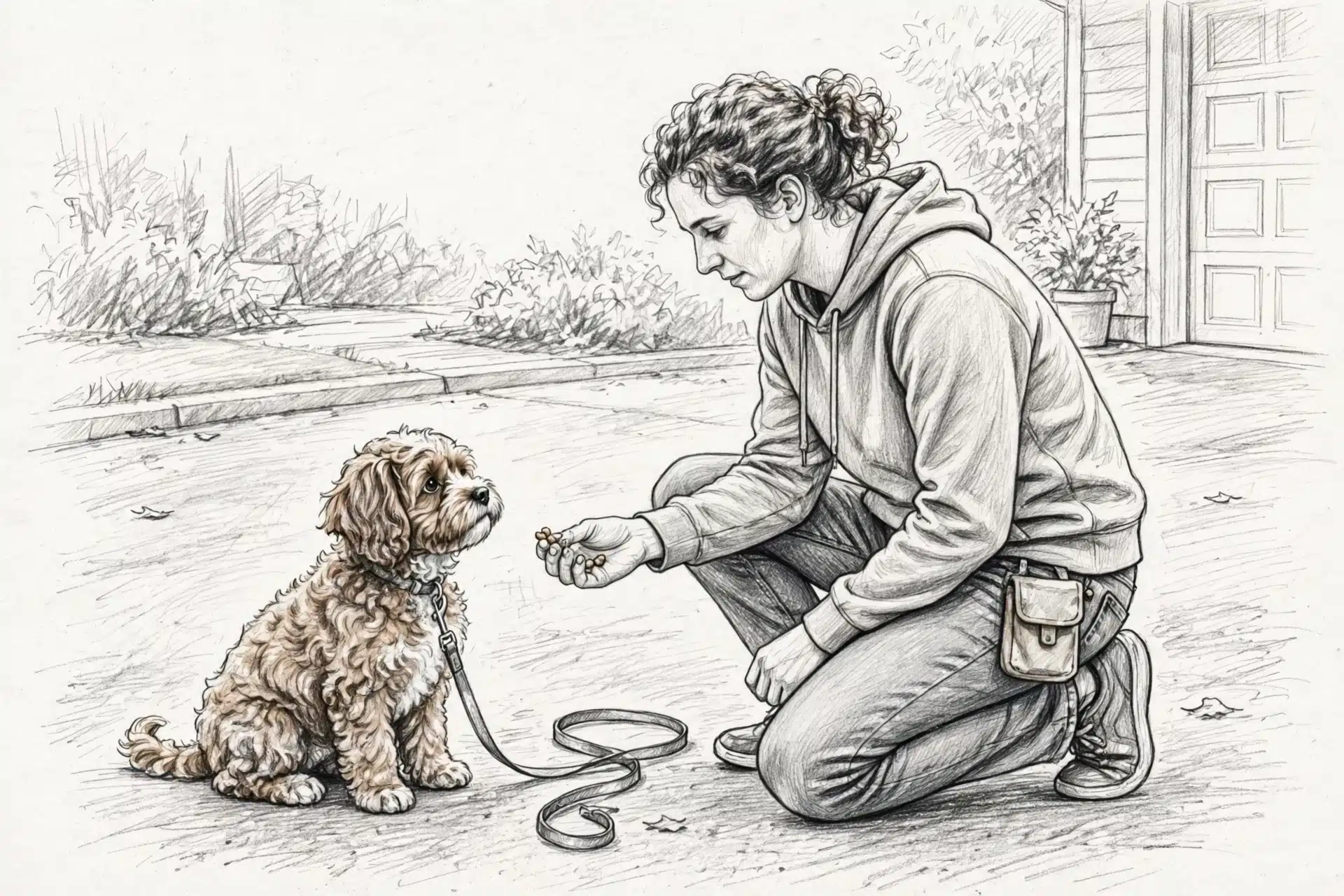
Decide where you want your puppy to walk, then hold the leash so that spot stays easy. Most beginners keep the puppy on the left, leash held loosely across the body with a soft bend in the elbow. Keep slack in the line. A taut leash teaches pulling before you say a word, so start every session with the leash loose and your puppy beside you, not ahead of you.
Reward the Step Beside You, Not the Pull
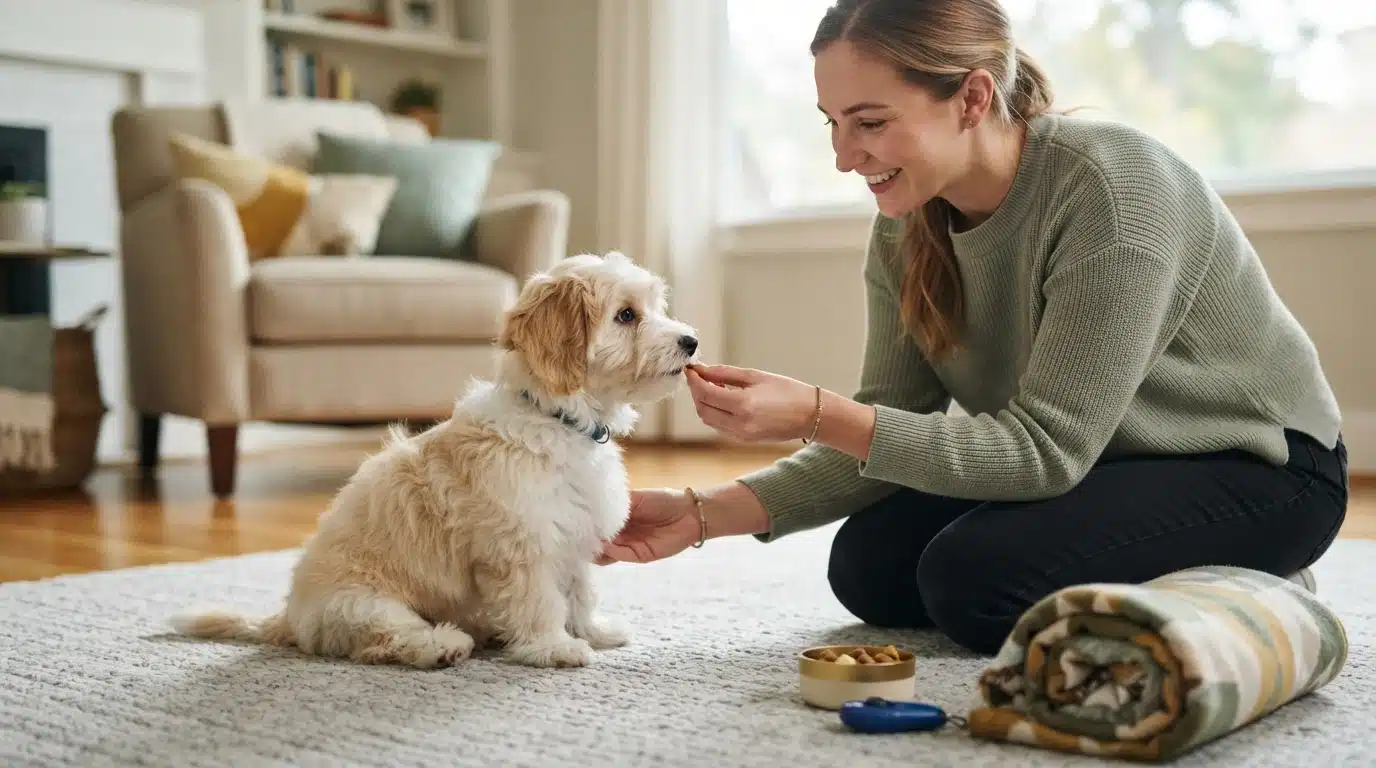
Reward-based puppy training works because you pay for the behavior you want. The moment your puppy takes a step at your side on a slack leash, mark it and feed a small treat at your knee level. If the leash goes tight, stop walking and wait. The instant your puppy looks back or steps toward you, which loosens the line, reward that choice and resume. Never yank or jerk the leash. You are teaching a 5-pound puppy that pulling makes the walk stop and staying close makes it continue.
Name the Behavior and Add an Off-Duty Walk
Once your puppy offers a few steps beside you, say “heel” or “let’s go” right as the slack leash is in position. This labels the skill, so the cue comes to mean “walk at my side and get paid.” Keep sessions to three to five minutes and end while your puppy is still winning.
Then balance it with an off-duty sniffing walk. Clip on the leash, drop all cues, and let your puppy wander and sniff within the leash’s length. Loose leash walking for puppies holds up better when the walk is not all work. sniffy freedom makes the structured minutes easy to accept, because your puppy never feels trapped at your side.
Step 4: Handle Pulling Without Punishment
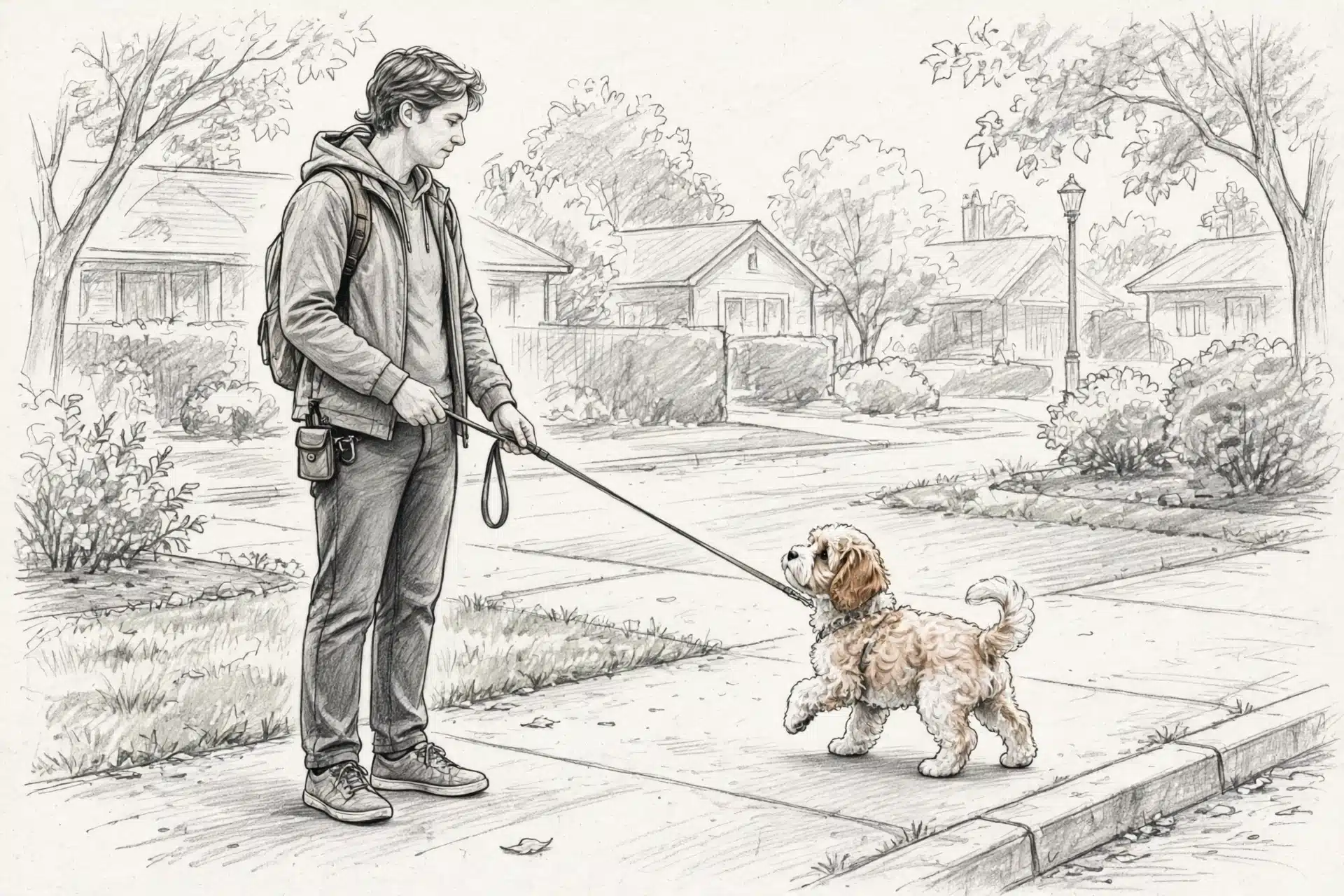
The first time your Cavapoo lunges to the end of the leash, resist the urge to yank back. Pulling is normal puppy behavior, not defiance. Here is how to stop a puppy pulling on the leash in the moment:
- Stop walking the instant the leash goes tight. Do not jerk, just freeze.
- Wait quietly until your puppy turns back toward you or the leash slackens.
- Mark the slack with a soft “yes” and reward next to your leg.
- Then take one step forward. Repeat as many times as the walk needs.
What to Do the First Time Your Puppy Pulls Hard
Hard pulls usually mean the walk is too exciting. If your puppy is straining toward a dog, a person, or a smell, move back a few feet to where the leash can stay loose. Let the trigger fade before you try again. Some days the whole outing is ten minutes of stopping and starting. That is still progress, because you are teaching that pulling makes the walk pause and slackness makes it continue.
Redirect to a Behavior Your Puppy Already Knows
When stopping alone does not work, trade the pull for something your puppy can win at. Say your puppy’s name, and when she glances at you, reward by your side, then keep moving. A quick sit works well too. You are asking for a small, rehearsed behavior instead of fighting over the leash, so the walk becomes a stream of easy wins rather than a tug-of-war.
Why Correction Tools and Punishment Are Excluded Here
Prong, choke, and stinging corrections have no place with an 8-week-old puppy who may weigh 4 or 5 pounds. Research reviewed by the AVSAB position statement on humane dog training finds that aversive methods carry risks of fear and aggression, while reward based puppy training builds the same skills without them. Pulling usually comes from excitement, so punish that and you may teach your puppy that walks feel scary. This same gentle approach is how Cavapoo breeders raise small companion breeds to handle early handling, and it works at home too.
Step 5: Raise the Distraction Ladder Gradually
A puppy who walks beautifully in your kitchen can fall apart on a sidewalk, and that is normal. Leash training a puppy means proving the skill in harder places, one small jump at a time. Move up only when your puppy can walk calmly at the current level for a full short session.
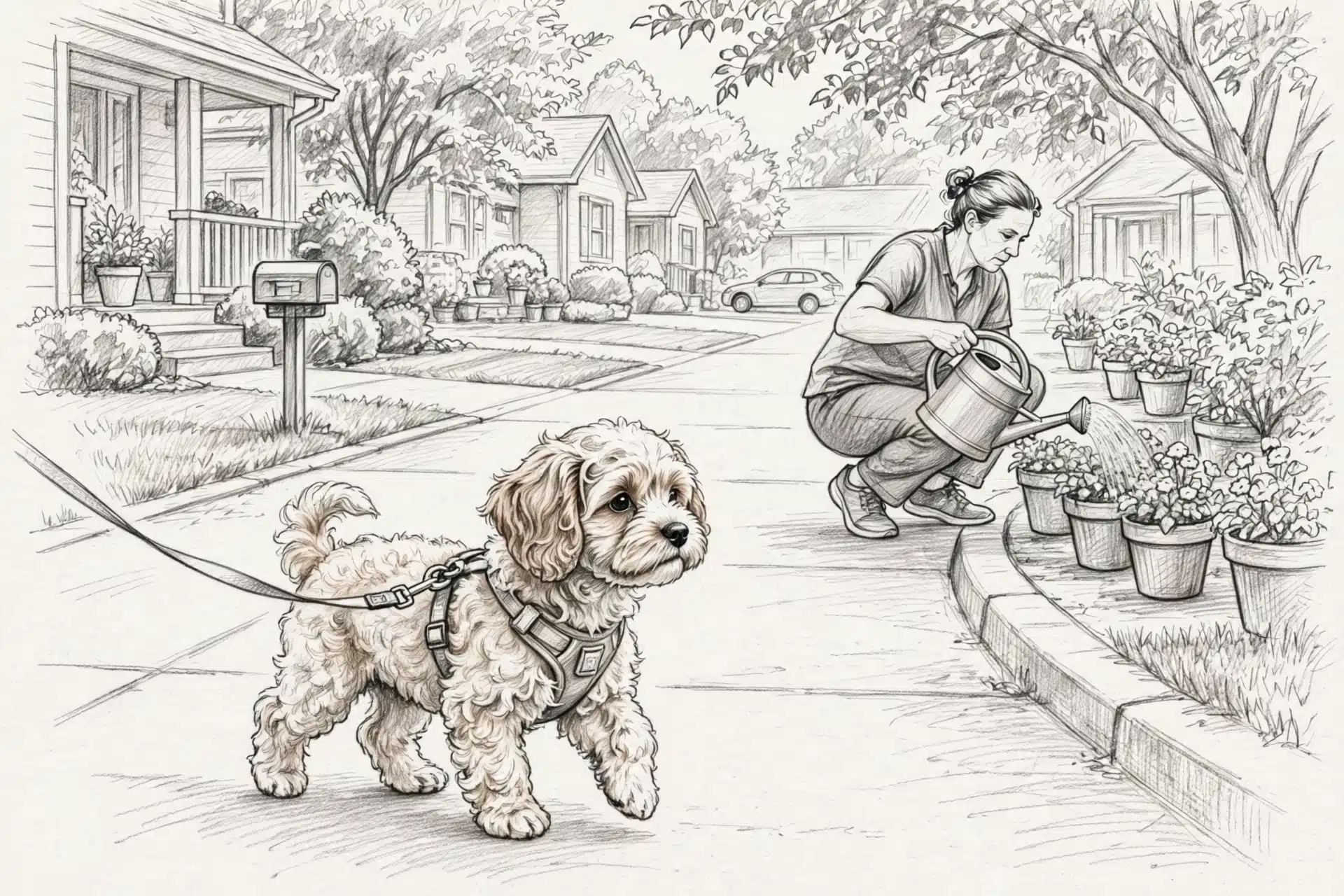
A Five-Stage Ladder From Empty Room to Busy Street
Work through these stages in order, and stay at each one for several days of success:
| Stage | Setting | You Win When |
|---|---|---|
| 1 | Empty room indoors | Ten steps on a loose leash |
| 2 | House with family moving around | Your puppy checks in without stopping |
| 3 | Quiet backyard | Sniffs, then returns to position |
| 4 | Quiet street at low-traffic hours | Passes a person without pulling |
| 5 | Busy sidewalk or park edge | Recovers within a few seconds after a distraction |
If stage 4 falls apart, drop back one stage for a few days. Falling back is not failure; it is how the skill becomes solid.
Small-Breed Specific Problems You Will Actually Meet
Some distractions hit a Cavalier Poodle mix puppy harder than a big dog. Birds and falling leaves trigger chase instincts, so watch for the frozen stare that comes right before a lunge. Other dogs look enormous from 10 inches off the ground, so give them extra distance and feed treats as they pass. Kids on bikes and skateboards bring fast movement and noise together. Because everything looms large, keep your reward rate higher outdoors than indoors. These puppy distraction training fixes work because you pay better than the environment does. The same rule applies at every stage: notice the distraction before your puppy does, then reward attention on you.
Walk Length and Weather for a Small-Breed Puppy
Keep sessions short. Five minutes of focused practice beats a long, sloppy walk, and two or three short outings a day beat one long one. Watch the weather too. In a Utah winter, pavement salt can sting small paws, so rinse them after walks, and in summer, test the pavement with your hand; if it burns you, it burns your puppy. Short loops near home work well while your puppy builds stamina. If you are still settling into your Cavapoo puppy’s first week at home, keep early walks brief and close to the house.
Common Mistakes to Avoid
Mistakes That Pull a Puppy Off Track
Most leash setbacks come from a few fixable habits. Using a heavy adult leash or clipping to a collar instead of a Y-front harness can strain a tiny puppy and make gear feel like punishment. Training too long is another: two or three short puppy leash training sessions beat one marathon that ends in zoomies. Letting pulling “just this once” work teaches your puppy that leaning into the leash pays off. And corrections like jerking or scolding have no place here, because fear shuts down learning fast. Consistency, not force, is what stops a puppy pulling on the leash.
Expectations Worth Adjusting
Beginners often expect a straight line, and Cavapoo puppies rarely give one. A good week can be followed by a messy one, especially around 12 weeks when everything looks interesting again. That is normal, not failure. Loose leash walking for puppies takes weeks of reps, not days, and progress shows up in small wins like a check-in or ten calm steps. Judge the trend over the month, not the walk. If a session falls apart, end it early and try again later with easier surroundings.

Loose-leash wins happen one short session at a time, and the same reward-based approach works for every part of raising your Cavapoo. If you’re still choosing a puppy or want preparation guidance from a program that starts training foundations early, see Sage Puppies, or keep practicing this week’s plan and check back for the next step.
Frequently Asked Questions
Q1: How do I leash train a Cavapoo puppy as a beginner?
Start indoors with a Y-front harness and 6-foot leash. Reward each step beside you on a slack leash, stop when it goes tight, then name the behavior and move up the distraction ladder one stage at a time.
Q2: What age should I start leash training a Cavapoo puppy?
Begin the week your puppy comes home, usually at 8 weeks. The key learning window runs to about 14 weeks, so early habit-building pays off fastest.
Q3: What harness and leash are best for a Cavapoo puppy?
Use an adjustable Y-front harness with a front clip and a lightweight, fixed 6-foot leash. Skip retractables and collars for walking.
Q4: How long should a Cavapoo puppy leash training session be?
Three to five minutes of focused practice works best. Two or three short sessions a day beat one long walk, and always end while your puppy is still succeeding.
Q5: How do I stop my Cavapoo from freezing on the leash?
Freezing usually means the gear or setting feels overwhelming. Go back indoors, let her drag the leash, and reward any movement with treats and a cheerful voice.
Q6: When can my Cavapoo puppy walk outside safely?
Practice in your yard early, but keep sidewalks for after the vaccine series finishes, usually around 16 weeks.
Conclusion
Cavapoo puppy leash training comes down to a short sequence. Fit a Y-front harness and lightweight 6-foot leash, make the gear boring indoors, then reward steps beside you on a slack leash and climb the distraction ladder slowly. Stop when the leash tightens, never jerk it, and keep sessions to three to five minutes. Judge progress over weeks, not walks, because a messy day says nothing about where the skill will land. The same patient, reward-based habits carry into other routines too, including the first weeks of a brushing and bathing schedule. Start small, pay your puppy for good choices, and loose leash walking follows sooner than you expect.