Quick Summary: Cavapoo puppies need measured meals on a steady clock, not free-feeding, with portions shifting from four down to two meals per day as they grow from 8 weeks to 12 months. Daily food totals range from about 1/3 cup for a tiny 8-week-old to 1 cup by adulthood, always on a small-breed puppy formula that meets AAFCO standards. Any food switch should happen slowly over seven to ten days, treats stay under 10% of daily calories, and a monthly hands-on body check catches weight drift before it becomes a problem. Sage Puppies shares this rhythm because their Cavapoos arrive already used to set meals, which makes the first week at home smoother for new owners.
Bringing home an eight-week-old Cavapoo is exciting, until you stare at the little scoop of kibble your breeder sent and wonder if a quarter cup is really enough, or already too much, for a six-pound puppy. Getting portions wrong in those first weeks causes real problems: loose stools from too much, low blood sugar from too little.
A clear Cavapoo nutrition and feeding schedule takes the guesswork out. In this guide, you’ll find an age-by-age portion chart from weaning through adulthood, a week-long plan for switching foods without an upset stomach, and a simple body-condition check you can do at home with your hands.
This advice comes from Sage Puppies, a small-breed program in South Jordan, Utah that raises Cavapoos and knows what these puppies actually eat day to day. Your puppy’s health starts with the right Cavapoo nutrition and feeding schedule, followed consistently.
Step 1: Build the Day-One Feeding Schedule for an 8-Week Cavapoo
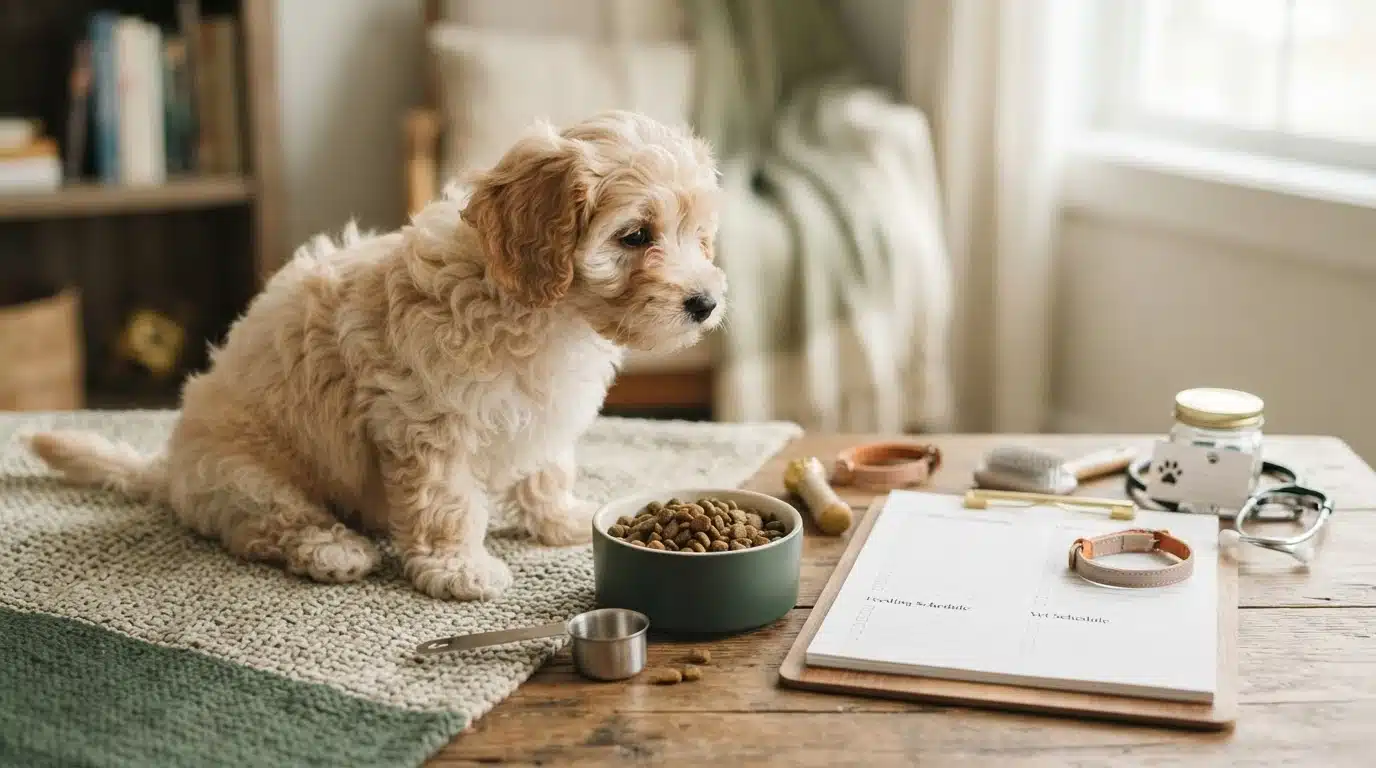
Your Cavapoo comes home around 8 weeks old, still on three or four meals a day from the breeder. Before pickup day, set the schedule in writing so the whole family feeds on the same clock.
Why Four Meals Beat Three for Young Cavapoos
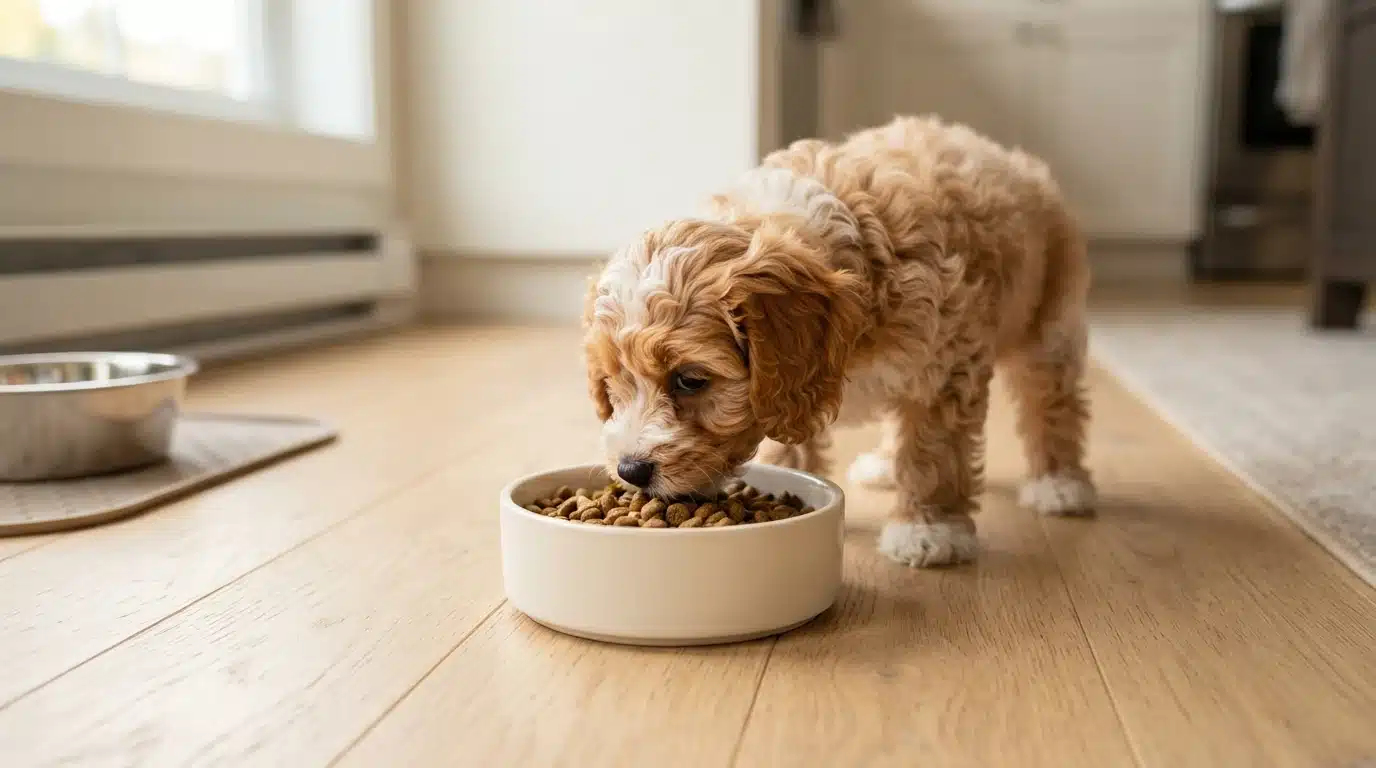
An 8-week Cavapoo has a tiny stomach and a fast metabolism. Small, frequent meals keep blood sugar steady and prevent the sluggish, wobbly behavior that comes with a long gap between feedings. Most puppy guides, including PetMD’s feeding guide, recommend three to four meals a day at this age, and small breeds often do best at the higher end. Ask your breeder what the litter was eating so you can match the brand and timing, then hold that pattern for the first week. Once your puppy turns 12 weeks old, you can drop to three meals, and later to two.
Sample Day 1 Meal Plan (Six-Pound Cavapoo)
Here is a realistic first day for a six-pound puppy eating a small-breed puppy kibble. Total daily food at this size usually lands between a half and three-quarters of a cup, but follow the label and adjust by body condition.
| Time | Meal | Portion |
|---|---|---|
| 7:00 a.m. | Breakfast | 3 tablespoons |
| 11:30 a.m. | Lunch | 3 tablespoons |
| 3:30 p.m. | Afternoon meal | 3 tablespoons |
| 7:00 p.m. | Dinner | 3 tablespoons |
| Before bed | Potty trip only | No food |
Measure with real tablespoons for the first week, not a scoop. For pickup-day prep, our first-week puppy guide covers the rest of the routine.
Step 2: Match Portions to Weight, Age, and Activity Level
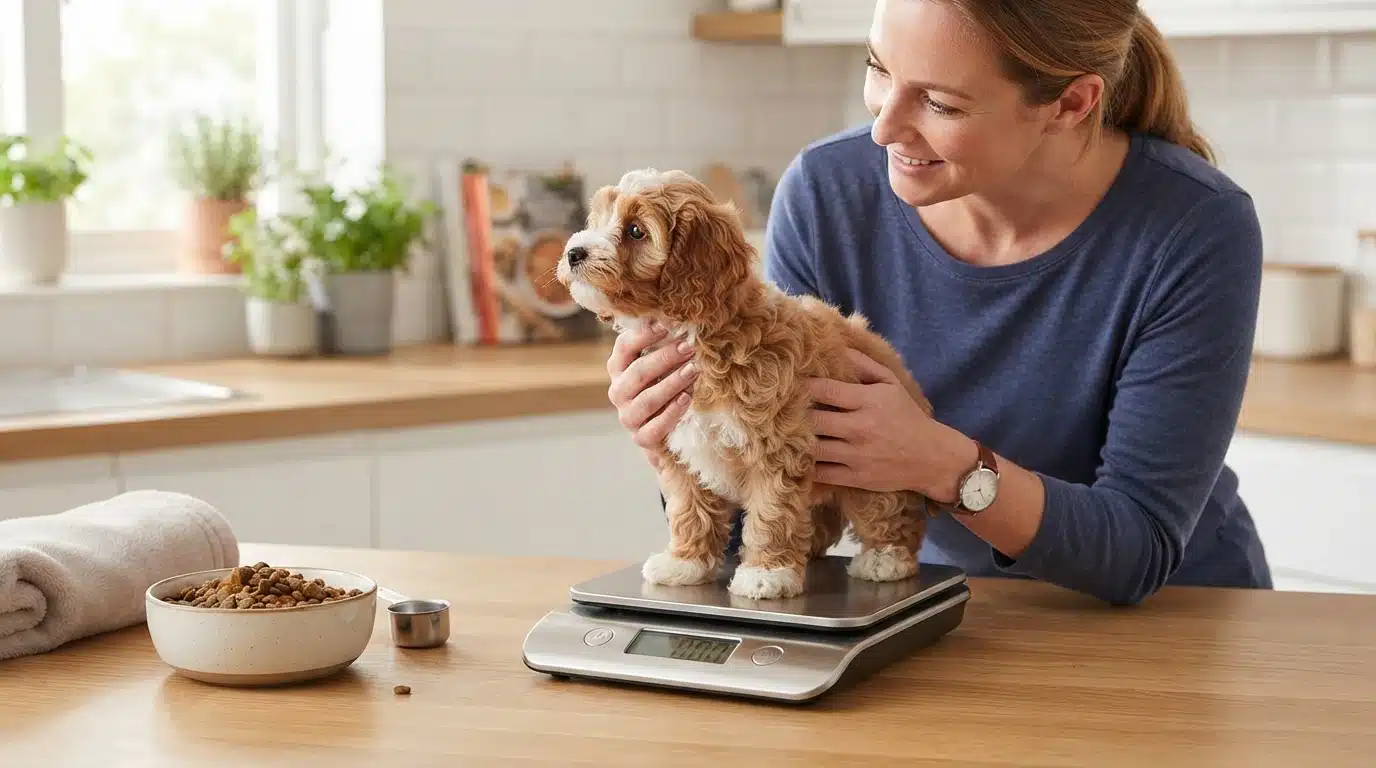
Feeding charts give you a starting point, not a rule. The right portion depends on three things: how much your Cavapoo weighs today, how old it is, and how hard it plays. Check weight every couple of weeks on a kitchen scale, because a pound or two matters a lot in a dog that will top out at 9 to 25 pounds.
Stage-by-Stage Portion Chart (8 Weeks to 12 Months)
Most Cavapoos eat 1/3 to 1 cup of small-breed puppy food per day, split across their meals. Small breeds need more calories per pound than large dogs, so puppy formulas matter here. Puppies under six months need roughly twice the calories per pound of an adult dog, according to PetMD’s calorie guide.
| Age | Typical Weight | Daily Food | Meals Per Day |
|---|---|---|---|
| 8-12 weeks | 2-4 lbs | 1/3 to 1/2 cup | 4 |
| 3-4 months | 4-6 lbs | 1/2 to 2/3 cup | 3 |
| 5-6 months | 6-9 lbs | 2/3 to 3/4 cup | 3 |
| 7-9 months | 9-12 lbs | 3/4 to 1 cup | 2 |
| 10-12 months | 12-18 lbs | 3/4 to 1 cup | 2 |
Treats, training bits, and chews count too. Keep them under 10% of daily calories, a limit recommended in Chewy’s puppy feeding guide.
Adjusting for Activity, Spay or Neuter, and Season
Portions shift when daily life shifts. A puppy that romps for two 20-minute sessions a day burns more than one that naps through a work-from-home afternoon. Watch the body, not the bowl: you should feel ribs with light pressure and see a waist from above.
Spay or neuter lowers calorie needs, sometimes by 20 to 30% within weeks of surgery. Cut food slightly first, since keeping the same portions is how extra weight starts. Some breeders share their own feeding notes with puppy families before pickup, so ask what your puppy has been eating.
Winter walks in colder states burn more energy; hot summers mean slower afternoons and smaller appetites. Adjust by about a tablespoon up or down, then reassess after a week.
Step 3: Choose a Small-Breed Puppy Formula That Meets AAFCO Standards
The bag matters as much as the brand. Small-breed puppy formulas pack more protein, fat, and calories into each kibble, which suits a fast-growing Cavapoo with a tiny stomach.
Reading the Label: Protein, Fat, and AAFCO Statements
Turn the bag over and find the AAFCO nutritional adequacy statement first. The Association of American Feed Control Officials sets nutrient profiles for pet food, and the statement tells you the food is complete and balanced for a named life stage, either by formulation to those profiles or by a feeding trial, as explained in AAFCO’s labeling guide. You want language covering growth or all life stages; adult-maintenance formulas are wrong for a puppy.
Next, scan the guaranteed analysis. A good small-breed puppy food typically shows crude protein around 28 to 30 percent and crude fat near 15 to 20 percent on a dry matter basis. The word “crude” just describes the testing method, not quality. Vets start with the AAFCO statement, then check protein and fat, then the ingredient list, a sequence echoed in this label-reading guide.
Ingredients Worth Including and a Few to Skip
A named animal protein should lead the list: chicken, lamb, or salmon. Whole grains like brown rice and oatmeal are fine for most Cavapoos, unless your vet advises grain-free for a specific reason.
Skip vague entries such as “meat by-product meal,” unnamed fats, added sugars, and artificial colors. Watch for novel ingredients doing more marketing work than nutritional work. Whatever you choose, keep the protein source consistent during the food transition you planned in Step 2, so your puppy’s stomach adjusts without a setback.
Step 4: Transition Foods Over Seven to Ten Days
Switch food gradually, even when the new food is better. A puppy’s gut needs time to adjust to new proteins and fats, and sudden swaps often cause loose stools. The American Animal Hospital Association advises changing food over about seven days, starting with roughly a quarter of the new food mixed in.
A Seven-Day Transition Calendar
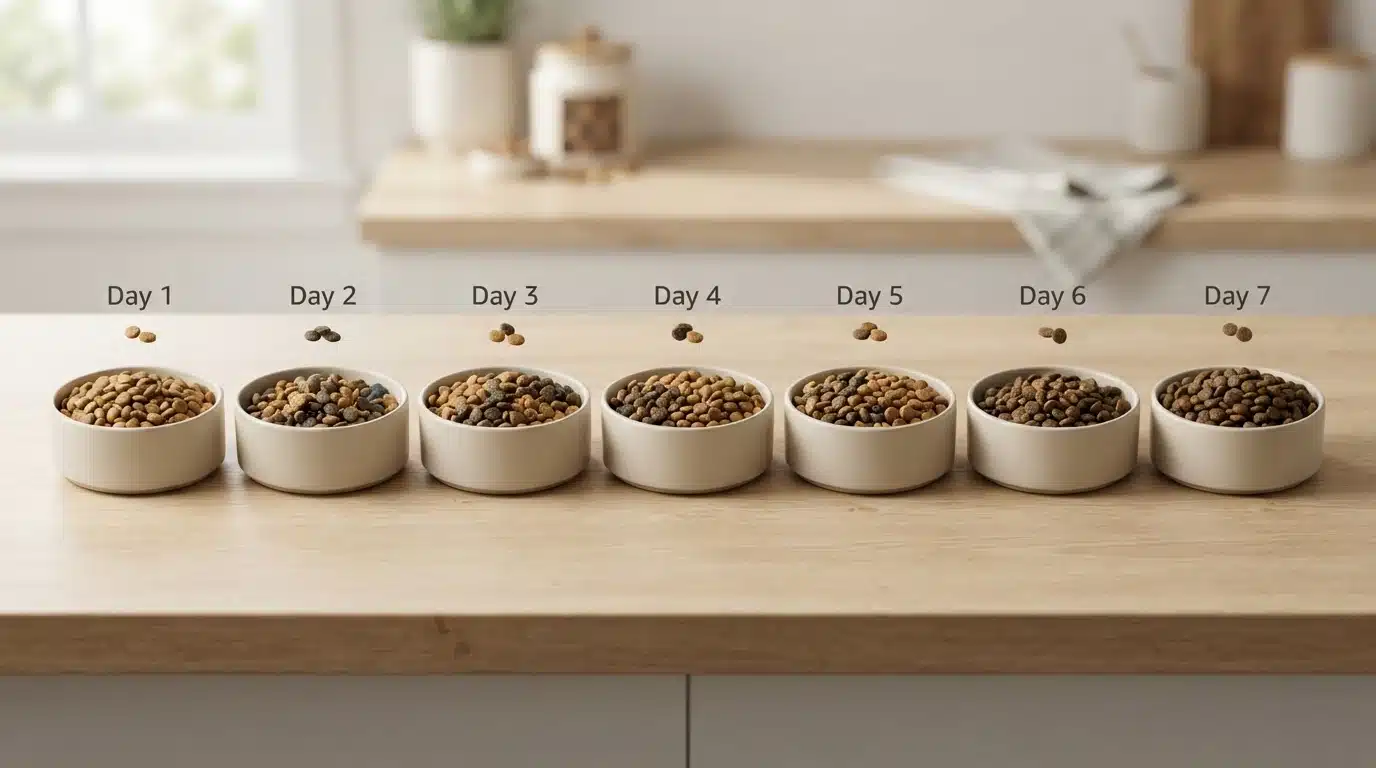
Split each meal into old food and new food, then shift the ratio every two days:
| Days | Old Food | New Food |
|---|---|---|
| 1-2 | 75% | 25% |
| 3-4 | 50% | 50% |
| 5-6 | 25% | 75% |
| 7+ | 0% | 100% |
Measure by volume, not by eye. Half a cup of each mixed together keeps the total portion on schedule, so your puppy never eats more or less than the plan calls for. If stools stay loose at any stage, hold that ratio for two extra days before moving on. Sensitive stomachs may need the full ten days, and that is fine.
What a Healthy Transition Looks Like
Firm, formed stools are the main signal that the switch is working. Mild softness for a day or two is common, but watery diarrhea, vomiting, or a refused meal means you should slow down and call your vet if it lasts beyond 24 hours. Keep treats plain and few during the transition week, because extra snacks make it hard to tell what upset the stomach. Watch appetite and energy too: a puppy that cleans the bowl and plays hard is usually handling the change well.
Step 5: Plan Treats, Toppers, and Hydration Around Training
Treats do double duty in a Cavapoo puppy’s day. They pay for training reps, but they also eat into the food budget you set in Step 4.
Treats and Toppers That Fit the Daily Budget
Vets use the 10% rule: treats, toppers, and chews together should stay under a tenth of your puppy’s daily calories. A puppy eating around 400 calories a day gets roughly 40 treat calories, which disappears fast with a pea-sized training morsel. The AKC notes the 10% counts everything, so measure the day’s total, not each session.
The simplest fix is to train with kibble. Pull a few tablespoons from the measured daily ration and feed them one piece at a time. Save softer, smellier treats for hard moments like recall in the yard or vet visits.
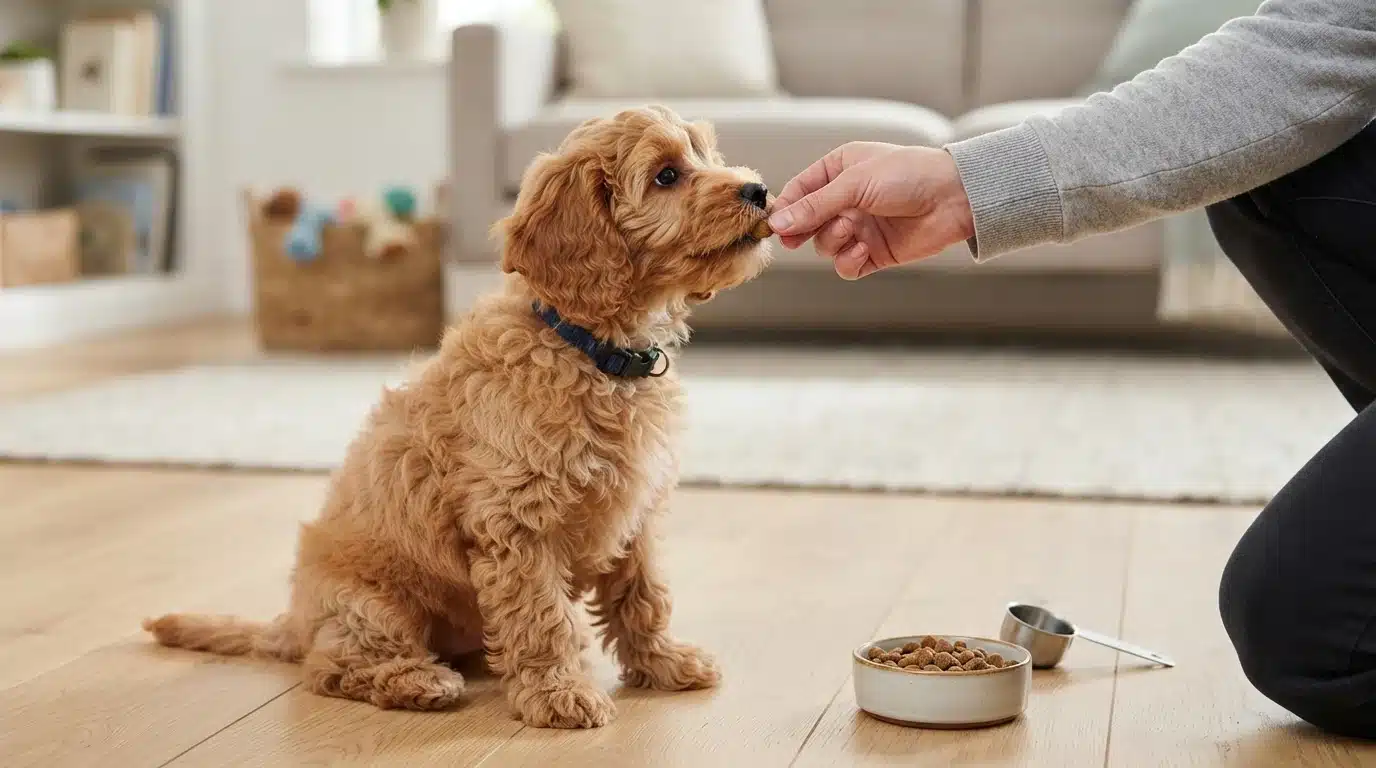
For toppers, a spoonful of plain wet food or a splash of warm water over kibble can win over a picky eater. Just subtract those calories from meals so the total stays steady.
Hydration, Wet Food, and the Winter Water Bowl
Small breeds dehydrate faster than big ones, so keep fresh water down all day and refresh it at every meal. Expect a puppy to drink shortly after eating and after play.
Wet food helps here too: canned food is roughly 75 to 78% moisture versus 10 to 12% in kibble, according to the FDA’s pet food guide. A spoonful mixed into dinner quietly adds fluids.
Watch for a pale or sticky tongue, thick drool, or low energy, and call your vet if the water bowl suddenly empties. In winter, indoor heating dries the air, so change the water twice daily and check the bowl isn’t frozen if it sits near a door.
Step 6: Track Growth and Body Condition Month by Month
The scale tells you what your puppy weighs, but not whether that weight is healthy. Body condition does that. Once a month, run a quick hands-on check alongside your weigh-ins so you catch a drift before it becomes a problem.
A Five-Point Body Condition Checklist
Vets score dogs on a nine-point scale, and PetMD’s guide puts ideal right in the middle, around 4 to 5. Here is what to check at home:
- Ribs: You should feel them easily under light pressure, with no thick fat layer hiding them.
- Waist: Looking down from above, your Cavapoo should have a visible tuck in behind the ribs.
- Belly: From the side, the abdomen slopes up toward the hind legs rather than hanging level.
- Spine and shoulders: Bones are felt but not sharp or prominent.
- Energy and coat: A well-fed puppy plays hard and sheds a healthy coat.
If the ribs vanish under fat or stand out visibly, adjust portions and recheck in two weeks.
When to Adjust the Schedule or Call the Vet
Trim portions by about a tablespoon per meal if weight climbs two months in a row. Add food if your puppy looks thin or leaves a bowl empty often. Call the vet for sudden appetite loss, vomiting, diarrhea, or no weight gain over a month, since growth problems can hide behind a normal-looking body.
Common Mistakes to Avoid in the First Six Months
Most feeding problems in the first six months come from a handful of repeatable errors. Avoid these and the portion charts above will actually work.
- Free-feeding. Leaving food down all day hides appetite changes and stalls house training. Serve measured meals on a schedule instead.
- Switching foods too fast. A sudden swap causes loose stools. Follow the 25% weekly blend and finish the transition over about a week.
- Treating like meals. Training treats count. Stay under 10% of daily calories, and subtract them from the bowl, not on top of it.
- Guessing portions after growth spurts. Weigh your puppy every couple of weeks and adjust the cup, not your instinct.
- Feeding for begging. Cavapoos act hungry at any hour. Extra food at 4 months shows up as extra weight at 12.
For more on reading your puppy’s cues day to day, our Cavapoo temperament and care guide covers routines beyond the bowl.
Putting the Schedule to Work for Your Cavapoo
A feeding schedule only helps if it fits real life. Set your puppy’s meal times around your day, then keep them steady, because dogs settle fastest when food arrives on time.
Print the portion chart, stick it on the fridge, and track weight every couple of weeks. If ribs feel hard to find under the coat, trim portions slightly; if ribs and spine show, add a bit. A quick hands-on check like the one in our Cavapoo coat guide helps you read a fluffy frame.
Expect adjustments. Growth spurts, spay or neuter surgery, and longer play sessions all shift how much your dog needs. Change one thing at a time so you know what worked. Puppies bred in a small home program like ours often arrive already used to set meals, which makes your first week smoother.

Feeding a tiny puppy on a schedule can feel stressful, but it gets simple with practice. Follow the portions and transition plan above, and check with your vet if anything seems off. Want a puppy raised with this care from day one? Visit Sage Puppies to meet our Cavapoos.
Frequently Asked Questions
Q1: cavapoo nutrition and feeding schedule
Feed a small-breed puppy formula on measured meals: four daily from 8 to 12 weeks, three until 6 months, then two. Total daily food runs 1/3 to 1 cup, adjusted by weight and body condition.
Q2: How much should I feed my 8-week-old Cavapoo?
About 1/3 to 1/2 cup daily, split into four meals, with roughly 3 tablespoons per meal for a small puppy.
Q3: When should I switch my Cavapoo to adult food?
Around 12 months, transitioning over seven to ten days using the gradual blend method.
Q4: Can I free-feed my Cavapoo?
No. Measured meals protect appetite signals, house training, and healthy weight.
Q5: How many treats can a Cavapoo puppy have?
Keep treats under 10% of daily calories, and subtract them from meal portions.
Q6: What if my puppy has loose stools after a food change?
Hold the current old-to-new ratio for two extra days, and call your vet if diarrhea lasts over 24 hours.
Wrapping Up
Feeding a Cavapoo well comes down to four habits: measured meals on a steady clock, portions matched to weight and age, a slow seven-to-ten-day food switch, and a monthly hands-on body check. Treats stay under 10% of daily calories, and free-feeding never enters the picture. Watch your puppy’s body rather than the bowl, because growth spurts and surgery will shift needs along the way. Print the portion chart, weigh every couple of weeks, and adjust one variable at a time. Do that, and mealtimes become the easy part of puppy ownership.