A practical, prevention-first routine for building reliable bathroom habits without punishment, panic, or unrealistic expectations. Whether your puppy comes home in Utah or is delivered elsewhere in the United States, the same calm system applies: supervise closely, use predictable potty triggers, reward success, and expand freedom gradually.
Trigger-based scheduleNo-punishment methodApartment and nighttime tips
Four-week roadmap for the first 30 days of puppy potty training.
The core idea
Potty training is less about waiting for your puppy to “ask” and more about creating so many well-timed successes that the right habit becomes predictable.
Before day one
What success should look like after 30 days
A puppy may not be completely house-trained in one month. A more useful goal is a strong, repeatable routine: fewer accidents, clearer body-language signals, quicker elimination outside, and carefully earned freedom inside.
Age, previous experience, schedule consistency, household layout, weather, and individual temperament all affect progress. Small companion puppies may need more frequent opportunities simply because their bodies are small—not because they are stubborn. Avoid comparing your puppy with someone else’s timeline.
Use this rule throughout the month: when accidents increase, reduce freedom and increase well-timed potty trips. When success becomes consistent, add freedom in small, testable increments.
Measure progress by
More successful potty trips
Fewer surprise accidents
Better recognition of puppy’s signals
Longer calm periods after a successful trip
Do not expect
Perfect reliability in every room
Adult-level bladder control
A puppy to understand punishment
One schedule to fit every puppy
Step 1
Set up the environment before the first accident
Good house training starts with management. Before your puppy comes home, decide where the puppy will sleep, rest, play, eat, and eliminate. The clearer those zones are, the easier it is to supervise and respond before an accident happens.
Outside
One primary potty spot
Choose a safe, easy-to-reach area with a consistent surface. Use the same exit and route during the first weeks whenever practical.
Inside
A small supervised zone
Use gates, a pen, a puppy-safe room, or a light house leash so the puppy cannot quietly disappear behind furniture.
Rest
A positive crate setup
Use an appropriately sized crate for sleep and brief rest—not as punishment or a substitute for exercise, interaction, and potty opportunities.
Supplies
Rewards and cleaner ready
Keep small treats by the exit, a leash within reach, and an enzymatic pet cleaner available for thorough accident cleanup.
Use events—not only the clock—to predict when your puppy is likely to need a bathroom break.When you cannot actively supervise, use a safe, appropriately sized management zone instead of giving the puppy full-house access.Step 2
Use the same seven-part potty routine every time
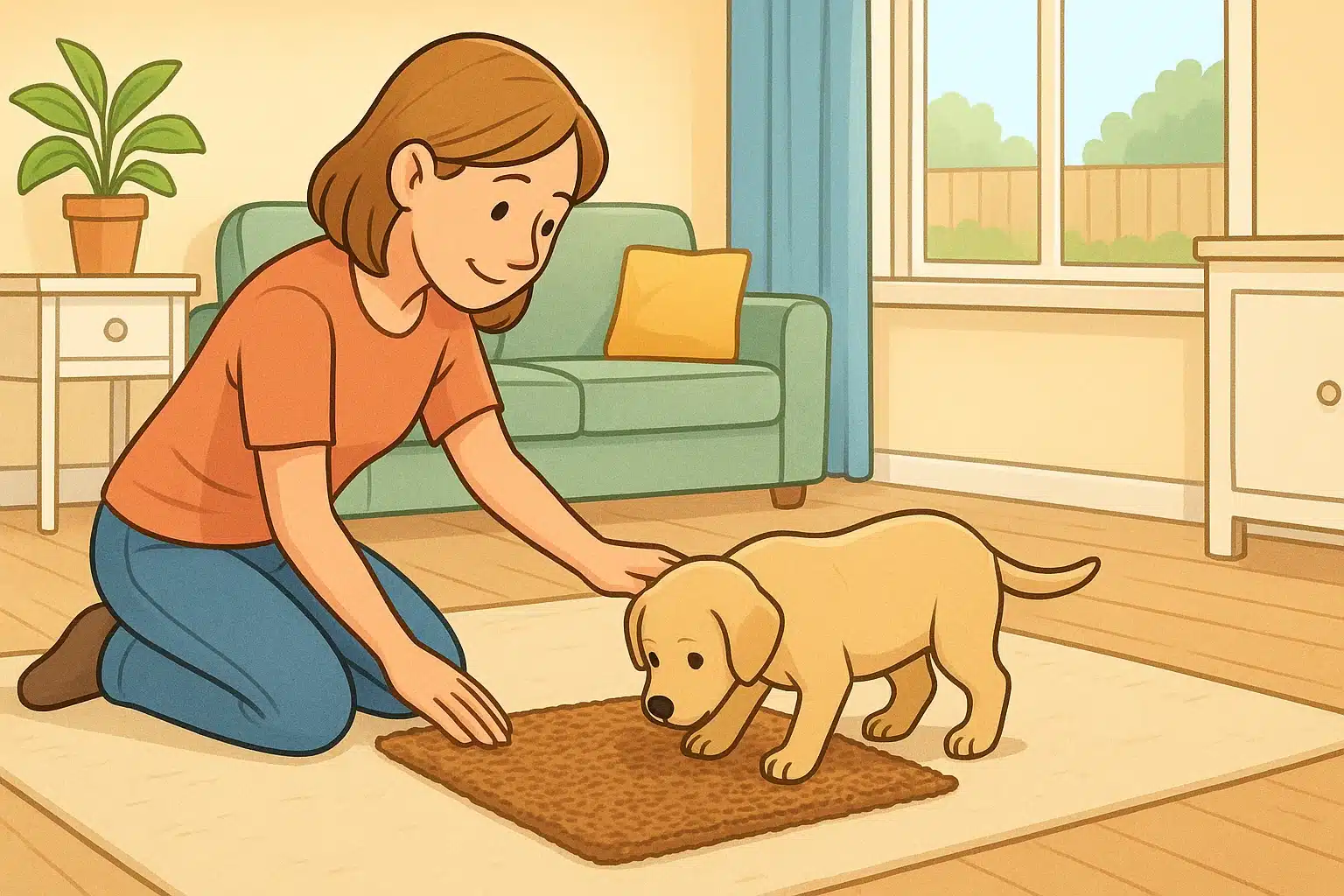
Notice the trigger. Waking, eating, drinking, vigorous play, excitement, and leaving a crate or pen should prompt a potty opportunity.
Go promptly. Use a leash and the same exit when practical. For a very young puppy who is likely to have an accident en route, carrying may help when it is safe to do so.
Use one primary spot. Stand quietly and give your puppy a brief chance to sniff and eliminate. Keep the trip calm rather than turning it into playtime.
Say the cue once. A simple phrase such as “go potty” works best when spoken softly while your puppy is already beginning to eliminate—not repeated constantly.
Mark the finish. As soon as your puppy completes the behavior, use a calm marker such as “yes” or warm praise.
Reward immediately. Deliver a small, high-value treat within a second or two, then allow a short sniff or calm play period when appropriate.
Reset when nothing happens. Return indoors to a small supervised area for roughly 10–15 minutes, then try again. Do not give free roaming after an unsuccessful trip.
A consistent exit, leash routine, and outdoor spot reduce delay and make the sequence easier for the puppy to recognize.Step 3
Build the day around potty triggers—not a rigid clock
Young puppies often need frequent opportunities, but a fixed hourly rule can be misleading. Watch the puppy in front of you and use a log to find patterns. Offer a potty break after the events below, plus any time you see purposeful sniffing, circling, abruptly leaving play, wandering toward an exit, or becoming restless.
Daily moment
What to do
Why it matters
First wake-up
Go directly to the potty spot before play or breakfast.
Sleep-to-potty is one of the most predictable patterns.
After food or a substantial drink
Offer a calm potty trip soon afterward and observe the timing that fits your puppy.
Eating and drinking often precede elimination.
Before and after active play
Take a preventive trip, especially after zooming, training, visitors, or energetic play.
Movement and excitement can make a need appear quickly.
After every nap
Go out promptly, even if the nap was short.
Waking is a high-value training opportunity.
Before confinement
Offer a potty trip before crate or pen time.
A comfortable puppy is more likely to rest.
Immediately after confinement
Leash and go outside before allowing indoor freedom.
This prevents the common “crate to carpet” accident.
Before bedtime
Keep the final outing quiet, complete, and boring.
Calm repetition supports the nighttime routine.
The table is a sequence guide, not a promise that a puppy can wait a particular number of hours. Increase or decrease frequency based on actual results.
The first month
Your week-by-week puppy potty-training plan
Days 1–7
Week 1: Make the routine predictable
Your first goal is not independence. It is prevention. Keep your puppy close enough that you can notice subtle changes, and use the trigger list aggressively. Take the puppy to the same spot, reward every successful elimination, and record the approximate time and preceding event.
Limit access to one main living area.
Use a light leash, gate, pen, or crate when needed.
Reward every outdoor success, even overnight.
Learn your puppy’s pre-potty body language.
Keep nighttime trips quiet and brief.
TargetFewer preventable accidents
SkillSame route and same spot
Owner focusNotice the pattern
Days 8–14
Week 2: Build communication
Continue the Week 1 routine, then begin pairing a simple verbal cue with the behavior. You may also introduce one consistent door signal, such as pausing at the door or lightly touching a bell. Treat the signal as a communication tool, not proof that the puppy can manage long waits.
Say the cue once as elimination begins.
Reward immediately after the puppy finishes.
Respond to door signals promptly at first.
Keep a shared log when multiple people help.
Continue supervising after a successful trip.
The reward should happen outside and immediately after completion so the puppy can connect it with the correct behavior.
Days 15–21
Week 3: Let the puppy earn a little more freedom
After a successful potty trip, test a short period in one additional puppy-safe room. Keep the puppy with you and make the test brief. Freedom is a training variable: add one room or a few minutes at a time, not the whole house at once.
Expand access only after a successful trip.
Keep bedroom and carpeted areas closed unless supervised.
Practice on different safe outdoor surfaces.
Continue using the same cue and reward sequence.
If an accident occurs, return to the previous successful level.
TargetShort, clean freedom periods
SkillPotty despite mild distractions
Owner focusExpand slowly
Days 22–30
Week 4: Generalize the habit and reduce prompting carefully
By the fourth week, many families recognize a reliable pattern. Continue rewarding success while gently testing new situations: another exit, a different safe potty location during travel, mild weather changes, or a longer—but still conservative—interval during a calm part of the day.
Change only one variable at a time.
Keep rewards valuable in new environments.
Practice before visitors, errands, and schedule changes.
Maintain the final bedtime and first-morning routine.
Return to more frequent trips during regressions.
Graduation is not “no more management.” It is knowing the puppy’s pattern, preventing mistakes during changes, and expanding responsibility at a pace the puppy can actually handle.
When mistakes happen
Handle accidents without fear or drama
Accidents are information. They usually point to a missed trigger, too much freedom, a distraction outside, incomplete elimination, or a schedule change. Punishment can make a puppy afraid to eliminate in front of people, which may create hiding rather than understanding.
Do not scold, chase, rub the puppy’s nose in the accident, or bring the puppy back later. Clean thoroughly and change the next repetition.
If you see the accident happening
Use a soft, neutral interruption—enough to pause, not frighten—then take the puppy directly to the potty spot. If the puppy finishes outside, reward normally. If you discover the accident after the fact, say nothing to the puppy and clean it thoroughly.
If accidents repeat in the same place
Block access temporarily, clean with an enzymatic pet cleaner according to the product directions, and revisit the schedule. Residual odor may encourage repeat use even when humans cannot smell it.
Real-world adjustments
Adapt the system without changing its logic
Apartments and condos
Plan the elevator or stair route before the puppy wakes. Keep shoes, leash, and rewards ready. Follow your veterinarian’s guidance about safe potty locations while vaccinations are underway.
Rain, snow, heat, or wind
Create a well-lit, safe, easy-to-clear potty area. Keep the trip brief and focused, then return indoors. Practice during mild weather before you need the routine in difficult conditions.
Pads or artificial turf
Use them intentionally. If indoor elimination will be a long-term option, keep the location and surface consistent. If your goal is outdoor-only, minimize mixed rules and transition gradually.
Travel or puppy delivery
Expect a temporary reset after transportation, a new home, or a schedule change. Start with Week 1 management for the first few days, even if the puppy had prior training foundations.
Multiple caregivers
Use the same cue, same reward standard, and one shared log. Inconsistent freedom and delayed responses are common reasons progress stalls.
Busy households
Assign responsibility by time block rather than assuming someone else went out. A simple checkmark on a shared schedule prevents missed trips.
Overnight potty trips should be safe, responsive, and boring: out, reward if successful, then back to rest.Troubleshooting
Use the accident pattern to choose the fix
What you see
Likely training issue
What to change next
Puppy plays outside, then eliminates immediately indoors
The outdoor trip became play, or the puppy received freedom before eliminating.
Use a leash, stand quietly, return to a small supervised zone if nothing happens, and retry soon.
Accidents happen at nearly the same time each day
The schedule is missing a predictable need.
Move the potty trip earlier than the usual accident and log results for several days.
Puppy sneaks into another room
Too much unsupervised freedom.
Close doors, use gates or a house leash, and add rooms only after successful trips.
Puppy signals but has accidents while waiting
The signal is recognized too late or the route is too slow.
Respond promptly, stage supplies by the door, and simplify the path outside.
Progress disappears after travel, visitors, or a move
The habit has not generalized to the new context.
Return temporarily to Week 1 management and rebuild success in the changed environment.
Sudden frequent accidents after reliable progress
Could be a routine disruption or a health concern.
Tighten management and contact your veterinarian when the change is abrupt or accompanied by other symptoms.
Regression is a reason to simplify the plan. A sudden or symptomatic change is also a reason to consider veterinary guidance.
A simple seven-day tracking log
For one week, record the time, trigger, result, location, and any accident. Patterns usually become easier to see when they are written down.
Day/time
Trigger
Potty result
Reward
Accident or note
Day 1
Wake / meal / drink / play / other
Urine / stool / both / none
Yes / no
Day 2
Day 3
Day 4
Day 5
Day 6
Day 7
Health and safety
Know when training advice is not enough
Contact your veterinarian promptly when you notice straining, blood, apparent pain, repeated attempts with little output, excessive thirst, vomiting or diarrhea, lethargy, or a sudden increase in accidents after a period of reliable progress. Training cannot diagnose or treat a medical problem.
For outdoor safety: ask your veterinarian which potty locations are appropriate for your puppy’s age, health status, and vaccination plan—especially in shared apartment areas, parks, rest stops, and other places used by unfamiliar dogs.
Frequently asked questions
Puppy potty-training FAQ
How often should I take my puppy outside?
Use frequent, trigger-based opportunities rather than relying on one universal hourly rule. Go out after waking, meals, substantial drinks, play, excitement, and confinement, plus whenever you see purposeful sniffing, circling, wandering, or restlessness. Adjust the frequency from your puppy’s actual results.
How long does it take to potty train a puppy?
Timing varies by age, history, health, routine, household layout, and individual puppy. Thirty consistent days can establish a strong foundation, but reliable house training often continues beyond the first month and must be practiced in new rooms and environments.
Should I use a crate for potty training?
A properly sized, positively introduced crate can support sleep, rest, and supervision. It should not be used as punishment or to make a puppy wait longer than is comfortable. Always pair crate time with timely potty opportunities and appropriate activity.
Are puppy pads a bad idea?
Not necessarily. They can be useful when an indoor toilet is part of the long-term plan or when access outdoors is temporarily limited. If your final goal is outdoor-only elimination, use pads intentionally and transition gradually so the puppy does not receive inconsistent surface rules.
What should I do when my puppy will not potty outside?
Keep the trip brief, leashed, quiet, and focused. If nothing happens, return indoors to a small supervised area for about 10–15 minutes, then try again. Do not give unsupervised indoor freedom immediately after an unsuccessful trip.
Should I punish my puppy for an accident?
No. Punishment does not explain where the puppy should eliminate and can create fear or hiding. Interrupt neutrally only when you catch the accident in progress, go outside, reward completion there, clean thoroughly, and adjust the next potty opportunity.
SP
About this guide
Sage Puppies shares practical preparation resources for families welcoming Havanese, Havapoo, and Cavapoo puppies. This educational article supports—not replaces—individual veterinary or professional training guidance.
Preparing for a puppy?
Start with a clear plan before your puppy comes home.
Explore available puppies, review our process, and use the Sage Puppies preparation resources to make the transition calmer for your family and your new puppy.
1. BrowseAvailable puppies
2. LearnHow it works
3. PreparePuppy prep guide
4. ApplyJoin the waitlist
Wisely Bred. Beautifully Loved. Serving families nationally, with pickup available in South Jordan, Utah.