Havanese vs. Havapoo vs. Cavapoo: Which Is Best for Your Family?
Comparing a Havanese vs. Havapoo vs. Cavapoo for families is not simply a matter of choosing the cutest puppy. The best match depends on your children’s ages, household activity, grooming expectations, other pets, training plans, and the amount of daily companionship your family can provide.
All Three Can Be Wonderful Family Dogs—For Different Reasons
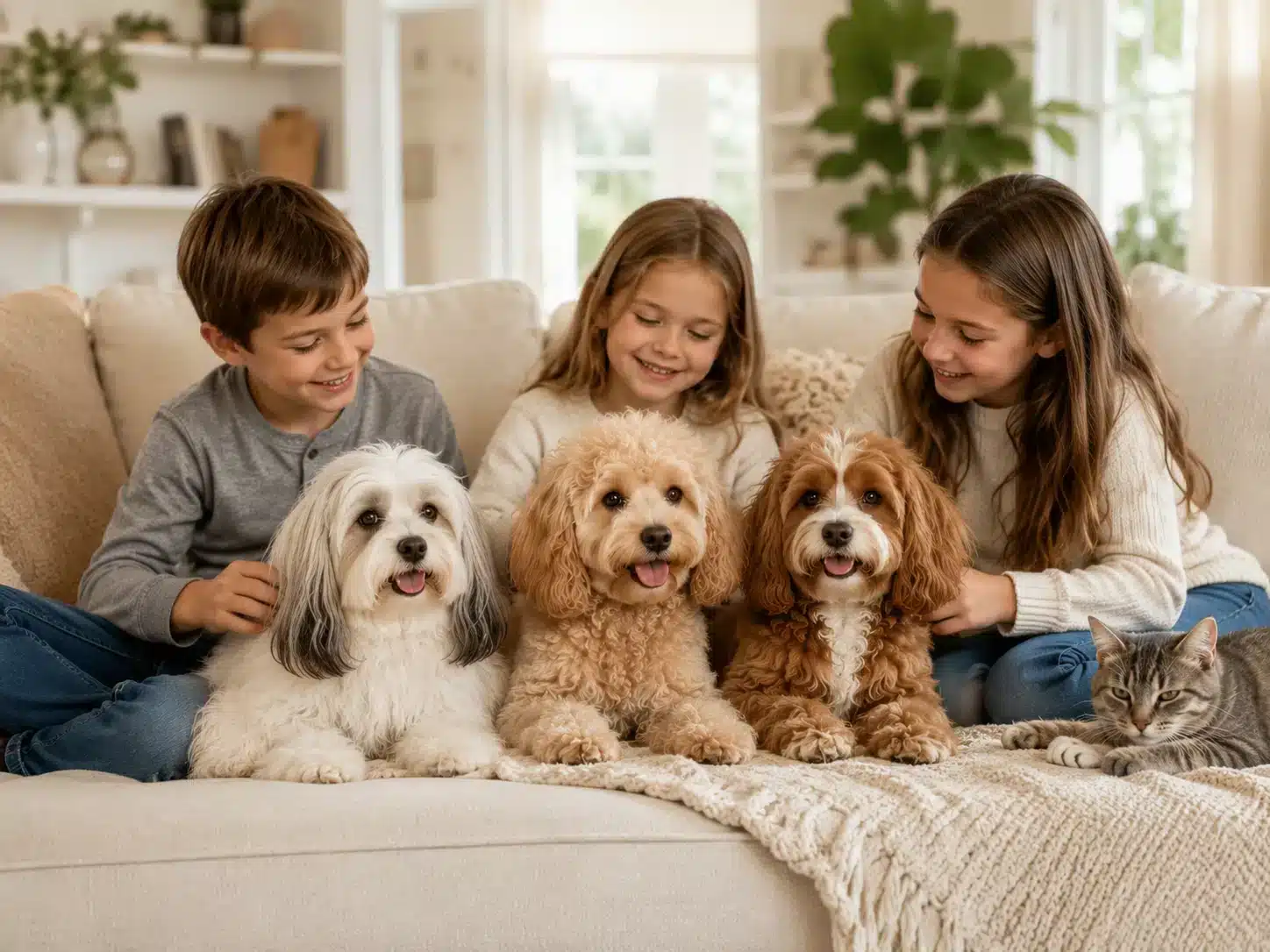
Havanese, Havapoos, and Cavapoos are affectionate companion dogs that can thrive in family homes. There is no universal winner. The strongest match comes from pairing a puppy’s individual temperament with the family’s routines and expectations.
Havanese
A small, devoted companion
A Havanese may suit families seeking a compact, affectionate dog that enjoys staying close to its people and participating in daily life without requiring an intensely athletic routine.
Havapoo
An adaptable, trainable blend
A Havapoo may fit families that want a social, intelligent, generally adaptable companion and are comfortable with some variation in coat, size, energy, and personality.
Cavapoo
An outgoing, playful companion
A Cavapoo may appeal to families wanting an affectionate, cheerful dog that enjoys play, training, walks, and frequent interaction with children and adults.
Important: Breed tendencies provide a useful starting point, but they do not replace individual puppy evaluation. Parent temperament, early development, health, socialization, household routines, and training all affect the adult dog your puppy becomes.
At-a-Glance Comparison
How the Three Breeds May Fit Everyday Family Life
This chart focuses on practical family considerations rather than repeating a general breed overview. Mixed-breed puppies can inherit different combinations of traits, so ask about the parents and the individual puppy rather than relying on generation or breed label alone.
Family factor
Havanese
Havapoo
Cavapoo
Typical family style
Close-knit families wanting a devoted companion
Families wanting adaptability and trainability
Interactive families wanting an affectionate playmate
Size
Consistently small and easy to accommodate
Usually small, but parent size affects the outcome
Usually small, with meaningful variation based on parents
Energy
Moderate; enjoys play and walks without needing an extreme exercise schedule
Moderate and variable; often enjoys training games and family activity
Moderate; commonly playful and enthusiastic about interaction
Young children
Can do well with gentle, supervised handling
Can do well when the puppy’s confidence and energy match the household
Can be an engaging playmate when children use respectful handling
Other pets
Often enjoys companionship when introductions are thoughtful
Frequently adaptable, although inherited traits vary
Often social, but individual interest in chasing and play should be evaluated
Trainability
Intelligent and responsive to patient, positive routines
Often highly responsive and motivated by interaction
Often eager to engage and learn with consistent reinforcement
Grooming
Frequent brushing and routine professional grooming
Frequent coat care; texture and matting risk vary
Frequent brushing and professional grooming are normally needed
Shedding
Generally low shedding, but not completely shed-free
Can be low shedding, but mixed coats are not predictable
May be low shedding, but coat and shedding vary by puppy
Alone time
Usually prefers substantial companionship
Often people-oriented and may dislike long isolation
Typically thrives with frequent family interaction
All three breeds need companionship, age-appropriate activity, coat care, and patient family training.
Havanese were developed as companion dogs, and many remain happiest when they are included in everyday household life. They may follow family members from room to room, settle near someone working or studying, and enthusiastically join playtime.
Often highly affectionate and people-focused
Small enough for apartments and compact homes
Usually benefits from gentle, consistent training
May be sensitive to rough handling or prolonged isolation
Havapoos combine Havanese and Poodle ancestry. Many are social, clever, and adaptable, but mixed-breed puppies do not inherit traits in fixed percentages. One puppy may be relaxed and cuddly while a littermate is more active and training-driven.
Cavapoos combine Cavalier King Charles Spaniel and Poodle ancestry. Many are cheerful, affectionate, and eager to participate. Their social nature can make them enjoyable family companions when they receive appropriate exercise, structure, and calm downtime.
Often playful and enthusiastic about family activity
Frequently enjoys training and social interaction
May need help learning to settle after exciting play
Adult size and coat depend heavily on the parents
Dogs and Children
Which Breed Is Best With Children?
Any of the three may be a loving companion for children, but no breed label guarantees safe or effortless interactions. A good match depends on the puppy’s confidence, the child’s behavior, adult supervision, and the family’s willingness to teach appropriate boundaries.
For toddlers and preschoolers
Small dogs can be injured by falling children, squeezing, carrying, or rough play. Adults should actively supervise every interaction and create puppy-only rest areas that children do not enter.
For school-age children
Older children can participate in feeding, short training sessions, grooming preparation, and structured play. An adult should still remain responsible for consistency and safety.
For active families
Havapoos and Cavapoos may especially enjoy training games, walks, and active play, although energy varies by puppy. Havanese can also be playful while often fitting a somewhat lighter exercise routine.
For quieter households
A calm Havanese or lower-energy puppy from any of the three breeds may fit well. The individual puppy’s arousal level and ability to settle are more informative than appearance alone.
Teach children these four rules
Let the puppy approach instead of chasing or cornering it.
Pet gently along the shoulder or side rather than grabbing the face.
Leave the puppy alone while it eats, sleeps, or rests in its safe area.
Ask an adult before lifting or carrying a small puppy.
Multi-Pet Homes
Living With Cats and Other Dogs
Havanese, Havapoos, and Cavapoos can all live successfully with other pets. Introductions, early socialization, resource management, and individual temperament usually matter more than choosing one breed name over another.
A confident, socially appropriate puppy may integrate more easily than an overly intense or fearful puppy. Existing pets also need space, predictable routines, separate feeding areas, and time to adjust.
Look for these qualities
Curiosity without relentless chasing
Ability to disengage and respond to the handler
Comfort around age-appropriate household sounds
Recovery after a mild surprise
Respect for another animal’s signals and space
Successful multi-pet households begin with gradual introductions, supervision, and protected rest spaces.
Coat Care and Shedding
Low Shedding Does Not Mean Low Maintenance
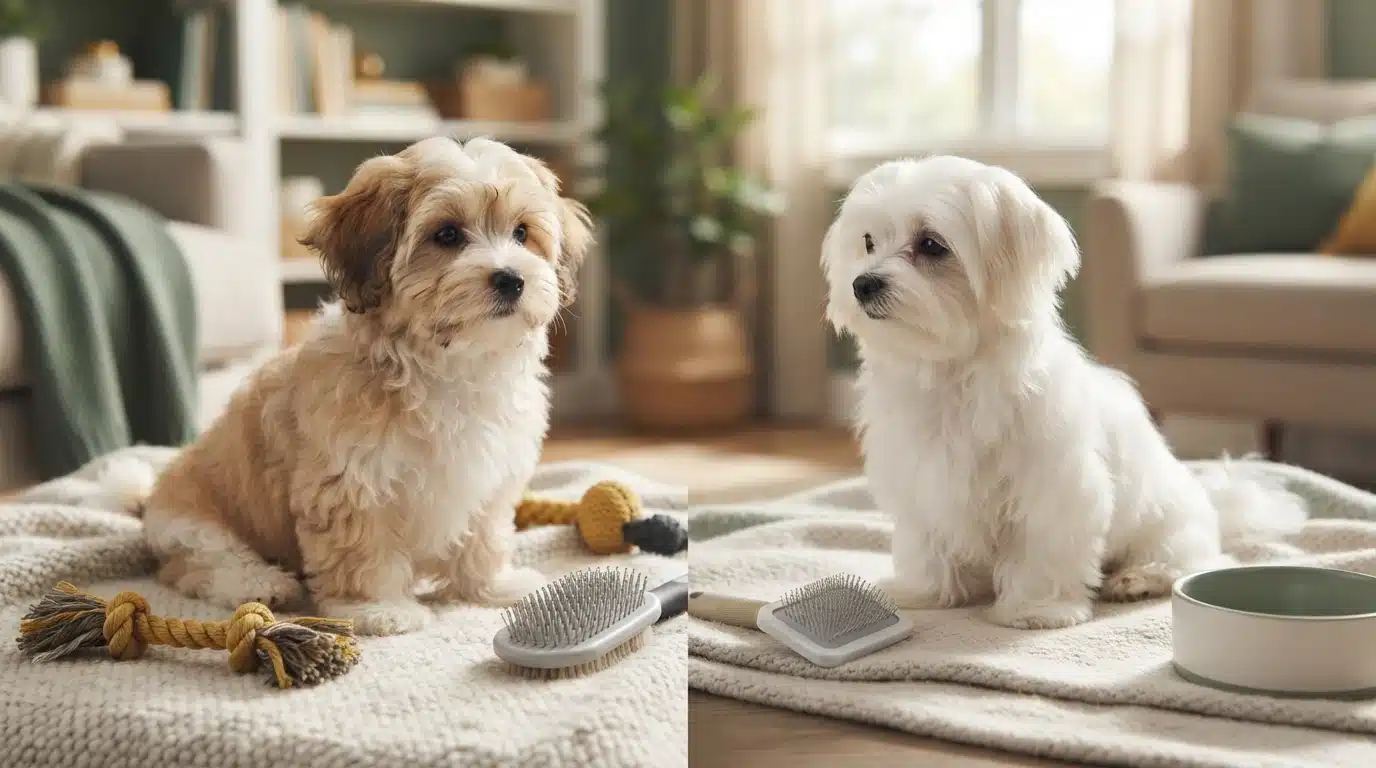
Families are often drawn to all three breeds because they may shed less than many other dogs. However, a coat that releases less hair frequently requires more brushing, combing, bathing, trimming, and professional grooming.
Havanese coats
The Havanese coat can be kept longer or maintained in a shorter puppy trim. Either choice requires consistent brushing and combing, especially around the ears, legs, collar area, and places where the coat rubs.
Havapoo coats
Havapoo coats may be wavy, curly, soft, or more cotton-like. Families should be prepared for regular grooming even when a puppy appears easy to maintain during its early months.
Cavapoo coats
Cavapoo coats also vary. Soft waves and curls can mat close to the skin, making thorough brushing and combing more important than simply brushing the visible surface.
Allergy expectations
No Havanese, Havapoo, or Cavapoo can be guaranteed completely hypoallergenic. Families with allergies should consult their healthcare professional and spend time around similar adult dogs before making a decision.
Training and Daily Activity
Which Is Easiest to Train?
All three are intelligent enough to learn family routines. The more useful question is whether your family can provide short, consistent, positive training sessions every day.
Havanese
Havanese can be bright, playful learners. They often respond best to gentle reinforcement and clear routines rather than repetitive drilling or harsh correction.
Havapoo
Many Havapoos enjoy problem-solving, food rewards, and interaction. Their intelligence can also mean they quickly practice unwanted habits when family rules are inconsistent.
Cavapoo
Many Cavapoos are eager to engage with people and can enjoy training. Excitable puppies may need extra practice with calm greetings, impulse control, and settling.
Family training tip: Assign adults responsibility for the routine, then give children small, supervised jobs. Conflicting commands and inconsistent rules are harder on a puppy than having only one person conduct every lesson.
Household Match
Choose the Dog That Fits the Life You Actually Live
Apartment or smaller home
All three can adapt to smaller spaces when they receive exercise, enrichment, training, and companionship. A consistently small Havanese may provide the most predictable size.
Busy household with frequent activity
A confident Havapoo or Cavapoo may enjoy a highly interactive household, but the puppy should still have a quiet area and structured opportunities to rest.
Home-based or retired family
Any of the three may thrive with substantial companionship. Families should still teach gradual independence so the puppy can remain comfortable when left for reasonable periods.
First-time dog owners
All three can suit first-time owners who understand grooming expenses, house-training demands, puppy supervision, and the importance of consistent positive training.
Families that travel frequently
Small size can make travel easier, especially with a Havanese or smaller Havapoo or Cavapoo. Families should verify adult size expectations and introduce travel routines gradually.
Long workdays away from home
None of these people-oriented breeds is an ideal choice for routine, extended isolation without a plan for breaks, care, enrichment, training, and companionship.
A Better Selection Process
Do Not Choose From Breed Name Alone
A responsible family match considers the puppy in front of you. Before reserving a puppy, discuss your household honestly with the breeder, including children’s ages, existing pets, noise level, activity, travel, work schedules, grooming expectations, and previous dog experience.
Choose a Havanese when your family wants a consistently small, affectionate companion and is prepared for regular coat care, gentle handling, and substantial togetherness.
Choose a Havapoo when your family values adaptability, trainability, and a social personality but understands that a mixed-breed puppy’s size, coat, and energy can vary.
Choose a Cavapoo when your family wants an affectionate, playful, people-oriented dog and can provide interactive training, regular exercise, grooming, and help learning calm household routines.
The best answer may be an individual puppy rather than a breed. A calm Cavapoo may fit a quiet family better than a high-energy Havanese, while a confident Havapoo may suit young children better than a more sensitive puppy of either breed.
Frequently Asked Questions
Havanese vs. Havapoo vs. Cavapoo FAQs
Which breed is usually calmest for a family?
Havanese may sometimes fit families seeking a lighter exercise routine, but calmness varies considerably among puppies. Parent temperament, early development, maturity, training, and the household environment all influence activity level.
Which is best for families with young children?
No single breed is automatically best for young children. Look for a confident, socially appropriate puppy and supervise all interactions. Children must learn not to chase, squeeze, lift, disturb, or overwhelm a small dog.
Which sheds the least: Havanese, Havapoo, or Cavapoo?
Havanese are generally low shedding. Havapoo and Cavapoo coats are more variable because they are mixed breeds. No puppy should be promised as completely non-shedding or hypoallergenic.
Which breed is easiest for a first-time owner?
All three can work for committed first-time owners. Havapoos and Cavapoos may be especially enthusiastic about training, while Havanese are often devoted companions. Grooming, supervision, socialization, and consistent routines are required for each.
Can these dogs live with cats?
Yes, many Havanese, Havapoos, and Cavapoos live successfully with cats. Gradual introductions, barriers, separate resources, supervision, and matching the puppy’s play and chase tendencies to the resident cat are important.
Are Havanese, Havapoos, or Cavapoos good apartment dogs?
All three can live successfully in apartments when their exercise, enrichment, training, bathroom, and companionship needs are met. Barking habits and the individual puppy’s energy level matter more than square footage alone.
Find Your Best Match
Which Sage Puppies Breed Fits Your Family?
Compare your children’s ages, activity level, grooming expectations, household schedule, and preferred companion style with our three family-focused breeds.