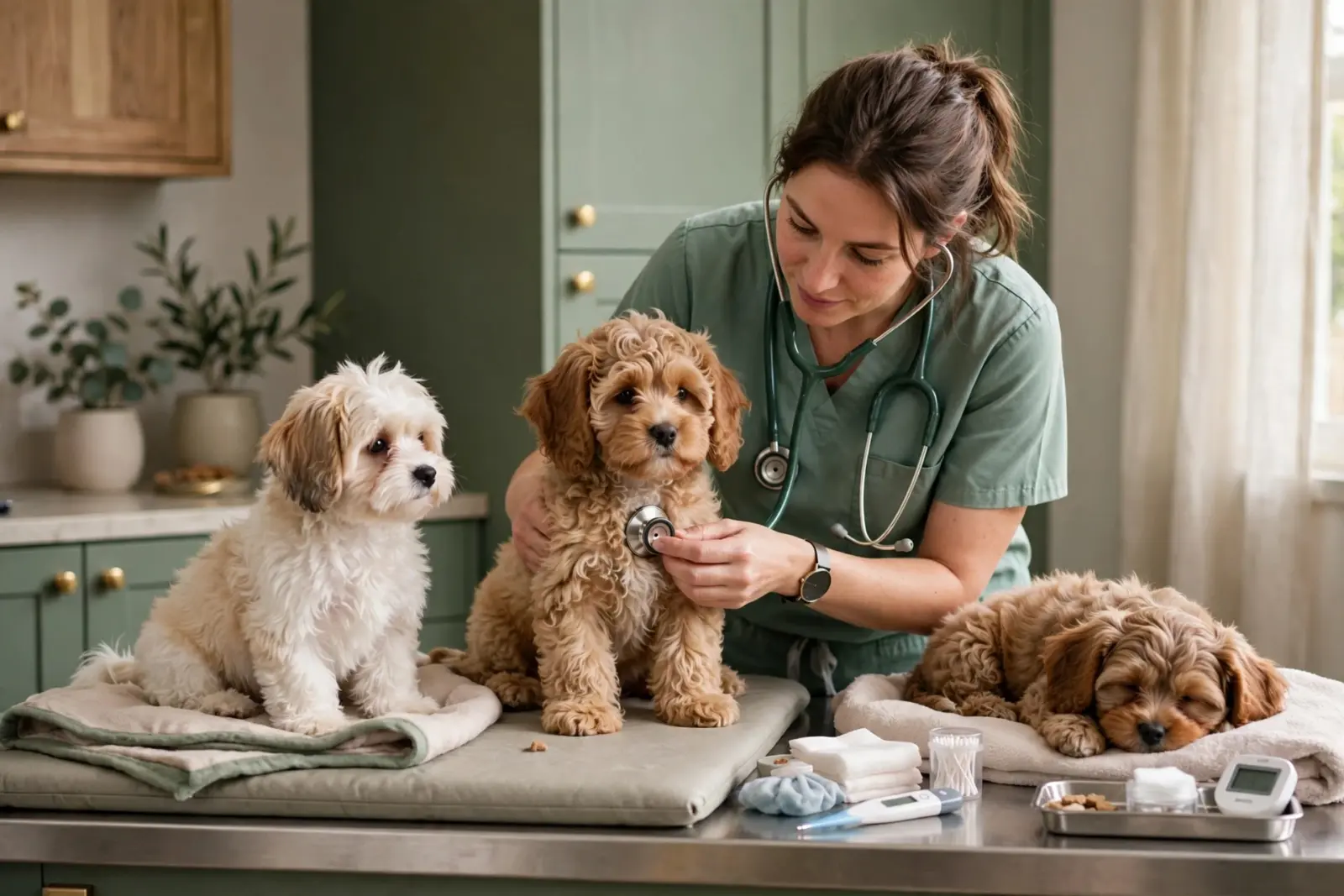
Quick Summary: The choice between a family-raised puppy and a shelter rescue comes down to which unknown your household can handle: inherited risks and a changing temperament, or an uncertain past. Family-raised puppies offer known parent health records, predictable adult size, and early socialization, while Sage Puppies highlights its Utah-raised Havanese, Havapoo, and Cavapoo puppies with screening records and written contracts. Shelter dogs cost far less upfront, often about $50 to $500, and show their adult temperament sooner, but usually have incomplete histories and need a two-to-four-week adjustment period.
Two Utah families can want the same small companion dog this month and still bring home completely different animals. One pays $3,500 to $4,500 for a family-raised Havapoo with parent health records and a written contract. The other pays about $150 in adoption fees for a shelter dog of unknown age and history. Both can end well. The family-raised puppies vs shelter rescue choice really comes down to which risk you prefer: unknown genetics in a young dog, or an unknown past in an adult one.
This family-raised puppies vs shelter rescue comparison weighs both paths against six shared criteria: what you acquire, cost, health paperwork, temperament and training readiness, breed fit, and logistics. It closes with a decision rule and written questions to ask either way, because honest family-raised puppies vs shelter rescue research should serve your household, not a sales pitch.
Family-Raised Puppies vs Shelter Rescue: At a Glance
| Family-raised puppy purchase | Shelter or rescue adoption | |
|---|---|---|
| What You Acquire | A young, unfixed puppy raised with household socialization before placement | A dog with an existing history, often a mix, with an existing health record |
| Typical Acquisition Cost | Sage Puppies publishes a general range of $3,500-$4,500 for Havanese, Havapoo and Cavapoo puppies | Published adoption fees commonly range from about $50 to $500 depending on age and organization |
| Age at Adoption | Typically a young puppy, with age set by the breeder’s developmental schedule | Any age from young puppies to seniors; many shelter dogs are adults |
| Health Documentation | Puppy exam records plus parent clinical screening such as OFA hips, patellas and annual eye exams, with DNA results kept separate | Vaccination, sterilization and microchip records provided by the organization, with breed-specific testing uncommon |
| Temperament Information | Observed handling and socialization record from the raiser; no history of a previous home | Behavior observations and intake notes, sometimes with foster or prior-home history |
| Breed and Household Fit | Breed is known in advance, including small companion breeds such as Havanese, Havapoo and Cavapoo | Breed often unknown or mixed; match depends on individual temperament and size |
How Family-raised puppy purchase and Shelter or rescue adoption Compare
Family-raised puppy purchase
This is buying a young dog raised in a home by a breeder who provides parent health records, a written contract and a structured placement process. It suits families who want a known breed, early household socialization and predictable adult size, such as a Havanese, Havapoo or Cavapoo.
Key strengths
- Breed and rough adult size known in advance
- Puppy exam records plus parent screening such as OFA hips, patellas and eye exams
- Documented handling during the socialization window
Shelter or rescue adoption
Adoption means taking in a dog of unknown or mixed origin, often an adult, from a municipal shelter or nonprofit rescue, with core vet care usually included in the fee. Fees commonly run about $50 to $500, and the right match depends on temperament and size rather than breed paperwork.
Key strengths
- Lowest upfront cost, with vaccinations, spay or neuter and microchip typically included
- Any age available, from puppies to seniors
- A home is opened for a dog that already exists
Two Roads to the Same Goal: What Each Path Actually Delivers
Both paths can put a healthy, happy companion in your home. What they deliver looks different, though, and knowing the difference up front saves disappointment later.
Family-Raised Puppies: What the Label Does and Does Not Promise
“Family-raised” means a puppy grows up in a home, not a kennel row. It promises early handling, a known mother, and usually a written contract. It does not promise health by itself: the real evidence is parent testing, such as OFA eye, hip and patella exams. Ask for records regardless of how warm the photos feel. A boutique program like Sage Puppies builds that documentation into its matching process, and you can see how a puppy matching process works before you commit.
Shelter and Rescue Adoption: Where the Dog Comes From
Shelter dogs arrive as strays, owner surrenders, or transfers from other facilities, so intake reasons vary widely. Most are mixed breeds of unknown age, and many need a decompression period before their true personality shows. Rescue groups foster dogs in homes and share what they observed there. Shelter adoption statistics show millions of animals enter US shelters each year, so a good match genuinely exists for patient families.
Before choosing either road, ask what you can verify rather than what you hope is true.
Cost Comparison: Acquisition Fee Versus First-Year Reality
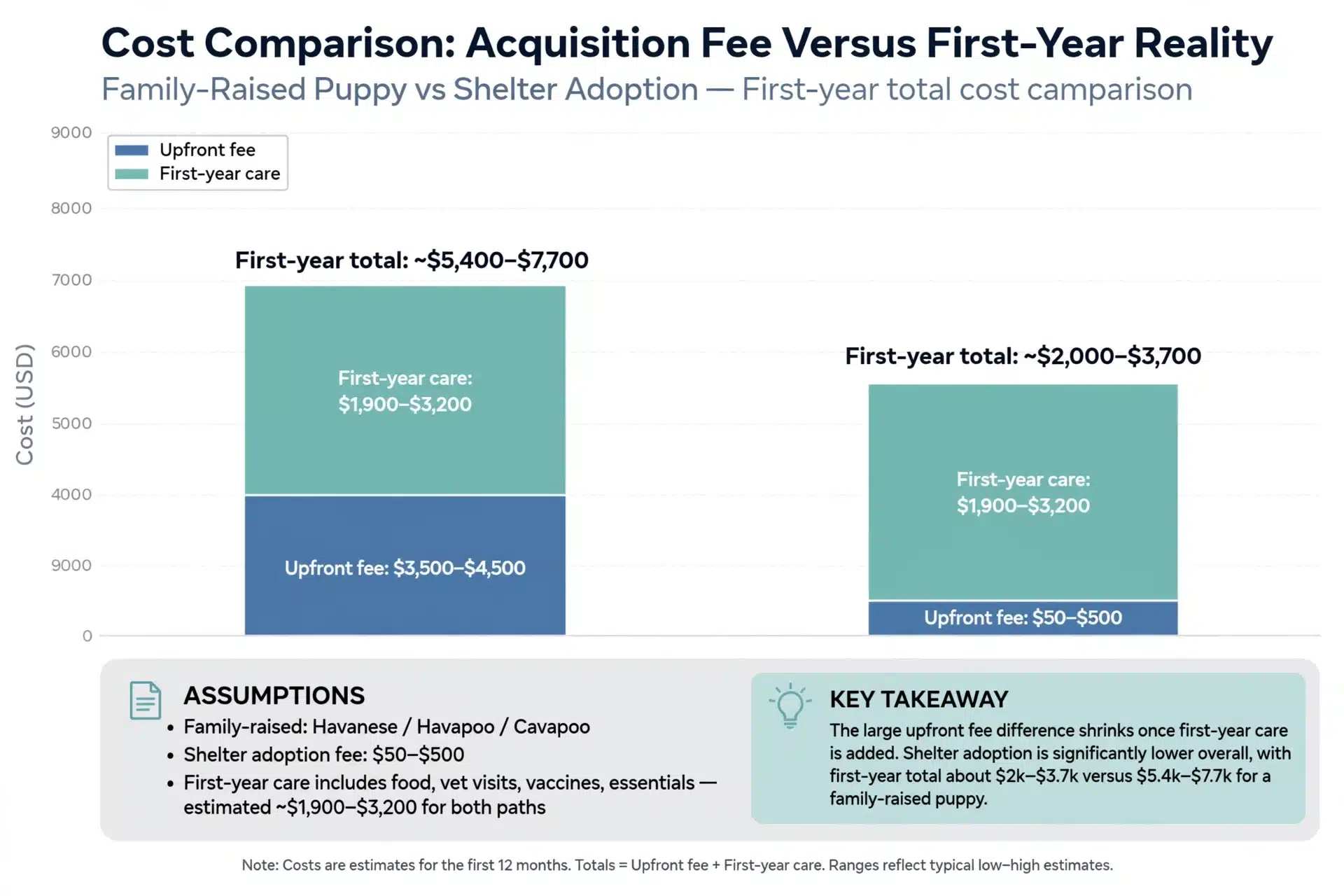
How much does a family-raised puppy cost versus a shelter adoption fee? Here are labeled planning figures, with assumptions noted: a family-raised Havanese, Havapoo or Cavapoo typically runs $3,500 to $4,500 up front, while a shelter adoption fee commonly runs $50 to $500. First-year care costs add a similar amount to both paths.
| Cost Layer | Family-Raised Puppy | Shelter Adoption |
|---|---|---|
| Upfront fee | $3,500-$4,500 | About $50-$500 |
| First-year care | Roughly $1,900-$3,200 | Roughly $1,900-$3,200 |
| First-year total | About $5,400-$7,700 | About $2,000-$3,700 |
The gap narrows once you look past the day you bring your dog home.
Upfront Acquisition Price and What It Covers
A breeder’s fee buys more than the puppy. At programs like Sage Puppies, it reflects parent health testing, early socialization, vaccinations, a written contract and breeder support, so you know what you are starting with. You can see how puppy pricing and reservation terms are structured before you commit.
Shelter fees stay low because they are subsidies, not full reimbursement. Intake exams, spay or neuter surgery and initial vaccines are often bundled in, but medical history before that day is usually unknown.
First-Year Costs and the Total-Cost Shift
First-year spending, excluding the dog itself, is roughly $1,900 to $3,200 for vaccines, parasite prevention, spay or neuter, gear and training, per ASPCA Pet Insurance’s breakdown. Rescued adults with a known history may need less; puppies of any origin need more. Adopted dogs can also need a decompression period and, at times, additional vet work.
So budget for first-year care separately from the fee. The acquisition price sets your starting point, not your total.
Health Evidence: Screening Records Versus Intake Records
The two paths hand you very different paperwork. Ask a breeder for these records:

- OFA hip and patella results for both parents
- A current eye examination (CERF/CAER)
- DNA test results for breed-relevant conditions
- A CHIC number confirming all required tests
- The puppy’s own vet check and vaccine record
The Orthopedic Foundation for Animals runs the CHIC program, and each dog must be permanently identified by microchip or tattoo before results count toward certification, according to OFA’s CHIC overview.
Reading Parent Screening and CHIC Certification Correctly
A CHIC number is the cleanest proof point you can ask for. For Havanese, the breed club requires OFA hips, OFA patellas and annual eye exams before a dog earns its certificate, as the Havanese Club of America explains. Verify the number yourself on OFA’s public database rather than trusting a screenshot. One honest caveat: CHIC lists dogs that complete the required tests, not only dogs with perfect results. Read each score, then ask how the breeder uses it. Breeders choosing pairing partners based on results give you the strongest signal. A mixed breed like a Havapoo may not carry a CHIC number, so ask for the parent tests by name. Sage Puppies shares parent screening records during its matching process, which makes this verification simple.
What a Shelter Medical Record Does and Does Not Tell You
A shelter intake record tells you what happened after arrival, not before. Expect vaccination dates, deworming, a spay or neuter record, a heartworm or illness screen, and notes on visible conditions. That is genuinely useful history. What it cannot show is the parents’ health, inherited risk, or early socialization, because that information simply does not exist for most rescued dogs. Treat the record as a starting point for your own vet visit, not a final answer. Budget for a full exam in the first weeks either way.
Temperament, Training and the First Year
The Puppy Developmental Curve
The first year shapes a dog’s temperament more than anything you do later. Puppies pass through a socialization window, roughly three to fourteen weeks old, when positive experiences with people, sounds and handling wire confidence in place. Breeders start this work before you ever meet the puppy. Then your job is potty training, crate training and short, upbeat lessons repeated daily. Small breeds like a Havanese or Cavapoo learn fast but have small bladders, so expect frequent trips outside for the first few months.

Adopting an Adult With a Known History
Are shelter dogs harder to train than puppies? Often the opposite. Many adopted adults already know house manners and basic cues, and older dogs hold attention longer than puppies. What takes time is trust. Plan a quiet decompression period of two to four weeks so a new dog can settle before you judge behavior or start group classes. The unknown is history: you may not know what a dog lived through, so patience matters more than technique. With a family-raised puppy you trade that mystery for predictability; you meet the parents and watch temperament develop from week one, which is why programs like Sage Puppies match puppies to each family’s activity level and household before go-home day.
Breed Predictability, Size and Household Fit
Predictability Versus Variety
With a purpose-bred puppy, you can predict a lot before you ever meet the dog. Breed standards and parent sizes let a good breeder estimate adult weight, coat type and temperament with reasonable accuracy. Havanese, Havapoo and Cavapoo puppies, for example, usually mature between 8 and 20 pounds, which is why small-breed programs can match them to apartments and townhomes with confidence.
Rescue works differently. Many shelter dogs arrive as adults with an unknown mix, so you learn size and temperament from the dog in front of you, not from paperwork. That suits families who value a dog’s actual personality over a predicted one, and it is honest trade-offs like this that decide the choice. A breed-by-breed comparison helps if you want to see how the three breeds differ before you commit.

Households, Children and Other Pets
Neither path has a monopoly on family dogs. What matters is the match, and match comes from evidence plus early socialization. Ask breeders how puppies are raised between three and twelve weeks, the core puppy socialization window, and whether they meet children, cats and other dogs before going home. Ask shelters how long a dog has been observed in a foster or decompression period, because a kennel hides temperament that a home reveals.
For very young children, many trainers prefer a dog whose history is fully documented, which is easier with a planned litter or a fostered adult. Energetic households with older kids often do well with either path. Match the dog’s energy and size to your routine, not to a category.
Could add a featured snippet: Can I adopt a Havanese or Havapoo from a rescue? Yes, breed-specific rescues exist, though waits are long and dogs are usually adults.
Availability, Logistics and Vetting Both Sellers
Timing, Travel and the Practical Logistics of Each Path
A family-raised puppy usually means waiting for a planned litter, while shelters and rescues can have new dogs arriving every week. Search often, because the right match may show up on a Tuesday. Once you are approved, a breeder sets a go-home date near eight weeks of age, and many programs offer local pickup or courier delivery. Families searching for family-raised puppies for sale near me can visit in person before committing, which national buyers can approximate with a video call. Rescues move faster but often require a home check, references and a meet-and-greet with resident pets. Plan a quiet first week either way, since puppies and adopted dogs both need time to settle. A program like Sage Puppies handles matching owner-managed rather than through a broker, so you always know who is answering your questions.
Questions to Ask in Writing, and Scam Red Flags
Get answers in writing from any seller: What health tests did the parents pass? What does the contract or adoption agreement cover? What are the deposit and refund terms? Who pays if a puppy gets sick in the first days? Rescues should share intake notes and any known history too. Then screen for fraud. The Better Business Bureau’s 2025 puppy scam update flags deals on popular breeds at surprisingly low prices, sellers who refuse a video call, and surprise fees for shipping or insurance. Its pet scam study also warns against paying by wire, gift card or cash app. A credit card gives you real protection.
Which Should You Choose: Family-Raised Puppies or Shelter Rescue?
Neither path is better in every case. A family-raised puppy fits best when you need a known history, predictable adult size and early socialization. A shelter rescue fits best when an adult dog’s temperament matters more than a puppy’s paperwork and you want to give an existing dog a home. Choose based on your household, timeline and budget:
A family-raised puppy is the right fit when you:
- Need a predictable breed and adult size, such as a small Havanese or Cavapoo that suits apartment living
- Want proof of parent health testing and a written contract
- Have time for house training, socialization and puppy-proofing your home
- Prefer to raise a dog from the start around children and daily routines
A shelter rescue is the right fit when you:
- Prefer an adult dog whose temperament and size are already visible
- Can offer patience during a decompression period after adoption
- Want a lower upfront cost than buying a puppy
- Feel drawn to rehoming a dog that already exists
When a Family-Raised Puppy Is the Right Fit
Pick a family-raised puppy when certainty matters most. You know the parents’ health results, the expected adult weight and how the litter was socialized before it ever reaches your door. That early handling shapes the critical puppy socialization window, which closes before most puppies go home.
First-time owners often do better here because you start habits from day one. Small-breeder programs such as Sage Puppies, which raises Havanese, Havapoo and Cavapoo puppies in Utah, build that early structure into every litter. If you are weighing options, guidance on choosing a responsible small-breed breeder applies the same standards anywhere.
When a Shelter Rescue Is the Right Fit
Choose rescue when an existing dog’s story moves you and your home is ready for one. Shelters and rescues intake millions of animals each year, and many are healthy, well-tempered adults who simply lost their home.
You will often see the adult dog’s real size and temperament on day one, which removes the guesswork of puppyhood. The trade-off is unknown history: health records may be missing, and most dogs need a quiet decompression period of a few weeks before they settle in. Adoption fees, commonly $50 to $500, cover spay or neuter and initial vaccines.

Still weighing the two paths? Ask questions, compare answers, and choose the match that fits your family. If a health-tested Havanese, Havapoo or Cavapoo raised in a home feels right, start the application at Sage Puppies and talk with Cassie directly.
Frequently Asked Questions
Q1: Family-raised puppies vs shelter rescue dogs: which is better?
Neither wins outright. A family-raised puppy offers known genetics and size; a rescue offers a visible adult temperament and lower upfront cost. Choose based on which unknown, past or pedigree, your household can best manage.
Q2: How much does a Havanese or Cavapoo puppy cost compared to adoption?
Family-raised small-breed puppies run $3,500 to $4,500, while shelter adoption fees run about $50 to $500. First-year care adds roughly $1,900 to $3,200 either way, so budget beyond the fee itself.
Q3: Can I adopt a Havanese or Havapoo from a rescue?
Yes, breed-specific rescues exist, though waits are often long and dogs are usually adults. If you want a puppy with documented parent health testing, a small-breeder program like Sage Puppies is the more predictable route.
Q4: What health records should I ask a breeder for?
Request OFA hip, patella and eye exam results for both parents, DNA tests for breed-relevant conditions, a CHIC number, and the puppy’s own vet check. Verify every result on OFA’s public database yourself.
Q5: Are shelter dogs harder to train than puppies?
Often not. Many adopted adults already know house manners, and older dogs focus longer. What they need is patience during a two-to-four-week decompression period before their real personality shows.
Q6: How long does it take to bring a puppy home?
Expect a wait for a planned litter, with go-home dates near eight weeks of age. Rescues move faster but often require a home check, references and a meet-and-greet with resident pets.
Conclusion
The family-raised puppies vs shelter rescue choice comes down to one question: which unknown can your household handle best? A family-raised puppy gives you known genetics, parent health testing and a predictable adult size, at $3,500 to $4,500 up front. A shelter rescue gives you a visible adult temperament and an adoption fee of about $50 to $500, with an unknown past. Both need first-year care of roughly $1,900 to $3,200, so the gap is smaller than it first appears. Ask for records in writing either way, then choose the path that fits your home, timeline and budget.