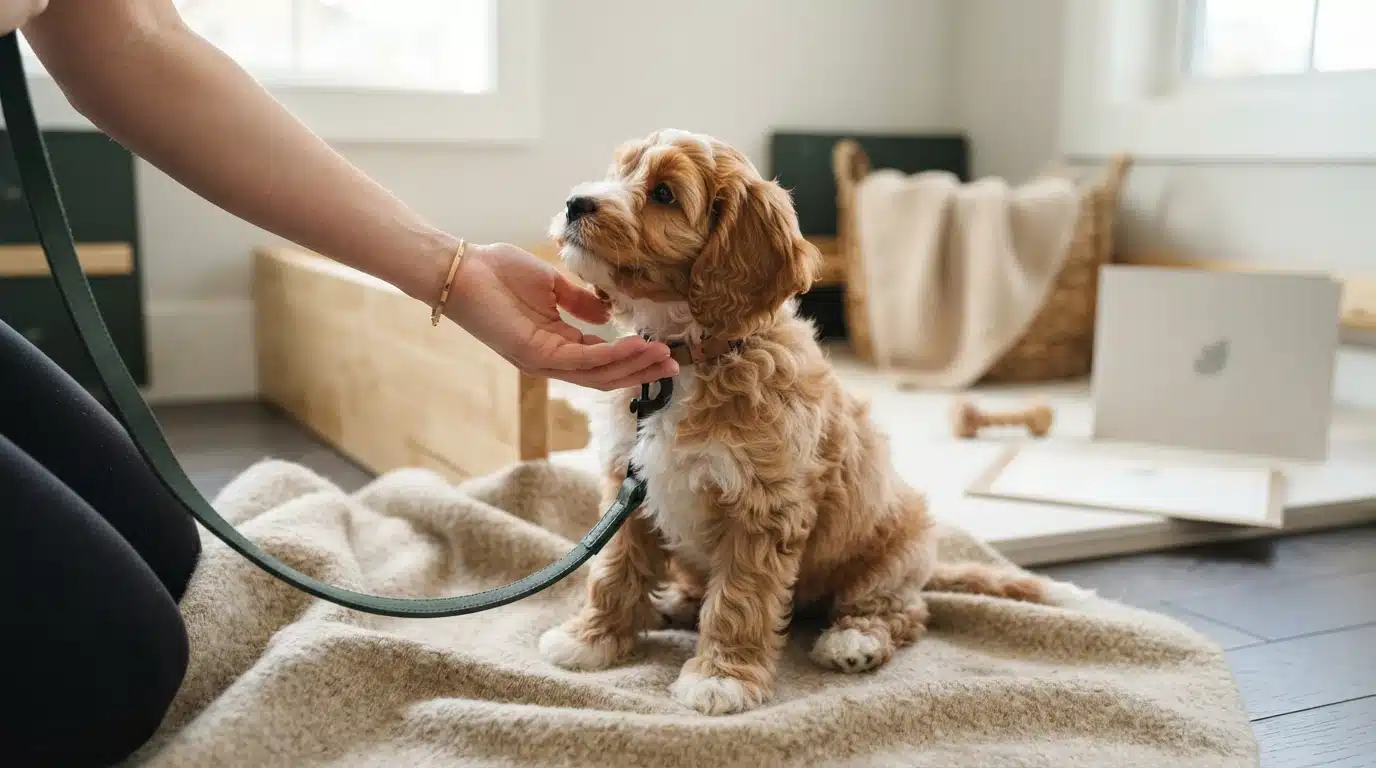
Cavapoo Generation Guide
F1 vs. F1b Cavapoo: Coat, Shedding, Size, and Temperament
The main difference between an F1 and F1b Cavapoo is parentage. An F1 Cavapoo is a first-generation Cavalier King Charles Spaniel and Poodle cross. An F1b Cavapoo is an F1 Cavapoo backcrossed to one of those parent breeds, so ask whether the other parent is a Poodle or a Cavalier. That pairing helps explain ancestry, but it does not determine a puppy’s coat, shedding, quality, personality, adult size, or family fit by itself.
- Generation describes parentage
- Coat traits still vary
- No dog is guaranteed allergen-free

The Quick Answer
F1 and F1b Cavapoos at a Glance
Both generations can make affectionate, trainable companion dogs. F1 identifies the first Cavalier–Poodle cross; F1b identifies a backcross. Coat and household fit require more information than the label. For the breed basics, learn what a Cavapoo is.
First-generation cross
An F1 Cavapoo has one Cavalier King Charles Spaniel parent and one Poodle parent. The expected pedigree ancestry for that pairing is 50% Cavalier and 50% Poodle.
- Coat may be wavy, loose-curled, or curlier.
- Shedding can range from very light to more noticeable.
- Traits may reflect either parent breed in different combinations.
- Regular brushing and professional grooming are still important.
Backcross generation
An F1 Cavapoo backcrossed to a Poodle has expected pedigree ancestry of 25% Cavalier and 75% Poodle. A backcross to a Cavalier reverses those figures: 75% Cavalier and 25% Poodle.
- Coat traits depend on the pairing and inherited coat variants.
- The label alone does not establish lower shedding.
- Grooming needs follow coat texture, density, and length.
- Temperament and size still depend on the individual puppy and parents.
Important: These percentages describe expected pedigree ancestry, not measured DNA results or percentages of curl, shedding, intelligence, or temperament. Littermates from the same pairing can inherit different coats, sizes, energy levels, and personality traits.
Parentage Explained
What Do F1 and F1b Actually Mean?
The letters and numbers describe how the puppy’s parents were paired. They are useful shorthand, but they should not be treated as a quality grade.
F1 begins with two parent breeds
An F1 Cavapoo is produced by pairing a Cavalier King Charles Spaniel with a Poodle. Which breed is the mother or father may vary by breeder and pairing.
F1b is a backcross
The “b” stands for backcross. It describes pairing an F1 Cavapoo with a dog from one of the original parent breeds: a Poodle or a Cavalier King Charles Spaniel.
Ask which breed was used
Ask the breeder to identify both parents and confirm which parent breed was used for the backcross. Do not assume every F1b label describes the same pairing.
Generation is not a health or quality rating. An F1b puppy is not automatically “better” than an F1 puppy. Responsible breeding decisions also consider parent health, structure, temperament, size, coat traits, and how the pairing supports the breeder’s program goals.
Side-by-Side Comparison
F1 vs. F1b Cavapoo Differences
This chart separates parentage from traits that need individual assessment. The parents and the individual puppy matter more than a generation label alone.
| Feature | F1 Cavapoo | F1b Cavapoo |
|---|---|---|
| Parentage | Cavalier King Charles Spaniel crossed with a Poodle | F1 Cavapoo backcrossed to a Poodle or a Cavalier; confirm the actual pairing |
| Expected pedigree ancestry | 50% Cavalier and 50% Poodle | Poodle backcross: 25% Cavalier / 75% Poodle. Cavalier backcross: 75% Cavalier / 25% Poodle. |
| Coat range | Coat texture varies with inherited coat traits | Depends on the backcross parent and inherited coat traits; the label does not guarantee curl |
| Shedding likelihood | Variable; assess the parents and relevant coat information | Variable; F1b alone does not establish less shedding than F1 |
| Grooming | Routine brushing, combing, bathing, and professional grooming; adjust to the coat | The same commitments apply; long, dense, or curly coats may need more frequent combing |
| Adult size | Depends primarily on the size and genetics of both parents | Depends on the size and genetics of the F1 parent and backcross parent, plus the family line |
| Temperament | Assess the parents, individual puppy, early development, and household routine | The same assessment applies; more Poodle ancestry does not guarantee easier training or a particular personality |
| Best fit | A household suited to the individual puppy’s temperament, size estimate, and care needs | A household suited to the individual puppy’s temperament, size estimate, and care needs |
Coat and Shedding
Does an F1b Cavapoo Shed Less?
Not necessarily. A Poodle backcross changes expected pedigree ancestry, but shedding depends on the coat variants a puppy inherits. Generation alone cannot guarantee coat texture or shedding level. Curl and shedding are related coat considerations, not interchangeable measures.
Coat outcomes are influenced by the specific genes each puppy inherits. Even puppies in the same litter can have different curl patterns, furnishings, density, softness, and shedding tendencies.
A breeder may evaluate the parents, related adult dogs, puppy coat development, and relevant coat-genetic information to make an informed estimate. A puppy photograph does not predict the adult coat. Neither an estimate nor coat testing promises that a puppy will never shed or will suit an allergy-sensitive household.
Low-shedding is not the same as hypoallergenic
No dog is completely allergen-free. People can react to proteins found in dander, saliva, and urine—not just loose hair. Families with dog allergies should consult an allergist before choosing a puppy. A generation label, coat photograph, or symptom-free visit cannot establish long-term allergy compatibility.
Grooming Needs
Which Generation Is Easier to Groom?
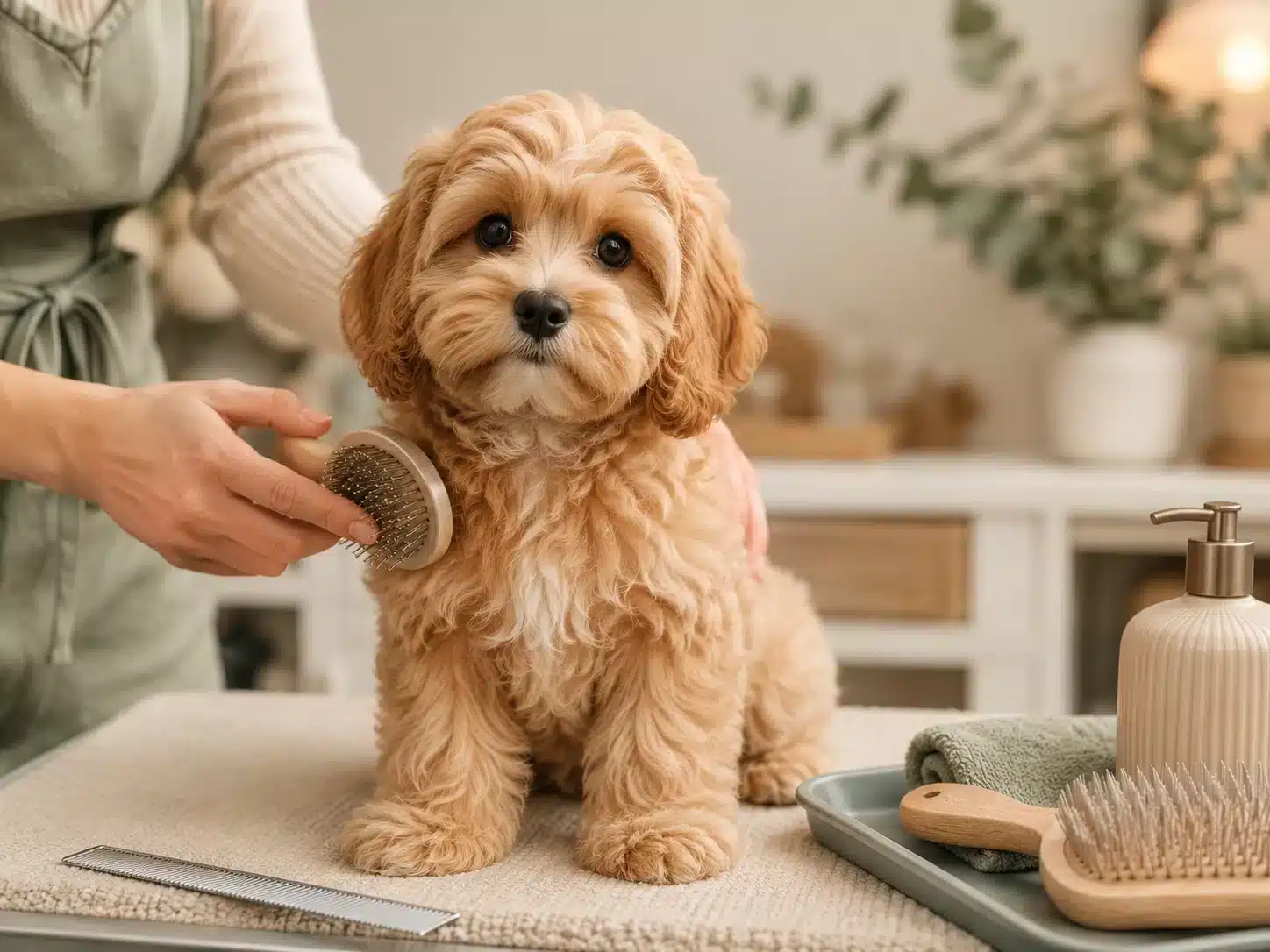
Neither generation should be considered maintenance-free. Grooming effort follows the individual coat’s texture, density, length, and tendency to tangle. Long, dense, or curly coats may need more frequent brushing and careful combing, whether the puppy is F1 or F1b.
Brushing and combing
Brush several times each week—or more often for longer or curlier coats—and use a metal comb to check that you have reached the skin beneath the surface fluff.
Professional grooming
Most Cavapoos benefit from regular professional grooming. The exact schedule depends on coat length, texture, activity, home maintenance, and the trim a family prefers.
Early handling practice
Positive introductions to brushing, nail care, baths, dryers, face handling, and standing calmly can make lifelong grooming safer and less stressful.
A practical tradeoff: Less loose hair around the home does not mean less coat care. Choose a routine you can maintain, and explore Cavapoo coat care and grooming for more detail.
Adult Size
Are F1b Cavapoos Smaller Than F1 Cavapoos?
Not necessarily. Adult size is influenced more directly by the actual size of both parents, the Poodle variety used, the family line, and the puppy’s individual genetics.
- Ask for the current weight and mature size of both parents.
- Ask about adult weights from previous related litters.
- Ask which Poodle variety appears in the pairing or family line.
- Treat projected adult weight as an estimate, not a guarantee.
Why the label can mislead: An F1b Cavapoo bred to a smaller Poodle may mature smaller than some F1 Cavapoos, but an F1b produced from larger parents can be larger than an F1 puppy from smaller parents. Generation does not override parent size.
Temperament and Family Fit
Do F1 and F1b Cavapoos Have Different Personalities?
Both F1 and F1b Cavapoos can be affectionate, social, and responsive to training. Individual puppies can still differ substantially. A higher expected proportion of Poodle ancestry does not guarantee greater intelligence, easier training, higher energy, or a particular personality.
Some puppies are naturally more outgoing, while others are thoughtful and observant. Some enjoy active households, while others settle more readily into a calmer routine. These differences may appear among littermates regardless of generation.
Early socialization, daily routines, training, sleep, enrichment, household consistency, and the puppy’s experiences after going home all influence developing behavior.
Look beyond the generation label
A thoughtful breeder should help families consider confidence, sociability, energy, resilience, handling tolerance, engagement, and the puppy’s response to new situations. Those observations are often more useful for matchmaking than choosing “F1” or “F1b” first.
Choosing the Right Puppy
Why Generation Alone Should Not Determine Your Choice
Generation can help set expectations, especially around coat possibilities, but it is only one part of a responsible puppy-selection process.
Parent health and suitability
Ask for each parent’s screening records and how health, structure, and temperament informed the pairing. A genetic panel covers only the variants tested and does not replace other relevant health exams. Read about Sage Puppies’ approach to parent health testing, then confirm the records for the actual parents.
Individual temperament
Choose a puppy whose confidence, energy, social style, and recovery from new experiences are compatible with your household.
Realistic coat expectations
Discuss possible curl, furnishings, shedding, matting, coat changes, and grooming needs instead of assuming every F1 or F1b puppy will look the same.
Parent and line size
Use parent weights and related adult dogs as the most useful indicators of mature size while remembering that every estimate has a range.
Your daily routine
Consider time for companionship, training, grooming, exercise, travel, child supervision, and gradual independence.
Breeder matchmaking
A breeder who knows the parents and observes the litter over time can help identify puppies that may fit a family’s priorities better than a label can.
Before You Reserve
Questions to Ask About an F1 or F1b Cavapoo
A clear breeder conversation should help you understand what is known, what is estimated, and what cannot be guaranteed.
- What is the exact parentage of this litter? For an F1b puppy, was the backcross parent a Poodle or a Cavalier?
- What are the mature weights and sizes of both parents?
- What coat types and shedding levels have appeared in related litters?
- Which health screenings were completed for each parent, and can I review the records? Separately, what puppy veterinary care is provided, and what do the written health terms cover?
- What grooming routine should this puppy’s future family expect?
- How are puppies introduced to handling, household sounds, people, surfaces, and age-appropriate training foundations?
- How do you help match each puppy’s temperament and energy level to a household?
- What support and next steps are provided before and after the puppy goes home?
A reputable breeder should be willing to explain the pairing honestly, discuss variability, and avoid promising a precise adult appearance, weight, shedding level, or personality.
Frequently Asked Questions
F1 vs. F1b Cavapoo FAQs
Is an F1b Cavapoo better than an F1 Cavapoo?
No. F1b describes a backcross generation, not a higher level of quality. The better choice is the puppy whose parents, temperament, expected size, coat needs, and overall fit align with your household.
Which sheds less, an F1 or F1b Cavapoo?
The labels alone do not reliably rank individual puppies by shedding. Ask about the exact pairing, parent coats, related adult dogs, and relevant coat-genetic information. Neither generation can be guaranteed not to shed.
Is an F1b Cavapoo hypoallergenic?
No dog is guaranteed hypoallergenic or allergen-free. Low shedding does not establish allergy compatibility. Families with dog allergies should consult an allergist before choosing a puppy; a coat photograph or brief visit cannot guarantee long-term tolerance.
Does an F1b Cavapoo require less grooming?
There is no generation-based guarantee of less grooming. Long, dense, or curly coats can trap loose hair and form mats. Consistent brushing, thorough combing, and professional grooming remain important for both generations.
Are F1b Cavapoos smaller than F1 Cavapoos?
Not automatically. The actual parents’ sizes, Poodle variety in the family line, related adult dogs, and individual genetics are more useful predictors of adult size than generation alone.
Do F1 and F1b Cavapoos have different temperaments?
Both generations may be affectionate, social, intelligent, and trainable. Temperament varies by puppy and is influenced by parent traits, genetics, early development, training, and the home environment.
Find Your Cavapoo Match
Choose the Puppy, Not Just the Generation
Learn about our Cavapoo puppies, breeding program, and next steps toward finding a thoughtful match for your family.